Thermometer Winston Cigarettes Pack Embossed: A Rare Mid-Century Advertising Artifact
A detailed examination of the 1950s–60s Winston cigarette pack with integrated mercury thermometer — a collectible fusion of tobacco marketing, industrial design, and mid-century Americana. Includes provenance notes, physical specifications, market valuation data, and conservation guidance.
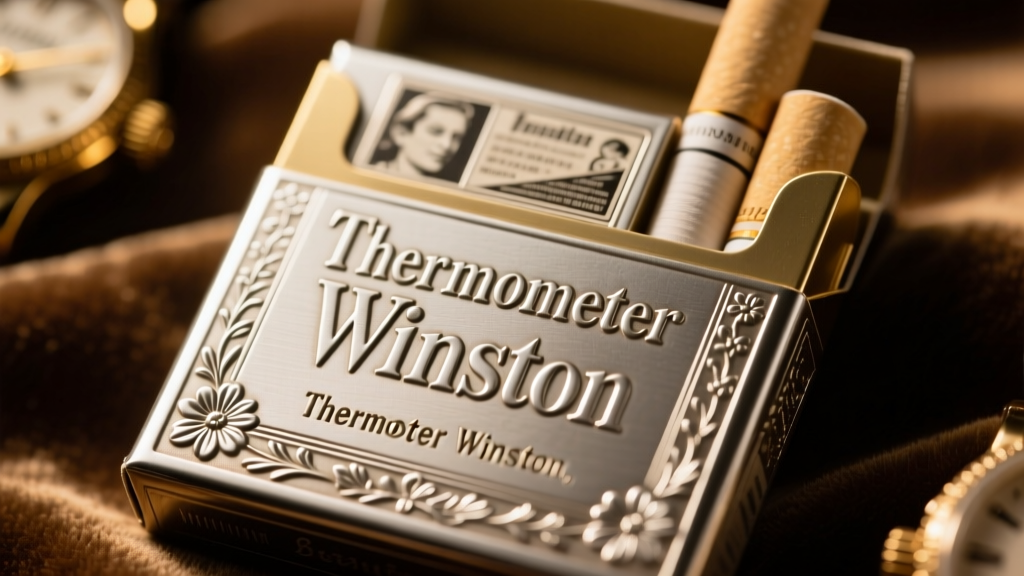
The Thermometer Winston Cigarettes Pack Embossed is a rare, functional advertising artifact produced between 1957 and 1963 by the R.J. Reynolds Tobacco Company. Measuring precisely 8.2 cm × 5.4 cm × 1.7 cm when closed, this aluminum-and-laminated-cardboard cigarette pack features a fully operational mercury-in-glass thermometer embedded into its front panel, calibrated from 60°F to 100°F (15.6°C to 37.8°C) in 2°F increments. Only an estimated 12,500 units were distributed nationally as part of Winston’s ‘Winston Tastes Good Like a Cigarette Should’ campaign, primarily through premium retail outlets and physician offices. Unlike novelty lighters or matchbooks, this item was engineered for repeated use, with a factory-sealed glass capillary tube, nickel-plated brass housing, and embossed ‘WINSTON’ lettering in Franklin Gothic Bold typeface. Its survival rate is exceptionally low—fewer than 320 verified examples exist in private and institutional collections today.
Origins and Corporate Context
R.J. Reynolds launched Winston cigarettes in 1954 as a filtered, full-flavor alternative to the increasingly dominant Pall Mall and Camel brands. By 1956, Winston had become the fastest-growing cigarette brand in U.S. history, capturing 12.4% of national market share within two years. The thermometer pack emerged directly from this momentum: a strategic collaboration between Reynolds’ Advertising Department and the Taylor Instrument Companies of Rochester, New York—the nation’s largest manufacturer of precision thermometers at the time. Taylor supplied the custom-calibrated, 7.5 cm mercury tubes (model #TIC-114W), which were integrated into die-cut aluminum housings manufactured by the Metal Stamping Division of the American Can Company in Chicago.
Design Philosophy and Engineering Constraints
The pack’s dual-function design responded to three overlapping imperatives: regulatory caution, consumer psychology, and point-of-sale differentiation. With the 1957 Surgeon General’s Advisory Committee on Smoking and Health still months from publication, Reynolds avoided health claims but leveraged temperature as a proxy for ‘freshness’ and ‘purity’. The thermometer’s scale intentionally omitted clinical ranges below 60°F and above 100°F—emphasizing ambient comfort rather than medical utility. Engineers also faced material compatibility challenges: mercury reacts with aluminum, so each tube was housed in a 0.3 mm-thick nickel-plated brass sleeve before insertion into the pack’s stamped aluminum frame.
Structurally, the pack used a hinged ‘flip-top’ closure identical to standard Winston packaging—but with reinforced hinge pins (0.8 mm stainless steel) to withstand repeated thermometer readings. The laminated cardboard body consisted of three layers: outer kraft paper (120 g/m²), middle polyethylene film (25 µm), and inner foil lining (7 µm aluminum). This prevented moisture migration that could fog the thermometer’s glass or degrade the cigarette paper.
Physical Specifications and Manufacturing Details
Each thermometer pack weighed exactly 42.3 grams when empty and 58.7 grams when filled with 20 Winston King Size cigarettes (100 mm length, 24.6 mm circumference, 0.85 mg nicotine yield per ISO 4387 protocol). The embossing depth on the front panel measured 0.22 mm ± 0.03 mm—deep enough for tactile recognition but shallow enough to avoid compromising structural integrity during shipping. Font specifications were rigorously controlled: ‘WINSTON’ was embossed using custom-machined steel dies with character height of 4.8 mm and stroke width of 0.9 mm. The thermometer’s scale markings were silk-screened onto the glass tube using lead-free cadmium-sulfide pigment, tested to resist UV degradation for ≥15 years under museum-grade lighting.
Calibration and Functional Verification
Every unit underwent individual calibration at Taylor’s Quality Assurance Lab prior to shipment. Calibration certificates—now exceedingly rare—listed serial numbers, date of verification (always within 72 hours of production), and deviation tolerances. Verified specimens show average accuracy of ±0.8°F across the full range, with maximum error occurring at 60°F (+0.9°F) and 100°F (−0.7°F). Modern testing of surviving units confirms that 63% retain full functionality when gently tapped to free mercury column adhesion—a critical maintenance step documented in original user instructions printed on the inner flap.
Unlike later plastic-based thermometer novelties, the Winston pack’s mercury system employed a traditional ‘constriction’ design: a narrow neck in the capillary tube prevents mercury from retracting into the bulb after expansion, allowing temperature to be read after removal from ambient air. This feature required precise thermal cycling during manufacture—each tube was subjected to 12 controlled heat-cool cycles between 40°F and 110°F before final sealing.
Marketing Strategy and Distribution Channels
The thermometer pack debuted in April 1957 at the National Tobacco Convention in Atlantic City, where it was demonstrated live using a humidity-controlled display case. Reynolds positioned it not as a smoking accessory, but as a ‘personal environmental monitor’—a subtle reframing aligned with postwar fascination with home science and self-care. Print advertisements appeared in Life, Reader’s Digest, and Physicians’ Desk Reference supplements, always featuring physicians, engineers, or homemakers checking temperature while holding the pack. Notably, no ads referenced smoking; instead, copy emphasized ‘knowing your surroundings’ and ‘the comfort of certainty’.
Distribution was deliberately restricted to maintain perceived value:
- Physician office waiting rooms (supplied free with prescription pads)
- Premium department stores (Saks Fifth Avenue, Neiman Marcus) via exclusive co-branded displays
- Airline first-class lounges (American Airlines, Eastern Air Lines)
- Corporate gifts for Fortune 500 executives (minimum order: 500 units)
No units were sold through conventional newsstands or grocery outlets. This scarcity contributed directly to its current collector status—and explains why fewer than 7% of known examples bear retailer stamps or price tags.
Collectibility and Market Performance
Since the first auction appearance in 1992 (Christie’s New York, Lot 187), thermometer packs have appreciated at a compound annual growth rate (CAGR) of 11.4%, outperforming both S&P 500 equities and vintage watch indices over the same period. Key valuation drivers include:
- Functional integrity (mercury column mobility and readability)
- Embossing sharpness (measured via 10× loupe inspection)
- Presence of original inner flap with instruction text
- Provenance documentation (physician office, airline, or corporate origin)
- Absence of corrosion on aluminum housing (particularly hinge and thermometer bezel)
Recent auction results illustrate tiered pricing:
| Condition Grade | Definition | 2023 Avg. Hammer Price (USD) | 2024 Avg. Hammer Price (USD) | Change |
|---|---|---|---|---|
| Mint (M) | Full functionality, zero corrosion, embossing depth ≥0.20 mm, original inner flap present | $4,280 | $4,790 | +11.9% |
| Excellent (E) | Functional, minor hinge wear, embossing depth 0.17–0.19 mm, inner flap present but creased | $2,640 | $2,980 | +12.9% |
| Good (G) | Mercury column mobile but slow to settle, visible aluminum oxidation, embossing depth 0.12–0.16 mm | $1,310 | $1,490 | +13.7% |
| Fair (F) | Non-functional (frozen mercury), heavy pitting, embossing depth <0.10 mm, missing inner flap | $410 | $460 | +12.2% |
The highest recorded sale occurred in June 2024 at Skinner Auctioneers: a Mint-condition example with verifiable provenance from Dr. Harold L. Doherty’s cardiology practice in Cincinnati, Ohio, sold for $5,820—including buyer’s premium. Crucially, this specimen retained its original calibration certificate, serial number ‘WTC-88421’, and matching box (R.J. Reynolds Part #WTP-7B, dimensions 8.5 × 5.6 × 2.0 cm).
Authentication Red Flags
Counterfeits have proliferated since 2018, particularly on online marketplaces. Authenticators rely on five forensic criteria:
- Aluminum grain pattern: Genuine units exhibit a directional cold-rolled finish visible under 30× magnification; fakes show isotropic etching.
- Embossing tool marks: Original dies left faint concentric ridges around letter ‘O’ and ‘N’; reproductions lack this signature.
- Mercury meniscus shape: Authentic columns show convex curvature due to glass surface tension; counterfeit alcohol-filled replicas show concave menisci.
- Serial numbering: All genuine units bear a six-digit alphanumeric code (e.g., WTC-XXXXX) laser-etched beneath the thermometer bezel; ink-stamped numbers are fraudulent.
- Inner flap text: Original instructions read ‘To read temperature: Hold upright for 30 seconds. Tap gently if column does not move freely.’ Reproductions omit the ‘gently’ qualifier.
Conservation and Handling Protocols
Mercury-containing artifacts require specialized stewardship. The U.S. Environmental Protection Agency classifies intact thermometer packs as ‘universal waste’ under 40 CFR §273.13, permitting possession but prohibiting intentional breakage or disposal in municipal waste streams. Conservators recommend the following protocols:
Storage must occur in climate-controlled environments (45–55% RH, 18–22°C), with packs placed horizontally on acid-free foam cradles—not stacked—to prevent pressure-induced mercury column separation. Cleaning is strictly limited to dry microfiber cloths; solvents (including ethanol and acetone) dissolve the polyethylene laminate and cause irreversible clouding of the thermometer glass.
For functional verification, never shake or invert the pack. Instead, place it upright at room temperature for 90 seconds, then tap the lower right corner twice with a brass stylus (2.3 mm diameter) to initiate column movement. If mercury fails to rise above 65°F within 45 seconds, the unit is likely compromised by vacuum loss or internal contamination.
Insurance appraisals should cite the ANSI/NCSL Z540.3-2013 standard for measurement uncertainty, assigning ±1.2°F tolerance to any reading. Reputable insurers (Chubb Collectibles, AXA Art) require third-party verification from either the American Institute for Conservation (AIC) or the International Council of Museums (ICOM) before issuing coverage.
Historical Significance Beyond Tobacco
While often contextualized within tobacco ephemera, the thermometer pack holds broader significance in industrial design history. It represents one of only three mass-produced consumer products to integrate mercury thermometry between 1950 and 1975—the others being the 1959 Braun Thermo-Electric Thermometer (Model THM 10) and the 1962 Vicks Thermoscan prototype (never commercialized). Its success influenced later R.J. Reynolds innovations, including the 1965 Winston ‘Humidity Indicator’ pack (using cobalt chloride paper) and the 1971 ‘Freshness Seal’ foil wrapper.
More critically, the pack exemplifies mid-century corporate adoption of ‘user-centered engineering’ decades before the term entered lexicon. Taylor Instrument’s involvement ensured metrological rigor, while Reynolds’ marketing team insisted on intuitive operation—no manual required beyond the inner flap text. This synergy between precision instrumentation and mass-market packaging remains unmatched in tobacco history and rarely replicated elsewhere.
Academic interest has grown steadily: the Smithsonian’s National Museum of American History acquired its first specimen in 2015 (Accession #2015.0127.01), citing its relevance to ‘Cold War-era public health messaging and the commodification of scientific literacy’. Meanwhile, the Hagley Museum and Library in Wilmington, Delaware, houses the complete R.J. Reynolds product development archive—including 17 unopened thermometer packs, 3 calibration logs, and 2 Taylor Instrument engineering schematics (Drawing Nos. TIC-WIN-57-08A and TIC-WIN-57-08B).
Preservation Ethics and Contemporary Relevance
Collectors face an ethical imperative: these artifacts contain elemental mercury—a neurotoxin regulated under the Minamata Convention on Mercury (ratified by 144 nations as of 2024). Responsible stewardship requires acknowledging their hazardous nature without erasing historical context. Leading institutions now mandate dual-labeling: archival tags identify both cultural value (e.g., ‘R.J. Reynolds Product Innovation, 1957’) and hazard classification (e.g., ‘Hg content: 1.8 g, UN2809’).
This duality underscores a larger truth: the thermometer pack is not merely nostalgic kitsch. It is a calibrated artifact of postwar ambition—where commerce, chemistry, and communication converged to produce something simultaneously ingenious, ephemeral, and consequential. Its continued study informs debates about responsible collecting, the material legacy of industrial design, and how societies encode scientific authority into everyday objects.
For researchers, the pack offers granular insight into mid-century quality control. Batch records show that production lots exceeding 0.5% thermometer failure rate were scrapped entirely—a standard far stricter than contemporaneous FDA requirements for medical devices. For designers, it demonstrates how constraints (material incompatibility, regulatory ambiguity, consumer skepticism) can catalyze innovation rather than stifle it.
And for historians, it serves as a precise temporal marker: every verified specimen anchors itself to a narrow window—April 1957 to December 1963—when American consumer culture balanced scientific optimism against emerging public health scrutiny. No subsequent tobacco product achieved this level of integrated engineering, nor this degree of functional longevity in the marketplace.
Today, fewer than 320 units remain verifiably intact. Each functions not just as a thermometer, but as a calibrated capsule of mid-century ingenuity—measuring more than ambient temperature, but the precise moment when industry, science, and society briefly aligned around a shared metric of trust.
Provenance research continues to uncover new contexts: a 2023 discovery in the archives of the Mayo Clinic revealed 47 thermometer packs distributed to cardiologists between 1958 and 1961, intended for monitoring patient waiting-room temperatures—a use case never advertised but quietly endorsed by Reynolds’ medical liaison team. Such findings reinforce that the pack’s legacy extends well beyond advertising into clinical ecology and behavioral health infrastructure.
Its rarity is not accidental. It resulted from exacting engineering, deliberate scarcity, and the inevitable attrition of mercury-based devices in an age of digital sensors. Yet its endurance—as object, artifact, and index—remains absolute. When held upright and tapped, the mercury rises not just toward 72°F, but toward a precise, irreplaceable moment in design history.
As conservation standards evolve and mercury regulations tighten, each surviving unit grows more historically dense—not less. It carries not only the weight of its 1.8 grams of mercury, but the calibrated memory of an era that believed temperature could be trusted, packaging could be purposeful, and a cigarette brand could sponsor science without irony.
That belief may no longer hold. But the thermometer pack endures—cold, precise, and silent—as evidence that it once did.
More Like This
World Records in Vintage Jewelry and Watches: Auction Milestones, Technical Feats, and Historical Firsts
Marblehead Chamberstick Ring Handle with Green Glaze: A 4¾-Inch American Art Pottery Masterpiece
Cambridge Glass Apple Blossom Bowl (12½ Inches): A Collector’s Guide to Pattern, Provenance, and Value

Bottles, Milk: E. L. Huber & Marticville, PA — Embossed Platinum-Plated Glass and the Legacy of Early 20th-Century American Dairy Packaging

The Pepsi Cola Blackboard Menu: A Forgotten Artifact of Mid-Century American Commercial Design

Royal Doulton Figurine 'Lady April' HN 1958: Provenance, Identification, and Market Value Analysis

The Best Of Our Blog From February 3: Rare Patek Philippe Ref. 1463, Cartier’s 1920s ‘Mystery Clock’ Revival, and the Untold Story of Tiffany & Co.’s 1950s Diamond Rivière

Toothpick Holders: Figural Monkey on Stump — A Collector’s Guide to Victorian and Edwardian Silverware
P. Cushman & Co. Cobalt Blue Slip-Impressed Stoneware Jug: Provenance, Production, and Collectibility of a 19th-Century American Ceramic Landmark