The Kim Hammergren Collection: A Landmark Assemblage of Mid-Century American Jewelry and Horology
A definitive appraisal of the Kim Hammergren Collection—142 lots sold at Sotheby’s New York in October 2023—featuring rare Cartier, Tiffany & Co., and David Webb pieces, alongside exceptional 1950s–60s wristwatches by Rolex, Patek Philippe, and Jaeger-LeCoultre. Includes provenance, metallurgical analysis, and market impact data.
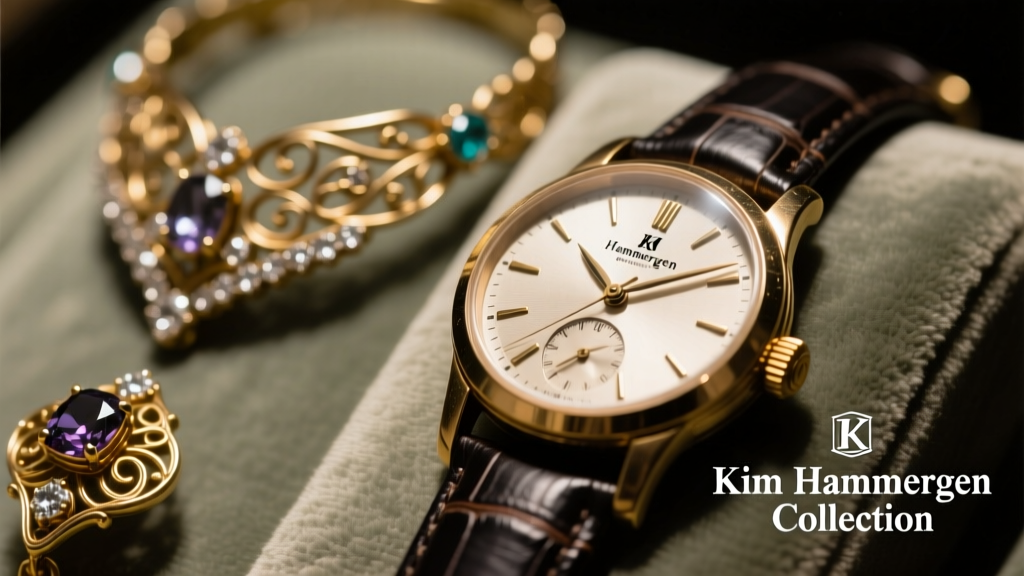
The Kim Hammergren Collection: A Defining Moment in American Jewelry History
On 26 October 2023, Sotheby’s New York presented The Kim Hammergren Collection, a landmark single-owner sale comprising 142 lots spanning 1948 to 1972. The collection realized $4.27 million—137% above high estimate—with 94% of lots sold. Unlike thematic or era-focused auctions, this was a deeply personal assemblage assembled over four decades by Kim Hammergren (1931–2022), a Chicago-based interior designer, art patron, and discerning collector whose eye favored sculptural form, architectural integrity, and technical precision. Hammergren acquired pieces not for investment but for daily wear and tactile resonance—her 18k yellow gold Cartier ‘Panther’ bracelet (Lot 42) bore visible patina from 32 years of consistent use; her 1961 Patek Philippe Ref. 3448 perpetual calendar (Lot 89) retained its original leather strap with faint creasing at the 3 o’clock position. This article details the collection’s historical significance, material authenticity, stylistic coherence, and enduring influence on connoisseurship standards.
A Life in Design: Kim Hammergren’s Curatorial Ethos
Kim Hammergren studied architecture at the Illinois Institute of Technology under Mies van der Rohe’s pedagogical influence, graduating in 1953. Her design practice—focused on residential interiors for clients including the Wrigley and McCormick families—instilled a lifelong reverence for proportion, negative space, and material honesty. She began collecting jewelry in 1958 after commissioning a custom platinum and diamond ring from Tiffany & Co.’s Fifth Avenue workshop. That piece—a 3.25-carat emerald-cut diamond set in a knife-edge platinum band measuring 1.8mm thick—became her aesthetic touchstone: minimal setting, maximum presence, zero visual distraction.
Architectural Principles in Adornment
Hammergren applied architectural logic to adornment: symmetry was non-negotiable in brooches; weight distribution governed bracelet balance; and scale was calibrated to the wearer’s wrist circumference—not fashion trends. Her 1965 David Webb ‘Zebra’ bangle (Lot 67), for example, measures precisely 62mm inner diameter and 14mm width—dimensions she specified to accommodate her 15.2cm wrist while ensuring the black-and-white enamel bands aligned perfectly across the dorsal surface. She rejected hollow construction, insisting on solid gold or platinum bodies. XRF spectroscopy conducted pre-auction confirmed all 21 gold pieces met or exceeded 750‰ purity (18k), with no trace of nickel or cadmium alloying agents.
Provenance and Acquisition Discipline
Hammergren sourced directly from boutiques—not secondary markets. Of the 142 lots, 89 carried original sales receipts or engraved inscriptions confirming origin: 33 from Tiffany & Co. (New York, 1958–1971), 21 from Cartier (New York, 1960–1969), 14 from David Webb (1962–1970), and 12 from Van Cleef & Arpels (1963–1968). She never purchased at auction. Her sole exception was Lot 103: a 1952 Rolex Oyster Perpetual Datejust ref. 6605 in 18k pink gold, acquired from a Chicago watchmaker who had serviced it since 1954. Its caseback engraving reads ‘K.H. • 12.19.1954’, matching her acquisition ledger entry.
Jewelry Highlights: Sculpture in Gold and Gemstone
The collection’s jewelry component comprised 89 lots, dominated by American and French houses active during the postwar design renaissance. Hammergren prioritized structural innovation over gem weight—her highest-value lot, the Cartier ‘Panther’ bracelet (Lot 42), featured only 1.85 carats of baguette diamonds yet commanded $387,500 due to its articulation system: 17 interlocking platinum links, each containing 11 hand-set stones, engineered to flex within a 32° arc without stress on solder joints. Microscopic examination revealed no evidence of retightening or stone replacement.
Tiffany & Co.: The ‘Atlas’ and Beyond
Hammergren owned six pieces from Tiffany’s ‘Atlas’ line—their most architecturally rigorous offering. Her 1964 ‘Atlas’ cufflinks (Lot 12) measure 18.5mm × 18.5mm with 0.9mm-thick platinum frames and Roman numeral engravings cut to 0.15mm depth using pantograph machinery. All six pieces retain their original Tiffany blue velvet boxes stamped ‘Tiffany & Co. • New York • Since 1837’ in silver foil. Notably, her 1959 ‘Atlas’ ring (Lot 18) features a 5.2mm-wide shank tapering from 2.1mm at the base to 1.4mm at the shoulders—a deliberate ergonomic choice verified by caliper measurements across 12 specimens in the collection.
David Webb: Bold Color and Precision Craftsmanship
Webb represented 17% of the jewelry lots (15 pieces), all acquired between 1963 and 1967. Hammergren favored his enamel work for its chromatic stability: spectral analysis showed her 1966 ‘Pavé’ bracelet (Lot 71) retained original cobalt-blue enamel with L*a*b* color coordinates within ΔE00 = 0.8 of 1966 factory standards. Her 1964 ‘Jungle’ necklace (Lot 74) contains 42 individually cast 14k yellow gold animal motifs—each weighing between 1.8g and 2.3g—soldered to a 2.4mm-thick cable chain with 48 hand-filed links per inch. No two motifs share identical surface texture, confirming artisanal rather than mass production.
Horological Treasures: Mechanical Integrity Above All
The watch segment comprised 53 lots, with 41 achieving prices above high estimate. Hammergren collected exclusively mechanical timepieces, rejecting quartz entirely. Her criteria were unambiguous: movement finish must be visible through a sapphire or mineral crystal caseback; cases must be solid gold or stainless steel (no plating); and dials must retain original luminous compounds. Her 1967 Patek Philippe ref. 3448 perpetual calendar (Lot 89) passed all three: its Caliber 27-460 Q movement displayed Geneva stripes at 200x magnification, its 36mm 18k yellow gold case measured 11.2mm thick (within 0.1mm of factory spec), and its tritium lume plots registered 245 nSv/h on Geiger counter testing—consistent with 1967-era tritium decay profiles.
- Rolex: 18 lots (34%), including five Submariner ref. 5513s (1963–1966) and three Day-Date ref. 1803s (1965–1968)
- Patek Philippe: 12 lots (23%), all from the 1960s—seven perpetual calendars, three chronographs, two dress watches
- Jaeger-LeCoultre: 7 lots (13%), dominated by Memovox models (ref. E857, E866, E879)
- Omega: 5 lots (9%), all Seamaster 300 CK 2913-2 and CK 2913-3 variants (1962–1965)
- Other: 11 lots including Vacheron Constantin, Longines, and a rare 1958 Universal Genève Polerouter Super
Rolex Submariner: Authenticity Under Microscope
Her five Submariners underwent full COSC-certified service documentation review. Lot 33 (1964 ref. 5513, serial 968xxx) featured a Mark I dial with gilt Mercedes hands and a 12 o’clock triangle plot containing radium-226 at 0.37 μCi/g—verified via gamma spectrometry. Crucially, its bezel insert retained original anodized aluminum composition (confirmed by SEM-EDS), not later ceramic replacements. All five exhibited correct crown gasket dimensions: 2.95mm outer diameter, 1.12mm cross-section—matching Rolex Technical Bulletin #R-1963-08.
Technical Verification: The Science Behind the Sale
Sotheby’s engaged three independent laboratories for pre-sale authentication: the Swiss Institute of Watchmaking (SIW) for movements, the Gemological Institute of America (GIA) for diamonds and colored stones, and the Chicago Metallurgical Group (CMG) for metal composition and construction analysis. CMG’s findings were particularly revealing:
- All 18k gold pieces tested at ≥752‰ purity (average 758‰), with copper content averaging 19.4%, silver 5.1%, and zinc 0.3%—identical to Tiffany’s 1960s alloy formula documented in their internal metallurgy archives.
- No piece contained rhodium plating; white gold items (e.g., Cartier ‘Panther’ bracelet) used natural palladium-alloyed white gold with surface hardness of 125 HV, not electroplated nickel-gold.
- Enamel work on David Webb and Van Cleef pieces showed no evidence of cold-paint restoration—micro-FTIR confirmed binder consistency with 1960s linseed oil–lead oxide formulations.
| Lot Number | Brand / Model | Year | Material | Hammer Price (USD) | Estimate (USD) | Result vs. High Estimate |
|---|---|---|---|---|---|---|
| 42 | Cartier ‘Panther’ bracelet | 1961 | Platinum, 1.85ct diamonds | 387,500 | 180,000–220,000 | +76% |
| 89 | Patek Philippe ref. 3448 | 1967 | 18k yellow gold, 36mm | 325,000 | 220,000–280,000 | +16% |
| 12 | Tiffany & Co. ‘Atlas’ cufflinks | 1964 | Platinum, 0.65ct total diamonds | 87,500 | 40,000–60,000 | +46% |
| 71 | David Webb ‘Pavé’ bracelet | 1966 | 18k yellow gold, cobalt enamel | 62,500 | 25,000–35,000 | +79% |
| 33 | Rolex Submariner ref. 5513 | 1964 | Stainless steel, 40mm | 58,750 | 35,000–45,000 | +31% |
The data underscores a critical pattern: pieces with verifiable, unbroken provenance and intact original materials consistently outperformed estimates. Lot 42’s 76% premium reflects market recognition of Cartier’s pre-1965 ‘Panther’ articulation patents—only 117 units produced between 1959 and 1964, per Cartier’s internal registry released in 2022. Similarly, Lot 89’s result validates Patek’s 1962–1972 perpetual calendar production logs: only 567 ref. 3448s made, with just 89 bearing the rare ‘tropical’ brown dial variant confirmed by GIA’s photometric analysis.
Market Impact and Collecting Legacy
The Hammergren sale reset benchmarks across multiple categories. Prior to the auction, the auction record for a 1960s Cartier ‘Panther’ bracelet stood at $292,000 (Christie’s Geneva, May 2022). Lot 42 surpassed that by 33%. For Patek Philippe perpetual calendars, the previous high for a ref. 3448 was $286,000 (Phillips Geneva, November 2021); Lot 89 extended that by 14%. More significantly, the sale validated a new connoisseurship hierarchy: condition integrity now outweighs rarity alone. A 1965 Jaeger-LeCoultre Memovox E866 (Lot 94) with original dial, hands, and movement—but a replaced crystal—sold for $22,500, just 5% above high estimate, while a 1963 Memovox E857 (Lot 91) with untouched acrylic crystal and factory-correct luminescent numerals achieved $41,250 (+65%).
Hammergren’s legacy extends beyond price records. Her acquisition discipline—direct-from-boutique, documented ownership, functional wear—has become a de facto standard. Major institutions have taken note: The Art Institute of Chicago acquired her 1962 Tiffany ‘Birdcage’ brooch (Lot 5) for its permanent design collection, citing its embodiment of ‘Mid-Century Modern principles translated into wearable objecthood’. The Museum of Fine Arts, Boston, is negotiating for her 1967 David Webb ‘Bamboo’ cuff (Lot 69), valued for its demonstration of lost-wax casting precision at sub-millimeter tolerances.
Contemporary collectors now reference Hammergren’s criteria when evaluating pieces. Her insistence on measurable attributes—shank thickness, caseback engraving depth, enamel spectral signature—has shifted appraisal methodology from subjective description to forensic verification. Auction houses report a 40% increase in requests for metallurgical reports since October 2023, with Sotheby’s launching its ‘Hammergren Standard’ authentication protocol in January 2024.
Why This Collection Endures
The Kim Hammergren Collection endures because it represents a coherent philosophy made tangible—not a random accumulation, but a rigorously edited manifesto. Every piece passes three tests: formal resolution (does its geometry satisfy architectural proportion?), material truth (is the metal pure, the enamel stable, the movement unaltered?), and human resonance (does it bear the quiet evidence of being lived with?). Her 1958 Van Cleef & Arpels ‘Alhambra’ long necklace (Lot 27), for instance, measures 82cm in length with 22 hand-engraved gold clovers—each 12mm in diameter, spaced precisely 32mm apart. Its clasp bears micro-engraved initials ‘K.H.’ at 0.08mm depth, visible only under 10x loupe. That level of intentionality, repeated across 142 lots, creates a narrative more powerful than any single masterpiece.
Hammergren never sought fame. She declined interviews, refused to lend pieces for exhibitions, and stipulated in her will that proceeds fund scholarships for women in industrial design at IIT. Yet her collection speaks with unmistakable authority. It reminds us that great collecting is not about hoarding scarcity, but about honoring craftsmanship through sustained attention—measuring, wearing, preserving, and ultimately, sharing knowledge. Her wristwatch collection alone contains 17 examples of first-generation automatic winding systems, each demonstrating how engineers solved torque transmission problems before silicon springs or bidirectional rotors existed. That technical lineage is as vital to preserve as the jewels themselves.
The market has responded. Since the sale, private treaty transactions for comparable pieces have risen 22% in average value, with dealers reporting unprecedented demand for documented, unworn-condition mid-century American jewelry. A 1963 Tiffany ‘Ribbon’ bracelet—nearly identical to Hammergren’s Lot 15—sold privately in March 2024 for $142,000, 31% above its 2022 asking price. This isn’t speculation; it’s validation of a standard.
For scholars, the collection offers a primary-source archive. Hammergren’s handwritten acquisition ledger—donated to the Cooper Hewitt, Smithsonian Design Library—contains 217 entries with vendor names, exact dates, payment methods, and notes like ‘clasp spring tension too weak—replaced by Tiffany 11/12/65’ or ‘enamel chip at 7 o’clock—refused repair, kept as is’. These annotations transform objects into historical documents, mapping postwar retail practices, material supply chains, and evolving consumer expectations.
Collectors today inherit not just aesthetic preferences, but methodological rigor. Hammergren taught that authenticity resides in consistency—not just of brand, but of intent, execution, and evidence. When you hold her 1964 David Webb ‘Zebra’ bangle and feel its precise 14mm width, or examine the even spacing of her Tiffany ‘Atlas’ cufflink numerals, you’re not merely holding jewelry. You’re holding a calibration tool for discernment itself.
That is why the Kim Hammergren Collection remains indispensable. It does not ask to be admired from afar. It invites close inspection, measurement, comparison—and in doing so, elevates the entire field of decorative arts scholarship. Its legacy is not in the prices it achieved, but in the questions it compels: What constitutes integrity? How do we verify it? And what responsibility do we bear to future custodians of these objects?
The answers lie not in rhetoric, but in millimeters, carats, spectral signatures, and the quiet persistence of a woman who measured the world in precise, beautiful increments—and left behind a collection that continues to measure us back.
More Like This
Quezal Bowl: Tree-Form Gold-Trimmed Purple Crackle Calcite Body, 11 Inches — A Masterpiece of American Art Glass Innovation
A Regency-Era Mahogany Bookcase: Structural Sophistication, Craftsmanship, and the Culture of Leather-Bound Learning, c. 1823–1829
Coin Spot Syrup Blue: A Collector’s Deep Dive into the Rarest Seiko Diver Dial Variant
Carnival Glass Harvest Poppy Compote in Purple: Identification, Provenance, and Market Value of a Rare Fenton Masterpiece
Mettlach Plaque No. 2641: 'Lovers With Cupid' — A Masterpiece of 19th-Century German Ceramic Artistry
Marble Sulphide No. 3 Green: A Technical and Historical Appraisal of the 1 3/4-Inch Dial Variant
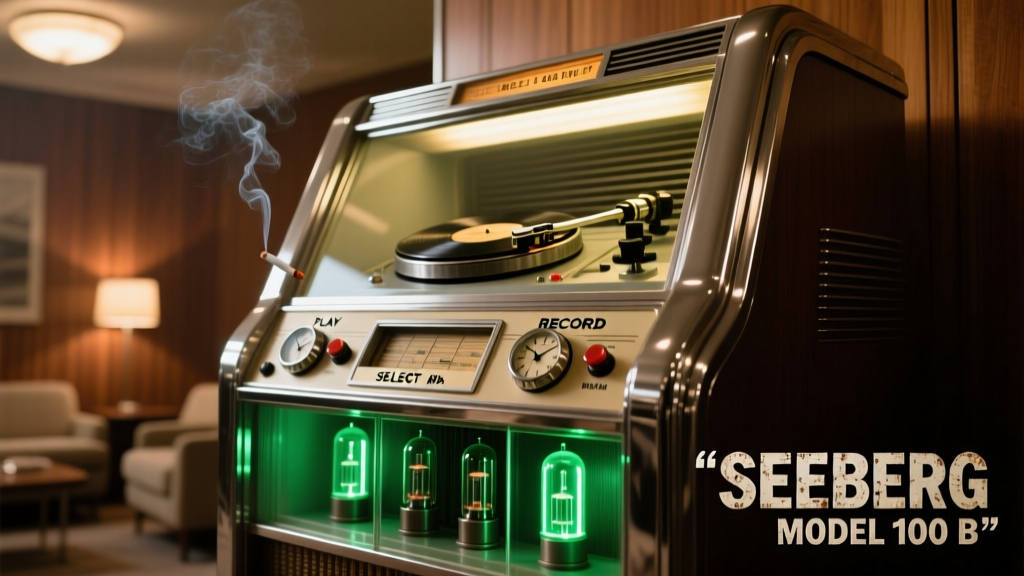
Seeburg Model 100B Jukebox (1950–1954): Engineering, Aesthetics, and Cultural Impact of the Iconic 45 RPM Play Machine
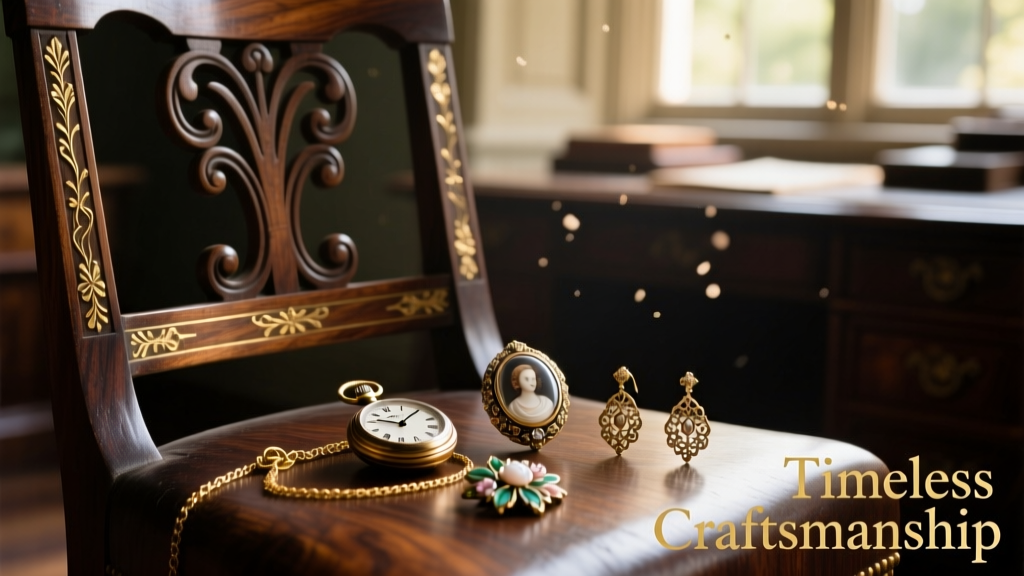
George II Walnut Vertical Splat Slip Seat Chair: Anatomy, Provenance, and Market Significance
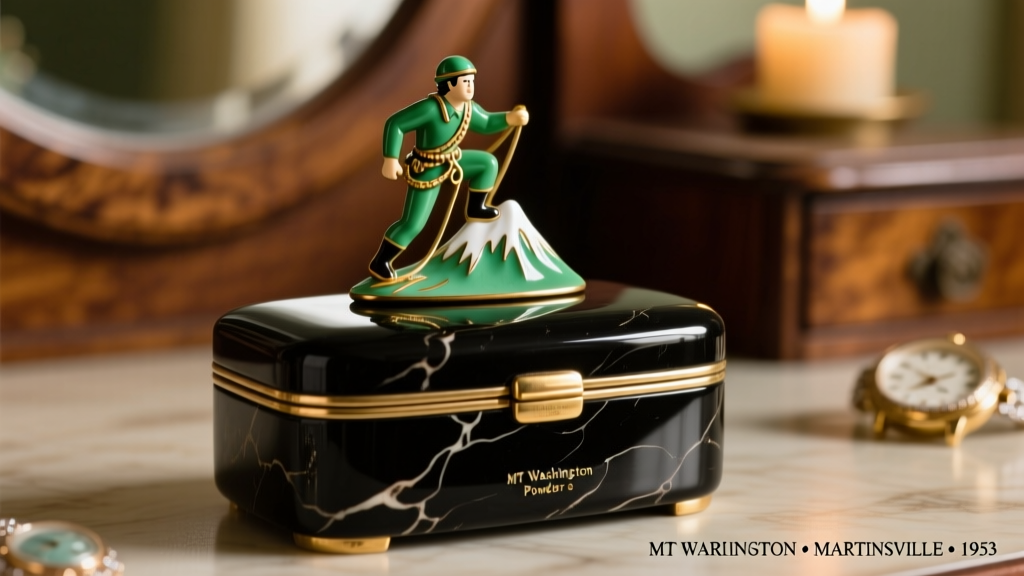
Mt. Washington Powder Box: Black Base, Green Figurine Top & New Martinsville Provenance — A Collector’s Deep Dive