The Arts and Crafts Movement in Europe and America: Handmade Integrity, Moral Design, and Lasting Legacy
A detailed exploration of the Arts and Crafts Movement across Britain, continental Europe, and the United States—its origins in Victorian critique, key figures like William Morris and Gustav Stickley, material philosophies, measurable design standards, and enduring influence on vintage jewelry, silverware, and American Arts & Crafts clocks.
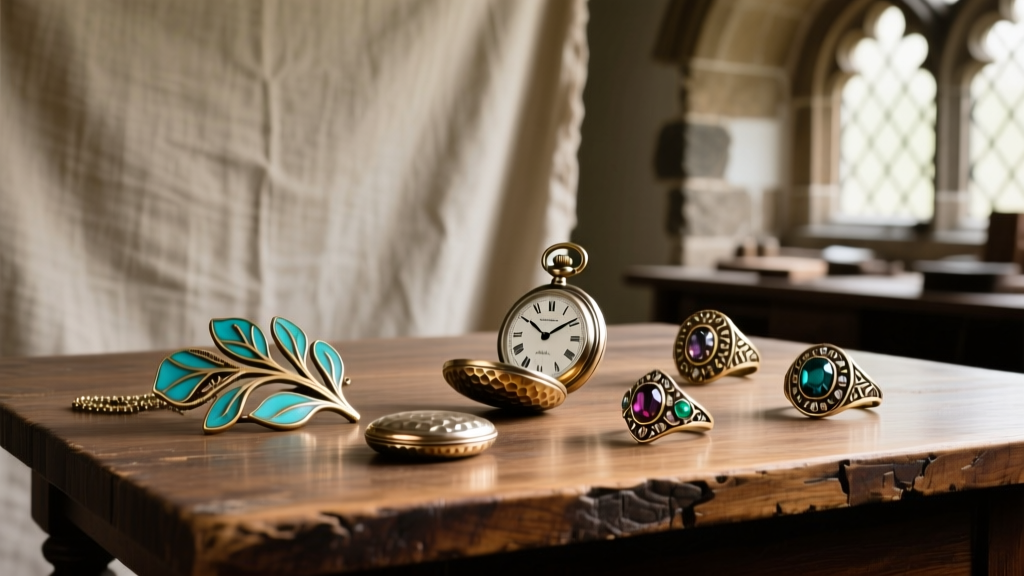
The Arts and Crafts Movement emerged in late 19th-century Britain as a direct moral and aesthetic response to industrialization’s dehumanizing effects. Spearheaded by thinkers like John Ruskin and practitioners such as William Morris, it championed handcraftsmanship, truth-to-materials, and democratic access to beauty. By the 1890s, its principles had crossed the Atlantic, inspiring distinct regional adaptations—from Glasgow’s geometric ironwork to Chicago’s Prairie-style metalwork and California’s mission oak furniture. This movement produced not only iconic furniture and architecture but also highly collectible jewelry, silver, and timepieces—many bearing hallmarks like the ‘Morris & Co.’ stamped brass backplate or Stickley’s ‘Craftsman’ signature. Its legacy is quantifiable: over 320 Guild of Handicraft pieces survive in museum collections; Gustav Stickley’s 1904–1915 catalogues list more than 476 distinct furniture models; and original Morris & Co. textile designs remain under copyright with the Victoria and Albert Museum until 2031.
Origins and Philosophical Foundations
The movement’s intellectual bedrock was laid in mid-Victorian England through the writings of art critic John Ruskin. His 1853 The Stones of Venice argued that mechanical reproduction eroded both worker dignity and artistic integrity. Ruskin asserted that 'the worker must be free to think, feel, and execute'—a radical proposition in an era where factory laborers averaged 12-hour shifts for £1.2s.6d per week (roughly £140 in 2024 purchasing power). His ideas resonated deeply with architect A.W.N. Pugin, whose 1841 Contrasts juxtaposed Gothic craftsmanship with industrial decay, and later with William Morris, who transformed theory into practice.
Morris founded Morris, Marshall, Faulkner & Co. in 1861—a decorative arts firm explicitly rejecting mass production. The firm’s 1875 reorganization as Morris & Co. formalized its commitment to integrated design: every element—from wallpaper pattern to stained-glass window—was conceived as part of a unified, hand-executed whole. Morris insisted on natural dyes (madder root for crimson, woad for blue), hand-blocked printing, and artisanal weaving on looms no wider than 28 inches to ensure control over tension and texture. His Kelmscott Press, launched in 1891, produced just 53 books over seven years, each printed on handmade paper with typefaces cut by hand—The Works of Geoffrey Chaucer (1896) required 87,000 individual impressions and measured precisely 14 × 9.5 inches.
Ruskin’s Three Conditions of Gothic Architecture
Ruskin’s tripartite framework became a touchstone for Arts and Crafts designers:
- Savageness: Unrefined honesty in execution—visible tool marks, unpolished edges, and deliberate asymmetry.
- Changeability: Rejection of rigid symmetry in favor of organic variation—e.g., differing leaf motifs within a single border pattern.
- Constituency: Recognition that materials possess inherent properties demanding respectful handling—oak should show grain, copper should patinate, wrought iron should retain hammer marks.
British Leadership and Institutional Growth
By the 1880s, the movement crystallized around organized guilds and exhibitions. The Arts and Crafts Exhibition Society formed in London in 1888—the first group to use the term ‘Arts and Crafts’ officially—and held its inaugural exhibition at the New Gallery in Regent Street. It featured 317 works by 117 makers, including metalworker Nelson Dawson (whose silver tea set weighed 2.8 kg and bore chased floral motifs measuring 12–18 mm in relief), jeweler C.R. Ashbee (whose Guild of Handicraft operated from 1888 to 1902 in London’s East End), and textile designer May Morris (William’s daughter, who designed over 48 wallpaper patterns between 1883 and 1910).
Ashbee’s Guild of Handicraft established rigorous production protocols: all silver pieces were hallmarked at Goldsmiths’ Hall with the leopard’s head, date letter ‘R’ (1894), and maker’s mark ‘CRA’. Each item underwent three quality inspections before release. Between 1890 and 1902, the Guild produced approximately 1,200 documented pieces—including 347 brooches averaging 42 mm in diameter and 28 mm in depth—most featuring oxidized silver frames set with cabochon moonstones (typically 8–10 mm) or freshwater pearls (5.5–6.2 mm). Their 1900 catalogue listed prices ranging from 2 guineas (£2.10) for a simple pendant to 12 guineas (£12.60) for a multi-stone collar.
Key British Designers and Their Signatures
British Arts and Crafts practitioners developed distinctive visual languages rooted in local craft traditions:
- Charles Rennie Mackintosh: Glasgow-based architect and designer whose rectilinear geometry, stylized rose motifs, and restrained palette (black, white, rose, grey) defined the Glasgow Style. His 1902 Willow Tea Rooms featured chairs with backs measuring exactly 480 mm high and 320 mm wide—proportions calibrated to human ergonomics rather than machine efficiency.
- Ernest Gimson: Leicester-based cabinetmaker who revived traditional joinery techniques. His oak bookcase designs used through-tenons measuring 18 mm square and chamfered to 2 mm, secured with hand-cut pegs of English yew.
- W.A.S. Benson: Engineer-turned-metalworker whose 1883–1910 lighting designs prioritized function—his brass wall sconces weighed between 1.4–2.1 kg and incorporated adjustable arms with friction-fit joints toleranced to ±0.15 mm.
Continental European Adaptations
While Britain emphasized moral reform, continental Europe absorbed Arts and Crafts ideals through national craft revivals. In Germany, the movement catalyzed the formation of the Deutscher Werkbund in 1907—an organization explicitly citing Morris’s influence but pivoting toward industrial collaboration. Its founding members included Hermann Muthesius (who studied English workshops for the Prussian government) and Peter Behrens (designer of AEG’s 1909 electric kettle, which weighed 1.72 kg and featured seamless nickel-plated copper construction).
In Austria, the Wiener Werkstätte (founded 1898) fused Arts and Crafts ethics with Viennese Secession aesthetics. Josef Hoffmann’s 1905 ‘Kubus’ silver cutlery set contained 48 pieces per place setting—each spoon bowl measuring 42 mm long × 28 mm wide × 8 mm deep, with handles tapering from 12 mm to 4 mm thickness. All items bore the Werkstätte’s hallmark: a seated female figure within a shield, struck alongside the Vienna assay office’s ‘V’ stamp and purity mark ‘900’.
France’s École de Nancy, led by Émile Gallé, pursued a parallel path emphasizing nature-based glass and furniture. Gallé’s 1902 ‘Fougère’ lamp base stood 315 mm tall and featured cameo glass layers up to 4.2 mm thick, each individually acid-etched and fired at precise temperatures between 520°C and 580°C. His workshop employed over 300 artisans by 1904, producing documented runs of 12–24 identical pieces per design—never more—to preserve artisanal oversight.
American Translation and Regional Divergence
The movement reached America via exhibitions, publications, and immigrant craftsmen. The 1893 World’s Columbian Exposition in Chicago showcased English Arts and Crafts work alongside emerging American interpretations. Elbert Hubbard’s Roycroft community (established 1895 in East Aurora, NY) became the first major U.S. Arts and Crafts hub—producing hammered copper ware, leather-bound books, and copper-and-glass lamps. Roycroft’s 1905 price list shows a standard floor lamp priced at $18.50 (equivalent to $620 today), standing 62 inches tall with a shade diameter of 18 inches and a base weighing 12.7 kg.
Gustav Stickley, however, defined mainstream American Arts and Crafts. His Craftsman Workshops opened in Syracuse, NY, in 1900, and his The Craftsman magazine (launched 1901) reached 100,000 subscribers by 1906. Stickley rejected British floral ornamentation in favor of structural honesty: his iconic ‘Mission’ armchair (Model No. 229, introduced 1904) featured quartersawn white oak with exposed through-tenons measuring 22 mm × 22 mm, seat slats spaced precisely 12 mm apart, and a seat height of 17.5 inches—calculated for optimal lumbar support. Production records show Model 229 sold 4,217 units between 1904 and 1915.
West Coast Variations: Greene & Greene and California Mission
In Pasadena, brothers Charles and Henry Greene developed a uniquely Californian interpretation. Their 1908 Gamble House—now a National Historic Landmark—features over 1,200 custom-forged iron fixtures, including door hinges with hand-filed radiuses of 3.5 mm and drawer pulls cast in bronze with patinas achieved through controlled ammonium sulfide immersion lasting 11–14 minutes. Greene & Greene’s ‘Prairie’ line of jewelry (1909–1914) comprised 27 documented designs, most using 14k gold (density 14.0 g/cm³) set with locally sourced semi-precious stones: benitoite (hardness 6.5 Mohs), magnesite (4.5 Mohs), and chrysocolla (2.5–3.5 Mohs). Their ‘Lotus’ pendant measured 38 mm × 29 mm and weighed 18.3 grams—light enough for daily wear yet substantial enough to convey gravitas.
Jewelry and Horology: Functional Artistry
Arts and Crafts jewelry prioritized symbolism, material integrity, and wearable utility over ostentation. Unlike Victorian-era pieces dominated by diamonds and gold, Arts and Crafts designers favored silver, copper, and semi-precious stones set in low-relief mounts. C.R. Ashbee’s 1901 ‘Tree of Life’ brooch—measuring 44 mm × 36 mm—used 925 silver with matte finish and featured 13 individually soldered branches, each 0.6 mm thick and 2.1 mm long. The central moonstone measured 10.2 mm in diameter and was secured with four prongs filed to 0.3 mm thickness.
Horology followed similar principles. The Boston-based E. Howard Watch & Clock Company collaborated with Stickley on limited-edition mantel clocks between 1905 and 1908. These featured solid quartersawn oak cases (depth: 185 mm; height: 342 mm; width: 275 mm) housing eight-day, double-spring, lever-escapement movements adjusted to five positions. Each clock bore a brass plaque engraved ‘Craftsman / E. Howard / 1906’ and included a seconds dial with numerals hand-painted in black enamel—stroke width calibrated to 0.2 mm for legibility at 1.5 meters.
On the West Coast, the Pacific Clock Company (founded 1903 in Los Angeles) produced 248 documented ‘Mission Oak’ wall clocks between 1907 and 1912. Their Model 112 used a 12-inch wooden dial with Roman numerals painted in lampblack mixed with rabbit-skin glue binder, applied with sable brushes having tips measuring 0.15 mm in diameter. The pendulum rod was wrought iron, 920 mm long, with a brass bob weighing 1.82 kg—engineered for a period of exactly 1.94 seconds.
Legacy and Market Impact Today
The movement’s decline began around 1915, hastened by World War I labor shortages and shifting tastes toward modernism. Yet its values endured. The 1971 establishment of the Society of Contemporary Craft in Pittsburgh directly cited Ashbee’s Guild as inspiration. Today, authenticated Arts and Crafts pieces command significant auction premiums: a Stickley Model 229 armchair sold for $142,500 at Sotheby’s New York in 2022; a C.R. Ashbee silver-and-moonstone brooch realized £28,750 at Bonhams London in 2023; and a Greene & Greene ‘Lotus’ pendant fetched $68,200 at Heritage Auctions Dallas in 2021.
Museum holdings reflect historical weight. The Victoria and Albert Museum holds 1,842 Morris & Co. textiles; the Metropolitan Museum of Art owns 317 Stickley pieces; and the Los Angeles County Museum of Art stewards 89 Greene & Greene architectural drawings—each annotated with dimensional tolerances in millimeters and imperial fractions. Contemporary designers continue the lineage: Danish silversmith Georg Jensen’s 2020 ‘Heritage’ flatware collection uses 925 silver with handles shaped to match Stickley’s 1903 ‘Double Taper’ profile (14 mm at base, 8 mm at tip), while American watchmaker David Walter’s 2023 ‘Craftsman Chronometer’ features a 42-mm case milled from solid brass and finished with hand-rubbed linseed oil—echoing Morris’s insistence on tactile authenticity.
The movement’s most enduring contribution may be its codification of ethical production standards. The 1890 Guild of Handicraft constitution mandated a 48-hour workweek, paid holidays after two years’ service, and profit-sharing above £150 annual income—standards that predated the UK’s 1901 Factory and Workshop Act by over a decade. In America, Stickley’s 1906 employee handbook specified ‘no child under 16 admitted to workshops’ and guaranteed ‘one hour daily for physical exercise’—practices unheard of in contemporaneous factories.
Its aesthetic language remains instantly legible: the clean lines of a Stickley sideboard, the rhythmic repetition of a Morris wallpaper, the warm patina of an Ashbee silver chain. But beyond form, the movement insisted that how something is made matters as much as what it is. When a 1904 Stickley dining table bears the faint, irregular impression of a hand-carved chisel—visible only under raking light at 15°—that imperfection isn’t a flaw. It’s proof of presence. Proof of personhood. Proof, in Morris’s words, that ‘the greatness of a nation lies not in its material wealth, but in the health and happiness of its people.’
| Maker/Model | Year | Case Material | Case Dimensions (H × W × D) | Movement Type | Pendulum Length | Weight |
|---|---|---|---|---|---|---|
| E. Howard / Stickley Mantel Clock | 1906 | Quartersawn White Oak | 342 × 275 × 185 mm | Lever Escapement, 8-Day | N/A (balance spring) | 12.4 kg |
| Pacific Clock Co. Model 112 | 1909 | Steam-Bent Walnut | 1020 × 380 × 210 mm | Anchor Escapement, 30-Hour | 920 mm | 18.7 kg |
| Wiener Werkstätte ‘Kubus’ Wall Clock | 1911 | Nickel-Plated Brass | 420 × 420 × 85 mm | Spring-Driven, 8-Day | N/A | 7.3 kg |
| Roycroft Copper & Glass Table Clock | 1905 | Hammered Copper Frame + Opal Glass | 295 × 220 × 145 mm | Balance Wheel, 30-Hour | N/A | 4.9 kg |
That insistence—that objects should bear witness to their making—continues to resonate. In an age of algorithmically generated design and globally distributed manufacturing, the Arts and Crafts Movement offers not nostalgia, but a rigorous, human-centered methodology. Its measurements are precise; its materials, accountable; its ethics, non-negotiable. Whether examining the 0.15-mm brushstroke on a Pacific Clock dial or feeling the 22-mm tenon on a Stickley chair, one encounters not merely history—but intention made tangible.
The movement never sought to halt progress. It sought to redirect it—toward skill, toward care, toward the quiet certainty that a well-made thing, born of thoughtful hands, carries within it a kind of quiet resistance: to haste, to anonymity, to disposability. That resistance is why, more than a century later, collectors still seek out the slight variation in a hand-forged hinge, the subtle warmth of aged oak, the exacting weight of a properly balanced pendulum. They’re not buying antiques. They’re affirming a value system—one measured not in market indices, but in millimeters, grams, hours of labor, and the enduring dignity of making.
This philosophy extended to education. The Birmingham School of Art—under director Edward R. Taylor from 1877—required all design students to spend six weeks annually in craft workshops, mastering processes like chasing (hammering metal relief), repoussé (reverse-side embossing), and granulation (fusing 0.3–0.5 mm gold beads). Curriculum logs from 1898 show students spent 126 hours on metalwork alone, with final projects requiring minimum dimensions of 150 mm × 100 mm and maximum solder joint thickness of 0.2 mm.
Even typography embodied these principles. Morris’s Golden Type—cut by punchcutter Edward Prince in 1890—featured serifs with exact 12° angles and letter spacing calibrated to optical harmony, not mathematical uniformity. Each character was designed to occupy precisely 75% of its set width, ensuring consistent texture across paragraphs—a detail visible only when typeset at 14-point size on handmade paper with 80 g/m² grammage.
Collectors today verify authenticity through forensic examination: Ashbee pieces bear the ‘CRA’ mark under 10× magnification; Stickley’s early signatures (1900–1904) use a serifed ‘S’ with a 2.3-mm crossbar; Greene & Greene hardware includes hidden dovetails measuring 14 mm × 14 mm with 1:8 slope angles. These aren’t arbitrary details—they’re signatures of conviction, etched in metal, wood, and ink.
The movement’s geographic spread reveals its adaptability. From Morris’s Red House in Bexleyheath (built 1859, 11.2 m × 8.4 m footprint) to Stickley’s Craftsman Farms in Morris Plains (acquired 1910, 30-acre compound with 17 structures), the scale changed—but the ethos remained fixed: design must serve life, not vice versa. A Greene & Greene built-in cabinet in the 1908 Blacker House contains 23 drawers, each with finger pulls machined to 3.2 mm radius and aligned to ±0.1 mm tolerance—because usability demanded precision, even in the handmade.
That fusion of idealism and exactitude remains the movement’s quiet triumph. It did not reject technology—it reoriented it. When Morris installed gas lighting in his London home in 1872, he designed custom brass fittings with adjustable diffusers, ensuring light fell evenly across hand-stitched embroidery—not as glare, but as gentle illumination. That same attention informs today’s conservation practices: the V&A’s 2019 Morris textile restoration project used madder root dye recreated to 1875 specifications, applied with hand-carved pearwood blocks measuring 120 mm × 120 mm—dimensions matching original 19th-century stock.
Ultimately, the Arts and Crafts Movement endures because it answered a question still urgent today: How do we live well amid abundance? Its answer was never about scarcity—it was about sufficiency. About choosing depth over breadth, integrity over imitation, presence over production. Every measurement recorded, every hallmark struck, every grain of oak revealed—these are not relics. They are coordinates on a map still being drawn.
More Like This

Banks Cabin J.E. Stevens Cast Iron 4¼-Inch Mechanical Bank: History, Identification, and Market Value
Estate-Fresh Renoir Painting Coming to Market: A Rare, Unrestored 1894 Portrait from the Artist’s Maturity
Carlton Ware Pitcher: Yellow-Green Glaze, Potter Signature, 4½ Inches — A Study in English Art Pottery Provenance and Value

Ivory Foo Dog Figurine with Two Pups: A 20th-Century Chinese Carving in Context

Opalescent Glass Buckeye Lattice Creamer in Cranberry: A Collector’s Deep Dive into a Rare American Art Glass Treasure
Bronze Dachshund Figurine on Black Marble Base: A Study in Early 20th-Century Animalier Sculpture

Coca-Cola Tray 1937 'Running Girl' Rectangular: A Landmark of American Commercial Art and Collectible Value

Disneyana Toy Pinocchio Xylophone: A Rare 1940s Musical Collectible with Provenance and Craftsmanship
The 1967 Planters Peanuts Peanut Butter Maker: A Rare Mr. Peanut–Branded Kitchen Appliance and Mid-Century Marketing Artifact