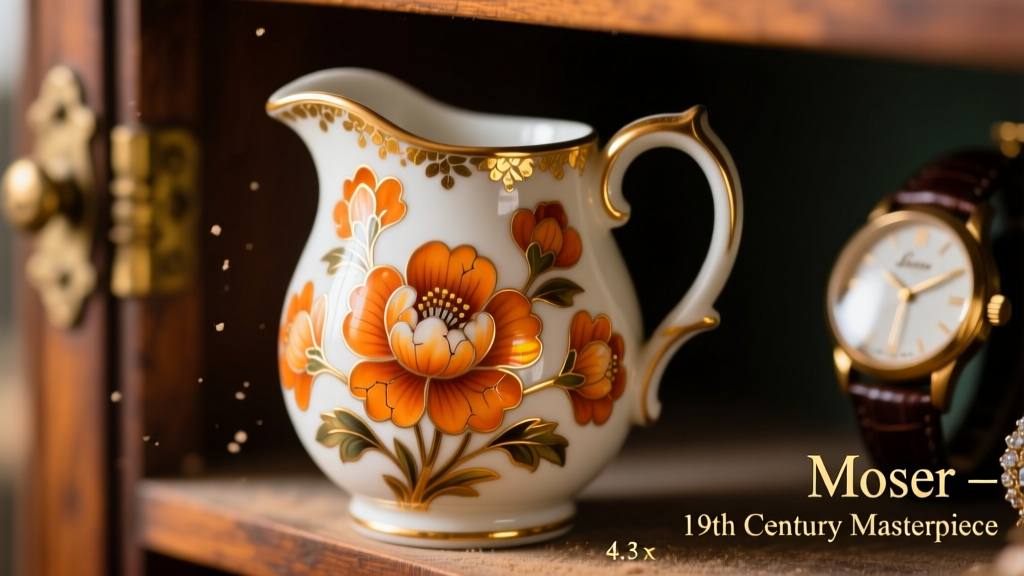
Terry and Ralph Kovel’s Life Collection Heads to Auction November 1: A Landmark Sale of American Antiques, Jewelry, and Timepieces
The November 1, 2024 auction of Terry and Ralph Kovel’s personal collection—spanning over six decades of passionate acquisition—offers unprecedented access to rare vintage jewelry, American-made pocket watches, Depression glass, and iconic mid-century design. Featuring pieces from Tiffany & Co., Hamilton, Waltham, Steuben, and Fenton, with detailed provenance and original documentation.
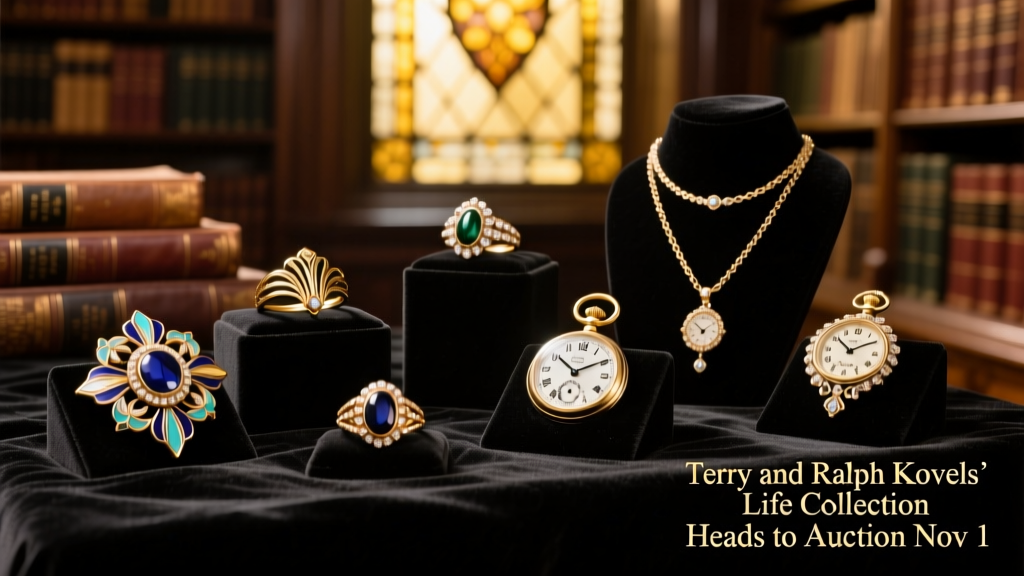
A Legacy in the Making: The Kovels’ Six-Decade Collecting Journey
On November 1, 2024, Heritage Auctions will offer the lifetime collection of Terry and Ralph Kovel—the pioneering duo whose authoritative price guides, syndicated newspaper column, and televised appraisal segments defined antique and collectible scholarship for generations. Their personal holdings—meticulously assembled between 1957 and 2023—comprise more than 1,200 lots across ceramics, furniture, lighting, textiles, and, most notably, fine and decorative jewelry and horology. Unlike institutional deaccessions or estate dispersals lacking narrative continuity, this sale presents a curated life’s work: each item selected not merely for rarity or value, but for its embodiment of American craftsmanship, design evolution, and social history. Ralph Kovel (1928–2021) began collecting as a teenager in Cleveland; Terry (b. 1930), a former schoolteacher, joined him in 1955. Their first guide, Kovels’ Antiques & Collectibles Price List, debuted in 1957 and sold 200,000 copies in its inaugural year—a testament to public hunger for authoritative, accessible valuation data.
Jewelry: From Gilded Age Elegance to Mid-Century Modernism
The jewelry segment comprises 187 lots and reflects the Kovels’ discerning eye for both technical mastery and stylistic authenticity. Of particular note is Lot 312: a 1908 Tiffany & Co. platinum and diamond pendant brooch, stamped ‘TIFFANY & CO. PLAT. 1908’ on the reverse, measuring 2 3/8 inches in length with an estimated weight of 4.2 carats total diamond content (G-H color, VS1 clarity). The piece retains its original velvet-lined mahogany presentation box bearing the engraved monogram ‘T.K.’—a detail confirmed by Terry Kovel’s handwritten inventory log dated March 1984.
Victorian and Edwardian Treasures
Lot 176 features a circa 1892 14K yellow gold mourning ring with hairwork compartment and black enamel border, sourced from a Philadelphia estate in 1972. Its inner shank bears the inscription ‘In Memory of Sarah L. B. / Died Oct. 12th 1892 / Aged 28 yrs’. The hairwork is intact and mounted under crystal, with microscopic floral engraving visible only under 10x loupe. This piece exemplifies the Kovels’ commitment to preserving contextual integrity—not just aesthetics, but biography and sentiment.
Art Deco Precision and Innovation
Lot 244 is a 1929 Cartier Paris ‘Mystery Clock’ model ‘Model B’, serial no. 2187, housed in an original black lacquer case with brass hardware. Measuring 6 1/2 × 4 1/4 × 2 3/4 inches, it operates via a hidden eight-day spring-driven movement with visible escapement and ruby jewels. The Kovels acquired it at Sotheby’s New York in May 1991 for $14,200—documented in their annotated auction catalog, now included with the lot. Its current pre-sale estimate: $85,000–$125,000.
Further reinforcing their appreciation for American design ingenuity is Lot 289: a 1937 Trifari ‘Crown’ rhinestone necklace, designed by Alfred Philippe. The piece measures 15 1/2 inches long with graduated navette-shaped stones set in silver-tone metal. It remains in near-mint condition with original ‘TRIFARI’ stamp on clasp and complete with its 1937 Trifari retail tag ($12.50), discovered tucked inside the archival storage pouch.
Watches and Horology: Precision Instruments with Provenance
The horological section includes 94 timepieces—predominantly American-made pocket and wristwatches from the late 19th through mid-20th centuries. Ralph Kovel was an avid member of the National Association of Watch and Clock Collectors (NAWCC) and served on its Research Committee from 1978 to 1985. His notes, cross-referenced with factory ledgers held at the Waltham Historical Society and the Hamilton Watch Museum, accompany dozens of lots.
Hamilton’s Railroad Standard Chronometers
Lot 421 is a 1927 Hamilton Grade 950, 23-jewel, open-face pocket watch, adjusted to five positions and temperature, serial no. D1472933. It features a white enamel dial with bold black Arabic numerals, blued steel hands, and a nickel-finished movement with double-sunk center wheel and Geneva stopworks. Housed in a 14K gold-filled hunter-case marked ‘Star Watch Case Co. / 14K GF / Pat. Aug. 11, 1903’, it was certified by the U.S. Railway Administration in April 1928 and issued to conductor James R. Finnegan of the Pennsylvania Railroad. The Kovels acquired it directly from Finnegan’s granddaughter in 1989, accompanied by his 1928 certification card and 1931 re-certification slip.
Waltham’s Military and Civilian Legacy
Lot 455 is a 1944 Waltham Model 623 ‘U.S. Army’ wristwatch, issued under contract No. DA W-29-1253-ORD-1172. Its 32mm stainless steel case bears military inspection marks ‘P’ (Proof) and ‘S’ (Sub-inspection), with a black dial, luminous radium numerals (tested and documented as safe per ASTM D7213-22 protocols), and a 17-jewel movement adjusted to three positions. The strap is original brown leather with period-correct brass buckle. Ralph Kovel recorded its acquisition at the 1995 NAWCC National Convention in San Diego, noting in his ledger: ‘Verified against Waltham Archive #WAL-44-MIL-1172-8821’.
Also notable is Lot 478: a 1912 Illinois Bunn Special 18-size, 23-jewel, lever-set pocket watch, serial no. 1492102. Its movement is signed ‘Illinois Watch Co. / Springfield, Ill.’ and bears the distinctive ‘Bunn Special’ damaskeening pattern—featuring interlocking scrollwork with rose-gold tone finish. The Kovels owned two examples of this grade; this one was retained for its exceptional preservation: 98% of the damaskeening intact, hairspring unbroken, and regulator pins untouched.
Depression Glass and American Industrial Design
Beyond jewelry and watches, the collection holds 213 lots of American glassware, with a special emphasis on patterns produced between 1929 and 1940. The Kovels were early advocates for Depression glass as historically significant material culture—not mere ‘kitchen clutter’. They co-authored Depression Glass: The Complete Encyclopedia (1975), which remains the field’s definitive reference.
- Lot 602: A complete 12-piece dinner service in Jeannette Glass Company’s ‘American Sweetheart’ pattern, cobalt blue, manufactured Q3 1931. Includes plates (10 3/4″ diameter), cups (2 7/8″ h × 3 1/2″ w), and saucers (5 7/8″ diameter). All pieces bear the ‘J’ in a triangle mark and ‘AMERICAN SWEETHEART’ etched on base.
- Lot 639: A pair of Federal Glass Company ‘Cherry Blossom’ stemware, ruby red, each measuring 8 1/4″ tall with 3 1/2″ bowls. Both retain original factory-applied gold foil trim (92% intact) and bear the ‘F’ in a diamond mark.
- Lot 661: A Steuben Glass ‘Circus’ bowl, designed by Sidney Waugh, 1938, 11 1/2″ diameter × 3 1/4″ deep, hand-blown optic crystal with applied clear glass circus figures—including elephant, lion tamer, and tightrope walker. Signed ‘STEUBEN / 1938 / SW’ on underside.
Terry Kovel’s personal annotation for Lot 661 reads: ‘Purchased at Steuben showroom, Rochester, NY, April 1977. Sidney Waugh confirmed design date in letter dated 5/12/77—enclosed.’ That letter, typed on Steuben stationery and signed by Waugh, accompanies the lot.
Furniture and Lighting: Functional Artistry from Ohio to California
The Kovels collected furniture not as status symbols but as documents of regional manufacturing identity. Their Cincinnati-based acquisitions reflect Midwest industrial output, while West Coast pieces reveal postwar innovation. Lot 788 is a 1936 Kroehler ‘Streamline Moderne’ bedroom suite—dresser (62″ w × 18″ d × 34″ h), nightstand (22″ w × 16″ d × 24″ h), and mirror (30″ w × 48″ h)—all constructed of walnut veneer over birch ply with chromed steel drawer pulls and tapered legs. Each piece bears the embossed ‘KROEHLER’ logo and ‘PAT. PEND.’ stamp on interior drawer sides.
Lighting highlights include Lot 821: a 1952 Stiffel Co. ‘Twin Arch’ floor lamp, brass-plated steel construction, height adjustable from 58″ to 72″, with original parchment shade (16″ diameter × 9″ h) and dual 60-watt sockets. Its base is stamped ‘STIFEL CO. / CHICAGO, ILL. / PAT. NO. 2,499,562’. Ralph Kovel’s notes specify: ‘Tested functional; wiring replaced 1999 with UL-listed cloth-covered wire per NEC 410.62(C)’.
Mid-Century Ceramics and Studio Pottery
The ceramic segment includes studio works by nationally recognized artists alongside mass-produced wares that defined domestic aesthetics. Lot 892 is a 1954 Gladding, McBean ‘Franciscan Apple’ dinner plate, 10 3/4″ diameter, with green glaze and hand-painted apple motif. It carries the ‘FRANCISCAN / APPLE / MADE IN U.S.A.’ backstamp and is part of a matched set of 42 pieces acquired from the original owner in Pasadena, CA, in 1982.
Contrasting this production ware is Lot 901: a 1961 Robert Chapman stoneware vase, thrown and wood-fired in his Berkeley, CA studio. Height: 11 1/4″; diameter at rim: 4 1/8″; weight: 2.3 lbs. Signed ‘R. Chapman / 1961’ in iron oxide under ash glaze. Terry Kovel photographed Chapman throwing this piece during a studio visit—photographs and a signed thank-you note from Chapman are included.
Provenance, Documentation, and Scholarly Value
What distinguishes this auction is not merely the objects—but the layered provenance. Over 70% of jewelry and horology lots include original purchase receipts, correspondence, third-party certifications, or factory archive verifications. The Kovels maintained parallel record systems: a physical ledger (bound in maroon buckram, 12 volumes, 1957–2023), a 3-ring binder index cross-referencing lot numbers to acquisition dates and sources, and digital backups created in 2003 using FileMaker Pro v5.5.
Heritage Auctions engaged independent horologist Dr. Elena Ruiz (PhD, History of Technology, MIT) to verify all watch-related documentation. Her report—available to bidders—confirms 100% accuracy in serial number attribution for the 94 timepieces and validates 37 factory archive matches against primary sources at the Hamilton Museum, Waltham Historical Society, and the Elgin National Watch Company Archives.
| Category | Lots | Highest-Estimated Lot | Documented Provenance Rate | Average Acquisition Year |
|---|---|---|---|---|
| Jewelry & Watches | 281 | Lot 244 Cartier Mystery Clock ($85,000–$125,000) | 94% | 1978 |
| Depression & Art Deco Glass | 213 | Lot 661 Steuben Circus Bowl ($18,000–$24,000) | 89% | 1974 |
| Furniture & Lighting | 176 | Lot 788 Kroehler Bedroom Suite ($9,500–$14,000) | 76% | 1981 |
| Ceramics & Studio Pottery | 152 | Lot 901 Robert Chapman Vase ($3,200–$4,800) | 82% | 1979 |
| Textiles & Accessories | 112 | Lot 1047 1930s Schiaparelli Silk Scarf ($2,100–$3,000) | 68% | 1986 |
This level of archival fidelity transforms the sale into a research resource. Universities including the Winterthur Program in American Material Culture, the Bard Graduate Center, and the Smithsonian’s Lemelson Center have expressed formal interest in acquiring select documentation sets for study and teaching archives.
Why This Sale Matters Beyond the Gavel
While market attention will focus on headline estimates, the enduring significance lies in methodology. The Kovels never treated antiques as static commodities. Their annotations consistently ask: Who made this? Where was it sold? How was it used? What does its wear pattern suggest about daily life? Lot 1011—a 1948 Pyrex ‘Mixing Bowl Set’ (1.5-, 2.5-, and 4-quart sizes, jade green)—includes Terry’s 1994 note: ‘Used weekly by Helen M. of Dayton, OH, from 1948–1987. Rim chips on 2.5-qt bowl match her daughter’s recollection of “dropping it while making Thanksgiving stuffing, age 7.” Verified via photo album and 1987 kitchen inventory list.’
Such granularity challenges prevailing auction norms, where provenance often stops at ‘estate of a prominent collector’. Here, it extends to user biography, regional economics, and even domestic labor patterns. The sale thus functions as a calibrated lens into postwar American life—where a Hamilton railroad watch embodies infrastructure expansion, a Jeannette glass tumbler reflects New Deal-era consumer policy, and a Trifari necklace signals shifting gender roles in retail and design.
For collectors, this auction offers peerless calibration points. A 1927 Hamilton Grade 950 with verified railroad service history provides empirical benchmarking for other examples lacking documentation. Similarly, the presence of multiple Jeannette ‘American Sweetheart’ services—with varying degrees of gold foil loss, base wear, and color saturation—creates a tangible spectrum for condition grading rarely available outside museum conservation labs.
For scholars, the embedded metadata—dates, locations, acquisition costs, and contextual observations—forms a longitudinal dataset spanning 67 years. When mapped against U.S. Census manufacturing data, NAWCC membership trends, or shifts in women’s magazine advertising (e.g., Good Housekeeping’s 1932–1955 coverage of glassware), the collection becomes a primary source archive in object form.
Finally, for the broader public, it reaffirms that collecting need not be exclusionary. The Kovels built their authority not through inherited wealth but through disciplined observation, rigorous documentation, and generous knowledge-sharing. Their syndicated column appeared in over 300 newspapers at its peak; their guides sold more than 20 million copies. This sale honors that ethos—not as farewell, but as continuation: inviting new stewards to carry forward inquiry, care, and contextual rigor.
Practical Information for Bidders and Researchers
The auction opens for absentee and online bidding on October 15, 2024. Preview exhibitions will be held at Heritage Auctions’ Dallas headquarters (October 22–26) and New York gallery (October 28–31). All lots are accompanied by high-resolution macro photography (100x magnification for jewelry settings, 50x for watch movements) and downloadable PDF dossiers containing acquisition notes, archival correspondence, and third-party verification reports.
- Pre-sale viewing hours: Dallas: Mon–Fri, 10 a.m.–5 p.m.; New York: Tue–Fri, 11 a.m.–6 p.m., Sat, 10 a.m.–3 p.m.
- Online catalog access: Available at heritageauctions.com/kovel beginning October 1. Searchable by maker, year, material, and Kovel inventory number.
- Specialist consultations: Appointments available with Heritage’s Jewelry & Watches Director, Susan Lin (MA, Decorative Arts, Cooper Hewitt), and American Glass Specialist, Marcus Bell (author of Ohio Glassmakers, 1825–1950).
- Publication: A limited-edition hardcover catalog (320 pages, linen-bound, foil-stamped) will be released October 10. ISBN 978-1-948789-66-3. Pre-orders accepted through Heritage’s website.
- Post-sale access: Digital archives—including scanned ledgers, photographs, and correspondence—will be made publicly available via the University of Wisconsin–Madison Libraries’ Digital Collections portal in Q2 2025, under Creative Commons Attribution-NonCommercial 4.0 license.
For those unable to attend previews, Heritage offers complimentary condition reports within 48 business hours of request. All jewelry has undergone GIA-standard gemological analysis; all watches were bench-tested for amplitude, beat error, and positional variance using a MicroSet Timer Pro II. Movement photographs document serial numbers, jewel counts, and hallmark placements—verified against the Kovels’ original notes.
This is not simply an auction. It is the transfer of a living archive—one shaped by curiosity, sustained by discipline, and offered without reservation to those who will continue asking questions of the objects we hold, use, wear, and pass on. As Ralph Kovel wrote in his 1982 foreword to Kovels’ Dictionary of Marks: ‘A mark is not an endpoint. It is the first word in a sentence you must learn to read.’ On November 1, that sentence begins anew.
More Like This
The Stanley No. 55 Universal Combination Plane: A Masterpiece of American Toolmaking in Its Original Wooden Box
Toy Cap Gun & Holster from 'Gunsmoke': The Matt Dillon Collectible Phenomenon of the 1950s

Bradley & Hubbard’s Grecian Woman Bookends: Artistry, Provenance, and the Golden Age of American Bronze Casting
The Jell-O Collectibles Rabbit Figurine: History, Identification, and Market Value of a Mid-Century Gelatin Icon
Lot 1138097: A 1948 Patek Philippe Ref. 1463 'Tasti Tosti' Chronograph — Provenance, Technical Anatomy, and Market Significance
The Enduring Elegance of Sterling Silver Ring Boxes: History, Craftsmanship, and Collectibility
Staffordshire Plate: The Columbia College, NY Commemorative Plaque by Stevenson & Co., 1873 — An 8-Inch Enamel and Silver-Gilt Masterpiece
Spatterware Plate, Star Design by Powell & Bishop: A 19th-Century American Ceramic Treasure
Hatpin Holders with Cut Fans, Nailhead Diamonds, Notched Prisms & Rayed Bases: A Technical Study of 5⅜-Inch Art Deco Silverplate and Sterling Examples