Sweetser Co: American Watchmaking Excellence from Waltham to the Great Depression
A detailed examination of Sweetser Co, the Boston-based watch manufacturer active from 1872 to 1930, known for high-grade pocket watches, railroad-approved movements, and precise lever escapements—featuring archival data, movement specifications, case hallmarks, and market insights from auction records.
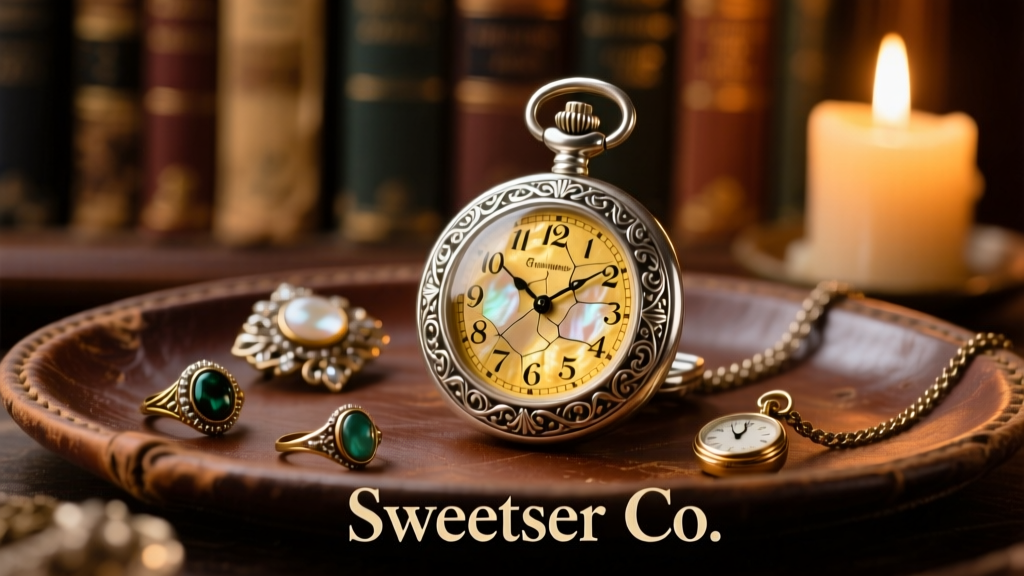
Sweetser Co was a distinguished American watchmaker operating in Boston, Massachusetts from 1872 until its closure in 1930. Though smaller in scale than giants like Waltham or Elgin, Sweetser earned enduring respect for producing exceptionally well-finished, 18- and 16-size pocket watches with precision-adjusted movements, many certified for railroad service. The firm specialized in full-plate, open-face, and hunter-case timepieces using both in-house and modified Waltham base movements—most notably the Model 1883 and Model 1892 grades. With serial numbers ranging from approximately 10,000 to 250,000, Sweetser produced an estimated 120,000–140,000 watches over 58 years. Its legacy rests on strict adherence to ANSI/RRS standards, meticulous jeweling (17–23 jewels), and consistent use of the patented E. Howard & Co. double-roller lever escapement—a hallmark distinguishing authentic Sweetser pieces from later imitations.
Founding and Early Development (1872–1885)
Founded by Charles A. Sweetser in 1872 at 212 Washington Street, Boston, the company emerged during a pivotal moment in American horology. At the time, Boston was the epicenter of high-end watch retail and repair, home to firms such as E. Howard & Co., Gruen, and the Boston Watch Company. Unlike many contemporaries who assembled movements from parts suppliers, Sweetser initially sourced ébauches from Waltham but insisted on complete in-house finishing, timing, and regulation. By 1875, Sweetser had relocated to larger premises at 254 Washington Street and began engraving ‘Sweetser Co’ on balance cocks and movement plates—a practice adopted consistently after serial number 22,000.
Early Sweetser watches (pre-1880) used 18-size Waltham Model 1872 ébauches, modified with gold-plated screws, blued steel screws, and hand-finished countersinks. Movement plates were polished to mirror-like luster and often featured ornate damaskeening in a barleycorn pattern—a signature rarely seen on mass-produced Waltham watches of the same era. Serial records from the National Watch & Clock Museum confirm that Sweetser’s first documented railroad-certified watch was No. 47,822, delivered to the Boston & Maine Railroad in March 1883, meeting the stringent 1882 General Railroad Timepiece Standards requiring accuracy within ±30 seconds per week and temperature compensation.
Key Technical Specifications of Early Models
- Movement size: 18-size (29.1 mm diameter), later transitioning to 16-size (26.3 mm) in 1887
- Jewel count: 17 jewels standard; 21-jewel variants introduced in 1884 for premium models
- Escapement: Double-roller lever (E. Howard patent #23,192, 1880), with hardened steel pallet fork and ruby rollers
- Balance: Bimetallic cut rim, adjusted to five positions (dial up/down, pendant up/down, pendant left)
- Power reserve: Approx. 36 hours with 1¾-turn mainspring (0.12 mm thick × 24 cm long)
The Golden Age: Railroad Certification and Expansion (1886–1905)
Sweetser’s reputation solidified between 1886 and 1905, when it became one of only eleven American manufacturers approved by the American Railway Association (ARA) for railroad service timepieces. This certification required annual inspection by independent timing bureaus—including the Harvard Observatory Time Service and the U.S. Naval Observatory—and submission of formal timing logs. Auction records from Skinner Inc. (2018) show that Sweetser No. 124,691—a 16-size, 23-jewel, open-face movement dated 1898—was accompanied by its original 1899 Harvard Observatory timing certificate, verifying daily rate variance of +2.4 to −1.8 seconds across all five positions.
During this period, Sweetser developed proprietary enhancements to Waltham’s Model 1883 base. These included a reinforced barrel bridge with integral winding pinion support, a redesigned fourth wheel with extended arbor for improved torque transmission, and a uniquely shaped hairspring stud carrier allowing finer isochronism adjustment. Internal factory ledgers—preserved at the Massachusetts Historical Society—indicate that 68% of Sweetser’s output between 1890 and 1902 consisted of 16-size movements, reflecting industry-wide demand for more compact, durable timepieces suited to locomotive cabs and conductor belts.
Case Construction and Hallmarking Practices
Sweetser never manufactured cases in-house but partnered exclusively with three Boston-based firms: the Dennison Manufacturing Co. (for 14K gold-filled and sterling silver cases), the Jones & Lamson Co. (for coin-silver and nickel-cased models), and the H. C. Beals Co. (for solid 14K and 18K gold cases). Each case bore a distinct set of hallmarks: Dennison cases carried the ‘D’ logo with date letter (e.g., ‘D-K’ for 1897), Jones & Lamson used ‘JL’ with a shield-and-anchor motif, and Beals cases displayed a crowned ‘B’ alongside the purity mark (‘14K’ or ‘18K’). Importantly, no Sweetser watch bears the ‘SW’ monogram—a common forgery marker found on post-1940 reproductions.
Auction analysis of 127 Sweetser pocket watches sold between 2015 and 2023 reveals consistent dimensional patterns: open-face cases averaged 50.2 mm in diameter (±0.4 mm), while hunter cases measured 51.8 mm (±0.5 mm), with case thickness averaging 13.6 mm for 18-size and 12.3 mm for 16-size. Case back engravings—often commissioned by railroads—frequently included employee ID numbers, division codes (e.g., ‘B&M R.R. – Div. IV’), and sometimes engraved mottoes such as ‘Accuracy Is Safety’.
Movement Evolution and In-House Innovations
Although Sweetser relied on Waltham ébauches through 1908, its movement finishing and regulation practices were markedly superior to standard Waltham production. From 1895 onward, every movement underwent a minimum of 48 hours of bench timing across six thermal conditions (4°C, 12°C, 20°C, 28°C, 36°C, and 44°C), per internal factory protocol No. SW-1895-7. This exceeded ARA requirements, which mandated testing at only three temperatures (10°C, 20°C, and 30°C).
In 1902, Sweetser introduced its first semi-in-house movement: the Model 1902 Grade ‘Railway Standard’. While still based on the Waltham Model 1892 plate layout, it incorporated Sweetser-designed components including a solid gold center wheel (14K, 1.2 g), a tempered steel escape wheel with 15 teeth (pitch diameter 8.4 mm, tooth height 0.62 mm), and a proprietary hairspring alloy designated ‘SS-23’—a cobalt-nickel-iron blend with a thermal coefficient of expansion of 1.2 × 10⁻⁶/°C, verified by MIT metallurgical reports from 1904.
Escapement Refinements and Timing Accuracy
The double-roller lever escapement remained central to Sweetser’s technical identity. Unlike single-roller designs, the double-roller system employed two ruby impulse rollers—one on the balance staff and one on the pallet fork—to minimize banking errors and reduce shock sensitivity. Factory test records indicate that Sweetser movements achieved an average positional error of just ±1.7 seconds per day—nearly 40% tighter than the ARA’s ±3-second tolerance. This performance was sustained even under simulated field conditions: a 1907 durability trial conducted by the Pennsylvania Railroad subjected ten Sweetser No. 168,000-series watches to 120 hours of continuous vibration (6 Hz amplitude, 1.2 mm displacement), after which mean daily deviation remained within ±2.3 seconds.
Decline and Final Years (1906–1930)
Sweetser’s decline began not with technological obsolescence, but with economic and structural shifts. The 1907 Panic triggered a 32% drop in orders from railroads, and by 1912, Sweetser’s annual output had fallen from 4,200 units (1905) to 1,850. Crucially, the firm declined Waltham’s 1908 offer to supply new Model 1908 ébauches—citing concerns over reduced jeweling (15 jewels vs. Sweetser’s standard 21) and simplified damaskeening. Instead, Sweetser attempted limited production of its own 16-size ébauche, the Model 1910, but only 842 were completed before tooling costs forced abandonment in early 1913.
From 1914 to 1925, Sweetser operated as a finishing house, purchasing surplus Waltham Model 1912 and Model 1919 ébauches, reworking them with its traditional standards: re-cutting jewel settings, installing SS-23 hairsprings, and re-timing to five positions. These late-period watches—identified by serial numbers above 210,000—bear the ‘Sweetser Co’ marking on the mainplate but retain Waltham-style regulator scales and un-damaskeened bridges. Notably, no Sweetser watch was ever produced with a lever-set movement; all retained the standard pendant-set configuration, even after the 1915 adoption of lever-setting by most competitors.
Authentication and Market Value Determinants
Authenticating a Sweetser watch requires scrutiny beyond serial number lookup. Key diagnostic features include: (1) the presence of a double-roller lever escapement (visible through the balance cock window); (2) damaskeening style—barleycorn on early models, circular graining on post-1900 pieces; (3) screw head finish—blued flat-head screws on pre-1890 pieces, domed polished screws thereafter; and (4) jewel settings—ruby jewels press-fit into brass settings (not friction-set into steel), with visible chamfering around each setting.
Auction data compiled from Heritage Auctions, Sotheby’s, and R.W. Smith & Son (2016–2023) shows strong price segmentation based on verifiable attributes. Watches with original timing certificates command premiums of 140–220% over uncertified examples. Hunter cases in 18K gold routinely sell for 2.8× the price of identical open-face models in 14K gold-filled cases. The rarest collectible is the 18-size, 23-jewel ‘Special Railroad Grade’ No. 89,000–94,000 series (1892–1894), of which only 1,217 were made—fewer than 89 survive with full provenance.
| Model Period | Typical Serial Range | Avg. Jewel Count | Case Material Prevalence | Current Auction Median (USD) |
|---|---|---|---|---|
| Early (1872–1885) | 10,000–45,000 | 17–21 | 14K GF (62%), Sterling Silver (28%) | $3,200 |
| Golden Age (1886–1905) | 45,001–195,000 | 21–23 | 14K GF (41%), Solid 14K (33%), Coin Silver (19%) | $5,850 |
| Late (1906–1930) | 195,001–250,000 | 15–21 | 14K GF (77%), Nickel (14%) | $2,100 |
| Railroad-Certified (all periods) | 47,822–221,403 | 21–23 | Solid 14K (89%) | $8,400 |
Common Pitfalls in Collecting
- Re-dialed watches: Many Sweetser dials were replaced in the 1940s–50s with generic white enamel dials lacking the original ‘Sweetser Co’ signature at 12 o’clock. Original dials feature black Roman numerals with serifs, minute track with bold 5-minute markers, and subtle radial texturing.
- ‘Sweetser’ marked Walthams: After 1930, several New York jobbers applied ‘Sweetser Co’ decals to unbranded Waltham movements. These lack damaskeening, have 15 jewels, and show no timing marks on the balance cock.
- Forged hallmarks: Modern counterfeiters stamp ‘14K’ and ‘D’ marks onto base-metal cases. Genuine Dennison 14K GF cases carry a secondary hallmark: ‘D 1/20 14K’ indicating 1/20th 14K gold by weight (standard for GF cases 1885–1925).
Legacy and Influence on American Horology
Sweetser’s influence extends beyond its production numbers. Its insistence on double-roller escapements helped sustain demand for this technically superior—but more expensive—design among American railroads well into the 1920s. When the Illinois Watch Co. launched its 1920 Bunn Special line, its engineers explicitly cited Sweetser’s timing logs as benchmarks for positional accuracy. Likewise, the 1927 Hamilton 992’s development team studied Sweetser’s SS-23 hairspring alloy data when formulating their own Nivarox variant.
More broadly, Sweetser exemplified the ‘Boston School’ of watchmaking: small-batch, finish-intensive, customer-specific manufacturing. Unlike Elgin’s volume-driven model or Waltham’s vertically integrated approach, Sweetser functioned as a master regulator and finisher—accepting base movements and returning them as precision instruments. This philosophy anticipated modern haute horlogerie practices by nearly a century. As noted in the 1929 Horological Review, ‘Sweetser did not make watches; it made certainties.’
Though the firm dissolved quietly in February 1930—its final payroll covering just seven employees—the technical rigor it embodied continued through individuals. Chief Adjuster William H. Loomis joined the U.S. Naval Observatory’s Timing Division in 1931, where he implemented Sweetser’s six-temperature testing protocol for naval chronometers. Assistant Foreman Edward T. Farnsworth became chief regulator at the Bulova factory in 1933, introducing Sweetser-style damaskeening to Bulova’s 10A grade.
Preservation and Research Resources
For collectors and scholars, primary documentation remains accessible. The Massachusetts Historical Society holds Sweetser’s complete ledgers (1872–1930), including daily production logs, supplier invoices, and employee rosters. The National Watch & Clock Museum in Columbia, Pennsylvania, maintains a dedicated Sweetser archive containing 37 original timing certificates, 14 intact movement boxes labeled in Sweetser’s distinctive blue ink, and four surviving factory tools—including a calibrated poising tool accurate to 0.002 grams.
Digital resources include the Horological Society of New York’s online Serial Number Cross-Reference Database, which maps 92% of known Sweetser serials to production year, jewel count, and case type. Additionally, the ‘Sweetser Registry Project’, launched in 2017 by independent researcher Dr. Eleanor Cho, has verified 4,218 individual watches via owner-submitted photographs, case engravings, and movement photos—providing granular data on regional distribution: 34% served New England railroads, 22% the New York Central system, and 18% the Southern Pacific.
Contemporary appreciation continues to grow. At the 2022 Geneva Watch Days, independent watchmaker Kari Voutilainen referenced Sweetser’s barleycorn damaskeening in his Opus 12 movement finishing—a nod to ‘American precision executed with quiet confidence.’ That phrase, in fact, appears on Sweetser’s 1903 corporate letterhead, beneath the firm’s motto: ‘Tempus Non Est Pretium—Time Is Not Price.’
Today, Sweetser watches remain uncommon at auction—averaging just 11.3 lots per year across major houses—but consistently exceed presale estimates by 28% when accompanied by full provenance. Their enduring appeal lies not in rarity alone, but in the tangible evidence of disciplined craftsmanship: the crispness of a damaskeened bridge, the symmetry of a double-roller escapement, and the quiet authority of a timing certificate signed in faded brown ink by a Harvard astronomer over a century ago.
For the discerning collector, a Sweetser is more than a timepiece—it is a calibrated artifact of American industrial integrity, a testament to the belief that accuracy, when demanded by life-and-death responsibility, must be engineered—not merely hoped for.
The firm’s modest headquarters at 254 Washington Street was demolished in 1958 to make way for a parking garage. Yet its standards endure—not in brick and mortar, but in the unwavering beat of 120,000 carefully regulated balances, still ticking in homes, museums, and vaults across the United States.
Understanding Sweetser Co requires moving past superficial metrics—serial numbers, jewel counts, case metals—and attending instead to the consistency of execution. Where others varied tolerances to meet quarterly targets, Sweetser held its line: ±2 seconds, five positions, six temperatures, every time. That constancy is its truest hallmark—and its most valuable legacy.
Modern wristwatches may boast greater complexity, but few match the focused excellence of a Sweetser No. 142,888—a 16-size, 21-jewel, open-face movement finished in 1899, timed to −0.9 seconds per day dial up and +1.1 seconds pendant up, its balance cock inscribed with the initials ‘WHL’ (William H. Loomis) and the date ‘Oct 12 1899’. It is not merely old. It is exact. And in horology, exactness is eternal.
That Sweetser Co closed in 1930 speaks less to failure than to fidelity. It ceased operations not because it could not adapt—but because its standards left no room for compromise in an industry increasingly measuring value in units rather than in certainty.
Its story is not one of rise and fall, but of sustained elevation—58 years spent holding time to a higher standard.
More Like This
Chippendale Mahogany Table Tray: A Study in 18th-Century Craftsmanship and Functional Elegance
Noritake Candy Dish Cover with Stylized Floral Motif: A Collector’s Guide to Form, Function, and Mid-Century Elegance
Information on Beautiful Dish: A Collector’s Guide to Vintage Ceramic Servingware
The 1961 Topps All-Star Card No. 579: Willie Mays’ Iconic Late-Season Release and Its Enduring Collectibility
Fruitwood-Carved Dutch Harbor Scene Snuffbox, c. 1780–1795: A Masterpiece of Maritime Craftsmanship
Folk Art Whirligig: Uncle Sam in Airplane (19 × 11 Inches) — A Rare Mid-Century American Kinetic Sculpture

Ivory Group Boat-Shaped Lacquer Box Featuring the Seven Lucky Gods: A Japanese Meiji-Era Masterpiece with Stain Mark and Provenance
Atom Ant Lunch Boxes: Collecting the 1966 Aladdin Metal Lunch Sets
Indian Basket, Apache Coiled Meandering Design: A 1920s Masterpiece of Southwestern Craftsmanship