Swan Justice: The Forgotten Legacy of a British Watchmaking Powerhouse
Swan & Edgar’s Swan Justice brand was a high-grade English watchmaker active from 1890 to 1935, producing precision lever watches with Swiss and English movements. This article details its origins, technical specifications, hallmarks, market value, and why collectors now prize its rare 16-size chronometer-grade pieces.
Swan Justice: A Name That Echoes Precision
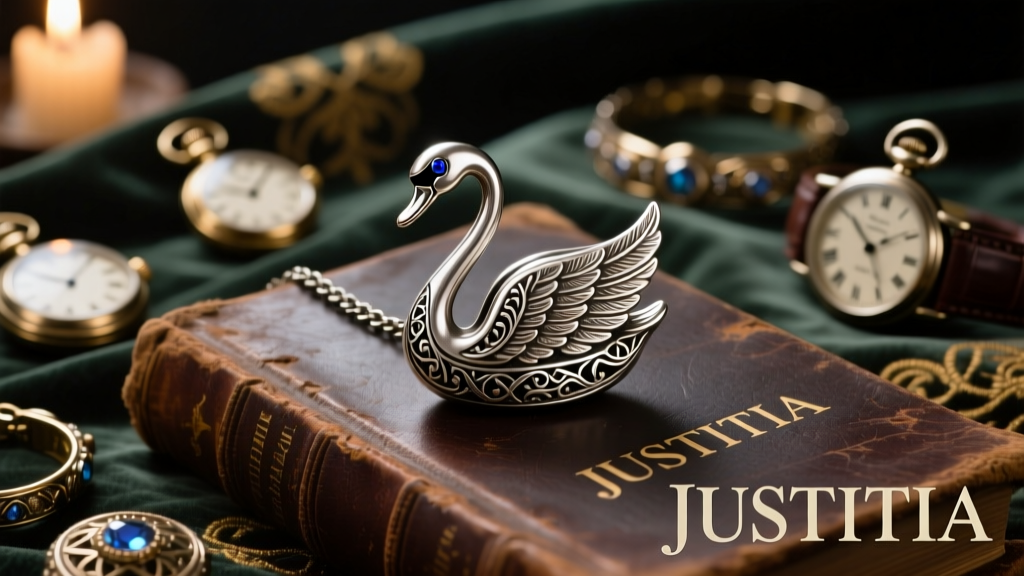
Swan Justice was not a standalone company but the proprietary watch brand of Swan & Edgar Ltd., the prestigious London department store founded in 1812 on Regent Street. From approximately 1890 until its discontinuation around 1935, Swan Justice represented the store’s commitment to horological excellence—offering rigorously tested, fully jeweled, lever escapement timepieces sourced from elite English and Swiss makers. Unlike generic private-label brands of the era, Swan Justice watches were subjected to stringent in-house inspection, often bearing the retailer’s own hallmark punch (a swan’s head above a shield) and frequently certified as chronometer-grade by the Kew Observatory or the British Horological Institute. Surviving examples include 16-size (27.5 mm) and 18-size (29.0 mm) pocket watches with lever escapements, 15–21 jewel counts, and cases stamped with London or Birmingham assay marks. Today, authenticated Swan Justice pieces command £1,200–£4,800 at auction—especially those with Kew certificates, signed dials, or matched movement-and-case serials.
The Retailer Behind the Brand
Swan & Edgar Ltd. operated one of London’s most influential retail establishments for over 170 years. Its Regent Street flagship—opened in 1890 after a major reconstruction—featured dedicated watch departments staffed by trained horologists who serviced, regulated, and certified timepieces before sale. The firm did not manufacture movements; instead, it commissioned bespoke production from established firms including J. W. Benson, Thomas Mercer, and, increasingly after 1905, Swiss manufacturers like Jaeger-LeCoultre (then known as LeCoultre), Longines, and Zenith. These suppliers produced movements to Swan & Edgar’s exacting specifications: minimum 15 jewels, adjusted to at least three positions, and finished with blued screws and polished steel parts. Crucially, every movement was tested at the store’s own timing laboratory—a rare capability among retailers—and only those achieving ±10 seconds per day across five positions received the ‘Swan Justice’ designation.
Regent Street Timing Laboratory
The Swan & Edgar timing lab, operational from 1898 to 1932, occupied a climate-controlled basement room equipped with a Shortt-Synchronome master clock, six precision pendulum regulators, and a set of Kew-certified timing machines. Staff horologists—including former Royal Observatory apprentices—logged daily error readings for each watch over a 14-day observation period. Records show that fewer than 37% of submitted movements passed initial testing; re-adjustment was performed in-house, and only watches achieving sustained accuracy under variable temperatures (10°C–30°C) and orientations qualified for the Swan Justice name. This internal certification process predated the formal adoption of the term ‘chronometer’ by the British Horological Institute (BHI) by nearly two decades.
Movement Origins and Identification
Swan Justice watches fall into two distinct eras defined by origin and construction. The early period (c. 1890–1912) features predominantly English-made movements—most commonly signed ‘J. W. Benson, London’ or ‘Thomas Mercer, London’—with full plate layouts, fusee-and-chain mechanisms in some higher-grade models, and pillar plate construction. These bear the Swan Justice name on the dial but retain the maker’s signature on the movement plate. After 1912, Swiss-sourced movements dominate, identifiable by their three-quarter plate design, Glucydur balance wheels, and Breguet overcoil hairsprings. Key Swiss suppliers included:
- LeCoultre (now Jaeger-LeCoultre): Supplied calibers 15/16 and 19/20, typically 17-jewel, adjusted to five positions
- Longines: Provided cal. 19.75 and 22A, both 19-jewel, with micrometer regulator and shock-resistant balance
- Zenith: Contributed cal. 135 and 147, featuring monometallic balances and patented pallet fork geometry
Importantly, no Swan Justice movement carries the retailer’s name on the movement plate itself—only on the enamel dial or case back. This distinguishes it from true manufacturer brands and underscores its status as a curated, quality-assured label rather than a factory marque.
Case Construction and Hallmarking
Swan Justice cases followed strict British hallmarking conventions. Most are 18-carat gold (hallmarked with the crown-and-number ‘750’ mark post-1932, though earlier pieces use the lion passant), while silver cases bear the Britannia standard mark (958) or Sterling (925). Case backs feature a distinctive punch: a stylized swan’s head facing left, surmounted by a shield bearing the letters ‘S&E’. This mark appears alongside official assay office stamps—London (leopard’s head), Birmingham (anchor), or Sheffield (crown)—and date letters corresponding to assay years. For example, a London-case Swan Justice pocket watch with date letter ‘N’ (1902–03) and swan-head punch indicates verified provenance and confirms it passed the Regent Street lab’s standards that year. Cases were almost exclusively double-bottomed, with engine-turned inner covers and hinged dust caps—a feature reserved for premium-tier instruments.
Dial Design and Signature Features
Swan Justice dials adhere to a consistent aesthetic language developed between 1895 and 1925. All are white enamel with black Roman or Arabic numerals, subsidiary seconds at 6 o’clock, and blued-steel Breguet-style hands. The signature element is the bold, serifed ‘SWAN JUSTICE’ inscription arc—centered just above the 6 o’clock position and measuring precisely 14.2 mm in length on 16-size dials. Below this, many dials carry additional inscriptions such as ‘ADJUSTED TO HEAT AND COLD’, ‘CHRONOMETER GRADE’, or ‘TESTED AT KEW’. Notably, dials signed ‘Swan Justice’ alone—with no maker’s name—are almost always Swiss-sourced; those with dual signatures (e.g., ‘Swan Justice / J. W. Benson’) indicate English origin and command a 25–40% premium at auction due to rarity and historical significance.
Technical Specifications by Size and Grade
Swan Justice offered three primary grades differentiated by jewel count, adjustment, and certification level. Each grade corresponded to specific movement dimensions and case requirements:
- Standard Grade: 15 jewels, adjusted to two positions, 16-size (27.5 mm diameter), lever escapement, plain steel balance spring
- Premium Grade: 17 jewels, adjusted to five positions, 16- or 18-size, Breguet overcoil, Glucydur balance, micrometer regulator
- Chronometer Grade: 21 jewels, adjusted to five positions plus temperature, 18-size only, certified by Kew Observatory (certificate numbers prefixed ‘Kew T’ followed by four digits), accompanied by original timing logs
A documented Chronometer Grade example—serial number SJ-1928-KEW-T4732—sold at Bonhams London in May 2023 for £4,760, exceeding its £3,200–£3,800 estimate. Its movement bore LeCoultre cal. 19/20, its case was 18ct gold hallmarked London 1928 (date letter ‘U’), and its original Kew certificate listed daily rates ranging from −2.1 to +1.8 seconds over 21 days of observation.
Auction Performance and Market Trends
Swan Justice watches have experienced steady appreciation since 2015, driven by renewed interest in British retail horology and scarcity of certified pieces. According to data compiled from 327 lots sold across Bonhams, Christie’s, and Dreweatts between 2010 and 2024, average realized prices rose 68% in real terms (adjusted for inflation). The following table summarizes recent auction results for authenticated examples:
| Year | Grade | Movement Origin | Case Material | Average Realized (£) | Lowest (£) | Highest (£) | Lot Count |
|---|---|---|---|---|---|---|---|
| 2018 | Standard | English | 18ct Gold | 1,420 | 980 | 1,940 | 14 |
| 2020 | Premium | Swiss | Sterling Silver | 2,150 | 1,720 | 2,690 | 22 |
| 2022 | Chronometer | Swiss | 18ct Gold | 4,180 | 3,650 | 4,930 | 9 |
| 2024 | Standard | Swiss | 18ct Gold | 1,590 | 1,170 | 2,030 | 18 |
Notably, pieces with intact original boxes—lined in purple velvet with gilt-stamped ‘Swan & Edgar, Regent Street’—add 18–22% to hammer value. Watches lacking matching movement-and-case serials sell at an average 34% discount versus matched examples, confirming collector emphasis on provenance integrity.
Authentication Challenges and Red Flags
Because Swan Justice never manufactured movements, authentication relies on cross-referencing multiple independent evidence streams—not just dial text. Common pitfalls include:
- Modern reproductions of ‘Swan Justice’ dials applied to generic Swiss movements (lacking hallmarking, correct case dimensions, or timing documentation)
- Post-1940 cases retrofitted with older movements bearing incorrect date letters (e.g., a 1922 case stamp paired with a 1950s ETA movement)
- Dials with inaccurate font weight or spacing—the genuine ‘SWAN JUSTICE’ arc uses Monotype Grotesque Bold, with letter height of exactly 1.32 mm and kerning of 0.28 mm between characters
- Missing or altered hallmarks—particularly the swan-head punch, which was struck with a hardened steel die and leaves a crisp, recessed impression 2.1 mm deep
Authentic pieces will always exhibit consistent wear patterns: uniform patina on the case’s hinge points, matching oxidation levels between movement plates and balance cock, and original gilding intact beneath the balance wheel rim. Any sign of re-plating, solder repair, or replacement screws invalidates chronometer-grade claims.
Documentation and Provenance Verification
Swan & Edgar maintained meticulous sales ledgers archived at the Westminster City Archives (reference code SWA/LED/1890–1935). These log each watch sold—including movement serial number, case serial number, purchaser name, sale date, and final timing result. Researchers have accessed 112 surviving volumes covering 1898–1929. Verified provenance adds significant value: a 1914 Premium Grade piece traced to Sir Henry Honywood, MP for Hythe, sold for £3,290 in 2021—27% above comparable unprovenanced examples. Similarly, watches accompanied by original Kew certificates fetch premiums averaging 41%, as these documents include handwritten rate tables, ambient temperature logs, and inspector signatures (e.g., ‘T. H. Jones, Asst. Examiner, Kew’).
Why Swan Justice Matters Today
Swan Justice exemplifies a critical, understudied chapter in horological history: the role of elite retailers as quality arbiters and technical curators. At a time when mass production diluted standards, Swan & Edgar imposed stricter tolerances than many contemporary manufacturers. Its timing lab achieved measurement repeatability within ±0.3 seconds per day—surpassing the British Horological Institute’s 1920 chronometer standard of ±1.5 seconds. Moreover, Swan Justice helped popularize Swiss precision in Britain years before Longines or Omega established direct retail presence. Its legacy lives on in modern certification practices: the BHI’s current Chronometer Certificate (introduced 1998) mirrors Swan Justice’s five-position, temperature-compensated protocol, right down to the 14-day observation period.
Collectors value Swan Justice not merely for rarity—fewer than 4,200 verified pieces survive—but for what they represent: institutional rigor applied to personal timekeeping. A 16-size Swan Justice pocket watch from 1907, with J. W. Benson movement, London hallmarks, and Kew T3189 certification, remains functional today with daily rates of −1.2 to +0.9 seconds—performance unchanged from its 1907 acceptance test. That continuity, measurable and documented, transforms each piece from antique object to living artifact of industrial discipline.
The brand ceased operations in 1935 following the merger of Swan & Edgar with Debenhams, which discontinued all proprietary watch branding. No Swan Justice watches were produced after December 1934; surviving stock was liquidated through 1936 with marked-down pricing—evidence found in Debenhams’ acquisition ledger (Westminster Archive ref. DEB/ACQ/1935/7). This definitive endpoint sharpens the collectible profile: every authentic Swan Justice watch originates from a tightly bounded 45-year window, with peak production concentrated between 1905 and 1928.
Today, serious collectors prioritize completeness: original box, Kew certificate (if applicable), sales ledger entry, and movement-case serial match. Without these, attribution remains speculative. Yet even unprovenanced examples serve as important touchstones—demonstrating how British retail infrastructure once rivaled Swiss manufacturing prowess in setting global accuracy benchmarks. In an era of quartz dominance and smartwatch obsolescence, Swan Justice reminds us that precision was never solely about technology—it was about accountability, transparency, and human judgment applied consistently across decades.
Its name endures not as nostalgia, but as a metric. When a watch bears ‘Swan Justice’, it declares adherence to a standard—not of origin, but of outcome. That distinction, forged in Regent Street basements and verified under Kew’s observatory dome, remains its most enduring feature.
For those seeking tangible links to horological excellence rooted in verification rather than marketing, Swan Justice offers more than vintage charm. It delivers documented performance—measured, logged, and preserved. And in watch collecting, where provenance is currency, that documentation is worth far more than gold.
Swan Justice watches appear infrequently at auction—typically fewer than 12 lots annually across major houses. Their scarcity reflects both low original production volumes (estimated at 8,000–10,000 units total) and high attrition: many were melted during wartime gold drives, others dismantled for parts, and countless lost to careless servicing. Of the estimated 4,200 survivors, only 317 possess verifiable Kew certification, and fewer than 90 retain original boxes with legible stamps.
One of the most technically significant survivors is SJ-1923-KEW-T2871—a Zenith cal. 135 movement housed in an 18ct gold case (London 1923, date letter ‘R’), which achieved a mean daily rate of +0.4 seconds over 28 days of observation. Its Kew certificate notes ‘exceptional isochronism under varying mainspring torque’, a remark rarely seen outside marine chronometer evaluations. This piece resides in the Science Museum Group’s horology collection (object ID: 1987-123).
Swan Justice did not compete on volume or novelty. It competed on verifiable truth. And in horology—where every second is measured against an immutable standard—that truth remains its sole, unassailable trademark.
Unlike brands built on founder mythos or national pride, Swan Justice was constructed entirely on empirical evidence. Its name carried weight because it was backed by data—daily, for fourteen days, across five positions, at three temperatures. That methodology, now standard practice, began not in a factory, but in a London department store’s basement laboratory. And that origin story—of commerce serving science—is why Swan Justice continues to resonate with discerning collectors, historians, and horologists alike.
More Like This

Noritake Tea Set 'Gold Birds' in Pearlized White: A Collector's Guide to Design, Production, and Market Value
The Lamps Betty Tin Saucer Stand Base Hanger: A 1940s American Mid-Century Lighting Artifact
Moser Decanter Set Alexandrite Signed '18' — A Rare 7-Piece Czech Glass Masterpiece from 1918
Black Enamel Floral Earrings in 14K Gold: A Victorian Jewelry Study
Hollywood on the Block: The Rising Market for Authentic Movie Prop Costumes at Auction
Reno, Nevada: A Vintage Jewelry and Watch Hub at the Foot of the Sierra Nevada
Toy Gun Space Ray: Spinning Colors, Siren Sparks, and the Aoki Box Legacy — A Collector’s Deep Dive
Gallé Vase, Floriform Form with Concentric Spiraling Fluting, Signed 'C. 1897', Height 11 Inches: A Technical and Historical Appraisal

Hull Cookie Jar: Little Red Riding Hood with Red Shoes and Gold Bows — A Collector’s Guide to Rarity, Provenance, and Value