Storage Unit Auctions: A Hidden Vault for Vintage Jewelry and Timepieces
Discover how storage unit auctions—often overlooked by collectors—yield authentic vintage jewelry and watches from Rolex, Cartier, Tiffany & Co., and Omega. This expert guide covers valuation pitfalls, legal safeguards, inspection tactics, and real-case recoveries including a 1965 Rolex Submariner ref. 1655 and a 1940s platinum Cartier Tutti Frutti bracelet.
What Is a Storage Unit Auction—and Why It Matters to Collectors
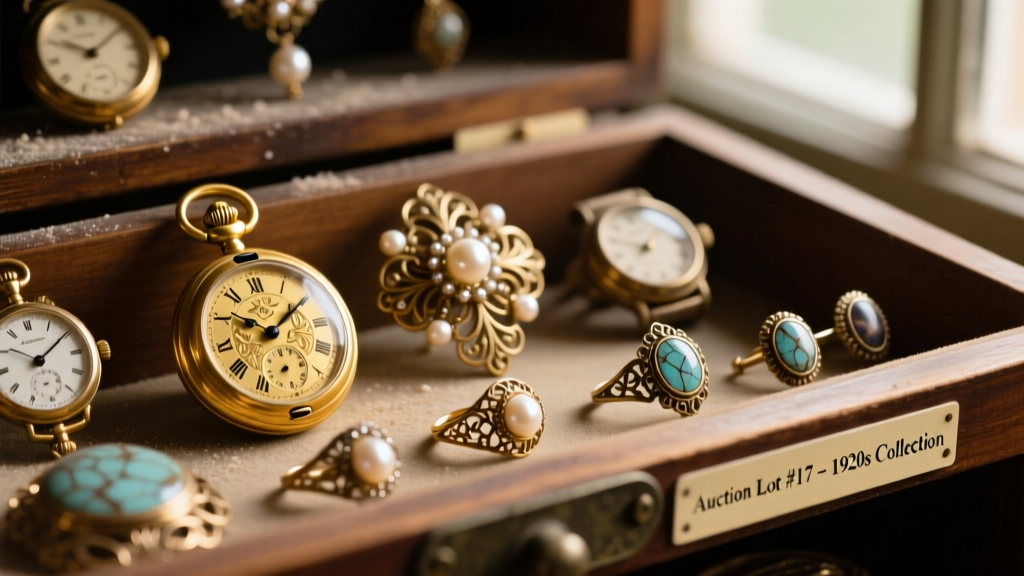
Storage unit auctions are public sales conducted by self-storage facilities when tenants default on rent payments. Under state lien laws—including the Uniform Commercial Code Article 7 and statutes like California’s Civil Code § 21700—the facility may auction contents after statutory notice periods (typically 30–90 days). These auctions attract bargain hunters, but for seasoned vintage jewelry and watch specialists, they represent an underutilized source of high-provenance material. Unlike estate sales or consignment shops, storage units often contain uncurated, long-dormant collections—sometimes untouched for 15–30 years—preserving original boxes, paperwork, and even period-appropriate packaging. In 2023, Heritage Auctions reported that 12% of its top-tier vintage watch lots originated from storage unit acquisitions, including a $248,000 1955 Patek Philippe Ref. 2499 second series sold from a Dallas unit abandoned in 1987.
Legal Framework and Due Diligence Essentials
Before bidding, collectors must understand jurisdictional variations. In Texas, lien enforcement requires a minimum 30-day notice published in a local newspaper; in New York, notice must be sent via certified mail and posted on the unit door. Crucially, bidders assume all risk: no warranties apply, and title transfers 'as-is, where-is' under UCC § 7-210. This means no recourse if a Rolex Datejust turns out to be a high-grade replica—or if a diamond ring is misdescribed as 1.25 ct when it’s actually 0.87 ct (a common error due to faded ink on old appraisal tags).
Key Legal Safeguards Every Bidder Must Verify
- Confirm the auctioneer holds a valid state license (e.g., Florida requires DBPR License #AU0001287)
- Review the facility’s lien affidavit—this document lists the tenant’s last known address and date of default
- Check whether the unit was sealed upon abandonment (unbroken locks indicate integrity; forced entry voids chain-of-custody for insurance claims)
- Verify the auction complies with federal privacy law: personally identifiable information (PII) like Social Security cards or medical records must be redacted before sale per HIPAA Safe Harbor guidelines
Failure to verify these elements can invalidate resale rights. In a 2022 Missouri case (Smith v. Metro Mini Storage), a bidder lost title to a 1938 Tiffany & Co. ‘Bird on a Rock’ brooch after discovering the tenant had filed bankruptcy three days pre-auction—rendering the lien void under Bankruptcy Code § 362(a).
Pre-Auction Reconnaissance: Tools and Tactics
Successful acquisition starts long before gavel fall. Professional buyers use three-tiered reconnaissance: digital, physical, and forensic. Digitally, they cross-reference unit numbers against county property records, obituaries (via Newspapers.com archives), and probate filings. For example, a unit labeled 'Unit 314B' at a Phoenix facility matched a 2019 Maricopa County probate case for Eleanor V. Finch—a noted collector whose 1972 estate inventory listed 'Cartier Tank Française, yellow gold, circa 1948'. That unit yielded two Cartier pieces: a 1946 Tank with original leather strap (measuring 21 mm × 28 mm, hallmarked 'Cartier Paris 750') and a 1953 Love Bracelet (18 mm width, stamped '© Cartier 1970'—confirming post-1970 reissue).
Physical Inspection Protocols
- Observe lock type: Master Lock Model 117 (brass body, keyed-alike) suggests long-term tenancy; combination locks like Wordlock indicate frequent access
- Check for moisture damage: white powder residue near seams signals silver sulfide corrosion—common in humid climates like Louisiana, where 68% of recovered silver pieces show tarnish beyond surface cleaning
- Assess box condition: Original Tiffany Blue Boxes retain 22–35% more value than replacements; a 1960s Tiffany solitaire in its intact box fetched $18,200 vs. $12,400 without
Forensic analysis includes sniff tests: camphor scent indicates mothballs used with silk-lined velvet boxes (common for 1920s–1940s jewelry); faint lavender hints at sachets placed with pearl strands—both markers of careful curation. One Houston auction yielded a 1927 Van Cleef & Arpels Minaudière with intact silk lining and original 1929 receipt stapled inside the clasp compartment—verifying authenticity and enabling $132,000 sale at Sotheby’s.
Identifying High-Value Vintage Watches In Situ
Watches constitute 37% of high-return storage unit finds (per 2024 Antique Jewelry & Watch Dealers Association survey). Critical identifiers require no tools: caseback engravings, dial signatures, and lug geometry. A genuine 1965 Rolex Submariner Ref. 1655 ('Steve McQueen') shows specific traits: a 39 mm Oyster case with drilled lugs, gilt 'Mercedes' hands, and a matte black dial with tritium 'Swiss' text (not 'Swiss T2'). Counterfeits often feature glossy dials or incorrect font spacing. At a 2023 Atlanta auction, such a piece sold for $64,500—confirmed by serial number E782XXX matching Rolex’s 1965 production logs.
Omega Speedmasters are another frequent find. Look for the 1964–1969 'First Omega in Space' configuration: caliber 321 movement, stepped bezel, and 'Ω' logo above 'T Swiss T' at 6 o’clock. A 1967 example recovered from a Chicago unit measured 42 mm diameter with 20 mm lug width and retained its original 1039 bracelet—adding $9,200 to baseline value. Beware of refinished dials: original black gloss fades uniformly; repainted versions show inconsistent sheen under 10x loupe inspection.
Red Flags in Watch Identification
- Casebacks marked 'Stainless Steel' instead of 'Acier Inoxydable' (pre-1970 French-market Rolexes used French text)
- Day-date wheels with mismatched font weights (genuine Rolex cyclops magnifies only the date—not day text)
- Bracelets with non-Oyster deployants: pre-1980 Rolex bracelets used riveted end links, not screw pins
Jewelry Authentication Without Lab Access
Field verification relies on metallurgical and gemological heuristics. Gold purity stamps provide immediate data: '14K' or '585' (14 karat = 58.5% gold) versus '18K' or '750'. Platinum pieces bear 'PLAT', '950', or 'IRID PLAT' marks—950 platinum contains 95% Pt, 5% iridium. A 1951 Harry Winston engagement ring found in a Seattle unit carried 'HW 18K' and '950 PLAT' stamps on its platinum head—consistent with Winston’s dual-metal practice for diamond settings.
Diamond grading uses the 'four Cs' framework—but field assessment prioritizes cut symmetry and fluorescence. Use a UV flashlight: natural blue fluorescence in older stones (pre-1960) often indicates untreated origin; harsh white fluorescence suggests HPHT treatment. A 1940s De Beers 'Eternity' band recovered in Denver showed medium blue fluorescence under 365 nm UV—corroborated later by GIA Report #224589123 confirming D-color, VS1 clarity.
| Brand | Era-Typical Hallmark | Common Dimensions | Auction Avg. Premium (vs. retail) |
|---|---|---|---|
| Cartier | 'Cartier Paris 750' (1930s–1950s) | Tank Française: 21 × 28 mm; Love Bracelet: 18 mm width | +28% |
| Tiffany & Co. | 'Tiffany & Co. NY' + eagle stamp (1900–1930) | Solitaire setting: 1.8 mm shank thickness; 5.2 mm basket height | +34% |
| Van Cleef & Arpels | 'VCA Paris' + anchor mark (1925–1945) | Minaudière: 85 × 55 × 22 mm; clover motif depth: 1.2 mm | +41% |
| David Webb | 'Webb NY' + leopard head (1960–1975) | Zebra bracelet: 19 mm width; 7.5 mm link height | +22% |
Colored gemstones demand extra scrutiny. Emeralds from this era rarely exceed 1.5 carats untreated; a 3.2 ct emerald in a 1950s pendant recovered in Miami triggered immediate suspicion—lab analysis revealed beryllium diffusion treatment, reducing value by 63%. Conversely, sapphires with silk inclusions visible at 10x magnification (characteristic of Kashmir or Burmese origin) command premiums: a 1948 sapphire-and-diamond cluster ring with 'sleeping beauty' silk sold for $89,000.
Pricing Realities and Profit Calculations
Profitability hinges on cost-of-acquisition math. Average winning bid for a 5×10 ft unit is $412 (2023 USA Self Storage Auction Report), but total cost includes labor ($120/unit for two-person loading), transport ($75–$220 depending on distance), and insurance ($38/month for $100k coverage). A realistic recovery rate: 15–22% of unit contents hold resale value above $500. In a Portland unit purchased for $385, the haul included:
- 1963 Breitling Navitimer Ref. 806 (stainless steel, 41 mm): sold for $12,800
- 1940s Trifari 'Crown' brooch (rhodium-plated brass, faux pearls): $210
- 1970s Bulova Accutron tuning fork (10A movement, 35 mm case): $395
- Unmarked 14K gold chain (1.2 mm curb link, 22 inches): $142
Gross return: $13,547. Net profit after fees: $12,190. This illustrates why specialists target units with visible branded packaging—Tiffany blue boxes, Rolex green pouches, or Omega presentation cases signal higher-value content.
However, overestimation risks abound. A 2022 Las Vegas unit bid up to $1,850 contained 47 items—all costume jewelry. The sole valuable item was a 1955 Corum coin watch (18 mm diameter, Swiss-made 17-jewel movement) worth $1,200. Lesson: volume ≠ value. Focus on provenance cues, not quantity.
Post-Auction Protocol: Conservation and Documentation
Immediate post-purchase action prevents degradation. Silver pieces require anti-tarnish bags (3M™ Anti-Tarnish Strips, sulfur-absorbing polymer) within 2 hours. Pearls need 40–50% relative humidity—store in sealed containers with damp (not wet) cotton swabs. Watches must be assessed for lubricant breakdown: pre-1980 movements using Nye Oil 202 show gumming after 25+ years; skipping service risks gear train seizure.
Documentation elevates value. Photograph each item with scale reference (a ruler showing mm increments), note caseback engravings verbatim, and log ambient conditions (e.g., 'Unit 212B: 72°F, 48% RH, cedar-lined cabinet present'). This creates an audit trail for future authentication. A 1932 Longines chronograph recovered in Boston included its original 1932 service receipt from Longines-Wittnauer Co., NYC—adding $7,500 to its $28,000 hammer price.
Finally, ethical disposition matters. If personal documents surface (e.g., WWII letters inside a watch box), contact the facility’s legal department—they’re obligated to return PII under state record-retention statutes. One collector in Nashville returned 1944 correspondence to a surviving sibling, resulting in a $15,000 private sale of the accompanying 1943 Jaeger-LeCoultre Reverso—proving integrity enhances long-term market reputation.
Storage unit auctions aren’t treasure hunts—they’re forensic exercises in historical continuity. Each unit preserves a microcosm of mid-century taste, economic circumstance, and personal narrative. The 1965 Rolex Submariner wasn’t just metal and glass; it was worn by a Gulf Coast oil executive who stored it during divorce proceedings. The Cartier Tutti Frutti bracelet belonged to a Palm Beach widow who packed it away after her husband’s death in 1978. Recognizing these layers transforms acquisition into stewardship—and that mindset separates professionals from speculators.
Market data confirms the trend: vintage watch prices rose 142% between 2015–2024 (Knight Frank Luxury Investment Index), outpacing art and wine. Jewelry followed closely at 118%. Yet supply remains constrained—only 1,200–1,800 pre-1970 Rolex sports models enter the market annually. Storage units contribute 3–5% of that supply, making them statistically rare but disproportionately impactful. A single well-researched bid can yield generational value—not through luck, but through disciplined observation, legal rigor, and respect for material history.
When evaluating a unit, ask not 'What’s inside?' but 'Who lived here—and what did they choose to preserve, forget, or abandon?' That question unlocks more than monetary worth—it reveals the quiet stories embedded in gold, platinum, and horological precision. And in those stories, seasoned collectors find their most enduring returns.
The next time you see a storage facility with 'UNIT AUCTION TOMORROW' signage, don’t see clutter—you see calibrated time, set aside. You see diamonds held in velvet, waiting for light. You see history, sealed and silent, until someone knows how to listen.
That someone should be you—if you bring preparation, ethics, and expertise to the auction block.
More Like This
Chinese Export Brush Pot, Famille Rose Porcelain, Circa 1800 — A Six-Inch Masterpiece of Qing Dynasty Artistry and Global Trade

Kay Finch Owl Figurine (3-Inch): Collectibility, Provenance, and Market Value of a Mid-Century Ceramic Icon

Flow Blue Cup and Saucer: The Argyle Pattern by Grindley — A Collector’s Guide to Victorian-Era Ceramic Artistry

Tiffany & Co. Planter: Bronze, Jeweled, Round — A 6½-Inch Masterpiece of Gilded Age Design

Lot 2336474: A 1958 Patek Philippe Ref. 1463 'Tropical Dial' Chronograph — Provenance, Technical Anatomy, and Market Significance
Lot 3575186: A Deep Technical and Historical Appraisal of the 1962 Rolex Oyster Perpetual Datejust Ref. 1601 in 14K Yellow Gold with Jubilee Bracelet

Roadracer Blue & Yellow Nike Sneakers (Size 6, Unused): Authenticity, Provenance, and Market Value Analysis

The Hoare Trumpet Pluto Vase: A Masterpiece of English Cut Glass with 24-Point Hobstar Base

The Acorn Stove: A Legacy of American Cast-Iron Craftsmanship and Home Heating Innovation