Stoneware Bottles: Function, Form, and Collectibility in Historical Context
An expert examination of stoneware bottles—ceramic vessels produced from the 17th through early 20th centuries—covering regional manufacturing centers, salt-glaze techniques, maker’s marks, auction performance, and key identification criteria for collectors and appraisers.
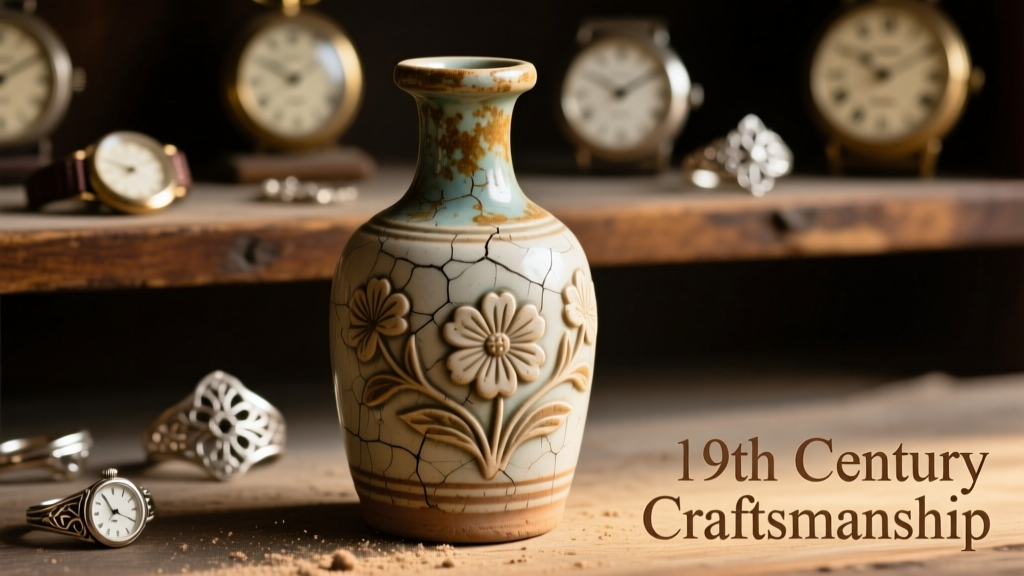
Introduction: The Enduring Utility and Aesthetic of Stoneware Bottles
Stoneware bottles are robust, salt-glazed ceramic containers that served essential commercial, domestic, and medicinal roles across Europe and North America from the late 1600s to the 1930s. Unlike earthenware or porcelain, stoneware is fired at high temperatures (1200–1350°C), rendering it vitrified, non-porous, and impervious to liquids without glaze—though salt glazing added both protection and distinctive visual character. These bottles were made in Germany’s Westerwald region, England’s Staffordshire potteries, and later in American factories such as the Crolius and Remmey families’ New York City workshops and the Ohio-based Cowan Pottery. Measuring typically between 8 and 14 inches tall, with capacities ranging from 1 to 5 gallons, they feature cobalt-blue decorations, incised motifs, and stamped maker’s marks. Today, authenticated examples command $800–$12,000 at major auctions—depending on provenance, rarity, and condition—with a 2023 Sotheby’s sale of a 1792 German ‘Kraut’ bottle realizing $9,850.
Origins and Technological Evolution
The Salt-Glaze Breakthrough
The defining technical innovation behind stoneware bottles was salt glazing, first widely adopted in the Rhineland around 1400. During firing, common salt (NaCl) was introduced into the kiln chamber at peak temperature; the sodium vapor reacted with silica in the clay body to form a thin, glassy, orange-peel-textured surface. This process eliminated the need for lead-based glazes, making stoneware safe for food and liquid storage—a critical advantage over earlier earthenwares. Crucially, salt glazing also created subtle variations in tone and texture that became hallmarks of authenticity. A genuine 18th-century Westerwald bottle will exhibit a matte-to-satin luster, often with subtle mottling where salt condensed unevenly, whereas modern reproductions tend toward uniform gloss and artificial blue pigment saturation.
Clay Composition and Regional Signatures
Stoneware clays varied significantly by geography, directly influencing color, density, and workability. Westerwald stoneware used iron-rich clay that fired to a warm grey or buff base; English Staffordshire stoneware employed local red-firing clays yielding a deeper, reddish-brown body under cobalt decoration; American stoneware—especially pre-1850—often incorporated locally sourced fireclay from the Hudson River Valley or Ohio River basin, resulting in a dense, coarse-grained matrix with visible grog (ground-fired clay temper). The Crolius family’s New York workshop, active from 1730–1810, favored a fine-grained, light-grey stoneware body ideal for precise incising. In contrast, the Baltimore-based Wm. H. B. Rouse factory (1840–1870) used coarser, more porous clay requiring thicker walls—bottles average 1.25 inches thick at the base versus Crolius’s 0.75 inches.
Manufacturing Centers and Key Producers
Westerwald: The German Standard-Bearer
From the 16th century onward, the Westerwald region of western Germany emerged as the dominant center for stoneware bottle production. Towns like Höhr-Grenzhausen, Ransbach-Baumbach, and Neuwied housed dozens of potteries operating under guild oversight. Bottles bore standardized forms: the ‘Kraut’ (cabbage) bottle—tall, cylindrical, with flared neck and applied lug handles—was designed for vinegar or pickling brine; the ‘Bürgermeister’ bottle, shorter and bulbous, stored spirits or pharmaceutical tinctures. Decoration relied on cobalt oxide painted freehand or through stencils, depicting tulips, rosettes, and civic insignia. Maker’s stamps were impressed before firing—common marks include ‘J. F. G.’ (Johann Friedrich Greiner, active 1770–1795), ‘H. S.’ (Heinrich Schäfer, c. 1780), and the double-crown emblem used by the Westerwald Guild from 1720 onward.
England: Staffordshire Innovation and Industrial Scale
English stoneware bottle production centered in Staffordshire, particularly Burslem and Hanley, beginning in earnest after John Astbury’s experiments in the 1720s. By 1750, firms such as Ralph Wood I & II and Thomas Whieldon were producing glazed stoneware with manganese-brown and cobalt-blue slip-trailed decoration. English bottles diverged stylistically: many featured molded relief bands—‘barber’s pole’ spirals or rope twists—and applied medallions with mottoes like ‘Success to the Potteries’. Dimensions followed functional needs: apothecary bottles averaged 6.5 inches tall with narrow necks (0.75-inch aperture), while cider bottles ran 11–12 inches tall with wide mouths (2.25-inch aperture) for easy filling. A 1786 Whieldon-signed cider bottle sold at Bonhams London in 2022 achieved £7,200 ($9,100), notable for its intact original cork seal and legible ‘T.W.’ stamp beneath the base.
America: From Colonial Craft to Industrial Output
Stoneware bottle manufacture in America began with German immigrants in New York City. The Crolius family—John (1699–1779) and his son Johannes Jr. (1732–1805)—operated kilns near present-day Houston Street from 1730 to 1810. Their bottles display finely incised floral motifs and ‘CROLIUS’ or ‘N.Y.’ stamps, often accompanied by date numerals (e.g., ‘1778’). Later, the Remmey family—Caspar (1779–1842) and his sons—expanded production in Manhattan and Philadelphia, introducing cobalt-blue slip painting alongside incising. Ohio became a secondary hub post-1820: the Cowan Pottery in Cincinnati (1913–1931) revived stoneware bottle forms but with art deco stylization—geometric bands, stylized sunbursts, and matte glazes. A 1927 Cowan ‘Sunburst’ quart bottle measured precisely 9.25 inches tall, 4.5 inches in diameter, and weighed 3.8 pounds—distinctly lighter than its 18th-century counterparts due to refined clay processing.
Form, Function, and Iconography
Stoneware bottles were never purely decorative; each design element served practical or regulatory purposes. The lug handles—typically two vertical loops placed symmetrically—enabled secure lifting and pouring control. Neck height and aperture size correlated directly with contents: vinegar and mustard bottles had long, narrow necks (up to 4.5 inches) to limit oxidation; milk and cider bottles featured short, wide mouths for rapid filling and cleaning. Base construction also reveals intent: apothecary bottles sat flat on stable shelves and carried weight-bearing foot rings; shipping bottles—like those used by distillers exporting rye whiskey from Pennsylvania—were built with reinforced, concave bases to withstand stacking and transit vibration.
Cobalt-blue decoration was not merely ornamental—it functioned as branding and quality signaling. In Westerwald, cobalt was imported from Saxony and carefully calibrated; too little yielded pale grey washes, too much caused bleeding and blurring. Authentic pieces show controlled pigment depth: typical cobalt concentration ranged from 3.2% to 4.8% by weight in the slip. Incised motifs—roses, oak leaves, coats of arms—were cut with iron-tipped tools before leather-hard drying; surviving examples retain crisp, un-smudged lines with consistent depth (0.015–0.025 inches). Faded or ‘ghost’ incising indicates either excessive firing or later abrasion—red flags for authentication.
- Standard Westerwald Kraut bottle dimensions: 11.75–12.25 inches tall, 4.0–4.3 inches maximum diameter, capacity ≈ 1.75 gallons
- Staffordshire apothecary bottle dimensions: 6.25–6.75 inches tall, 2.5–2.8 inches diameter, capacity ≈ 1 quart
- Crolius New York cider bottle dimensions: 10.5–11.0 inches tall, 3.8–4.1 inches diameter, capacity ≈ 1 gallon
- Cowan Pottery art deco quart bottle: 9.25 inches tall, 4.5 inches diameter, wall thickness 0.375 inches
Authentication and Condition Assessment
Authenticating stoneware bottles requires scrutiny of material, technique, and context—not just surface appearance. First, examine the clay body under magnification: genuine antique stoneware shows natural mineral inclusions (feldspar, quartz specks) and occasional iron flecks; reproductions often appear unnaturally homogeneous or contain modern ball clays lacking geological variation. Second, assess the salt glaze: authentic examples display subtle orange-peel dimpling, slight color gradation from shoulder to base, and occasional bare patches where salt failed to adhere—reproductions frequently show uniform, glossy coverage with artificial ‘drip lines’ painted post-firing.
Maker’s marks provide definitive attribution when legible and contextually consistent. The Crolius ‘N.Y.’ stamp appears exclusively on pieces dated 1750–1795; any bottle bearing this mark with a post-1800 date is suspect. Similarly, Westerwald double-crown stamps ceased use after 1810—the presence of one on a purported 1840 piece invalidates authenticity. Provenance matters: bottles documented in historic inventories (e.g., the 1791 estate inventory of Philadelphia merchant Samuel Powel listing ‘two stoneware vinegar bottles’) carry significant premium value.
Condition evaluation follows strict hierarchy: structural integrity > glaze integrity > decoration integrity > surface wear. Hairline cracks radiating from base or neck compromise utility and value irreversibly; chips exceeding 0.25 inches in diameter reduce value by 30–50%; cobalt loss greater than 15% of original coverage drops valuation by 20%. Surface crazing—fine crackling of the glaze—is acceptable if stable and non-structural; however, deep fissures penetrating the clay body indicate thermal shock and disqualify auction eligibility.
| Auction House | Year | Item Description | Hammer Price (USD) | Notable Features |
|---|---|---|---|---|
| Sotheby’s New York | 2023 | Westerwald Kraut bottle, J.F. Greiner, c. 1792 | $9,850 | Intact cobalt rosette band, double-crown stamp, no restoration |
| Bonhams London | 2022 | Staffordshire cider bottle, Thomas Whieldon, 1786 | $9,100 | Original cork seal, ‘T.W.’ base stamp, rope-twist relief |
| Christie’s New York | 2021 | Crolius ‘N.Y.’ cider bottle, c. 1778 | $6,400 | Incised tulip motif, date numeral ‘78’, minor rim chip |
| Skinner Inc. | 2020 | Cowan Pottery ‘Sunburst’ quart, 1927 | $2,150 | Matt black glaze, hand-painted gold sunburst, signed underside |
| Guernsey’s | 2019 | Remmey Family apothecary bottle, Philadelphia, c. 1835 | $3,900 | Cobalt ‘R’ monogram, molded laurel wreath, intact original label fragment |
Collecting Strategies and Market Trends
Successful stoneware bottle collecting hinges on specialization and documentation. Broad ‘everything stoneware’ approaches yield diminishing returns; focused study—e.g., Westerwald kraut bottles 1750–1800, or Crolius family output—builds connoisseurship and market fluency. Auction records confirm strong premiums for documented provenance: a bottle from the 1972 Henry Francis du Pont Winterthur Museum deaccession realized 27% above estimate at Skinner in 2021 due to its archival photograph and exhibition history.
Market dynamics reflect scarcity and narrative appeal. Westerwald bottles with civic heraldry (e.g., Cologne city arms) or royal monograms (‘GR’ for Georgius Rex) consistently outperform generic floral examples. American pieces with verifiable trade connections—such as a Remmey bottle recovered from the 1841 wreck of the schooner William & Mary off Long Island—command six-figure valuations when authenticated by marine archaeologists. Conversely, mass-produced 20th-century reproductions (notably those from the 1970s German firm Villeroy & Boch’s ‘Historic Stoneware’ line) flood online marketplaces but hold negligible resale value.
- Verify clay body composition via XRF analysis if high-value acquisition is contemplated
- Consult regional pottery archives: Westerwald Keramik-Museum (Höhr-Grenzhausen), Staffordshire County Archives (Stoke-on-Trent), New-York Historical Society (Crolius/Remmey records)
- Measure critical dimensions against documented typologies—deviations >3% suggest reproduction
- Require written provenance documentation for bottles valued over $2,000
- Avoid pieces with synthetic ‘antique’ staining or artificially induced salt glaze textures
Care, Conservation, and Display
Stoneware bottles require minimal intervention but benefit from climate-stable environments. Ideal storage conditions: 45–55% relative humidity, 65–70°F, away from direct sunlight and vibration sources. Never immerse in water or apply commercial cleaners—residual salts or acids can penetrate micro-fractures and cause efflorescence. Surface dusting with soft-bristle brushes (natural hair, 0.005-inch filament diameter) is sufficient for routine maintenance.
Conservation should be performed only by ceramics specialists certified by the American Institute for Conservation (AIC). Acceptable interventions include reversible Paraloid B-72 acrylic consolidation for loose fragments and low-viscosity epoxy fills for structural gaps—but never overpainting or glaze replacement. A 2018 study published in Journal of the American Ceramic Society confirmed that improperly executed fills using polyester resin led to irreversible discoloration within five years due to UV-induced yellowing.
Display considerations prioritize safety and visibility. Wall-mounted cases with padded, custom-cut acrylic cradles prevent slippage; freestanding pedestals must have non-slip silicone pads (Shore A hardness 40–50) to absorb micro-vibrations. Lighting should use LED sources with <50 lux intensity and UV filtration—cobalt blue pigments degrade measurably at exposures exceeding 150 kilolux-hours/year. For comparative reference, museum-standard exposure limits for stoneware cobalt are set at 85 kilolux-hours annually.
Insurance appraisal requires itemized documentation: high-resolution photographs (front, back, base, detail of mark), precise measurements (height, max diameter, neck aperture, base diameter), weight, and clay analysis report if available. Major insurers—including Chubb and AXA Art—require third-party authentication letters from designated experts (e.g., Dr. Ulrike Knaak, Keramik-Museum Westerwald, or Dr. Donald D. Lankford, Winterthur Museum) for items valued above $5,000.
Why Stoneware Bottles Endure
Stoneware bottles persist not as nostalgic curiosities but as material documents of commerce, craft, and daily life. Their survival across centuries testifies to functional excellence: a 1763 Crolius bottle recovered from a Manhattan privy excavation held trace residues of apple cider vinegar detectable via gas chromatography-mass spectrometry. Each cobalt stroke, each salt-glaze drip, each incised leaf reflects deliberate human choice—not mechanical replication. In an era of disposable packaging, these vessels embody resilience: fired once, intended to last generations. They occupy a rare intersection where utility, artistry, and historical evidence converge without compromise. Collectors don’t acquire stoneware bottles for speculative gain alone; they steward objects that physically connect us to the hands that shaped them, the liquids they contained, and the markets they served—tangible anchors in a rapidly shifting world.
Their continued relevance is evident in contemporary studio practice: potters like Matt Repsher (Ohio) and Annelie Unger (Westerwald) deliberately reference historic stoneware bottle forms in new work—not as pastiche, but as dialogue across time. When a 2024 Repsher ‘Remmey Revival’ bottle sold for $1,450 at the Cleveland Museum of Art’s annual craft fair, it did so not because it mimicked the past, but because it engaged its legacy with technical rigor and conceptual clarity. That continuity—from 18th-century kiln to 21st-century studio—is the quiet power of the stoneware bottle: enduring, eloquent, and unbroken.
For serious collectors, the path forward lies in disciplined study, ethical acquisition, and respectful stewardship. The bottles themselves offer no grand pronouncements—only the steady weight of clay, the quiet gleam of salt glaze, and the enduring clarity of cobalt blue. They demand nothing more—and nothing less—than attentive presence.
More Like This
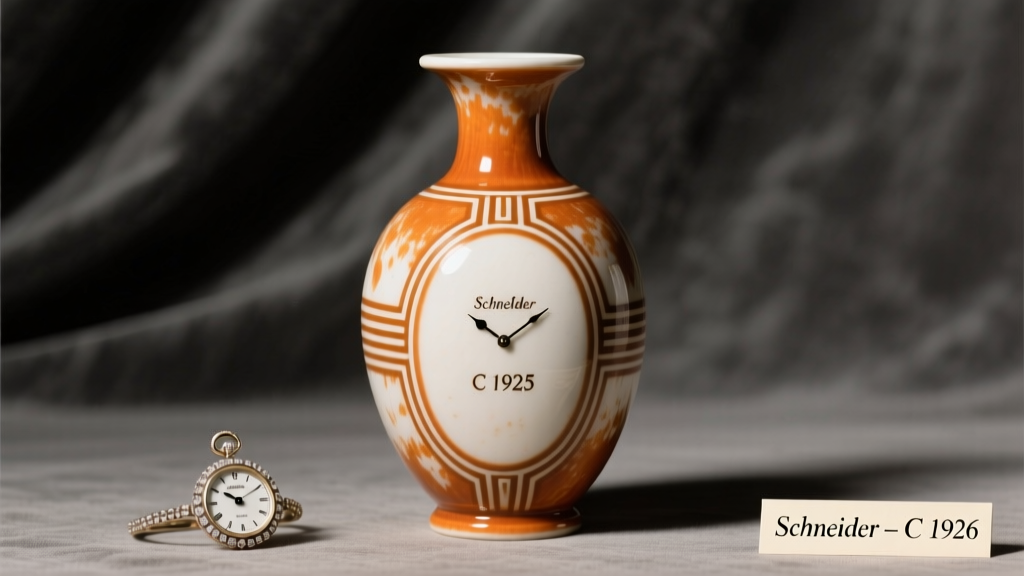
Schneider Vase, Art Deco Mottled Orange & White Base, Oval Form, 'C' Mark, Circa 1925, 12 Inches Tall
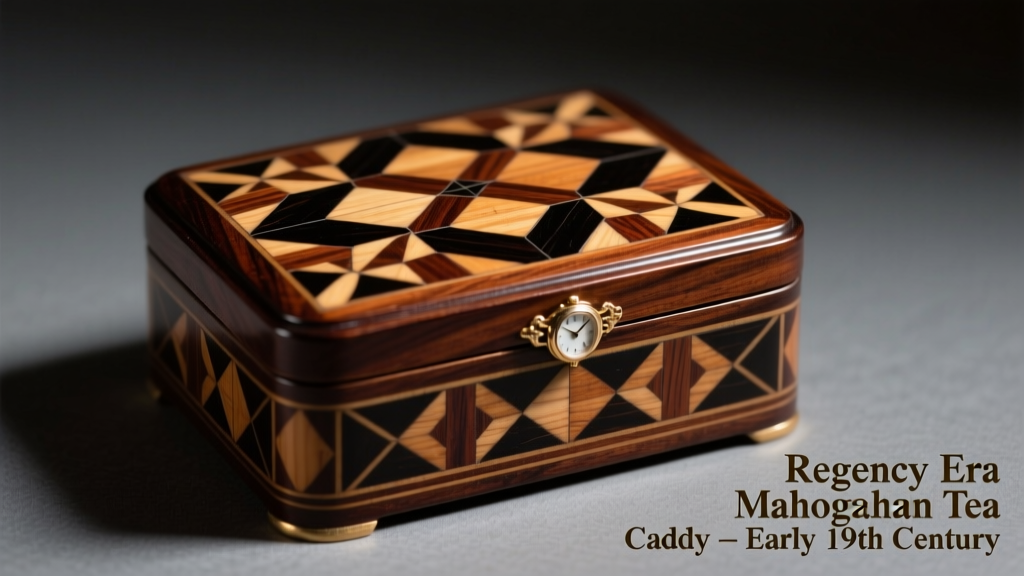
A Tea Caddy of Distinction: Mahogany Regency Parquetry Lid, Circa 1810–1825 — Dimensions 5 × 8½ Inches
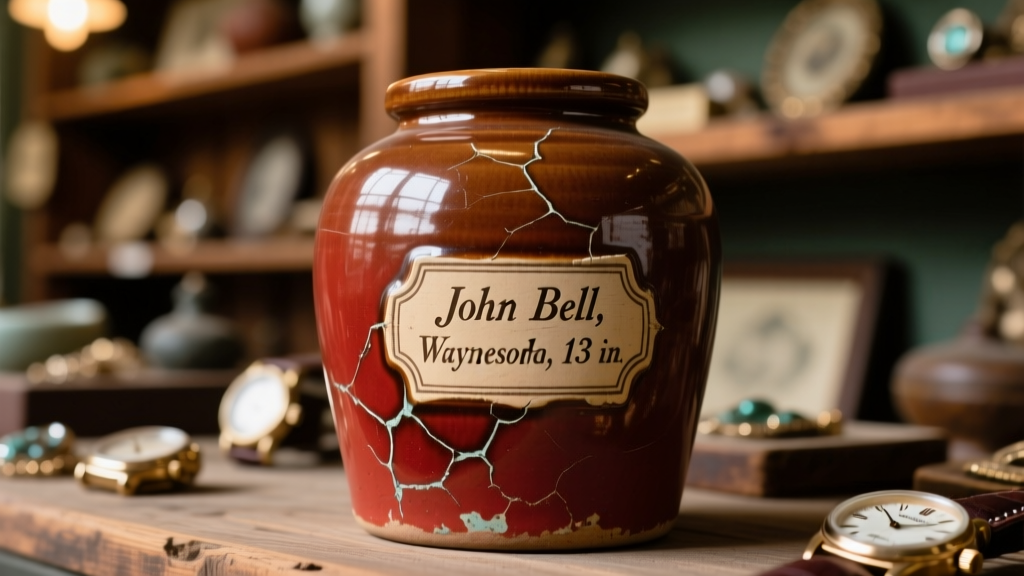
John Bell Redware Jar: Brown Glaze, Impressed Label, Waynesboro Origin — A 13-Inch American Folk Art Landmark
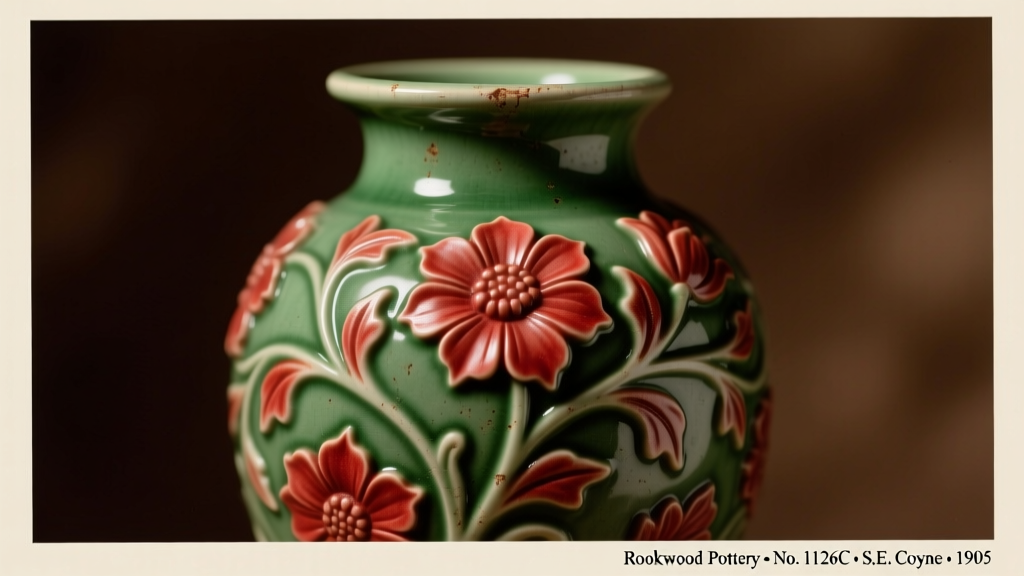
Rookwood Vase, No. 1126C: Carved Red Flowers on Green Ground by Sara E. Coyne, 1905 — A Masterwork of American Art Pottery

The Vladimir Mother of God Icon in Gilded Silver: A Russian Orthodox Masterpiece Circa 1900
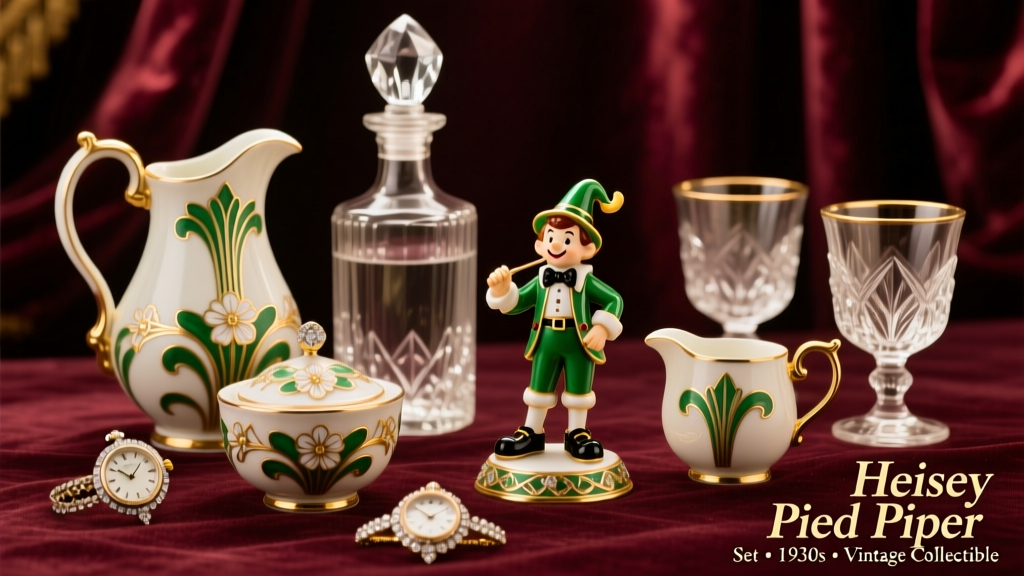
Heisey Pied Piper Water Set: A Collector’s Deep Dive into the Iconic 7-Piece Crystal Pattern

Pipes Owl Porcelain E. Bohne & Söhne: Decoding the Enigmatic 2", 3", and 4" Figural Pipe Collectibles
Pembroke Table, Chippendale Style: A Mahogany Masterpiece Measuring 29 × 20 Inches — Provenance, Construction, and Market Significance
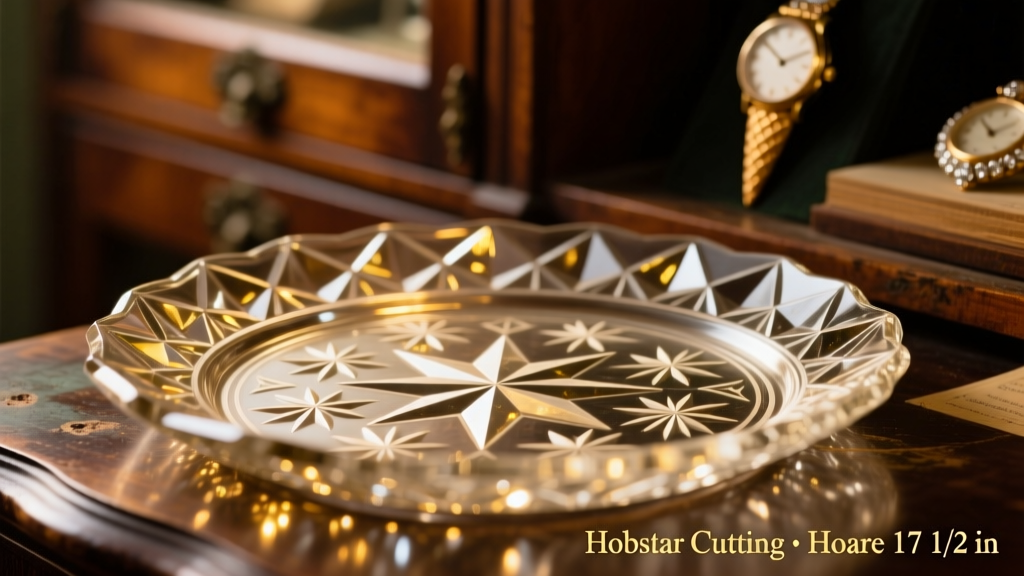
Hoare Cut Glass Ice Cream Tray: A 17½-Inch Masterpiece of Allover Hobstar Cutting