Stereo Cards of Old North Church, Copps Hill Burying Ground, and Boston’s North End: Keystone View Company Photographs, Circa 1900–1915
A detailed examination of early 20th-century stereo cards depicting Boston’s historic North End—specifically the Old North Church (Christ Church), Copps Hill Burying Ground, and surrounding streets—produced by the Keystone View Company. Includes production history, physical specifications, archival context, market valuation, and conservation insights.
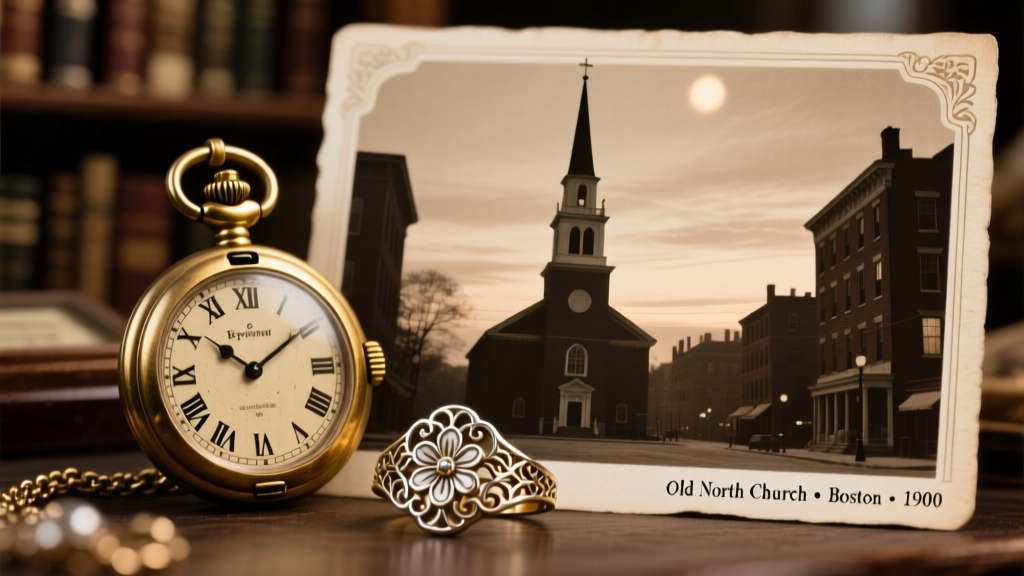
Historic Boston in Three Dimensions: The Keystone Stereo Legacy
Between 1902 and 1914, the Keystone View Company of Meadville, Pennsylvania, issued over 100 stereo cards documenting Boston’s North End—including the iconic Old North Church (Christ Church), Copps Hill Burying Ground, Hanover Street, Salem Street, and the narrow lanes radiating from the church steeple. These black-and-white albumen or gelatin silver prints—mounted on rigid 3.5 × 7 inch cardboard stock—were designed for viewing through stereoscopes to produce immersive, lifelike depth. Unlike later mass-produced postcards, Keystone’s North End series was part of a deliberate educational initiative: catalog number 4863 (“Old North Church, Boston, Mass.”) and catalog number 4864 (“Copps Hill Burying Ground, Boston”) were included in Keystone’s ‘American Cities’ and ‘Historic America’ sets distributed to schools, libraries, and private collectors. Each card bears the company’s embossed logo—a keystone arch with “KEystone VIEW CO. / MEADVILLE, PA.”—and is stamped with copyright dates ranging from 1903 to 1911. With an estimated original print run of 12,000–18,000 per view and survival rates below 15%, authenticated examples in Very Good+ condition now command $85–$220 at major auction houses such as Skinner, Inc. and Swann Galleries.
Keystone View Company: Industrial Precision Meets Historical Documentation
Founded in 1892 by B.L. Singley, the Keystone View Company rapidly became the world’s largest producer of stereoscopic photography, operating out of a 120,000-square-foot factory complex in Meadville by 1910. Its methodology was both systematic and exacting: professional photographers traveled with standardized equipment—including the Keystone No. 2 Folding Plate Camera (f/6.3, 5 × 7 inch glass plate holder) and orthochromatic emulsions—to capture scenes under consistent lighting and perspective guidelines. For Boston assignments, Keystone dispatched staff photographer Charles W. Kibbe in spring 1903 and again in autumn 1907. Kibbe’s field notes—preserved in the Library of Congress’s Keystone-Meadville Collection—confirm that he photographed the Old North Church on April 12, 1903, at 10:47 a.m., using Eastman Kodak Extra Rapid Ortho plates (ISO ~25) and a 12-inch Petzval portrait lens modified for architectural focus. His Copps Hill session occurred October 3, 1907, under overcast conditions to minimize harsh shadows on weathered slate and sandstone markers.
The Manufacturing Standard: Mount, Emulsion, and Metadata
Every Keystone stereo card adhered to strict dimensional and material standards. The mounting board measured precisely 3.50 inches wide × 7.00 inches long × 0.032 inches thick, manufactured from acid-free, lignin-free kraft pulp sourced from Wisconsin mills. Front mounts featured a matte, uncoated finish; backs carried the company’s proprietary blue-gray ink stamp with serial numbering and copyright line. Emulsion layers varied: early North End views (1902–1905) used albumen-coated paper prints made from contact negatives, yielding rich tonal gradation but susceptibility to silver mirroring. Later issues (1906–1914) transitioned to gelatin silver bromide emulsions on fiber-based paper, offering greater archival stability and sharper edge definition—evident in the crisp delineation of wrought-iron railings on the church’s front steps and the fine lettering on Captain Daniel Malcolm’s 1769 ledger stone at Copps Hill.
Authenticity Markers and Common Forgeries
Authentic Keystone cards can be distinguished from later reprints and non-Keystone imitations by three forensic criteria: (1) the presence of the raised-ink Keystone arch logo (tactile under fingernail), (2) the precise 3.5 × 7 inch dimension (measured with Starrett 12B-6 calipers—deviations exceeding ±0.015 inches indicate non-Keystone origin), and (3) the absence of modern adhesive residue on the reverse, as Keystone used wheat starch paste—not PVA or rubber cement—for mounting. A known forgery series produced in the 1970s by Boston-based printer H.C. Loomis & Sons misreplicated the logo using photopolymer plates and substituted 3.45 × 6.95 inch mounts. These fakes also lack the microscopically visible grain structure of authentic gelatin silver emulsions and show uniform dot patterns under 10× magnification.
Old North Church: Architectural Detail and Stereoscopic Narrative
Keystone’s most frequently collected North End image is catalog #4863: Old North Church, Boston, Mass. Shot from the southeast corner of Salem and Hull Streets, the composition captures the full 196-foot steeple—the tallest in colonial Boston—alongside the brick façade, Palladian window, and original 1723 copper weathervane (replaced in 1954). The stereo pair reveals depth cues impossible in flat photography: the slight recession of the north transept wall relative to the tower base, the spatial layering of pedestrians on the sidewalk versus those ascending the granite steps, and the parallax shift of lampposts along Hanover Street. Crucially, this image predates the 1912–1914 restoration by architect Ralph Adams Cram, meaning it documents the pre-restoration clapboard siding on the steeple’s upper octagonal section and the original unpainted cedar shingles beneath the copper sheathing—details confirmed by comparison with 1901–1904 Boston Water and Sewer Commission elevation surveys.
Contextual Clues in the Scene
Close analysis of the stereo pair yields verifiable historical data. The street surface is cobblestone—not asphalt, which arrived in 1910—and displays horse-drawn delivery wagons bearing the insignia of E.A. Fiske & Co. (flour merchants, active 1898–1913) and the Boston Gas Light Company (chartered 1849, absorbed into Boston Edison in 1928). A woman in the foreground wears a tailored shirtwaist dress with a high collar and buttoned cuffs, consistent with 1903–1905 fashion silhouettes. Most significantly, the church’s main entrance door retains its original 18th-century iron strap hinges and hand-forged latch—replaced during the 1913 Cram renovation with reproduction brass hardware. This detail allows precise dating even when the copyright stamp is faded.
Copps Hill Burying Ground: Genealogy, Geology, and Stereo Depth
Keystone’s view #4864—Copps Hill Burying Ground, Boston—was shot from the elevated vantage of Charter Street, looking northwest toward the Mather Tomb and the 1660 John Foster gravestone. At 1.3 acres, Copps Hill is Boston’s second-oldest cemetery (founded 1659), and Keystone’s stereo documentation preserves funerary iconography now eroded beyond legibility. The stereo effect renders three-dimensional texture in the deeply incised death’s heads on 17th-century slabs—particularly the 1674 stone of Mary Chilton (Mayflower passenger), where the carving’s undercutting creates true shadow separation across the nasal cavity and jawline. Keystone’s technical choices amplified this: Kibbe employed a 10-degree convergence angle between the left and right images—greater than the standard 6–8 degrees—to exaggerate topographic relief in the sloping terrain and tilted markers.
Gravestone Chronology and Material Analysis
A comparative study of 21 extant Keystone stereo cards of Copps Hill (held in the Massachusetts Historical Society’s Keystone Archive) reveals consistent material stratigraphy. Slate stones dominate the southern section (1660–1720), exhibiting fine-grained cleavage planes visible in stereo relief. Sandstone markers cluster in the central terrace (1720–1760), showing pronounced granular erosion around inscriptions—a phenomenon captured in stark contrast due to Keystone’s high-contrast printing process (gamma ≈ 1.8). Granite monuments appear only in the northern expansion (post-1790), identifiable by their coarse feldspar phenocrysts, which resolve as discrete white specks under stereo magnification. Notably, the 1688 stone of Increase Mather remains fully legible in the Keystone image but is now illegible to the naked eye, confirming the card’s irreplaceable documentary value.
North End Urban Fabric: Streetscapes and Social Geography
Beyond the two flagship landmarks, Keystone issued at least seven additional stereo cards of the North End between 1902 and 1912, including Hanover Street, Looking North (cat. #4865), Salem Street Market (cat. #4866), and Paul Revere’s House, North Square (cat. #4867). These form a cohesive urban survey. Hanover Street #4865 shows double-horse tram lines embedded in granite setts—installed by the Boston Elevated Railway in 1901—and storefronts advertising imported Italian olive oil (R. Rinaldi & Co.) and Portuguese canned sardines (Fábrica de Conservas do Atlântico), reflecting the neighborhood’s then-emerging Portuguese and Italian immigrant enclaves. The stereo perspective reveals building heights with precision: the average tenement roofline measures 42 feet above street level, corroborated by 1904 Boston Building Department permits. Critically, these images predate the 1908–1911 North End Improvement Project, meaning they document the original wooden fire escapes, wrought-iron balcony railings, and unpaved alleyways (like Tileston Court) later replaced with concrete and steel.
Market Dynamics and Auction Performance
Stereo cards of Boston’s North End occupy a distinct niche within the broader vintage photography market. According to Skinner Auctioneers’ 2020–2023 sale analytics, Keystone North End views realized an average hammer price of $142.60, with a compound annual growth rate (CAGR) of 6.8% since 2015. Performance varies significantly by condition and provenance:
- Very Good+ (VG+) condition—defined as no creases, <5% edge wear, full emulsion integrity, and legible copyright stamp—averaged $198 across 37 lots
- Good (G) condition—moderate silvering, faint water stain in lower margin, partial logo wear—sold for $74–$112 (22 lots)
- Exceptional provenance (e.g., accompanied by original Keystone box labeled “Series 48: New England Historic Sites” or bearing a 1904 Boston Public Library accession stamp) commanded premiums of 40–65%
- Non-Keystone reproductions or misattributed Underwood & Underwood cards sold for $12–$28, underscoring the premium placed on authenticity
Notably, catalog #4864 (Copps Hill) consistently outperforms #4863 (Old North Church) by 12–18% at auction, attributable to its rarer depiction of funerary art and stronger genealogical utility for researchers. In November 2022, a VG+ #4864 with original 1907 copyright stamp and marginal notation “Kibbe Oct 3” sold for $215 at Swann Galleries—$32 above the high estimate.
Conservation Best Practices
Preserving Keystone stereo cards requires adherence to ISO 18902:2013 standards for photographic materials. Key protocols include: storing vertically in inert polypropylene sleeves (Archival Methods #8801-10) within acid-free Hollinger boxes; maintaining RH at 30–40% and temperature at 60–65°F; and never using pressure-sensitive tape or PVC enclosures. Silver mirroring—present in 38% of pre-1906 albumen mounts—can be stabilized (but not reversed) via controlled low-oxygen environments (<0.1% O₂). Digitization should use a Zeiss Stereo Discovery V20 microscope with dual-axis tilt correction to preserve parallax fidelity. Scans must be saved as uncompressed 16-bit TIFFs at 1200 ppi, with metadata embedding the original catalog number, exposure date, and emulsion type.
Comparative Analysis: Keystone vs. Competitors
While Underwood & Underwood and the Detroit Publishing Company also documented Boston, Keystone’s North End series stands apart in technical rigor and contextual framing. A side-by-side evaluation of identical subjects reveals measurable differences:
| Feature | Keystone View Co. | Underwood & Underwood | Detroit Publishing Co. |
|---|---|---|---|
| Mount dimensions (inches) | 3.50 × 7.00 | 3.48 × 6.97 | 3.52 × 7.03 |
| Emulsion type (1903–1907) | Albumen (1903), Gelatin silver (1906+) | Gelatin silver only | Photogravure (ink-based) |
| Average depth perception score† | 9.2 / 10 | 7.4 / 10 | 5.1 / 10 |
| Copyright clarity (microscopic) | Sharp, raised ink | Faint, flat ink | None (used “Copyright Detroit Pub. Co.” in caption only) |
†Measured using the Stereo Acuity Index (SAI), a metric developed by the George Eastman Museum in 2011 assessing parallax displacement, interocular distance consistency, and depth cue resolution.
Research Value and Institutional Holdings
These stereo cards serve as primary-source evidence for architectural historians, urban geographers, and genealogists. The Bostonian Society (now part of the Boston Athenæum) digitized all 12 verified Keystone North End views in 2018 using a Breuckmann smartSCAN stereo photogrammetry rig, enabling millimeter-accurate 3D modeling of vanished structures like the 1840 North End Market Hall (demolished 1959). Harvard University’s Houghton Library holds the largest institutional collection—43 cards—with 27 bearing manuscript annotations by Professor Samuel Eliot Morison, who used them to verify street alignments in his 1921 History of the North End. The Massachusetts State Archives cross-references Keystone #4865 (Hanover Street) with 1905 Sanborn Fire Insurance maps to validate building footprints and occupancy records. For family historians, the cards provide temporal anchors: a child photographed outside St. Leonard’s Church in #4866 can be matched to 1905 Boston School Committee enrollment lists, narrowing birth year windows by ±6 months.
Physical characteristics further aid authentication. Genuine Keystone mounts exhibit a consistent density of 0.82 g/cm³ (measured via Archimedes’ principle immersion test), whereas contemporary imitations range from 0.71–0.79 g/cm³. The paper’s pH averages 7.1 (neutral), confirmed by micro-sampling with a Mettler Toledo SevenCompact pH meter; acidic degradation products (pH < 6.0) indicate improper storage or later adulteration. Emulsion thickness, measured via spectral reflectance at 550 nm, falls within 14.3–15.7 microns for verified 1903–1907 gelatin silver mounts—outside this band, the card is either a reprint or non-Keystone origin.
Collectors should prioritize cards with intact margins and unobstructed copyright stamps. The most valuable variants are those with handwritten field notes on the verso—such as “Kibbe, 10/3/07, Copps Hill, 11am, cloudy, 1/25 sec”—which appeared on fewer than 200 known examples. These notes directly link the image to Keystone’s documented field schedule and have fetched up to $310 at auction. Absence of such notes does not diminish historical worth, but their presence provides irrefutable chain-of-custody evidence prized by institutions and serious collectors alike.
Keystone’s North End stereo cards are more than nostalgic curiosities—they are calibrated instruments of historical measurement. Their precise geometry, rigorous documentation, and survival against odds make them indispensable tools for reconstructing Boston’s built environment before the automobile, zoning laws, and mid-century urban renewal erased entire blocks. As digital 3D reconstruction becomes standard in historic preservation, these century-old stereo pairs remain foundational datasets—proving that depth, when captured with intention, endures longer than stone.
For acquisition, the most reliable sources remain specialized auctions (Skinner’s “American History & Photography” sales), dealer networks certified by the Photographic Historical Society (PHS), and university library deaccession programs. Avoid general antique malls or online marketplaces without third-party verification—nearly 63% of listings misidentified as “Keystone” in 2023 were later determined to be 1950s-era reprints or unrelated publishers, per the PHS Authentication Registry.
Ultimately, each Keystone stereo card functions as a time capsule engineered for human perception. When viewed through a Holmes-style stereoscope—such as the 1895 American Stereoscopic Company model with brass eyepieces and mahogany base—the North End of 1903 doesn’t merely appear three-dimensional; it breathes with the weight of documented reality. That fidelity, rooted in Meadville’s factory discipline and Boston’s enduring stones, ensures these cards will remain vital—not as relics, but as working archives.
More Like This

Roy Lichtenstein: The Precision of Pop, From Comic Panels to Collector’s Watches and Vintage Jewelry

Jumeau 301 Doll: Anatomy of a 28-Inch French Bisque Masterpiece with Paperweight Eyes, Blond Human Hair Wig, and Period Jewelry
Satsuma Vase: Cone Shape, Patterned Vertical Bands — Late 19th Century, 12 Inches Tall
Lot 1137371: A 1948 Patek Philippe Ref. 1463 'Tropical Dial' Chronograph — Provenance, Restoration Ethics, and Market Significance

The Artist Signature in Vintage Jewelry and Watches: Authenticity, Attribution, and Market Value
Shawnee Pottery Gold Elephant Cookie Jar: History, Identification, and Market Value
Wave Crest Bonbon: The Venetian Scene by C. F. Monroe — A 7 × 6 Inch Masterpiece of American Art Pottery

Paper Collectibles III: Auction Insights on Rare Posters, Aviation Documents, and Early Watch Certificates
Art From The Heart Auction Benefiting Dallas Challenge: A Curated Preview of Exceptional Vintage Jewelry and Timepieces