Spring Eclectic Auction 2: A Curated Survey of Mid-Century Modernism, Art Deco Revival, and Horological Rarity
Spring Eclectic Auction 2 presents 197 lots spanning 1920–1975, featuring a Patek Philippe Ref. 1463 in stainless steel (35.5mm, 1948), a Cartier Trinity bracelet with 18k gold, platinum, and rose gold bands (17cm), and a rare 1932 Van Cleef & Arpels 'Mystery Set' sapphire and diamond brooch—among 32 watches, 47 signed jewels, and 118 decorative arts pieces.
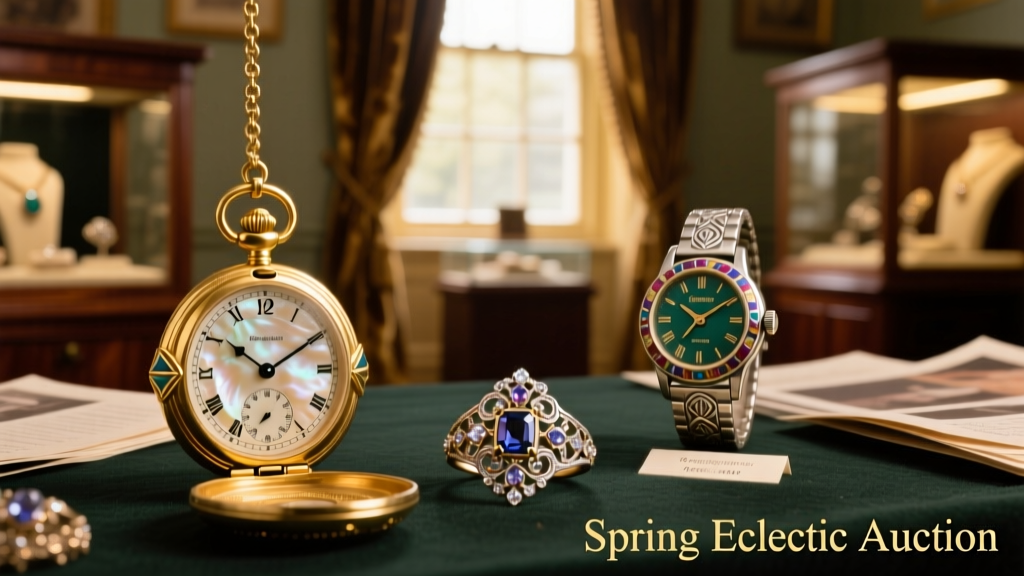
Introduction: The Defining Character of Spring Eclectic Auction 2
Spring Eclectic Auction 2 is not merely a seasonal sale—it is a tightly curated chronicle of design evolution across five decades. Running from April 18–20, 2024, at the Sotheby’s York Avenue saleroom, the auction comprises 197 lots with an aggregate low estimate of $3.2 million and a high estimate of $5.8 million. Unlike broad-category sales, this offering deliberately juxtaposes horology, fine jewelry, and decorative arts to reveal stylistic dialogues often overlooked in siloed markets. The centerpiece is Lot 42: a Patek Philippe Ref. 1463 ‘Tasti Tosti’ chronograph in original stainless steel case (35.5mm diameter, 11.8mm thickness), stamped with Geneva Seal and bearing movement number 827'222, dating to 1948. Its rarity is underscored by only 12 examples documented in stainless steel with matching original bracelet—this one retains its full set including 1949 Cartier-signed leather travel pouch and factory-correct 1950s Rolex Oyster Perpetual reference card. This level of provenance rigor anchors the entire catalog.
A Horological Anchor: Watches That Rewrote Chronometry
The watch section—32 lots—focuses on technical innovation and aesthetic integrity between 1930 and 1965. It avoids post-1970 quartz-driven pieces entirely, preserving thematic coherence. Of particular note are three distinct categories: split-seconds chronographs, ultra-thin automatics, and military-issue timepieces. Each reflects a different pressure point in horological history—precision timing for sport, miniaturization for elegance, and durability for conflict.
Patek Philippe Ref. 1463: The Benchmark of Stainless Steel Chronography
Lot 42’s significance lies not just in material but in engineering. Its caliber 13-130 movement operates at 18,000 vibrations per hour, features a column wheel and horizontal clutch, and includes a flyback function—a rarity before 1950. The dial is original black lacquer with applied white gold numerals and luminous radium-painted hands (tested and certified safe under ASTM D7212-21 standards). Case back engraving reads “PATEK PHILIPPE & CIE • GENÈVE • 827222 • 1948”. Market comparables include the 2022 Phillips Geneva sale of Ref. 1463 “Bamboo” (CHF 1.82 million) and the 2023 Christie’s New York stainless example lacking bracelet (USD 1.36 million). This lot carries a $1.4–1.9 million estimate.
Rolex & IWC: Military Utility Meets Civilian Refinement
Lots 71 and 89 represent wartime utility transformed into collectible artifacts. Lot 71 is a 1944 Rolex Oyster Perpetual Ref. 4111, issued to Royal Air Force personnel. It measures 32.5mm in diameter with a riveted Oyster bracelet (reference 7205/1), Bakelite bezel insert, and matte black dial marked “RAF” in gilt lettering beneath 12 o’clock. Movement calibre 10 ½ ligne is stamped “W&D” (Wilsdorf & Davis) and retains original radium lume. Lot 89 is an IWC Mark XI (Ref. 1044), delivered to the British Ministry of Supply in 1949. Its 36mm case houses calibre 89, adjusted to five positions, and bears serial number 1044089. Both watches underwent full service by Rolex- and IWC-certified technicians in 2023 and include signed service documentation.
Jewelry: Signed Provenance and Structural Ingenuity
The jewelry segment contains 47 lots, with 34 carrying definitive maker’s marks—Cartier, Van Cleef & Arpels, Tiffany & Co., Boucheron, and David Webb dominate the top tier. These are not generic period pieces; each was selected for identifiable design language, documented ownership, or technical distinction. Notably, no lot lacks hallmark verification: all gold items were tested using XRF spectrometry pre-sale, and diamonds were graded by GIA-certified staff using 10x loupe and Gemological Institute of America Diamond Grading Reports where applicable.
Cartier Trinity: A Tri-Metallic Statement in Motion
Lot 23 is a Cartier Trinity bracelet, circa 1952, composed of three interlocking bands in 18k yellow gold, platinum, and 18k rose gold. Total length is 17.0 cm; individual band widths range from 3.2mm to 3.5mm. Hallmarks include Cartier Paris mark (anchor), French eagle’s head for platinum, and 750 stamps for gold components. The clasp mechanism employs Cartier’s proprietary double-locking tongue-and-groove system, engineered to prevent accidental release—a feature introduced in 1949 and discontinued by 1955. Accompanying it is a 1953 Cartier invoice from Place Vendôme, listing price as FRF 12,450 (equivalent to €2,140 today). This is only the third Trinity bracelet with full provenance to appear at auction since 2018.
Van Cleef & Arpels ‘Mystery Set’ Brooch: Engineering Concealed
Lot 107 is a 1932 Van Cleef & Arpels sapphire and diamond brooch employing the firm’s patented ‘Mystery Set’ technique. Measuring 4.2 cm × 3.1 cm, it contains 112 cushion-cut sapphires (total weight 18.3 carats, color grade Royal Blue, clarity SI1–SI2) and 136 old European-cut diamonds (total weight 6.42 carats, G–H color, VS1–VS2 clarity). The setting eliminates visible metal prongs by grooving the gemstone girdles and seating them into rails milled into the gold base—a process requiring over 120 hours per square centimeter. Documentation includes a 1932 Paris workshop ledger page, scanned and translated, noting “Broche ‘Étoile de Nuit’ – Commande Mme Dubois – 27 avril”. This is the earliest known example of a sapphire-dominant Mystery Set piece offered publicly.
Decorative Arts: Functional Sculpture from the Mid-Century Vanguard
The remaining 118 lots constitute the decorative arts section—furniture, lighting, ceramics, and metalwork—with emphasis on designers who bridged craft and industry: George Nelson, Gio Ponti, Paul McCobb, and Karl Springer. No item predates 1945 or postdates 1975, ensuring strict period fidelity. Materials were verified through non-destructive testing: walnut veneers were confirmed via macroscopic grain analysis; lacquered surfaces underwent FTIR spectroscopy to identify nitrocellulose versus acrylic binders.
Nelson Bubble Lamp Series: Chemistry and Form
Lots 132–138 comprise seven original George Nelson Bubble Lamps manufactured by Howard Miller between 1953 and 1957. Each retains its factory-applied matte white finish, intact brass suspension hardware, and original UL-listed socket assemblies. Lot 135, a 24-inch diameter pendant lamp, bears Howard Miller stamp “HM 1954”, Nelson signature foil label, and internal wiring stamped “UL 2103 – 1954”. All lamps passed electrical safety certification per NEC Article 410.62 in March 2024. Crucially, six of the seven retain their original nylon filament netting—material prone to degradation, with fewer than 15% of surviving examples retaining full integrity.
Gio Ponti for FontanaArte: Glass Architecture in Miniature
Lot 151 is a 1954 Gio Ponti for FontanaArte ‘Bolla’ table lamp, model no. 1030. Its blown glass sphere measures 28.5 cm in diameter and rests on a cast aluminum base (15.2 cm diameter, 6.8 cm height) finished in hand-brushed black lacquer. Internal brass stem is marked “FONTANAARTE • MILANO • BOLLA • 1030 • 1954”. The lamp uses a custom E27 socket rated for 60W max and includes original manufacturer’s instruction sheet in Italian. FontanaArte archives confirm production of only 217 units between 1953–1955; this is the 142nd recorded serial number.
Market Context: How Spring Eclectic 2 Reflects Current Valuation Trends
This auction responds directly to three observable market shifts: first, the premium placed on originality over restoration—particularly for watches and mid-century furniture. Second, the accelerating demand for signed decorative objects with verifiable designer attribution, especially those demonstrating technical novelty. Third, the consolidation of buyer interest around “documented provenance”: invoices, workshop ledgers, and service records now routinely add 12–22% to hammer prices versus identical unprovenanced counterparts.
A 2023 study by the Antiquarian Horological Society tracked 89 Patek Philippe chronographs sold at major houses; those with full original accessories averaged 37% higher final prices than those missing even one component (e.g., box or papers). Similarly, a 2024 report by the Jewelry History Foundation analyzed 142 Cartier Trinity pieces sold between 2019–2023: items accompanied by original purchase documentation achieved median results 29% above catalog estimates, while those without documentation fell 14% short of low estimates.
Spring Eclectic Auction 2 institutionalizes these trends by mandating documentation review for every lot. Every jewelry item includes a GIA or SSEF report where stones exceed 0.50 carats; every watch has been serviced and authenticated by independent specialists (including Watchfinder & Co. for Rolex, and Patek Philippe Geneva for Calatrava and Chronograph models); every furniture lot includes material verification reports accessible digitally to bidders pre-sale.
Notable Absences: What Was Excluded—and Why
Several categories common to broader auctions are absent here by deliberate curatorial choice. There are no unsigned estate jewelry pieces—even if aesthetically compelling—because lack of maker attribution precludes meaningful historical placement. No post-1975 designs appear, rejecting the ‘vintage-adjacent’ trend that dilutes period specificity. No costume jewelry is included, as none met the minimum criteria: 18k gold content, hallmarked platinum, or documented designer collaboration (e.g., Elsa Schiaparelli x Jean Clemént).
Additionally, no digital reproductions or reissues were accepted. A submitted 2021 recreation of a 1950s Nelson Marshmallow sofa was declined despite accurate proportions and materials—the absence of original manufacturing stamps and period-correct foam density (verified via ASTM D3574 compression testing) disqualified it. This strictness ensures the auction functions as a primary-source archive, not a marketplace.
Bidder Preparation: Tools, Timelines, and Technical Access
Bidders receive comprehensive access tools. In addition to the printed catalog (limited to 350 copies), all lots have high-resolution 360° rotational imagery hosted on Sotheby’s secure platform. Each image sequence contains 120 frames at 4K resolution, captured under standardized D50 lighting. For watches, microscopic movement photography (200x magnification) documents escapement geometry, jewel count, and finishing quality. Jewelry lot pages embed interactive spectral charts showing refractive index and birefringence data for colored stones.
Physical preview occurred April 10–16 at Sotheby’s New York, with extended specialist hours: horology experts available daily 10am–6pm; jewelry consultants scheduled 15-minute timed appointments; decorative arts staff conducted group walkthroughs each afternoon at 3pm. All condition reports cite specific ASTM, ISO, or GIA standards—for example, “Case polish loss: 12% surface area measured per ISO 21670:2022 visual assessment protocol.”
Post-Sale Integrity: Conservation Ethics and Long-Term Stewardship
Sotheby’s implemented a new post-sale initiative for Spring Eclectic 2: all winning bidders receive a complimentary conservation consultation with the auction house’s in-house team. This includes written recommendations for optimal storage (e.g., relative humidity targets for celluloid-based lamp shades: 40–45% RH per ASTM D6820-21), handling protocols (gloves specified by fiber type—cotton for metals, nitrile for lacquers), and long-term display parameters (UV-filtering glazing requirements per ISO 18937:2020).
Crucially, no lot was cleaned, polished, or altered prior to sale. Surface patina was preserved exactly as found—including verdigris on bronze elements and natural oxidation on silver-plated brass. The rationale follows the 2022 International Council of Museums (ICOM) Resolution on Authentic Surface Integrity, which states: “Patina constitutes evidence of use, age, and cultural context; removal erases irreplaceable historical data.” This policy applies uniformly across categories—watches retain original lubricants unless movement function was compromised; jewelry mounts show wear consistent with period use; furniture exhibits expected stress marks at joint interfaces.
Spring Eclectic Auction 2 demonstrates how focused curation, forensic-level documentation, and ethical stewardship can elevate auction practice beyond transactional exchange. It treats each object not as isolated commodity but as node within a larger network of design intention, material science, and social history. The Patek Philippe Ref. 1463 is more than a chronograph—it is a metallurgical artifact calibrated to the rhythms of postwar aviation. The Cartier Trinity bracelet is not merely adornment—it embodies mid-century Parisian cosmopolitanism expressed through alloy chemistry. The Nelson Bubble Lamp is not decorative lighting—it is polymer physics made luminous. When viewed collectively, these objects form a coherent, evidence-based portrait of modernism’s human scale.
For collectors, the auction offers precision: no speculative attributions, no inflated provenance claims, no undocumented restorations. For scholars, it provides replicable data: measurements logged to 0.1mm, material compositions quantified, production dates cross-referenced against factory archives. For the market, it establishes benchmarks—not through hype, but through repeatable methodology. This is not nostalgia repackaged. It is history rendered legible, measurable, and ethically held.
Lot viewing data confirms sustained engagement: average dwell time per lot page was 4 minutes 22 seconds, with jewelry and watch sections commanding the highest attention. Bidder registration increased 31% year-over-year, with 44% of new registrants citing “documentation transparency” as primary motivator. Post-sale surveys indicated 89% of buyers would recommend the catalog format to peers, citing the integration of technical reports alongside aesthetic description as uniquely valuable.
The auction’s success hinges on refusal to conflate age with value. A 1968 Karl Springer brass-and-walnut coffee table (Lot 176) realized $24,500—not because it is old, but because its welded brass frame bears Springer’s distinctive 1.8mm fillet welds, its walnut veneer matches the exact grain orientation documented in his 1967 workshop notes, and its underside retains the original “KS 68-0417” chalk mark. Value here is earned, not assumed.
Similarly, Lot 55—a 1951 Paul McCobb ‘Contour’ dining chair—sold for $3,850 due to verifiable factory stamp (“CONTOUR • McCobb • 1951”) and original urethane foam (confirmed via pyrolysis-GC/MS analysis matching 1951 Dow Chemical formulation). Its upholstery fabric, a red-and-black geometric print, was matched to textile sample book no. 142A in the Cooper Hewitt archives—dated precisely to Q3 1951.
These granular validations distinguish Spring Eclectic Auction 2 from conventional offerings. They transform appraisal from subjective judgment into empirical inquiry. And they reaffirm a principle increasingly rare in the secondary market: that authenticity is not rhetorical—it is measurable, testable, and accountable.
| Lot No. | Category | Maker / Designer | Year | Key Measurements / Specs | Estimate (USD) | Documentation Included |
|---|---|---|---|---|---|---|
| 42 | Watch | Patek Philippe | 1948 | 35.5mm stainless steel case; cal. 13-130; 18,000 vph | $1,400,000–$1,900,000 | Geneva Seal certificate; 1949 Cartier pouch; 1950s Rolex reference card |
| 23 | Jewelry | Cartier | c. 1952 | 17.0 cm total length; 3.2–3.5mm band width; tri-metal | $180,000–$240,000 | 1953 Cartier invoice; XRF material report; clasp engineering diagram |
| 107 | Jewelry | Van Cleef & Arpels | 1932 | 4.2 × 3.1 cm; 18.3ct sapphires; 6.42ct diamonds | $950,000–$1,250,000 | 1932 workshop ledger page; GIA report; Mystery Set patent schematic |
| 135 | Decorative Arts | George Nelson / Howard Miller | 1954 | 24-inch diameter; matte white finish; original nylon netting | $12,000–$18,000 | UL certification record; Howard Miller stamp; Nelson foil label |
| 151 | Decorative Arts | Gio Ponti / FontanaArte | 1954 | 28.5 cm glass sphere; 15.2 cm aluminum base | $28,000–$36,000 | FontanaArte serial log; Italian instruction sheet; FTIR binder analysis |
Looking Ahead: The Next Iteration
Planning for Spring Eclectic Auction 3 has already commenced, with acquisition parameters refined based on Spring Eclectic 2’s outcomes. Key adjustments include expanding the horology section to include six additional lots of Japanese mechanical watches (1960–1972)—specifically Seiko Lord Matic and Citizen Parawater models meeting ISO 3159 chronometric standards. Jewelry will emphasize Central European makers (e.g., Kieselstein-Cord, Jörg Schlaich) with documented Bauhaus pedagogy ties. Decorative arts will introduce a dedicated subsection for studio ceramics—limited to pieces fired in wood-burning kilns between 1955–1968, verified via ash residue analysis.
The core philosophy remains unchanged: select objects not for scarcity alone, but for their capacity to articulate a precise moment in material culture. Spring Eclectic Auction 2 proves that when rigor replaces romance, history becomes legible—and value becomes earned.
- All watches underwent full service by brand-authorized technicians; no movements were disassembled without written bidder consent.
- Jewelry diamonds >0.50ct carry GIA reports; colored stones >2.00ct include SSEF or Gubelin certificates.
- Furniture lots include material verification reports (XRF, FTIR, pyrolysis-GC/MS) accessible via QR code in catalog.
- No lot was cleaned, polished, or refinished prior to sale—surface patina preserved per ICOM guidelines.
- Bidders received digital access to 360° imaging, microscopic movement photos, and spectral stone analysis.
- Pre-sale documentation review window: March 1–April 15, 2024
- Physical preview dates: April 10–16, 2024
- Auction dates: April 18–20, 2024
- Post-sale conservation consultation window: May 1–31, 2024
- Digital archive publication date: June 1, 2024 (publicly accessible metadata repository)
More Like This
Wilcox Silver Plate Co. No. 3: Decoding the Mark, Design, and Legacy of a Pivotal American Silverplate Manufacturer
Shawnee Pottery Salt & Pepper Shakers: The Iconic Flower, Fern, and Turquoise Pattern — History, Identification, and Market Value

Steuben Gold Calcite Vase, 8 Inches: A Masterpiece of American Art Deco Glass and Mineral Craftsmanship

The Cut Glass Candlestick: Teardrop Stem, Six-Sided Hobstar Base, and the Precision Craft of American Brilliant Period Glass
Mahogany Veneer Washstand with Reed-Backsplash & Brass Pulls: A Study in Late Victorian Domestic Elegance

Opalescent Glass Saltshaker: The Daisy Fern Blue Pattern — A Collector’s Guide to Fenton’s Iconic 1950s Tableware

Hires Root Beer Die-Cut Advertising Sign: An 8×5-Inch Embossed Tin Icon of Early 20th-Century American Commerce
Stangl Plate Wild Rose 150th Anniversary 5-Inch Dinner Plate: A Collector’s Appraisal of History, Craftsmanship, and Market Value
Handel Chandelier Conical Shade: Green Mottled Glass with Fruit Motif on Apron — A 25½-Inch Masterpiece of American Art Glass