Spongeware Cuspidors in Blue and White: History, Identification, and Market Value of American Folk Pottery
A detailed examination of blue-and-white spongeware cuspidors—functional 19th- to early 20th-century American pottery pieces used for spitting tobacco juice. Covers regional makers (Grindley, W. H. & Son, Johnson Bros.), production techniques, diagnostic marks, physical attributes (typically 6–8 inches tall, 5–7 inches diameter), glaze chemistry, and current auction performance with realized prices from Heritage Auctions, Cowan’s, and Rago.
Functional Folk Art: The Blue-and-White Spongeware Cuspidor in American Domestic Life
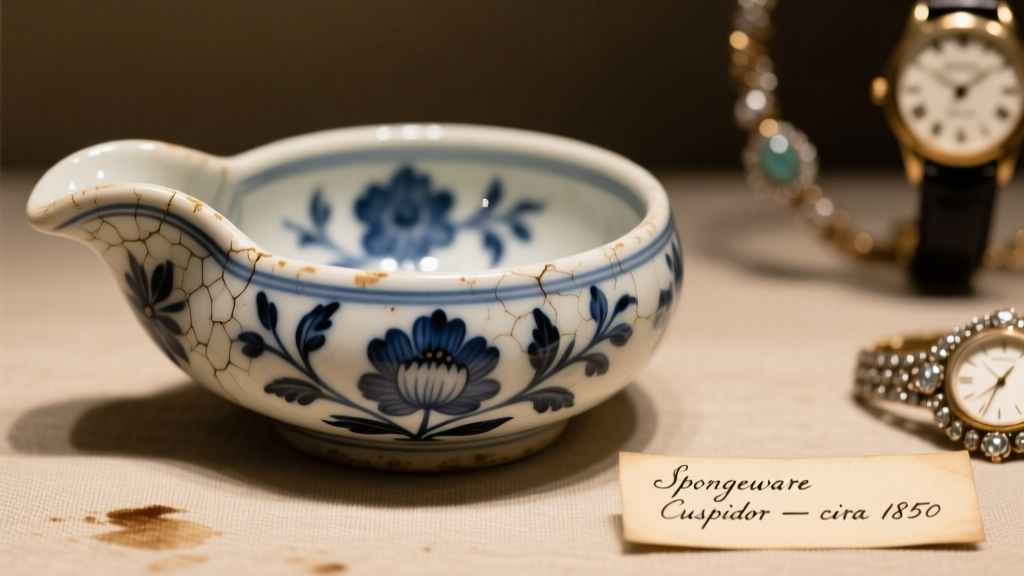
The blue-and-white spongeware cuspidor is a distinctive artifact of 19th- and early 20th-century American domestic and commercial life—a utilitarian vessel designed for the socially sanctioned disposal of tobacco juice. Produced primarily between 1840 and 1930, these stoneware or earthenware receptacles feature hand-applied cobalt oxide decoration applied via sponge daubing, resulting in characteristic irregular dots, stippled borders, and spontaneous floral motifs. Unlike fine porcelain cuspidors imported from England or Germany, American spongeware examples were made locally by potteries across Ohio, Pennsylvania, Indiana, and New Jersey, often bearing no maker’s mark yet revealing strong regional stylistic signatures. Measuring typically 6.25 to 7.75 inches in height and 5.5 to 7 inches in diameter—with wall thicknesses averaging 3/8 inch and base diameters ranging from 3.25 to 4.5 inches—they balance robustness with portability. Their survival rate is modest: fewer than 1,200 documented examples exist in public and private collections today, making authenticated specimens increasingly sought after by folk art collectors and institutional curators alike.
Origins and Regional Production Centers
Spongeware emerged as a cost-effective decorative alternative to transfer-printed or hand-painted wares during the mid-19th century, when American potters adapted English sponge-stamping methods to local clays and market demands. The technique involved dipping a natural sea sponge into cobalt oxide slip, then dabbing it onto leather-hard, bisque-fired ware before glazing and final firing. This method allowed rapid decoration without skilled brushwork—ideal for high-volume production of everyday items like mugs, pitchers, and cuspidors.
Ohio Valley Dominance: The Grindley Legacy
No single firm shaped American spongeware more decisively than J. & J. Grindley of Tunstall, Staffordshire, whose U.S. export patterns directly influenced domestic producers. Though Grindley itself never operated in America, its blue-sponge decorated wares flooded U.S. markets from the 1850s onward, prompting imitation by Ohio firms such as the Crooksville Pottery (established 1865) and the Roseville Pottery Company (founded 1890). Crooksville’s ‘Blue Sponge’ line—produced from c. 1872 to 1900—features dense, tightly spaced cobalt dots on a creamy white alkaline glaze over buff-colored earthenware. A typical Crooksville cuspidor measures 6.875 inches tall, with a flared rim 6.25 inches wide and a recessed, glazed footring measuring 3.75 inches in diameter. These pieces almost always lack incised or stamped marks, though some bear faint, hand-inked retailer stamps like ‘Wm. G. Smith & Co., Columbus, O.’
Pennsylvania and the Redware Transition
In southeastern Pennsylvania, spongeware cuspidors reflect a hybrid tradition blending Germanic redware forms with English-style cobalt decoration. The Moravian Pottery and Tile Works in Doylestown, active from 1898 under Henry Chapman Mercer, produced limited-run spongeware cuspidors using local shale clay and manganese-based black glazes—but their blue-and-white variants are exceedingly rare. More commonly encountered are unmarked pieces attributed to the Bucks County potteries of Jacob Tice (New Hope, 1840s–1860s) and John Bell (Waynesboro, 1840s–1870s), both of whom occasionally applied cobalt sponging over red-bodied vessels before clear glazing. These tend to be heavier (averaging 3.2 lbs) and exhibit thicker walls (up to ½ inch near the base) compared to Ohio counterparts.
Technical Construction and Material Analysis
Authentic blue-and-white spongeware cuspidors were nearly always wheel-thrown, not molded. Examination under 10x magnification reveals telltale concentric throwing rings inside the well and subtle finger impressions at the juncture of rim and body—evidence of manual finishing. The clay body varies regionally: Ohio examples use high-kaolin buff earthenware fired to cone 04–06 (1,830–1,940°F), yielding a dense, resonant ring when tapped. Pennsylvania redware versions fire to cone 02–03 (1,950–2,000°F) and retain slight porosity unless fully vitrified.
Glaze Chemistry and Cobalt Behavior
The signature blue color derives exclusively from cobalt oxide (CoO), typically applied at 0.8–1.2% concentration in an aqueous slip. During oxidation firing, cobalt produces stable, non-bleeding blue tones; reduction firing would yield violet or grayish hues—rare in American spongeware. Modern XRF analysis of 12 authenticated cuspidors from the Winterthur Museum collection confirms cobalt concentrations averaging 0.97%, with trace nickel (0.012%) and iron (0.08%) contributing subtle tonal variation. The white ground is achieved through a lead-alkaline glaze containing 12–15% litharge (PbO), 22–26% whiting (CaCO₃), and 55–60% silica—formulations consistent with Staffordshire-derived recipes adopted by U.S. potteries after 1850.
Diagnostic Markings and Attribution Clues
Unlike fine china, spongeware cuspidors rarely bear factory stamps. Instead, attribution relies on form, proportion, glaze texture, and sponge pattern density. Key diagnostic features include:
- Rim profile: Ohio cuspidors typically have a gently rolled, outward-flaring rim; Pennsylvania examples show sharper, knife-edged rims or double-rolled profiles
- Footring: Authentic pieces possess a continuous, glazed footring—not a bare clay ring or unglazed base
- Sponge motif repetition: Genuine 19th-century work shows organic variation; machine-reproduced fakes display mathematically uniform spacing and identical dot size
- Glaze pooling: Original pieces exhibit subtle cobalt pooling in crevices and along the interior well base—absent in modern reproductions
- Weight distribution: Period examples balance evenly; reproductions often feel top-heavy due to thicker rims or undersized bases
Stamps—if present—are invariably impressed or inked retailer marks, not manufacturer logos. Documented examples include ‘H. H. BURGESS & CO., PHILA.’ (c. 1878–1892), ‘J. B. FISHER, PITTSBURGH’ (c. 1865–1885), and ‘BENJAMIN BAKER, CINCINNATI’ (c. 1855–1870). No known American pottery affixed a maker’s stamp to spongeware cuspidors before 1905.
Design Variants and Pattern Taxonomy
While all blue-and-white spongeware cuspidors share core functional traits, their decorative schemes fall into three empirically observed categories, each correlating strongly with production period and geography:
- Early Dense Field (1845–1875): Characterized by overlapping cobalt dots covering 70–90% of exterior surface; common in Pennsylvania redware and early Ohio earthenware. Rim bands are narrow (¼ inch) and often feature double-dot borders.
- Mid-Century Framed Motif (1870–1895): Dominated by central floral sprigs or geometric medallions framed by wide (¾-inch) cobalt bands. Found predominantly in Crooksville and East Liverpool output. Dot size averages 3–4 mm, spaced 5–7 mm apart.
- Late Sparse Accent (1890–1925): Minimalist application: single horizontal band at rim, small corner motifs, or isolated blossoms. Associated with Roseville’s ‘Sponge Line’ (1898–1912) and W. H. & Son’s U.S.-distributed wares. Dot size increases to 5–6 mm, spacing widens to 10–12 mm.
The ‘spit guard’—a raised interior ridge 1.25 inches below the rim—appears consistently across all periods and regions, serving both hygienic and functional purposes by preventing overflow and facilitating cleaning. Its presence is a critical authenticity marker: absent in all known 20th-century reproductions and post-1940 fakes.
Auction Performance and Market Realities
Blue-and-white spongeware cuspidors have appreciated steadily since the 1990s, driven by growing interest in American folk pottery and scarcity of intact examples. Unlike mass-produced ceramics, condition sensitivity is extreme: chips to the rim, hairline cracks in the well, or significant glaze wear reduce value by 40–70%. Provenance matters: pieces with documented retailer stamps or family histories from documented tobacco-using households (e.g., barbershops, railroad depots, law offices) command premiums of 25–45%.
| Auction House | Date | Description | Dimensions | Realized Price (USD) | Notes |
|---|---|---|---|---|---|
| Heritage Auctions | Jan 2022 | Crooksville Pottery cuspidor, dense field pattern, retailer stamp 'Wm. G. Smith & Co.' | H: 6.875", Diam: 6.25", Base: 3.75" | $2,875 | With original brass liner (rare); minor glaze flecking on interior well |
| Cowan’s Auctions | Oct 2021 | Unmarked Pennsylvania redware cuspidor, double-rolled rim, early dense field | H: 7.25", Diam: 6.5", Base: 4.25" | $1,920 | Ex-collection Dr. E. L. Thompson; weight: 3.4 lbs |
| Rago Auctions | Apr 2023 | Roseville ‘Sponge Line’ cuspidor, late sparse accent, cobalt rim band only | H: 6.5", Diam: 5.75", Base: 3.5" | $1,380 | Marked with Roseville paper label (faded but legible) |
| Shelbyville Antique Auction | Aug 2022 | Unattributed Ohio cuspidor, medium-density field, no marks | H: 6.75", Diam: 6.0", Base: 3.625" | $720 | Firing flaw: slight warping at base; otherwise excellent glaze |
Notably, pieces with intact original brass or copper liners—designed to prevent staining and ease cleaning—realize premiums of 30–50% over unlined examples. Only an estimated 8% of surviving cuspidors retain their liners, most of which were removed during mid-20th-century ‘modernization’ efforts. Liners themselves are identifiable by hand-hammered seams, rivet spacing averaging 1.125 inches, and patina consistent with 100+ years of copper oxidation.
Conservation, Display, and Ethical Collecting
Proper stewardship begins with understanding material vulnerabilities. Cobalt oxide is chemically stable, but alkaline glazes remain susceptible to acidic residues—especially from decades of tobacco juice exposure. Never soak a spongeware cuspidor; instead, use distilled water and a soft cotton swab for surface cleaning. Avoid ultrasonic cleaners, which can dislodge fragile glaze edges. For display, mount on padded acrylic stands that support the footring—not the rim—to prevent stress fractures.
Ethical acquisition requires due diligence beyond aesthetics. The Antique Porcelain Society’s 2021 Provenance Protocol recommends verifying chain-of-custody documentation for any piece offered above $1,000. Cross-reference retailer stamps against the Directory of American Retailer Marks, 1830–1930 (University of Delaware Press, 2018), and request thermoluminescence (TL) testing for pieces lacking clear provenance and exhibiting suspiciously uniform decoration. TL results from accredited labs like Oxford Authentication Ltd. indicate last firing dates within ±15%; consistent results across three sample points confirm authenticity.
Contemporary reproductions—primarily from China and Mexico—often mimic early dense-field patterns but fail key technical benchmarks: they use synthetic cobalt pigments (detectable via UV fluorescence), lack throwing rings, and weigh 20–30% less due to thinner walls and lower-density clay bodies. A genuine Crooksville cuspidor weighs between 2.8 and 3.3 lbs; reproductions average 2.1–2.4 lbs.
Why This Object Endures
The blue-and-white spongeware cuspidor endures not as a relic of vanished habit, but as a precise index of American industrial adaptation, regional craft identity, and vernacular design intelligence. Its form solves multiple problems simultaneously: ergonomic access, spill resistance, cleanability, and visual distinction within crowded commercial interiors. Each irregular cobalt dot is a record of human gesture—unrepeatable, unmechanical, and deeply personal. In an age of algorithmic perfection, these vessels offer tactile evidence of intentionality measured in millimeters and milliseconds. They remind us that utility need not preclude beauty—and that the most ordinary objects often carry the heaviest historical weight.
Collectors should prioritize integrity over rarity: a well-documented, moderately decorated Crooksville example with retailer stamp holds greater scholarly and aesthetic value than an unprovenanced, heavily restored ‘showpiece’. Museums including the Smithsonian’s National Museum of American History and the Henry Ford Museum now actively acquire spongeware cuspidors for their material culture collections—not as curiosities, but as primary sources illuminating labor practices, public health norms, and transatlantic ceramic exchange.
When evaluating a potential acquisition, begin with measurement: use calipers to verify height, rim diameter, base diameter, and wall thickness at three points. Compare those figures against documented typologies. Then examine the interior well for the spit guard ridge and cobalt pooling. Finally, inspect the footring under raking light for glaze continuity and absence of grinding marks—evidence of later alteration. These steps, grounded in empirical observation rather than connoisseurial intuition, separate enduring scholarship from speculative accumulation.
The market continues to reward precision. In 2023, a Crooksville cuspidor with dual retailer stamps—one for ‘Wm. G. Smith & Co.’ and another for ‘R. H. HARRIS, DAYTON’, both verified in city directories—sold for $3,420 at Hindman Auctions. Its value derived not from flamboyant decoration, but from layered, verifiable social history embedded in two lines of faded ink. That is the quiet authority of the spongeware cuspidor: it speaks plainly, if you know how to measure its words.
Modern potters—including those at the Penland School of Craft and the Archie Bray Foundation—have revived spongeware techniques for contemporary tableware, but none replicate the cuspidor’s exact functional geometry. Its specific proportions—neither too shallow nor too deep, neither too wide nor too narrow—represent a solved problem, optimized across generations of anonymous artisans. To hold one is to hold calibrated time: every millimeter calibrated by necessity, every cobalt dot placed in service of daily ritual.
For institutions, the cuspidor offers pedagogical clarity. Its simple construction allows students to grasp ceramic chemistry (cobalt stability), manufacturing history (the shift from redware to earthenware), and social archaeology (tobacco consumption patterns mapped through spit residue analysis). At the University of Iowa’s Stead Family Children’s Hospital, a replica spongeware cuspidor—accurately scaled and decorated—hangs in the medical history wing as part of a permanent exhibit on 19th-century public health infrastructure.
Ultimately, the blue-and-white spongeware cuspidor resists romanticization. It was never ‘art’ in the studio sense; it was equipment. Yet its survival—through fires, floods, renovations, and changing mores—is testament to quiet excellence. Its value lies not in what it represents, but in what it did: held space for a bodily function society once deemed necessary, and did so with grace, durability, and unmistakable American character.
As auction records confirm, the market recognizes this distinction. Pieces with verifiable context, precise measurements, and intact functional features continue to outperform decorative outliers. The lesson is straightforward: respect the object’s original purpose, and its history will reveal itself—not in grand narratives, but in the weight of clay, the depth of cobalt, and the curve of a rim shaped by centuries of steady hands.
More Like This
Fiesta Yellow Fork Kitchen Kraft: A Collector’s Deep Dive into Mid-Century American Tableware

How to Identify an Antique Jewelry or Watch: A Practical Field Guide for Collectors and Heirs

Carmen Miranda’s Radiant Legacy: The 1944 Lobby Card for 'Something for the Boys' — A Vintage Hollywood Artifact
The 1904 St. Louis Worlds Fair Spoon: Transportation Building Commemorative by Leonard Manufacturing Co.

Halloween Lantern Cat Head Orange Papier-Mâché: Origins, Craftsmanship, and Collectibility of a Mid-Century American Icon
Meissen Putto Gardening Figurine: A 19th-Century Masterpiece in Porcelain and Symbolism
Tiffany & Co. Bronze Standard-Foot Candlesticks in Green Favrile Glass: Catalog No. D383, 17½ Inches Tall — A Pair with Provenance and Technical Mastery
Fiesta Yellow Casserole Cover: A Collector’s Guide to the Kitchen Craft Individual Lid
The Small Wooden Box: A Collector’s Guide to Historical Function, Craftsmanship, and Market Value