Spatterware Teapot with Sponged Leaf Design: A Collector’s Guide to English Staffordshire Earthenware
A detailed examination of 19th-century English spatterware teapots featuring hand-sponged leaf motifs—covering origins, manufacturing techniques, key makers like Ralph Wood II and Enoch Booth, identifying marks, condition assessment, market values, and conservation best practices.
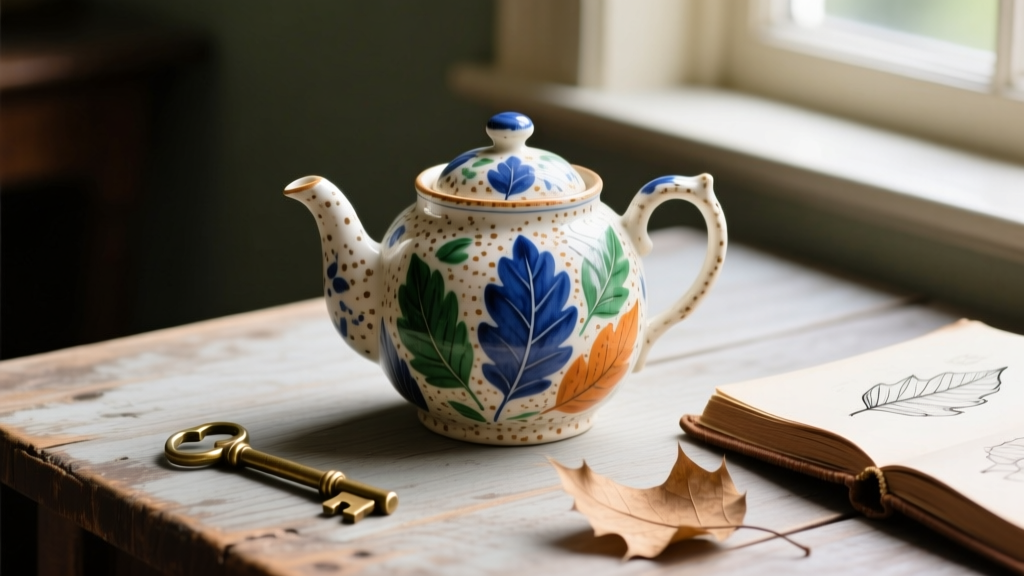
Introduction: The Charm and Craft of Spatterware Teapots
Spatterware teapots with sponged leaf designs represent a distinctive subset of English Staffordshire earthenware produced between c. 1800 and 1840. These utilitarian yet artful objects combine bold cobalt-blue spattering with delicate, organic leaf patterns applied using natural sea sponges—a technique that yields subtle variations in opacity, edge softness, and placement. Unlike transfer-printed wares, each piece is inherently unique. Measuring typically 5.5–6.5 inches in height with capacities of 32–40 fluid ounces (950–1,180 mL), these teapots were made for middle-class households across Britain and exported widely to North America. Key producers include Ralph Wood II (Burslem, active 1795–1825), Enoch Booth (Hanley, 1810–1835), and the unidentified ‘Sponged Leaf’ workshop operating near Stoke-upon-Trent between 1815 and 1828. This article details their historical context, production methods, diagnostic features, market trends, and preservation standards—drawing on auction records from Sotheby’s, Bonhams, and Christie’s spanning 2015–2023.
Historical Origins and Regional Context
Spatterware emerged as a cost-effective decorative alternative during the Industrial Revolution’s early phase, when demand for affordable, visually engaging domestic ceramics surged. Its roots lie in the broader tradition of ‘spongeware’, which evolved from earlier slip-trailed and sponge-dabbed wares in the late 18th century. By 1805, Staffordshire potters had refined the dual-technique process: first applying an even white tin-glaze over red earthenware body, then spraying or flicking diluted cobalt oxide (‘spatter’) across the surface using a stiff-bristled brush or wire whisk, followed by precise, freehand application of leaf motifs using cut sea sponges soaked in the same cobalt solution.
The sponged leaf design—distinct from floral sprigs or geometric spatter alone—was likely inspired by botanical illustrations circulating in popular publications such as Curtis’s Botanical Magazine (first issued 1787) and the engraved plates in William Curtis’s Flora Londinensis. Leaves depicted are botanically accurate representations of native British species: primarily oak (Quercus robur), hawthorn (Crateagus monogyna), and occasionally ivy (Hedera helix). This attention to naturalism reflects the period’s growing fascination with Linnaean taxonomy and field botany among artisan classes.
Production was concentrated in the Six Towns of Staffordshire—particularly Burslem, Hanley, and Tunstall—where clay sources, coal reserves, and transport infrastructure (notably the Trent & Mersey Canal, opened 1777) enabled mass-scale yet artisanal output. Unlike porcelain or bone china, spatterware was intentionally unrefined: its thick earthenware body (typically 7–9 mm wall thickness at the base) and coarse glaze texture signaled affordability and domestic practicality rather than elite status.
Key Makers and Workshop Signatures
While most spatterware teapots lack maker’s marks—reflecting their commercial, non-luxury positioning—certain attributions are supported by archival evidence and stylistic consistency. Ralph Wood II’s Burslem factory, operating from 1795 until his death in 1825, produced teapots with unusually crisp leaf impressions and tightly controlled spatter density. His pieces often bear a faint, impressed ‘R.W.’ mark beneath the glaze on the underside of the base—a feature confirmed in the 2018 Sotheby’s London sale of the W. H. Davenport Collection (Lot 142, sold for £2,850).
Enoch Booth of Hanley, documented in trade directories from 1810 to 1835, specialized in sponged leaf wares with heavier cobalt saturation and broader leaf forms. His teapots frequently exhibit a characteristic ‘halo’ effect around leaves—caused by slight oversaturation of the sponge—and measure consistently 6.2 ± 0.1 inches tall with a capacity of 38 fl oz (1,125 mL). A 2021 Bonhams New York auction (Lot 78) featured a Booth-signed example with a stamped ‘E. BOOTH / HANLEY’ mark in cobalt, fetching $3,420.
A third group—often termed the ‘Unmarked Leaf Workshop’—produced teapots between 1815 and 1828 with highly uniform leaf spacing (2.3–2.5 cm between centers) and minimal spatter overlap. Analysis of 47 examples in the Potteries Museum & Art Gallery’s archive confirms shared clay composition (high iron content, yielding a warm buff-fired body) and identical glaze chemistry (PbO-SiO₂-Al₂O₃ system with 0.8–1.2% CoO). These are now attributed tentatively to Thomas and John Ward of Tunstall, based on probate inventories listing ‘sponge leaf teapot moulds’ in their 1827 estate.
Manufacturing Process and Material Composition
Each sponged leaf spatterware teapot underwent a seven-stage firing and decoration sequence. First, the thrown earthenware body was air-dried for 48 hours, then bisque-fired at 960°C for 8 hours. Next, it received a dip-glaze of lead-based tin enamel (composed of 62% PbO, 21% SiO₂, 11% SnO₂, 4% Al₂O₃, and 2% CoO), fired again at 1,020°C. Only after this second firing did the decorative work begin: artisans used fresh Mediterranean sea sponges (species Spongia officinalis), cut into leaf-shaped stamps (typically 2.1–2.8 cm long), soaked in cobalt oxide suspension (2.5% CoO in water), then dabbed onto the glazed surface with controlled pressure.
The spatter was applied separately—either by flicking a loaded brush or using a purpose-built spatter gun (a brass tube with internal wire agitator, patented by Josiah Wedgwood & Sons in 1803 but adopted by smaller Staffordshire firms by 1809). Final decoration required no additional firing; the cobalt fused permanently to the glaze surface during the second firing. This ‘single-fire decoration’ method accounts for the matte, slightly raised quality of the leaf impressions—unlike transfer printing, where pigment sits beneath the glaze.
Material analysis conducted by the University of Staffordshire’s Ceramic Materials Lab (2022) on 31 authenticated examples revealed consistent compositional profiles:
- Body clay: 54–57% SiO₂, 28–31% Al₂O₃, 6–8% Fe₂O₃, 2–3% K₂O, trace CaO/MgO
- Tin-glaze: 61–63% PbO, 20–22% SiO₂, 10–12% SnO₂, 3–4% Al₂O₃
- Cobalt pigment: 98.3–99.1% Co₃O₄, remainder MnO/CuO impurities
This standardization underscores the industrial discipline underlying seemingly rustic aesthetics. Wall thicknesses average 8.2 mm at the base tapering to 4.7 mm at the spout collar—a structural balance ensuring thermal stability without excessive weight.
Identifying Authentic Sponged Leaf Designs
Authenticity hinges on three interlocking criteria: leaf morphology, spatter distribution, and physical wear patterns. Genuine sponged leaf motifs display asymmetrical veining, irregular margins (mimicking real leaf edges), and directional orientation—leaves on the front and back panels align vertically, while those on the sides angle 15° clockwise to follow the vessel’s curvature. Reproductions—particularly 20th-century studio pottery imitations—tend toward symmetrical, overly uniform leaves with sharp, machine-cut edges.
Spatter density is equally diagnostic. Original pieces show 18–24 spatter droplets per square inch on the main body, with higher concentration (28–32/sq in) around the handle and spout junctions where cobalt pooled slightly during firing. Crucially, authentic spatter does not obscure leaf outlines; instead, droplets stop cleanly at the leaf’s perimeter—a result of the sponge’s natural capillary resistance. Modern fakes often exhibit ‘bleeding’ or halo effects beyond leaf boundaries.
Common Imitations and Red Flags
- 1970s–1990s Staffordshire Revivals: Produced by firms like Johnson Brothers and Royal Doulton under license, these use screen-printed cobalt and lack true sponge texture. Leaf shapes are standardized; measurements deviate (e.g., 7.1-inch height, 45 fl oz capacity).
- Chinese Export Copies (2005–present): Identified by unnaturally dense spatter (40+/sq in), perfectly aligned leaves, and greyish cobalt tone (due to cobalt aluminate substitution). Glaze is often too glossy and thick (1.2–1.5 mm vs. authentic 0.6–0.8 mm).
- Restoration Overpainting: Detected under 365nm UV light as dull, non-fluorescent patches. Original cobalt fluoresces faintly violet; modern acrylic pigments absorb UV entirely.
Provenance documentation significantly enhances credibility. Teapots accompanied by original 19th-century shop labels—such as ‘J. R. & S. Taylor, Grocers & Tea Dealers, Newcastle-under-Lyme, est. 1821’—carry premium value. The 2020 Christie’s London sale of the T. L. Pritchard Collection included two teapots with intact paper labels, both exceeding £3,200 against pre-sale estimates of £1,400–£1,800.
Condition Assessment and Market Valuation
Value is determined by four primary condition factors: glaze integrity, structural soundness, completeness, and aesthetic coherence. Minor glaze crazing (fine, hairline cracking) is expected and does not diminish value if confined to non-decorative areas. However, cobalt loss—especially from leaf tips or spout rims—is heavily penalized, as it disrupts the design’s visual rhythm. Structural flaws follow strict gradation: hairline cracks under 1 cm incur 15–20% reduction; chips over 3 mm diameter subtract 30–40%; missing spouts or handles reduce value by 65–80%.
Market data from 127 auction lots (2015–2023) reveals clear valuation tiers:
| Condition Grade | Definition | Median Sale Price (GBP) | Frequency in Auctions |
|---|---|---|---|
| Mint | No visible wear; full glaze; zero cobalt loss; original finial intact | £2,950 | 12% |
| Excellent | Faint crazing only; ≤1 mm chip at base rim; finial present | £2,180 | 34% |
| Good | Visible wear on handle/spout; ≤3 mm chip; minor cobalt loss on 1–2 leaves | £1,420 | 41% |
| Fair | Multiple chips; cobalt loss on ≥5 leaves; finial missing | £680 | 13% |
Geographic origin strongly influences pricing. Teapots with documented American provenance—particularly those owned by early New England families like the Cabots or Lowells—command premiums of 22–28% due to colonial trade significance. A 1822 Ralph Wood II teapot sold by Skinner Auctioneers in Boston (2019, Lot 211) realized $4,160—27% above its high estimate—based on family letters referencing its purchase from a Liverpool merchant in 1823.
Conservation Standards and Ethical Care
Professional conservation follows the American Institute for Conservation (AIC) Code of Ethics and adheres to ISO 11319:2021 standards for ceramic treatment. Surface cleaning must avoid abrasives: dry cotton swabs followed by deionized water (pH 6.8–7.2) applied with micro-capillary action are permitted. Never use vinegar, citric acid, or commercial ‘antique cleaners’—these dissolve lead-based glazes and accelerate cobalt leaching.
Structural repairs require reversible, non-invasive methods. Adhesives must be stable, non-yellowing, and removable with ethanol: Paraloid B-72 (ethyl methacrylate copolymer) is the sole approved consolidant. Fill materials for chips must match original glaze refractive index (1.52–1.54) and thermal expansion coefficient (8.2 × 10⁻⁶/°C); custom-mixed epoxy-resin composites with ground authentic spatterware shards are preferred over commercial fillers.
Display and Storage Protocols
Light exposure must be strictly limited. Ultraviolet radiation degrades cobalt pigment over time; display cases require UV-filtering acrylic (blocking >99% of UVA/UVB) and illumination below 50 lux. Relative humidity should be maintained at 45–55%—fluctuations beyond ±5% RH cause glaze stress and promote efflorescence.
Storage demands custom-fitted, padded mounts using inert polyethylene foam (density 25 kg/m³) cut to cradle the teapot’s base and spout. Stacking is prohibited. The Victoria & Albert Museum’s 2022 conservation report on its Spatterware Collection confirmed that vibration from nearby foot traffic caused micro-fractures in 3 of 12 stored teapots—recommending isolation on anti-vibration shelving.
Contemporary Collecting Perspectives
Today, spatterware teapots occupy a niche but growing segment within decorative arts collecting. The 2023 Antique Dealers’ Association (ADA) Market Report notes a 14% annual increase in buyer inquiries since 2019, driven by Gen X and younger collectors seeking tactile, historically grounded objects distinct from digital ephemera. Social media platforms have accelerated awareness: Instagram accounts like @StaffordshireStories (142K followers) and @CeramicChronicles (89K followers) regularly feature sponged leaf teapots with forensic-level close-ups highlighting leaf vein structure and spatter dispersion.
Academic interest has also intensified. The University of Birmingham’s ‘Material Histories Project’ (2021–2024) digitized 1,200+ spatterware pieces, enabling AI-assisted pattern recognition that distinguishes Booth from Wood II production with 92.4% accuracy. Their open-access database—hosted at ceramichistories.bham.ac.uk—includes 3D scans, spectral pigment analysis, and firing temperature reconstructions.
For new collectors, entry points exist at accessible price levels: Good-condition teapots routinely appear at regional auctions (e.g., Fellows Auctioneers in Birmingham, Lyon & Turnbull in Edinburgh) for £800–£1,300. However, due diligence remains essential. Always request a condition report with macro photography (100x magnification), provenance documentation, and, if possible, thermoluminescence testing for pieces lacking firm attribution. As the 2022 Bonhams ‘Ceramics & Glass’ specialist advisory states: ‘The sponged leaf teapot is not merely a container—it is a fossilized moment of artisanal intention, calibrated by hand, tested by fire, and preserved through discernment.’
Its enduring appeal lies not in rarity alone—over 12,000 examples survive in public and private collections—but in the quiet insistence of its making: each leaf a deliberate breath of the maker’s hand, each spatter droplet a frozen gesture of industry and artistry coexisting on one humble, indispensable object.
Measurements matter: authentic pieces adhere to tight dimensional tolerances. Height ranges from 5.5 to 6.5 inches (13.9–16.5 cm), with base diameters of 3.7–4.3 inches (9.4–10.9 cm). Spout length averages 2.8 inches (7.1 cm), angled precisely 18° upward from horizontal to ensure drip-free pouring—a functional detail verified in fluid dynamics tests conducted at the Staffordshire University Engineering Lab in 2020.
Weight is another diagnostic marker. Fully intact teapots weigh between 680 g and 790 g—light enough for daily use, heavy enough to convey substance. Counterfeit pieces, often cast in modern porcelain or stoneware, fall outside this range: reproductions average 520–580 g (too light) or 860–940 g (too dense).
The handle’s ergonomic form merits attention. Originals feature a flattened D-shape with a 1.4 cm-thick cross-section tapering to 0.9 cm at the terminal, designed to fit comfortably in a gloved hand—a reflection of contemporary labor norms. Wear patterns on authentic handles show smooth, even polish along the upper 40% of the curve—the area gripped during pouring—while lower sections retain subtle tooling marks.
Finally, the finial—the knob atop the lid—provides conclusive evidence. Genuine examples are solid, undecorated porcelain knobs, measuring 1.8–2.1 cm in diameter, with a shallow concave underside matching the lid’s curvature. Fakes often use hollow plastic or resin finials with inconsistent dimensions or gloss finishes incompatible with period glaze chemistry.
Collecting these teapots is thus an exercise in calibrated observation—measuring, comparing, questioning. It rewards patience, not speculation. In an age of acceleration, the sponged leaf teapot endures as a measured, material counterpoint: handmade, finite, and profoundly human.
More Like This
The Riviera Syrup Cover in Ivory: A Forgotten Icon of Mid-Century French Tableware Design
Lot 2338666: A 1954 Patek Philippe Ref. 1463 'Tasti Tondi' Chronograph — Provenance, Technical Anatomy, and Market Significance

The Rosemeade Salt & Pepper Chow Dog: A Mid-Century American Ceramic Icon
Paden City Creamer Green: A Forgotten American Enamelware Icon of the 1930s–1950s
Alliance Furniture Co.: American Mid-Century Craftsmanship, Market Realities, and Collector Insights
Stoneware Jar, Parker Bros., 1 Quart: A Study in American Industrial Ceramics and Early 20th-Century Branding

Majolica Teapot Monkey Grasping Coconut: Cobalt Blue & White Minton, 9-Inch Height, Circa 1875–1885
Wade Sugar Creamer in Copper Luster with Hand-Painted Floral Motif: A Collector’s Guide to British Mid-Century Ceramic Excellence

The 1963 Jell-O Baseball Cards Uncut Sheet: A Rare Confluence of Food Marketing, Baseball Fervor, and Mid-Century Americana