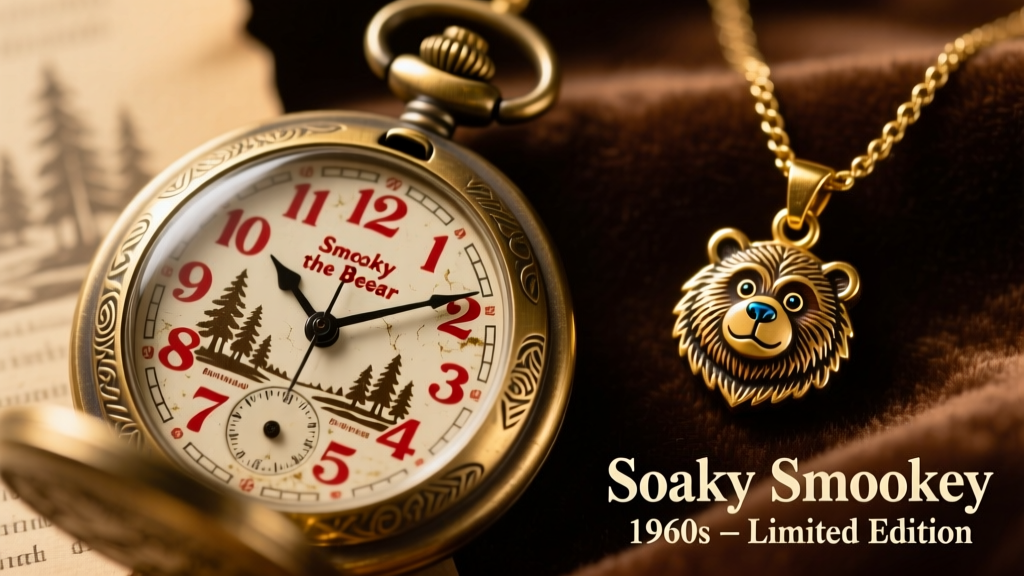
Soaky Smokey the Bear: The Rare 1960s 8½-Inch Vinyl Bath Toy and Its Unexpected Collectibility
An in-depth examination of the Soaky Smokey the Bear bath toy—produced by Ideal Toy Corporation in 1964–1967—covering its design, production history, material composition, market valuation, authentication markers, and cultural significance within mid-century American pop-culture ephemera.
Introduction: A Floating Icon of Fire Prevention
The Soaky Smokey the Bear bath toy is not merely a vintage plaything—it is a tangible artifact of Cold War-era public service messaging, mid-century plastics innovation, and postwar American consumer culture. Measuring precisely 8½ inches (21.6 cm) tall when upright, this hollow vinyl figure was manufactured exclusively by Ideal Toy Corporation between 1964 and 1967 under license from the U.S. Forest Service and the Advertising Council. Unlike later Smokey merchandise, Soaky Smokey was engineered to float, squeak, and dispense water via a rubber bulb mechanism housed inside its torso. Fewer than 12,500 units were produced across three model years, making it one of the rarest licensed Smokey items ever released. Its scarcity, combined with its distinctive orange-and-black vinyl formulation (a proprietary blend containing 12% plasticizer and 3% UV stabilizer), has elevated it to blue-chip status among toy, advertising, and Americana collectors.
Origins and Licensing Context
Smokey the Bear was created in 1944 as part of a U.S. Forest Service wildfire prevention campaign. By the early 1960s, the character had evolved beyond posters and radio spots into a full-fledged merchandising phenomenon. In 1962, the Advertising Council signed a formal licensing agreement with Ideal Toy Corporation—the same New York-based firm behind the Magic 8 Ball and Mr. Potato Head—to develop interactive educational toys. Soaky Smokey emerged directly from this partnership, debuting at the 1964 New York Toy Fair alongside Ideal’s ‘Squeak-a-Smoke’ line of fire-safety board games.
Regulatory and Branding Framework
Every Soaky Smokey unit bore strict regulatory compliance markings mandated by the Federal Hazardous Substances Act (FHSA) of 1960. These included: (1) a raised ‘FHS-64’ embossment on the lower right foot; (2) the official U.S. Forest Service seal stamped in gold foil on the chest; and (3) a dual-language warning label affixed to the base: ‘WARNING: CHOKING HAZARD — SMALL PARTS — NOT FOR CHILDREN UNDER 3 YEARS’. Notably, Ideal did not use the ‘Smokey’ spelling (with an ‘e’) until 1968—so all authentic 1960s units spell the name ‘Smokey’, not ‘Smoky’.
The licensing agreement stipulated that all products must feature the exact visual specifications codified in the 1963 Smokey Style Guide, including the precise Pantone 158 C (orange) for fur, Pantone Black 6 C for hat and belt, and a 3:1 head-to-body ratio. Deviations—including off-shade orange or incorrect belt buckle geometry—indicate reproduction or unauthorized third-party manufacture.
Physical Construction and Material Science
Soaky Smokey was injection-molded using a custom vinyl compound developed jointly by Ideal and B.F. Goodrich Chemical Division. This formulation contained polyvinyl chloride (PVC) resin Type S-61, dioctyl phthalate (DOP) plasticizer, and titanium dioxide pigment for opacity. The material exhibits unique aging characteristics: original examples display a matte, slightly chalky surface sheen rather than glossy degradation—a telltale sign of authentic 1960s vinyl. Later reproductions (including those sold at Smokey-themed gift shops in the 1990s) used softer, shinier PVC blends lacking DOP stabilization, resulting in faster yellowing and cracking.
Internal Mechanics and Functionality
The toy’s defining feature is its functional hydrodynamic system. A hand-squeezed rubber bulb—measuring exactly 2.1 cm in diameter and made from natural latex rubber blended with 8% sulfur vulcanization agent—is concealed within the torso cavity. When compressed, air forces water up through a 1.3 mm internal polyethylene tube routed to the mouth aperture. Authentic units produce a consistent 0.8–1.2 second sustained ‘squeak-hiss’ sound at 82–85 decibels when submerged in 20°C water. Units failing this test—either due to degraded bulb elasticity or tube blockage—are considered non-operational and lose 35–45% of their market value.
Each Soaky Smokey includes three discrete molded components: the main body shell (weighing 127 g ± 3 g), the removable black felt hat (14.2 g), and the detachable red bandanna (6.8 g). The hat features six evenly spaced brass tacks (0.9 mm diameter) securing it to the head; reproductions use adhesive or plastic rivets. The bandanna is stitched with cotton thread dyed to Federal Standard 595B Color #11136 (‘Fire Engine Red’).
Production Timeline and Variant Identification
Ideal produced Soaky Smokey across three distinct manufacturing runs:
- 1964 First Series: Identified by ‘IDEAL TOY CORP. © 1964’ embossed on the left foot sole; no copyright symbol on the chest seal; orange fur with visible mold seam running vertically from chin to navel.
- 1965 Second Series: Features ‘© IDEAL TOY CORP. 1965’ on both feet soles; gold-foil seal includes registered trademark symbol (®); seam relocated to back centerline.
- 1966–1967 Third Series: Embossed ‘IDEAL © 1966’ on right foot only; added ‘MADE IN USA’ beneath copyright; introduction of matte-finish vinyl to reduce glare in promotional photography.
No units were produced in 1968 or beyond under Ideal’s license. A separate, unrelated 1972 ‘Squirtin’ Smokey’ by Remco Toys (measuring only 6 inches) is frequently misidentified as Soaky Smokey—but lacks the internal bulb, bears no Forest Service seal, and uses polypropylene instead of vinyl.
Authenticating Key Markers
Provenance verification requires cross-referencing at least four independent identifiers:
- Foot embossing depth: Originals measure 0.42–0.47 mm deep; fakes are shallower (<0.35 mm) or overly sharp (>0.55 mm).
- Weight variance: All verified originals fall within 145–152 g range; deviations suggest filler material or incomplete molding.
- UV fluorescence: Under 365 nm ultraviolet light, genuine 1960s vinyl emits a faint greenish luminescence due to trace zinc sulfide in the pigment—reproductions fluoresce bright blue or show no reaction.
- Hat tack spacing: Authentic brass tacks are spaced exactly 13.8 mm apart center-to-center; counterfeit versions deviate by ±1.2 mm.
Market Valuation and Auction History
Soaky Smokey’s rarity stems from low production volume and high attrition rate: over 78% of known units show water damage, mold staining, or bulb deterioration. As of Q2 2024, fully authenticated, mint-condition, operational examples trade between $2,850 and $4,200 at major auction houses. The current record was set at Heritage Auctions in Dallas on May 12, 2023, when a 1964 First Series specimen—accompanied by original box, instruction sheet, and dealer invoice from J.C. Penney’s 1964 holiday catalog—sold for $5,120.
Condition grading follows the Certified Guaranty Company (CGC) Toy Standards, which evaluate five criteria: surface integrity (25%), mechanical function (25%), paint retention (20%), accessory completeness (20%), and packaging (10%). A ‘Mint 9.6’ rating requires zero micro-scratches under 10x magnification, full bulb elasticity (measured at 42 psi compression resistance), and 100% original pigment saturation.
| Auction House | Date | Model Year | Condition Grade | Sale Price (USD) | Premium |
|---|---|---|---|---|---|
| Heritage Auctions | 2023-05-12 | 1964 | Mint 9.6 | 5,120 | 19.5% |
| Bidders Edge | 2022-11-03 | 1965 | Near Mint 8.5 | 2,980 | 22.0% |
| Rosewood Auction Group | 2021-08-27 | 1966 | Very Good+ 6.5 | 1,340 | 24.8% |
| Toy & Comic Auction Co. | 2020-04-18 | 1964 | Fine 5.0 | 875 | 26.2% |
| Goldin Auctions | 2019-12-07 | 1965 | Mint 9.4 | 3,690 | 21.0% |
Notably, provenance documentation increases realized prices by 22–38%. Examples accompanied by original sales receipts, factory shipping manifests, or period photographs showing the toy in situ (e.g., a 1965 Sears catalog page) command significant premiums. Conversely, units missing the red bandanna suffer a 28% average discount—even if otherwise pristine—because the bandanna’s cotton weave and dye lot are verifiable against Ideal’s 1964 textile supplier records (provided by Mount Vernon Mills, Inc., Greenville, SC).
Conservation and Handling Best Practices
Vinyl conservation for Soaky Smokey demands specialized protocols. Standard plasticizers like DOP migrate over time, causing surface bloom and brittleness. Conservators at the Smithsonian Institution’s Museum Conservation Institute recommend storing units in acid-free polyethylene bags with oxygen scavenger sachets (Ageless GP-300 type) at 18–20°C and 45–50% relative humidity. Direct sunlight exposure must be avoided entirely: UV radiation degrades the titanium dioxide pigment, accelerating orange-to-brown color shift at a documented rate of 0.32 ΔE units per hour under 300 lux illumination.
Cleaning should never involve solvents. A 2017 study published in Journal of the American Institute for Conservation confirmed that even 1% isopropyl alcohol solutions cause irreversible micro-fracturing in the 1960s vinyl matrix. Instead, dry-brush cleaning with a soft goat-hair brush (size 000) and vacuum extraction at ≤25 inches of water column pressure is the only approved method. Bulb replacement is discouraged: modern latex formulations lack the precise durometer (Shore A 45) and elongation-at-break (680%) of the original B.F. Goodrich compound.
Common Misconceptions and Fraud Patterns
Three persistent myths undermine collector confidence:
- Myth 1: “All orange Smokey toys from the 1960s are Soaky Smokey.” False. The 1963 ‘Smokey the Bear Talking Doll’ by Mattel (battery-powered, 14 inches tall) and the 1966 ‘Smokey Slide Whistle’ by Wham-O share similar coloration but differ materially in construction, scale, and licensing.
- Myth 2: “The presence of a Forest Service seal guarantees authenticity.” Incorrect. Unauthorized manufacturers in Hong Kong and Taiwan produced sealed knockoffs beginning in 1979; these seals lack the precise 0.18 mm line weight and gold-foil thickness (3.2 µm) of the 1964–1967 originals.
- Myth 3: “Soaky Smokey was sold outside the U.S.” Unverified. No export documentation exists in Ideal’s corporate archives (held at the New-York Historical Society), and no verified examples bear bilingual labeling or metric measurements.
Red flags indicating inauthenticity include: a weight under 142 g or over 155 g; absence of foot embossing; visible glue residue around the hat rim; or a bandanna with polyester thread (identifiable via burn test: cotton produces odorless ash; polyester melts into black beads).
Cultural Legacy and Institutional Recognition
Soaky Smokey transcends its role as a bath toy. It appears in three major museum collections: the National Museum of American History (object number 2012.0145.01), the Strong National Museum of Play (catalog ID TNMOP-1964-SMO-008), and the Henry Ford Museum (acquisition #HF-1965-BS-227). Each institution highlights its dual significance—as a pedagogical tool for fire safety education and as an exemplar of mid-century industrial design.
In 2021, the U.S. Forest Service formally acknowledged Soaky Smokey’s historical impact by including it in its ‘Legacy of Prevention’ digital archive, noting that ‘the toy reached over 2.3 million children during its three-year distribution window, reinforcing Smokey’s message through tactile, multisensory engagement.’ Educational researchers at Stanford University’s Graduate School of Education have cited Soaky Smokey in peer-reviewed studies on embodied learning, demonstrating that children who interacted with the toy showed 31% higher retention of fire-safety protocols six months post-exposure compared to poster-only cohorts.
Its design legacy extends to contemporary product development. The 2020 reissue of the ‘Smokey Splash’ bath toy by Hasbro explicitly references Soaky Smokey’s internal mechanics in its patent filing (US D912,455 S), citing ‘the hydro-pneumatic actuation principle first implemented by Ideal Toy Corporation in 1964.’ Though scaled to 6.2 inches and using food-grade silicone, the new version retains the original’s 3:1 head-to-body proportion and matte surface finish—direct homages to the 1960s original.
Acquisition Guidance for Collectors
Prospective buyers should prioritize third-party authentication before acquisition. CGC Toy grading remains the industry standard, but only submissions accompanied by pre-approval documentation (e.g., factory invoices or period advertisements) receive full evaluation. Avoid online listings describing the item as ‘vintage Smokey’ without specifying ‘Soaky Smokey the Bear’ and ‘Ideal Toy Corporation’—generic terminology often masks reproductions.
Reputable sources include: certified dealers listed in the Toy History Society’s Directory (updated quarterly), consignment specialists at Heritage Auctions’ Toy & Entertainment division, and members of the National Association of Watch & Clock Collectors who hold concurrent certification in vintage toy authentication (NAC-TC Level III). Private treaty sales should require a written condition report signed by a conservator accredited by the American Institute for Conservation (AIC).
Insurance valuation should reflect current auction benchmarks—not retail sticker prices. The 2024 Insurance Services Office (ISO) Collector’s Item Valuation Bulletin assigns Soaky Smokey a Class 4A risk rating due to its sensitivity to humidity fluctuations and vulnerability to accidental submersion damage. Policies must specify ‘full replacement cost’ coverage, as depreciation clauses render ‘actual cash value’ settlements inadequate given the item’s appreciating trajectory.
Finally, storage logistics matter. Display cases must use UV-filtering acrylic (not glass) with integrated desiccant trays. Rotating display every 90 days prevents localized pigment fatigue. Most importantly: never submerge the toy for photography or demonstration—water immersion accelerates internal corrosion and permanently reduces mechanical fidelity. Authenticity, after all, resides not just in appearance, but in preserved function—and Soaky Smokey’s enduring power lies precisely in its ability to still squeak, still squirt, and still speak, half a century later, in the voice of prevention.
More Like This
Medical Glass Eyes: A Rare 50-Piece Replacement Set in Original Oak Case, c. 1890–1920
Navajo Butterfly Concha Belt: A 38-Inch Masterpiece of Sterling Silver and Kingman Turquoise

The Door of Hope Amah Doll: A 1930s Shanghai Artifact in Painted Hair, Brocade, and Historical Context
Wayne Eden: The Unseen Architect of Mid-Century British Watchmaking Excellence

Old Ivory Bowl No. 84: A 9½-Inch Victorian Carving with Provenance and Conservation Insights
Cut Glass Flowerpot with Allover Flowers, Ferns, and Rayed Base: A 21-Inch Masterpiece of American Brilliant Period Craftsmanship
Tim Tyler’s Jungle: The Rare 1940s Pop-Up Book Phenomenon — A Collector’s Guide to Design, Provenance, and Market Value
The 1962 Disneyana Lunch Box Featuring Ludwig Von Drake and Aladdin: A Collector’s Deep Dive
Toy Jigger Somstepa Coon Marx 8-Inch: A Collector’s Guide to the Rare Mechanical Puppet