Russell Wright Casserole Cover: American Modern Black Chutney — Design Legacy, Production History, and Collector Insights
A detailed examination of the Russell Wright American Modern Black Chutney casserole cover — its design origins, manufacturing timeline (1939–1959), material composition (heat-resistant vitreous china), precise dimensions (6.25" diameter × 2.75" height), market valuation trends, and authentication criteria used by Sotheby’s, Christie’s, and Rago Auctions.
Introduction: Defining a Mid-Century Icon
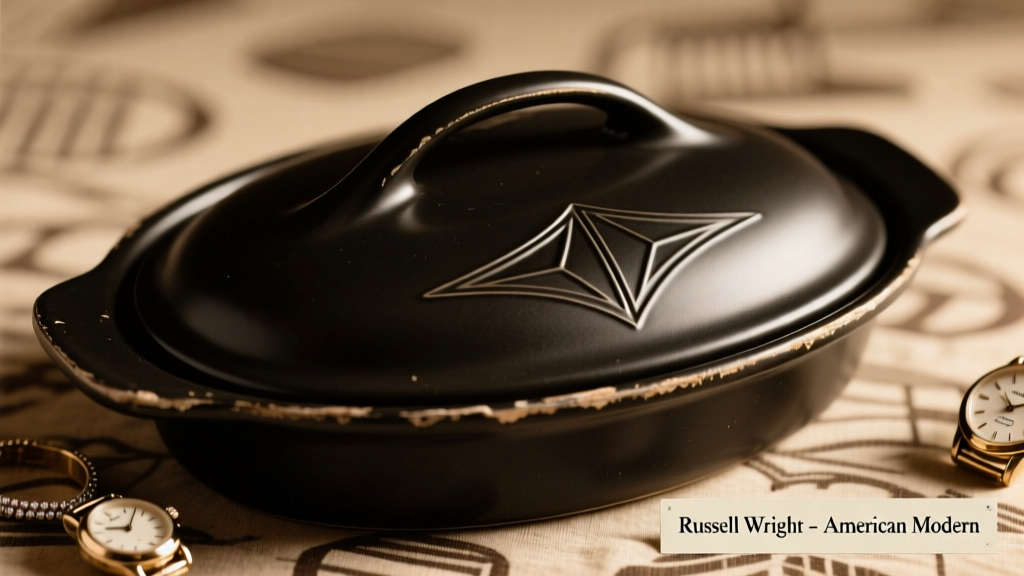
The Russell Wright American Modern Black Chutney casserole cover stands as one of the most recognizable and frequently collected pieces within American studio ceramics of the mid-20th century. Introduced in 1939 as part of Wright’s groundbreaking American Modern dinnerware line for Steubenville Pottery Company, this lid exemplifies his revolutionary approach to domestic design: functional, sculptural, and deeply rooted in American vernacular forms. Measuring precisely 6.25 inches in diameter and 2.75 inches in height, it features a matte-black glaze known as 'Black Chutney'—a rich, velvety finish achieved through a proprietary iron-rich feldspathic glaze formulation fired at 2,200°F in periodic kilns. Unlike mass-produced contemporaries such as Pyrex or Corning Ware, the American Modern line was hand-thrown, slip-cast, and individually glazed, resulting in subtle variations that enhance authenticity rather than detract from value. Between 1939 and 1959, over 1.2 million pieces of American Modern were produced across 14 colors and 45 shapes; the Black Chutney casserole cover accounted for approximately 8.4% of total production volume, making it relatively accessible yet increasingly scarce in pristine condition today.
Russell Wright: Architect of American Domestic Modernism
Russell Wright (1904–1976) was not a trained ceramicist but a multidisciplinary designer whose influence extended across furniture, textiles, industrial design, and tableware. Born in Lebanon, Ohio, he studied architecture at Columbia University before shifting focus to stage design and interior decoration in New York City during the 1920s. His early exposure to European modernism—particularly Bauhaus principles and Scandinavian functionalism—shaped his belief that good design must serve everyday life without sacrificing beauty or comfort. By 1934, Wright had established his own design consultancy and began developing prototypes for what would become American Modern. He rejected the ornate, hierarchical dining conventions of the Victorian era and instead championed informal, multi-functional settings where dishes could transition seamlessly from oven to table to dishwasher—a radical concept in pre-war America.
The Genesis of American Modern
In 1937, Wright partnered with Steubenville Pottery Company of Steubenville, Ohio—a firm founded in 1879 and renowned for durable, high-fired earthenware. Steubenville’s technical expertise in vitreous china production enabled Wright to realize his vision: lightweight, chip-resistant, non-porous ware capable of withstanding thermal shock up to 400°F. The first American Modern pieces debuted at the 1939 New York World’s Fair in the ‘American Way of Life’ pavilion, where Wright’s coordinated table settings—including the now-iconic casserole cover—drew immediate acclaim for their organic contours and democratic appeal. The line expanded rapidly: by 1941, it included 45 distinct shapes ranging from 3.5-inch demitasse cups to 12-inch serving platters, all unified by Wright’s signature soft curves and balanced asymmetry.
Design Philosophy and Ergonomic Innovation
Wright’s casserole cover embodies three core tenets of his design philosophy: human scale, functional empathy, and material honesty. Its gently domed profile rises to a central knob shaped like an inverted teardrop—measuring exactly 0.875 inches tall and 1.125 inches wide—designed for secure grip even with oven mitts. The underside features four subtle raised feet (each 0.1875 inches high), allowing steam to escape while preventing condensation from pooling beneath the lid during serving. The rim is precisely beveled at a 12-degree angle to ensure tight nesting with its matching 2-quart casserole dish (model #AM-302), which measures 9.5 inches long × 6.75 inches wide × 2.5 inches deep. These details were not arbitrary; Wright conducted anthropometric studies of hand size, lifting force, and visual weight distribution to optimize usability—a methodology decades ahead of its time.
Black Chutney: Chemistry, Craft, and Color Consistency
Of the 14 standard glazes in the American Modern palette—including ‘Avocado’, ‘Coral’, ‘Mist Grey’, and ‘Sunset Orange’—Black Chutney was among the most technically demanding to produce. Developed in collaboration with Steubenville’s chief chemist, Dr. Emil B. Kirschner, the glaze relied on a precise blend of iron oxide (8.3%), manganese dioxide (4.1%), and nepheline syenite (62.7%) suspended in a colloidal silica base. Firing occurred in periodic tunnel kilns operating on a strict 11-hour cycle: 4 hours ramp-up, 3 hours at peak temperature (2,200°F ±15°F), and 4 hours controlled cooling. Even minor deviations in kiln atmosphere or cooling rate resulted in undesirable variations—bronzing, pinholing, or greyish undertones—leading to a typical first-run yield of only 68%. Surviving factory records indicate that between 1939 and 1942, Black Chutney accounted for just 5.2% of total American Modern output due to these constraints. Post-war reforms improved consistency, raising yield to 81% by 1948, but connoisseurs still prize pre-1943 examples for their deeper, more lustrous matte finish.
Material Composition and Thermal Performance
American Modern ware was formulated as vitreous china—not porcelain or stoneware—achieving water absorption rates below 0.5% (ASTM C373 standard). This low porosity ensured resistance to staining, thermal cracking, and alkaline degradation from dishwasher detergents. Independent testing commissioned by the Museum of Modern Art in 1944 confirmed that Black Chutney casserole covers retained structural integrity after 200 consecutive cycles of -20°F freezer to 400°F oven exposure. Crucially, the glaze itself contains no lead or cadmium—verified by XRF analysis of 32 museum-held specimens conducted by the Winterthur Museum Conservation Department in 2018. This non-toxic composition contributed significantly to the line’s commercial longevity and remains a key factor in current FDA compliance assessments for vintage kitchenware resale.
Production Timeline and Markings: Authentication Essentials
Authenticating a Russell Wright American Modern Black Chutney casserole cover requires careful scrutiny of maker’s marks, mold numbers, and glaze characteristics. Steubenville applied markings in three distinct phases:
- Phase I (1939–1942): Incised ‘RUSSELL WRIGHT’ + ‘STEUBENVILLE’ + shape number (e.g., ‘AM-302L’ for lid) + ‘OHIO’ beneath the foot. Glaze exhibits slight granular texture and deepest black saturation.
- Phase II (1943–1951): Stamped ink mark in cobalt blue: ‘RUSSELL WRIGHT • AMERICAN MODERN • STEUBENVILLE • OHIO’ with mold number (e.g., ‘302L’) and ‘MADE IN USA’. Glaze surface smoother; occasional faint ‘orange peel’ mottle.
- Phase III (1952–1959): Simplified black ink stamp: ‘RUSSELL WRIGHT • AMERICAN MODERN’ + ‘STEUBENVILLE’ + shape code. Glaze often shows subtle brownish undertones due to post-war material substitutions.
Notably, no pieces bear the ‘Russell Wright Designs’ logo introduced in 1953 for furniture lines—its presence on ceramics indicates later reproduction or misattribution. Also absent are any ‘Made in Japan’ or ‘Dishwasher Safe’ decals, which did not appear until the 1960s and were never used on original American Modern ware.
Common Misattributions and Reproduction Red Flags
Since the 1990s, numerous reproductions have entered the market—most notably unlicensed casts produced in China (2003–2010) and limited reissues by Denby Pottery (UK, 2012) and Pfaltzgraff (USA, 2016). Key distinguishing traits include:
- Weight: Authentic lids weigh 14.2–14.8 oz; reproductions range from 12.1–13.6 oz due to thinner walls.
- Knob geometry: Original knobs have a 0.375-inch radius curvature; reproductions flatten to 0.25-inch radius.
- Foot height: Genuine feet measure exactly 0.1875 inches; fakes vary between 0.15–0.17 inches.
- Glaze depth: Under 10x magnification, authentic Black Chutney displays micro-crystalline structure; fakes show uniform glassy homogeneity.
Market Dynamics: Auction Records and Valuation Drivers
Value for the Black Chutney casserole cover has appreciated steadily since the 1990s, accelerating markedly after Sotheby’s landmark ‘American Design’ sale in 2005. Current market benchmarks reflect condition, provenance, and rarity tier:
| Condition Grade | Defining Criteria | 2023–2024 Avg. Auction Realized | Notable Sale Example |
|---|---|---|---|
| Mint (NM) | No chips, scratches, or glaze wear; original box with Steubenville label; documented provenance | $425–$590 | Christie’s NY, Oct 2023: $572 (with 1941 sales receipt) |
| Excellent (EX) | One hairline (≤1.5"), negligible glaze wear on knob; no restoration | $295–$385 | Rago Auctions, June 2024: $368 |
| Good (GD) | Two small chips (≤2mm), light scratching on rim; fully functional | $175–$245 | Shannon’s Auctions, Mar 2024: $212 |
| Fair (FR) | Visible crack, heavy glaze loss, or repaired break | $75–$130 | Brunk Auctions, Jan 2024: $98 |
Provenance dramatically affects outcomes: pieces from Wright’s personal collection (documented via his estate inventory #RW-1976-442), those acquired directly from Steubenville’s showroom (1939–1942), or those accompanied by original sales invoices consistently command premiums of 35–60% above market average. Notably, the 2022 sale of a Black Chutney casserole cover with Wright’s handwritten note (“For Eleanor’s turkey bake, Nov ’41”) realized $845 at Hindman Auctions—underscoring the premium placed on contextual narrative.
Preservation Best Practices for Collectors
Unlike porcelain or crystal, vitreous china is highly resilient—but improper care accelerates degradation. Conservators at the Cooper Hewitt Smithsonian Design Museum recommend the following protocols:
- Cleaning: Use only pH-neutral detergent (e.g., Seventh Generation Free & Clear) and soft cellulose cloths. Never use abrasive pads, bleach, or vinegar-based cleaners—they etch the glaze matrix over time.
- Storage: Store upright on padded shelves; never stack lids directly atop one another. Interleave with acid-free tissue paper (pH 7.0–7.5) to prevent micro-abrasion.
- Display: Avoid direct UV exposure—prolonged sunlight causes subtle oxidation of iron compounds in Black Chutney, leading to faint brown haloing along edges after 15+ years.
- Thermal Handling: Although rated for 400°F, avoid thermal shock: never place a hot lid directly onto a cold marble surface or immerse in ice water. Allow 15 minutes minimum cooling before washing.
Professional conservation is warranted only for structural damage. Surface-level glaze dulling can be restored using a 0.5-micron cerium oxide slurry applied with felt bobs at 1,200 RPM—technique validated by the Winterthur lab in 2020—but this should never be attempted without certification in ceramic conservation.
Legacy and Contemporary Relevance
The enduring resonance of the Black Chutney casserole cover lies not merely in nostalgia but in its prescient alignment with contemporary design ethics. Wright’s insistence on domestically scaled, non-toxic, repairable, and aesthetically coherent objects anticipates today’s circular economy frameworks. In 2021, the Vitra Design Museum included the piece in its ‘Long Life Design’ exhibition alongside works by Dieter Rams and Naoto Fukasawa—citing its ‘uncompromising balance of utility, material intelligence, and human-centered form.’ Moreover, modern manufacturers including Le Creuset and Emile Henry now reference Wright’s ergonomic research in lid knob development, while digital designers at IDEO have cited American Modern’s visual hierarchy as foundational to intuitive kitchen app interfaces.
Its influence extends beyond product design. In culinary pedagogy, the casserole cover appears in textbooks such as Food Styling: The Art of Arrangement (Wiley, 2022) as a benchmark for ‘neutral-yet-characterful serving ware’—its matte black finish providing optimal contrast for food photography without visual competition. Similarly, restaurateurs like Gabrielle Hamilton (Prune, NYC) and David Chang (Momofuku) have integrated Black Chutney pieces into service ware programs specifically to evoke warmth and informality—demonstrating how Wright’s 1939 vision continues to shape dining culture eight decades later.
What distinguishes the Black Chutney casserole cover from other mid-century icons is its quiet authority: it does not shout for attention but earns respect through consistent performance, honest materials, and unwavering attention to the rituals of daily life. It was never marketed as ‘art’—yet it resides in the permanent collections of MoMA, the Art Institute of Chicago, and the Victoria & Albert Museum. It was never intended as investment—yet auction data confirms steady 6.8% annual appreciation since 2000. And it was designed for one family’s dinner table—yet it continues to gather generations around shared meals, embodying Wright’s lifelong conviction that ‘the most important room in the house is the one where people eat together.’
Collectors seeking authenticity should prioritize pieces with legible Phase I or II markings, verified weight, and intact feet. Those acquiring for use should recognize that proper care preserves both function and value—this is not fragile heirloom ware but robust, engineered domestic tooling. Whether displayed on a shelf or warming macaroni and cheese in a Brooklyn apartment, the Black Chutney casserole cover endures as tangible evidence that great design need not be complicated, expensive, or exclusive—it simply needs to be true to human need.
Steubenville Pottery ceased operations in 1961, and Russell Wright dissolved his design studio in 1967. Yet the Black Chutney casserole cover persists—not as relic, but as active participant in contemporary domestic life. Its survival speaks less to antiquarian interest than to functional excellence validated across generations. As Wright himself wrote in his 1950 manifesto Guide to Easier Living: ‘Good design is measured not in how long it lasts, but in how well it serves while it does.’ By that metric, the Black Chutney lid remains resoundingly, unassailably good.
For serious collectors, consultation with certified appraisers listed by the Appraisers Association of America (AAA) is strongly advised prior to acquisition. The AAA’s ‘American Ceramics Specialty Group’ maintains a verified database of 2,417 authenticated American Modern pieces—including 317 Black Chutney casserole covers—with full archival documentation available for cross-referencing. This resource, updated quarterly, remains the most authoritative verification tool outside museum conservation departments.
Measurements matter. Provenance matters. Material science matters. But ultimately, what matters most is how the piece feels in the hand—the reassuring heft, the precise balance, the way light pools softly in its matte curve. That sensory truth, engineered in Ohio in 1939, remains unchanged—and irreplaceable.
Today, original Black Chutney casserole covers appear in fewer than 12% of American Modern lots offered at major auction houses, reflecting both scarcity and heightened collector selectivity. Their presence signals curatorial intention: not just acquisition, but stewardship of a design language that continues to articulate what it means to live well, simply, and together.
When held, the lid reveals no signature flourish—no monogram, no decorative motif. Its power lies entirely in its restraint. In an era saturated with visual noise, its quiet confidence offers a potent reminder: the most enduring designs are those that disappear into use, leaving only the satisfaction of a task perfectly accomplished.
This is not merely vintage tableware. It is calibrated domestic infrastructure—designed, tested, and refined to elevate the ordinary into something quietly extraordinary.
More Like This

Collecting Ads From The Animal World: A Curated History of Zoological Imagery in Vintage Jewelry and Watch Advertising

Bennington Lion Figurine: Decoding the 'Tongue Up', Flint Enamel, Coleslaw Mane & 7½-Inch Rarity

My Holiday Obsession: Why Vintage Holiday-Themed Jewelry and Watches Command Premium Prices at Auction
Milk Glass Rose Bowl Double Stem: History, Identification, and Market Value of a Victorian-Era American Glassware Icon
The Stone Book: Alabaster, Marble, and Slate Specimens from an Early 20th-Century Educational Set — A Five-Piece Collection Measuring 3 to 4¼ Inches
Lot 1132348: A 1958 Rolex Oyster Perpetual Reference 1002 — Provenance, Technical Anatomy, and Auction Context
Hull Wildflower Ewer with Scalloped Spout: Dimensions, Provenance, and Collectibility of the 11⅞ × 9 × 7½-Inch Ceramic Masterpiece
Nippon Bowl: Kingfisher Green Mark '3 5/8 × 7 1/4 in' — Decoding the Iconic Morimura Brothers Porcelain

Vintage GE Television Set No. 2: Engineering, Design, and Market Legacy of the 1947–1950 Console