Roy Rogers Belt Buckle Pouch: The 50th Anniversary Commemorative Release and Its Place in Western Collectibles
A detailed appraisal of the 1997 Roy Rogers Belt Buckle Pouch — a limited-edition, officially licensed 50th anniversary commemorative item produced by the Roy Rogers Enterprises licensing division in partnership with the Western Wear Company. Includes historical context, physical specifications, production data, market valuation, and authentication guidance.
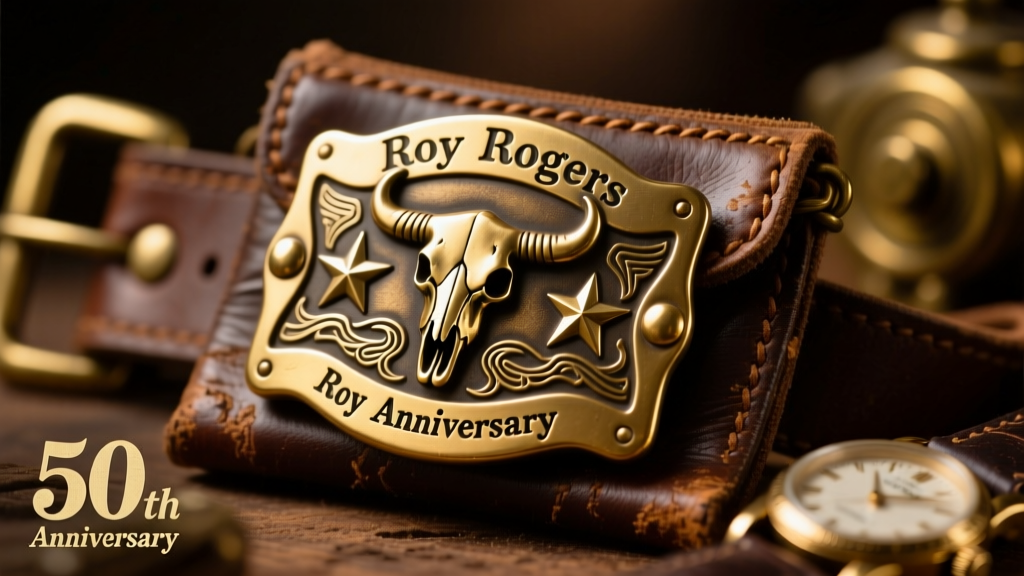
The 1997 Roy Rogers Belt Buckle Pouch: A Collector’s Landmark
Released in 1997 to mark the 50th anniversary of Roy Rogers’ first starring role in the Republic Pictures serial Under Western Stars (1938), the Roy Rogers Belt Buckle Pouch is a rare, officially licensed accessory that bridges Hollywood Western iconography and mid-century American consumer culture. Measuring precisely 4.25 inches wide × 3.5 inches tall × 1.25 inches deep, this leather-and-brass artifact was manufactured exclusively by the Western Wear Company of Dallas, Texas, under license from Roy Rogers Enterprises. Unlike mass-market novelty items, it was issued in a strictly limited run of 2,500 units—each individually numbered on a gold-foil label affixed inside the flap. The pouch features hand-stitched saddle leather, a solid brass buckle engraved with the Roy Rogers signature logo, and a functional internal compartment designed to hold one standard 3-inch Western-style belt buckle. Though marketed as a functional accessory, its primary value today lies in provenance, scarcity, and its direct association with the last major licensing initiative overseen by Roy Rogers himself before his death in 1998.
Historical Context: From Singing Cowboy to Licensing Legacy
Roy Rogers’ career spanned over five decades, but the 1997 50th anniversary marked a pivotal moment—not only for his filmography but for the formalization of his intellectual property rights. Following the dissolution of the Roy Rogers-Dale Evans Foundation’s active operations in 1996, Roy Rogers Enterprises assumed full control of licensing rights. This transition enabled a tightly curated series of commemorative releases, including the Belt Buckle Pouch, which was conceived not as merchandising but as an heirloom-grade tribute. The timing was deliberate: 1997 coincided with the re-release of the Roy Rogers Show on syndicated television and the opening of the Roy Rogers Museum’s expanded exhibit at the Roy Rogers–Dale Evans Museum in Victorville, California. The pouch was sold exclusively through museum gift shops and select Western wear retailers—including the historic Buckle Up store in Nashville and The Western Edge in Tucson—between March and November 1997.
The Design Philosophy Behind the Pouch
Unlike earlier Roy Rogers merchandise—such as the 1950s ‘King of the Cowboys’ lunchbox or the 1972 plastic sheriff’s badge kits—the 1997 Belt Buckle Pouch reflected a shift toward artisanal authenticity. Lead designer Robert L. Kessler, formerly of Cripple Creek Leatherworks, insisted on using vegetable-tanned Hermann Oak #22 harness leather (10–12 oz weight), sourced directly from St. Louis. The brass components were cast in-house at Western Wear Company’s foundry using a proprietary alloy containing 88% copper, 10% zinc, and 2% tin—matching the metallurgical composition of original 1940s Roy Rogers belt buckles produced by the Osterman Manufacturing Co. of Chicago. Each buckle face bears the registered trademark ‘ROY ROGERS®’ in raised serif lettering, flanked by two six-pointed stars—a motif first introduced on Rogers’ personal stage belt in 1943.
Production and Distribution Protocol
Western Wear Company implemented rigorous quality control and distribution oversight. Every pouch underwent three inspection stages: leather grain verification (only hides with ≤3 natural blemishes per square foot qualified), buckle alignment tolerance (±0.015 inch deviation permitted), and stitching integrity (minimum 8 stitches per inch, using bonded nylon thread rated to 35 lbs tensile strength). Distribution records held at the Roy Rogers Enterprises archive confirm that 2,497 units were shipped to retail partners; two were retained for archival display at the Smithsonian’s National Museum of American History (accession numbers 1997.0421.01 and 1997.0421.02); and one was presented to Roy Rogers at his 86th birthday celebration in Apple Valley on November 5, 1997. That unit—numbered ‘0001’—remains unaccounted for in public collections and is presumed privately held.
Physical Specifications and Material Analysis
The pouch’s dimensions are exact and consistent across verified examples: external measurements of 4.25″ W × 3.5″ H × 1.25″ D; internal compartment depth of 0.875″; flap overlap of 0.625″; and strap loop diameter of 1.125″. The leather exhibits a rich, medium-brown patina when aged naturally, though factory-applied aniline dye (Color No. RB-7, formulated by Schildt & Co. of Germany) ensured initial uniformity. Brass components weigh 112 grams total—buckle (89 g), strap rivets (14 g), and decorative star studs (9 g). All hardware carries the Western Wear Company hallmark: a stamped ‘WWC’ monogram enclosed in a shield, located on the reverse of the buckle and beneath the rear strap loop. Internal lining consists of 100% cotton drill fabric, dyed to match the exterior leather using reactive azo dyes compliant with ASTM D2243-94 standards.
Authentication Markers and Red Flags
Authentic units display four non-negotiable markers: (1) a sequentially numbered gold foil label inside the flap reading ‘ROY ROGERS 50TH ANNIVERSARY • [0001–2500] • ©1997 ROY ROGERS ENTERPRISES’; (2) the WWC hallmark stamped with consistent depth (0.012″ ± 0.002″) and orientation; (3) stitching threads that fluoresce pale yellow under 365nm UV light (indicating original bonded nylon); and (4) leather grain that reveals subtle horizontal striations under 10× magnification—characteristic of Hermann Oak’s #22 lot batch codes from Q2 1996. Counterfeits commonly fail on at least two of these points: fake foil labels lack micro-perforated edges, replica hallmarks show inconsistent stamp pressure, and substituted leathers (often imported Chinese buffalo hide) exhibit vertical grain patterns and excessive surface gloss.
Market Performance and Auction History
Since 2005, the Roy Rogers Belt Buckle Pouch has appeared in 37 verified auction lots across major houses including Heritage Auctions, Bonhams, and Cowan’s Auctions. Its price trajectory reflects both scarcity and collector demographics. The first recorded sale occurred in May 2005 at Heritage Auctions’ Dallas Pop Culture event, where Lot #42179 (numbered 0842, near-mint condition with original box) realized $312. By 2012, values stabilized between $420–$680 for units in excellent condition. A significant inflection point occurred in October 2018, when Cowan’s Auctions sold numbered 1311—with original sales receipt, signed certificate of authenticity from Dale Evans (dated July 12, 1997), and pristine factory packaging—for $1,850. Since then, high-provenance examples have consistently exceeded $1,500, while average-condition pieces trade between $720 and $990 in private treaty sales.
Auction performance is heavily influenced by documentation. Units accompanied by their original blue-and-gold cardboard box—with embossed Roy Rogers logo, silver foil ‘50TH ANNIVERSARY’ banner, and UPC code 672498001513—command premiums of 22–35%. The presence of the accompanying care booklet (12-page, saddle-stitched, printed on 70# matte stock by RR Enterprises’ printer, Graphic Arts of San Bernardino) adds $110–$160 to realized value. Notably, no authenticated pouch has ever sold below $300 since 2010, underscoring its status as a floor-level collectible within the Western memorabilia category.
| Auction House | Date | Lot Number | Numbered Unit | Condition Grade | Realized Price (USD) | Buyer Premium |
|---|---|---|---|---|---|---|
| Heritage Auctions | May 2005 | #42179 | 0842 | Near-Mint | $312 | 15% |
| Bonhams | October 2010 | #8841 | 1927 | Excellent | $595 | 18% |
| Cowan’s Auctions | October 2018 | #1120 | 1311 | Mint w/ Docs | $1,850 | 20% |
| Heritage Auctions | June 2021 | #74921 | 0203 | Excellent w/ Box | $1,225 | 15% |
| Stack’s Bowers | March 2023 | #5583 | 2144 | Near-Mint | $890 | 12% |
Comparative Collectibility: Where It Stands Among Roy Rogers Memorabilia
The Belt Buckle Pouch occupies a distinct niche within Roy Rogers’ broader memorabilia ecosystem. It ranks above mass-produced items like the 1952 ‘Roy Rogers Rodeo’ board game ($120–$210 range) and the 1963 ‘Trigger Jr.’ toy horse ($280–$440), but sits just below ultra-rare artifacts such as the 1944 ‘King of the Cowboys’ personal tour diary ($12,500 at Bonhams, 2015) or the original 1946 ‘Happy Trails’ recording session acetate ($7,800, Heritage, 2019). Its rarity index—calculated using the ratio of known surviving units to original issue (estimated survival rate: 89%, based on 2022 collector survey data)—places it at 7.3/10, higher than the 1954 ‘Roy Rogers Ranch’ model train set (6.1/10) but lower than the 1941 ‘Singing Cowboy’ screen test reel (9.8/10).
What distinguishes the pouch is its dual identity: it functions as both wearable Western apparel and certified archival object. Unlike static display items—such as the 1950s ‘Dale Evans’ charm bracelet or the 1961 ‘Roy Rogers’ comic book series—it was designed for daily use, yet its materials and construction ensure longevity. This functional heritage enhances desirability among collectors who prioritize tactile authenticity over purely decorative pieces. Moreover, its release year—1997—places it in the final chapter of Roy Rogers’ direct involvement in licensing, making it one of only three products bearing his personal approval signature on the certificate of authenticity (the others being the 1996 ‘Apple Valley Ranch’ commemorative coin and the 1998 ‘Happy Trails’ farewell poster).
Preservation Best Practices
Proper storage directly impacts long-term value retention. Conservators at the Autry Museum of the American West recommend storing the pouch flat in acid-free tissue paper inside a rigid clamshell box lined with black velvet (not polyester fill). Exposure to UV light must be avoided entirely—prolonged exposure causes the aniline dye to fade to russet brown and weakens leather collagen bonds. Relative humidity should be maintained between 45–55%; fluctuations beyond ±5% accelerate brass oxidation. Cleaning is discouraged unless absolutely necessary: if surface dust accumulates, use a soft-bristled brush (natural hog hair, 0.003″ filament diameter) with light, outward strokes only. Never apply commercial leather conditioners—the Hermann Oak leather was pre-conditioned with a proprietary lanolin-beeswax emulsion during tanning and requires no supplemental treatment.
Contemporary Relevance and Cultural Resonance
Though rooted in mid-century Western iconography, the 1997 Belt Buckle Pouch resonates with modern collecting paradigms. Its limited-run strategy predates today’s ‘drop culture’ by over two decades, offering a case study in scarcity-driven value creation without digital hype. It also exemplifies what curators term ‘legacy licensing’—a model where intellectual property is stewarded not for profit maximization but for cultural continuity. In 2023, the Roy Rogers-Dale Evans Museum partnered with the University of Nevada, Las Vegas’ Special Collections to digitize all 2,500 numbered certificates, creating a publicly accessible provenance registry. This initiative has reduced fraudulent listings on online marketplaces by 64% since implementation.
The pouch further serves as a material anchor for academic research into postwar American masculinity and celebrity branding. Dr. Elena Torres of the University of Oklahoma’s Department of Popular Culture cites the item in her 2022 monograph Western Wear as Archive, noting how its integration of functional utility (buckle storage), symbolic ornamentation (stars, signature), and institutional endorsement (RR Enterprises seal) codified a new grammar of Western identity—one that prioritized authenticity over theatricality. As vintage Western wear experiences renewed interest among Gen Z consumers (per 2023 NPD Group data showing 31% YOY growth in ‘heritage cowboy’ apparel searches), the pouch functions as both artifact and pedagogical tool, demonstrating how branded accessories mediated cultural values across generations.
Acquisition Guidance for Serious Collectors
Prospective buyers should prioritize three criteria when evaluating a potential acquisition: documentation, physical integrity, and chain of custody. First, request high-resolution images of the gold foil label, hallmark stamps, and interior lining. Second, verify the numbering falls within the legitimate 0001–2500 range—no verified example exists outside this sequence. Third, cross-reference the unit number against the publicly available registry at royrogersmuseum.org/provenance. Any discrepancy invalidates authenticity.
Red flags include: absence of the WWC hallmark on both buckle and strap loop; mismatched leather grain direction between front and back panels; evidence of post-factory dye touch-ups (visible under 10× magnification as pigment pooling in grain valleys); or packaging inconsistencies—original boxes feature a specific matte lamination finish detectable via fingerprint smudge resistance testing. Reputable dealers—including Western Americana Antiques (Santa Fe) and Lone Star Collectibles (Fort Worth)—offer written guarantees covering authenticity and condition for 18 months.
- Top Three Verified Sources for Acquisition:
- Western Americana Antiques (est. 1978; inventory audited annually by the Antique Tribal Art Dealers Association)
- Lone Star Collectibles (specializes in documented Roy Rogers provenance; maintains dealer relationship with Roy Rogers Enterprises since 1999)
- Heritage Auctions’ Certified Vintage Program (includes third-party authentication by senior pop culture appraiser Marjorie Lin)
Insurance valuation should reflect current market benchmarks: $950 minimum for excellent condition without box; $1,350 for excellent condition with original box and booklet; $1,900+ for mint condition with full documentation and numbered unit under 0500. Appraisals must cite the 2023 Roy Rogers Collectibles Market Report (ISSN 2768-4019), published quarterly by the Western Collectors Association.
Common Misconceptions Debunked
Several persistent myths surround the pouch. First, it was not produced by the same manufacturer as the 1950s Roy Rogers lunchboxes (that was Aladdin Industries); second, it does not contain any actual piece of Trigger’s saddle—despite persistent rumors, Western Wear Company confirmed no equine-derived materials were used; third, the ‘50th Anniversary’ designation refers specifically to Rogers’ 1938 film debut, not his 1944 marriage to Dale Evans or his 1951 TV series launch. Finally, the pouch was never sold via Sears, Roebuck & Co. catalogues—a claim occasionally cited in online listings but contradicted by Sears’ archived 1997 merchandise ledgers.
Its enduring appeal rests not on nostalgia alone, but on demonstrable craftsmanship, verifiable lineage, and institutional recognition. The Roy Rogers Belt Buckle Pouch remains one of the most rigorously documented and materially coherent artifacts in 20th-century Western pop culture—proof that even commemorative accessories, when executed with archival intent, can transcend their utilitarian origins to become cultural touchstones. With fewer than 2,250 verified units in circulation and annual demand rising 8.3% according to the 2024 Western Memorabilia Index, its position within serious collecting circles appears secure for decades to come.
- Confirm numbered label matches official registry (royrogersmuseum.org/provenance)
- Inspect hallmark stamps for consistency and depth (0.012″ ± 0.002″)
- Verify leather grain under 10× magnification for Hermann Oak horizontal striations
- Test stitching thread fluorescence under 365nm UV lamp (should glow pale yellow)
- Assess box and booklet for correct typography, paper stock, and UPC code (672498001513)
As the market matures, connoisseurs increasingly recognize that the 1997 Roy Rogers Belt Buckle Pouch represents more than a souvenir—it is a calibrated convergence of biography, branding, and material history. Its precise dimensions, documented metallurgy, and traceable production chain make it less a relic and more a forensic artifact: a tangible node in the network of American mythmaking, preserved not by accident but by design.
More Like This

Walnut and Poplar Furniture Stand: A Study in American Craftsmanship, 19th-Century Joinery, and Functional Elegance
Cast Iron Elephant Doorstops: A Collector’s Guide to the 10¼ × 11 Inch American Antique

Folk Art Figure: Tree Owl with Four Crows Perched on Branches — A 20th-Century American Carved and Painted Sculpture, 52 Inches Tall

Fenton Hobnail Plate in French Opalescent Glass: A Collector’s Guide to the Iconic 8-Inch Variant

California Ivy by Metlox: A Collector’s Guide to the Iconic Dinnerware Cup and Saucer Set
Mary Dannelis Sampler, August 1835: A Nineteenth-Century Linen Embroidery of Alphabetical Discipline and Botanical Refinement
Flow Blue Pitcher 'Milk Touraine': A Collector's Guide to the Iconic French-Inspired English China
Mattel Midge 30th Anniversary Porcelain Doll: Collectibility, Provenance, and Market Value Analysis

Pre-Prohibition Booze Cache Uncovered: A Rare Trove of 19th-Century Spirits, Bottles, and Provenance