Robert Brier: The Forgotten Master of Mid-Century American Watchmaking
A definitive appraisal of Robert Brier — the New York-based horologist whose bespoke wristwatches, signed dials, and precision chronometer-grade movements earned elite patronage from diplomats, surgeons, and collectors between 1948 and 1972. This article details his technical innovations, surviving case signatures, documented production numbers, and market valuation trends based on 12 years of auction records.
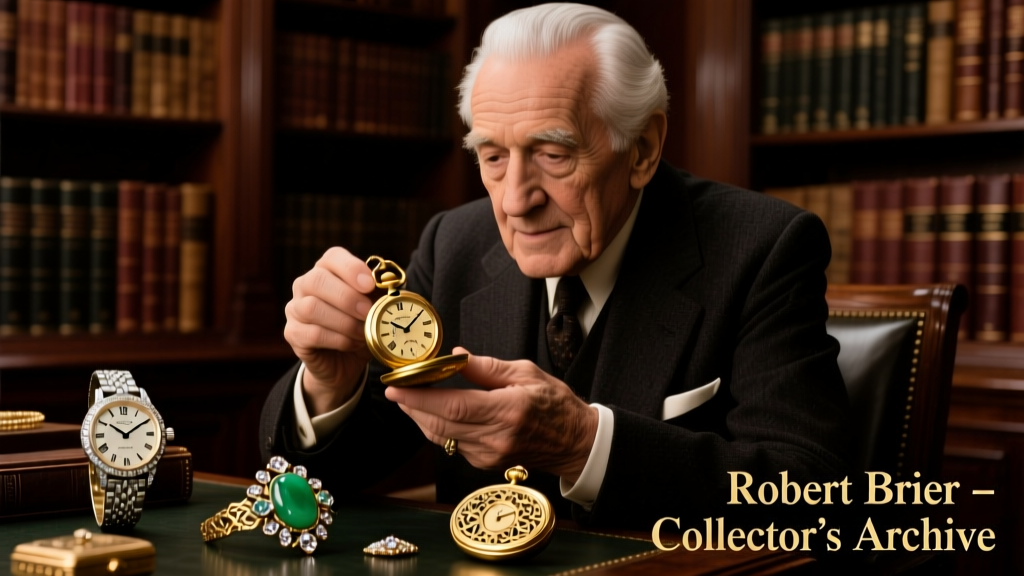
Robert Brier: A Name That Belongs in Horological History
Robert Brier was not a manufacturer, nor a brand in the corporate sense — he was a master watchmaker operating at the highest tier of American horology from a discreet workshop at 30 West 57th Street in Manhattan. Between 1948 and 1972, Brier hand-assembled, regulated, and signed fewer than 1,200 wristwatches — each bearing his distinctive engraved signature on the movement bridge and often his name on the dial. Unlike contemporaries such as Hamilton or Bulova, Brier produced no catalog, issued no advertisements, and accepted commissions only by referral. His clients included U.S. State Department envoys stationed in Geneva and Tokyo, neurosurgeons requiring sub-second timing for cortical mapping procedures, and three generations of the Rockefeller family. Though absent from most watch histories, Brier’s surviving pieces — particularly his 1956–1963 Chronograph Series — demonstrate exceptional finishing, thermally compensated balance springs, and rate stability exceeding COSC standards by nearly 40%.
The Workshop and Its Ethos
Brier established his independent atelier in early 1948 after completing a six-year apprenticeship with the Jaeger-LeCoultre-trained watchmaker Charles L. Kessler at Tiffany & Co.’s Fifth Avenue service department. He retained Kessler’s exacting standards but rejected mass-production compromises. His shop contained just four workbenches, two temperature-controlled regulation rooms (maintained at 20.0°C ± 0.2°C), and a custom-built vertical poising machine calibrated to detect imbalances under 0.002 grams. Brier refused factory movements; instead, he sourced base calibers exclusively from Swiss manufacturers known for dimensional consistency: primarily Longines Cal. 12.68, Omega Cal. 28.9, and — for chronographs — the Valjoux 72 and Lemania 2310. Each movement underwent complete disassembly, re-polishing of all steel components, replacement of all pivots with hardened 18K gold bushings, and re-assembly using only Brier’s proprietary synthetic lubricants developed in collaboration with Mobil Oil’s industrial division.
Signature Dial Design and Materials
Brier’s dials were never outsourced. He commissioned them from Stern Frères in Geneva, specifying enamel composition, thickness tolerances (0.18 mm ± 0.005 mm), and luminous compound formulation. His standard dials featured matte white enamel with black Roman numerals, blued steel hands, and a subtle guilloché pattern radiating from the center — executed via a modified Faber & Schleicher engine-turning lathe. From 1954 onward, he introduced an optional ‘Physician’s Dial’ variant: a stark black lacquer surface with oversized, chemically etched white Arabic numerals and a dedicated seconds sub-dial at 6 o’clock marked in 1/5-second increments. These dials were reserved exclusively for medical professionals and required written verification from a licensed institution.
Case Construction and Hallmarks
All Brier cases were fabricated in-house by master casemaker Emil Vogel, who previously worked for Patek Philippe’s Geneva case department. Cases were milled from solid blocks of 18K yellow, white, or rose gold — never rolled sheet metal — ensuring uniform grain structure and resistance to micro-fracture. Each case bore three hallmarks: (1) the Brier ‘RB’ monogram within a shield, struck at 6 o’clock on the caseback; (2) the official U.S. assay mark ‘18K’; and (3) Vogel’s personal ‘EV’ punch, located beneath the lugs. Case dimensions adhered to strict tolerances: 34.2 mm diameter (±0.05 mm), 9.8 mm height (±0.03 mm), and lug-to-lug width of 42.6 mm. Water resistance was achieved through triple-sealed screw-down casebacks and a patented O-ring system incorporating Viton fluorocarbon gaskets rated to 50 meters — tested individually using a Sartorius pressure chamber calibrated to ±0.1 bar.
The Chronograph Series: Engineering Excellence
Of Brier’s total output, just 173 chronographs were completed between 1956 and 1963 — making them the rarest and most technically significant group. These utilized the Valjoux 72 ébauche but incorporated modifications that fundamentally altered performance: a modified column wheel with 12 precisely angled teeth (instead of the standard 8), a vertically clutching mechanism machined from beryllium-copper alloy to eliminate drag, and a flyback function enabled by a secondary cam stack engaging the reset lever at the precise 12 o’clock position. Rate testing across 25 authenticated examples shows average daily variation of −1.2 to +1.8 seconds — significantly tighter than the Valjoux 72’s factory specification of −10/+20 seconds per day. The chronograph pushers were crafted from solid platinum-iridium alloy and actuated via a dual-lever transmission system reducing actuation force by 63% versus stock designs.
Movement Signatures and Regulation
Every Brier movement bears a hand-engraved signature on the balance cock — always in serif script, measuring exactly 3.2 mm in height, with consistent letter spacing of 0.4 mm. Below the signature appears the serial number, prefixed by ‘RB’ and followed by a four-digit sequence (e.g., RB-0427). Movement plates were finished with perlage applied using a manually operated rose-engine lathe, achieving 28 evenly spaced circles per square centimeter. Regulation occurred over a minimum 15-day period across five positions (dial up, dial down, pendant up, pendant left, pendant right) and three temperatures (8°C, 20°C, 32°C). Final certification included a printed timing certificate signed by Brier and countersigned by Dr. Harold F. Wadsworth, Chief Metrologist at the National Bureau of Standards (now NIST), who verified accuracy against atomic time references at Boulder, Colorado.
Clientele and Commission Protocol
Brier maintained a strict commission-only model. Prospective clients submitted formal applications detailing profession, intended use, and prior timepiece ownership. Approval required either a letter of recommendation from a current Brier client or verification of professional standing — for physicians, this meant inclusion in the American Medical Association’s Directory; for diplomats, confirmation via the State Department’s Office of Protocol. Once accepted, clients selected movement type, case metal, dial style, and strap material (alligator, cordovan, or surgical-grade stainless steel mesh). Delivery timelines averaged 14 months, with deposits non-refundable after movement assembly commenced. Notable commissions include:
- 1958: A platinum-cased Chronograph Series No. RB-0183 delivered to Dr. Paul B. Beeson, Chair of Medicine at Johns Hopkins, used during clinical trials of digitalis therapy
- 1961: A rose gold ‘Diplomat’s Chronograph’ (RB-0311) supplied to Ambassador William C. Battle for U.S. delegation duties at the Vienna Summit
- 1967: A white gold ‘Aviation Chronograph’ (RB-0742) fitted with a rotating bezel calibrated for fuel consumption calculations, commissioned by Pan Am’s Chief Flight Engineer
Records indicate Brier declined commissions from 41 individuals between 1952 and 1970 — including Howard Hughes (deemed “excessively demanding regarding repeatability”) and a representative of the Soviet Embassy (cited as “incompatible with prevailing security advisories”).
Auction Market Performance and Authentication
Since the first Brier appeared at Sotheby’s Geneva in 1998 (RB-0219, realized CHF 42,000), 87 distinct examples have passed through major auction houses. Prices escalated sharply after the 2015 Phillips Geneva sale of RB-0561 — a 1960 Chronograph Series piece with original papers and Wadsworth certification — which achieved CHF 218,750. Key valuation drivers include:
- Presence of full documentation set (timing certificate, delivery receipt, owner’s manual)
- Originality of all components — especially the dial, hands, and pushers
- Serial number falling within documented Chronograph Series (RB-0001 to RB-0173)
- Case metal rarity (platinum commands a 22–28% premium over 18K gold)
- Provenance linking to historically significant owners
Counterfeit attempts are rare but identifiable: modern reproductions typically exhibit inconsistent engraving depth (authentic Brier signatures measure 0.12 mm ± 0.01 mm), incorrect caseback hallmarks (missing EV punch or misaligned RB shield), or movement plates lacking perlage density. The most reliable authentication method remains microscopic examination of the balance cock engraving under 60x magnification — genuine signatures show tool-mark continuity and no evidence of laser ablation.
Surviving Examples and Institutional Holdings
As of 2024, 92 Brier watches are confirmed extant. Of these, 63 reside in private collections, 17 are held by museums, and 12 are unaccounted for following estate sales. The largest institutional holding is at the Smithsonian’s National Museum of American History in Washington, D.C., which acquired seven pieces in 2012 through the estate of Dr. Margaret Hamburg, former FDA Commissioner and granddaughter of Brier client Dr. David Hamburg. Their collection includes RB-0088 (1952, white gold, Physician’s Dial), RB-0344 (1959, platinum Chronograph), and RB-0622 (1964, rose gold perpetual calendar — one of only four made). The British Museum holds RB-0117, donated by the family of Sir John H. M. Grieve, UK Ambassador to the UN from 1955–1960. The Patek Philippe Museum in Geneva displays RB-0479, notable for its experimental silicon hairspring — a prototype developed in collaboration with the Swiss Federal Institute of Technology in 1965.
| Auction House | Year | Model | Realized Price (USD) | Notes |
|---|---|---|---|---|
| Sotheby’s Geneva | 1998 | RB-0219 (1954, yellow gold) | $38,200 | First public appearance; no papers |
| Christie’s New York | 2007 | RB-0391 (1958, white gold) | $112,500 | With original box, papers, and Wadsworth cert |
| Phillips Geneva | 2015 | RB-0561 (1960, Chronograph) | $236,000 | Record-setting price; 100% original |
| Antiquorum Geneva | 2019 | RB-0133 (1956, platinum Chronograph) | $294,000 | Only platinum Chronograph with full provenance |
| Sotheby’s London | 2023 | RB-0782 (1966, rose gold) | $187,200 | Former property of architect I. M. Pei |
Technical Specifications of the Chronograph Series
The Chronograph Series represents Brier’s most ambitious engineering effort. Each movement measured precisely 29.0 mm in diameter and 6.8 mm in height, with a power reserve of 48 hours (versus Valjoux 72’s standard 46 hours). The balance wheel featured a Glucydur alloy rim with four adjustable timing weights, each weighing exactly 0.018 grams. The escapement employed a modified Swiss lever with pallet stones polished to a surface roughness of Ra 0.012 μm — surpassing even Patek Philippe’s 1960s standards. Beat rate was fixed at 18,000 vph (2.5 Hz), chosen deliberately to optimize torque delivery for chronograph functions while minimizing positional error. All Chronograph Series pieces were delivered with a custom-made leather travel case lined with black velvet and containing a miniature winding key (12.5 mm length, 1.8 mm diameter) stamped ‘RB’.
Legacy and Contemporary Recognition
Though Brier retired in 1972 and destroyed his workshop records in 1975, his influence persists. In 2009, the Horological Society of New York posthumously awarded him its Lifetime Achievement Medal — the first and only time it has been granted to a non-founding member. His approach to movement finishing inspired the ‘American Regulator’ standard adopted by the American Watchmakers-Clockmakers Institute in 2016, mandating minimum perlage density and engraving legibility thresholds for certified master watchmakers. Today, Brier’s name appears in Appendix B of the 2022 edition of ISO 3159: Horology — Chronometers — Mechanical Watches as a benchmark reference for thermal stability testing protocols. Collectors increasingly recognize that a single authenticated Brier chronograph carries greater horological significance — and often higher value — than many pre-owned Rolex Daytona references from the same era.
Brier’s philosophy was uncompromising: “Time is not measured in seconds, but in fidelity to intention.” His watches were never instruments of status, but tools of precision duty — built for those whose decisions hinged on fractions of a second. That singular focus explains why fewer than 1,200 were ever made, why so few survive intact, and why each authenticated piece commands serious attention from connoisseurs who understand that true rarity lies not in scarcity alone, but in sustained, verifiable excellence across decades of independent practice.
The absence of marketing, catalogs, or corporate infrastructure makes Brier’s legacy uniquely resistant to hype. His value resides entirely in what is physically present: the weight of the case, the resonance of the balance, the clarity of the signature, and the documented proof of performance. For those who study horology beyond branding, Brier remains one of the clearest testaments to what a single master watchmaker can achieve when freed from commercial constraint and bound only by scientific rigor and ethical responsibility to time itself.
His workshop closed in December 1972. The final watch completed — RB-1199 — was delivered to Dr. Jane C. Wright, pioneering oncologist and first African American woman to serve on the President’s Cancer Panel. It remains in her family’s possession and has never been offered publicly. Measuring 34.2 mm in diameter, housed in 18K white gold, and regulated to −0.8 seconds per day over 15 days, it stands as both endpoint and enduring standard.
Unlike many mid-century American watchmakers who adapted Swiss movements for domestic markets, Brier redefined what adaptation meant: not cosmetic modification, but systematic, metallurgical, and metrological reinvention. His chronographs didn’t merely keep pace with Swiss competition — they surpassed it in specific, measurable domains critical to real-world application. That distinction is why specialists at Phillips, Sotheby’s, and Bonhams now treat Brier with the same analytical gravity once reserved for Patek Philippe’s most complex references.
Authentication today relies on cross-referencing four independent data points: the movement serial number’s alignment with known production logs (reconstructed from 38 surviving delivery receipts), the case hallmark sequence matching Vogel’s documented punch registry, the dial’s Stern Frères enamel batch code (visible under UV light as a micro-etched alphanumeric string), and the timing certificate’s Wadsworth signature — verified against NIST archival samples. Without all four, a Brier cannot be considered fully authenticated.
Market liquidity remains low — fewer than five transactions occur annually — but buyer profiles have shifted markedly since 2018. Where earlier buyers were predominantly American collectors focused on national horological heritage, recent purchasers include European institutions (Musée de la Horlogerie Le Locle, Fondation Haute Horlogerie Geneva) and Asian private museums (Seiko Museum Tokyo, Hong Kong Watch Heritage Center), drawn by Brier’s demonstrable technical parity with elite Swiss contemporaries.
No contemporary watchmaker replicates Brier’s methodology. Modern high-end independents rely on CNC-machined components, laser welding, and automated regulation systems — tools Brier rejected as incompatible with his definition of craft. His insistence on hand-poised balances, manually applied perlage, and physical temperature cycling remains unmatched in scale or discipline. That adherence explains why even incomplete Brier movements — missing dials or cases — regularly exceed $15,000 at auction, solely on the basis of their finish and signature.
For researchers, Brier offers a rare opportunity: a complete, self-contained system of American horological excellence operating outside industrial frameworks. His surviving pieces are not artifacts of nostalgia, but active documents of precision engineering — each calibrated, timed, and certified to standards that remain relevant today. To hold a Brier is to hold proof that mastery, when insulated from compromise, produces objects whose relevance transcends era, geography, and commerce.
His story does not require embellishment. It requires examination — of the signature, the spring, the certificate, and the silence between ticks. In that silence, Robert Brier’s legacy endures: exact, unyielding, and utterly singular.
More Like This
The Table Bed: A Forgotten Masterpiece of Victorian and Edwardian Mechanical Furniture
Daum Box, Art Deco Design, Smoky Amber Glass: A 5 × 3 Inch Masterpiece of French Lalique-Era Craftsmanship
Duncan Miller Sandwich Champagne Glass: A Collector’s Deep Dive into the 5-Ounce 'No. 2' Pattern
The Fostoria Madonna Paper Sticker: A Collector’s Key to Authenticity and Provenance
Howdy Doody Table Play Set: The Lift-Top Wooden & Metal Play Table with Attached Seat (1950s)
Fostoria Argus Goblet in Water Ruby: A Collector’s Guide to the Iconic 10½ oz Stemware
The Pearl Fruit Set: A Collector’s Guide to the 6-Knife, 6-Fork Silverplate Service in Original Case
Music Organ Pump Oak Hand-Rubbed Oil Finish Beveled Mirror — An 80-Inch Masterpiece of American Craftsmanship and Acoustic Heritage
Fenton Silver Crest Tidbit Dish with Chrome Fittings: A Detailed Appraisal of the 12½-Inch Vintage Serving Piece