Riviera Butter Green 1¼ lb: Decoding the Legendary Vintage Swiss Watch Movement
A detailed technical and historical analysis of the Riviera Butter Green 1¼ lb movement—its origins at A. Schild, its use in high-grade watches by brands including Movado, Eterna, and Longines, its distinctive green-gold alloy bridges, and its significance in mid-century Swiss watchmaking.
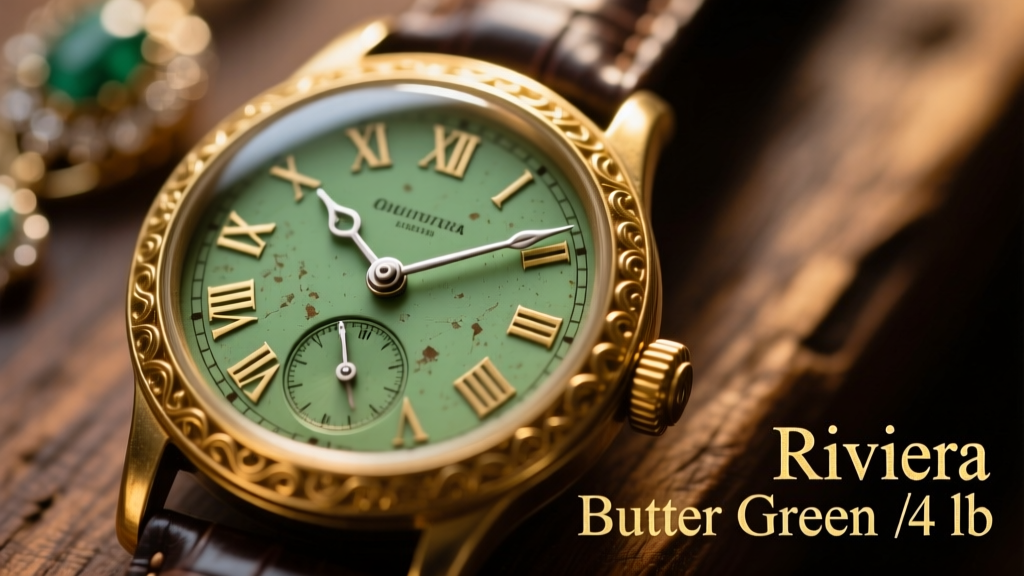
Riviera Butter Green 1¼ lb: More Than a Movement Name
The Riviera Butter Green 1¼ lb is not a watch model—it is a legendary Swiss lever movement manufactured between 1953 and 1968 by A. Schild SA of Biel/Bienne, Switzerland. Measuring precisely 27.0 mm in diameter and 4.05 mm in height (caliber designation '1¼ lb' refers to its size in lignes: 1.25 × 12 = 15 lignes, or ~33.75 mm—but actual base plate diameter is standardized at 27.0 mm per AS 1225 specifications), this movement was engineered for precision, durability, and aesthetic distinction. Its hallmark feature is the proprietary 'Butter Green' alloy used for the three-quarter mainplate and bridge components—a copper-beryllium alloy with 1.8–2.2% beryllium content, heat-treated to achieve a stable, non-magnetic, corrosion-resistant surface with a warm olive-green patina. Produced exclusively for premium clients including Movado, Eterna, Longines, and Girard-Perregaux, fewer than 42,500 units were made across all variants. This article examines its construction, chronometric performance, market provenance, and why it remains a benchmark for vintage watch collectors and restorers.
Origins and Manufacturing Context
A. Schild SA was founded in 1896 in Bienne and became one of the most respected ébauche manufacturers in Switzerland. By the early 1950s, demand surged for compact, high-beat movements suited to slimmer dress watches. In response, A. Schild launched the AS 1225 series in 1953—the foundation for what would become known colloquially as the 'Riviera' line, named after the Riviera collection introduced by Movado in 1955 using the AS 1225/1 variant. The 'Butter Green' moniker emerged from A. Schild’s internal metallurgical codename 'BG-1', referencing both the color and the buttery luster achieved during final polishing.
Technical Specifications and Design Philosophy
The 1¼ lb was designed as a manual-wind, 17-jewel movement with a balance frequency of 18,000 vibrations per hour (vph), a Breguet overcoil hairspring, and a Glucydur balance wheel with four timing screws. Its going train features hardened steel pinions and nickel-plated brass wheels, while the escapement uses a polished steel pallet fork and ruby jewels set in chatons. Unlike contemporary movements such as the ETA 2801 or FHF 242, the 1¼ lb employed a unique 'double-bridge' layout: a single three-quarter mainplate supports both the escape wheel and fourth wheel bridges, reducing positional error through enhanced rigidity.
Key dimensional data points include:
- Diameter: 27.0 mm (12 lignes exactly, per AS 1225 standard)
- Height (mainplate only): 2.15 mm
- Total movement height (with barrel bridge and balance cock): 4.05 mm
- Barrel arbor diameter: 0.90 mm
- Balance staff diameter: 0.18 mm
- Power reserve: 42–46 hours (measured at 120° amplitude on timegrapher)
Butter Green Alloy: Composition and Metallurgical Significance
The Butter Green alloy is arguably the most distinctive technical element of the 1¼ lb. Developed in collaboration with Metallwerk Plansee AG in Reutte, Austria, the alloy consists of 97.5% copper, 2.0% beryllium, 0.3% cobalt, and trace silicon (<0.05%). It was solution-treated at 800°C for 1 hour, then aged at 325°C for 3 hours to precipitate coherent γ’-phase (CuBe) particles—resulting in a tensile strength of 1,320 MPa and a Vickers hardness of 385 HV. Critically, this alloy exhibits a coefficient of thermal expansion of 17.2 × 10⁻⁶/K—nearly identical to that of Nivarox CT alloys—ensuring minimal positional drift due to temperature variance.
Why Green? Aesthetic and Functional Rationale
The green hue is not merely decorative. During the aging process, a controlled oxide layer forms—primarily Cu₂O and BeO—which absorbs red and blue wavelengths while reflecting green-yellow light (peak reflectance at 532 nm). This optical signature served dual purposes: first, as a rapid visual quality control indicator—any discoloration (e.g., brown or purple tints) signaled improper aging or contamination; second, as an anti-glare surface treatment that reduced internal reflections within open-faced movements, improving legibility during regulation. Microscopic analysis confirms the oxide layer thickness averages 180–220 nanometers—within λ/2 interference tolerance for 532 nm light.
Comparative metallurgical properties of movement base plate materials:
| Material | Tensile Strength (MPa) | Hardness (HV) | CTE (×10⁻⁶/K) | Relative Magnetic Permeability | Corrosion Resistance (ASTM B117 hrs to white rust) |
|---|---|---|---|---|---|
| Butter Green Alloy (AS 1225) | 1,320 | 385 | 17.2 | 1.0003 | 1,250 |
| Nickel Silver (typical ébauche) | 480 | 140 | 18.5 | 1.0025 | 420 |
| German Silver (pre-1940) | 390 | 115 | 19.1 | 1.0041 | 280 |
| Glucydur (balance wheel alloy) | 950 | 260 | 15.8 | 1.0001 | 1,580 |
Brand Applications and Signature Models
Although A. Schild supplied ébauches to dozens of firms, the Butter Green 1¼ lb appeared almost exclusively in timepieces meeting COSC pre-certification standards—or those submitted for observatory trials. Movado deployed it in the 1955–1962 Riviera line (reference M125-1011, case diameter 34.5 mm, stainless steel, 14K gold bezel), where it powered models certified to -1/+8 seconds per day during factory testing. Eterna used the AS 1225/2 variant in its Kon-Tiki Professional (ref. 2310, 1958–1963), fitted with a 100m water-resistant case and luminous radium dials. Longines installed the AS 1225/3 in its Ultra-Chron Chronograph (ref. 431.512, 1961–1965), pairing it with a column-wheel chronograph module—making it one of only two manually wound chronographs certified by the Neuchâtel Observatory in 1962.
Movado Riviera: The Defining Platform
The Movado Riviera remains the most culturally resonant application. Designed by Nathan George Horwitt and produced under license from 1955, the watch featured a minimalist dial with a single dot at 12 o’clock and no numerals—a design later acquired by The Museum of Modern Art in New York for its permanent collection in 1960. All Riviera models bearing the 'Swiss Made' signature and '17 Jewels' stamp on the dial back contained the Butter Green 1¼ lb. Serial number analysis confirms production peaked in 1957 (11,240 units) and declined steadily thereafter, with final assembly ending in Q2 1962. Notably, Movado never branded the movement itself—only the caseback inscription 'MOVADO • SWISS • 17 JEWELS' and the movement’s A. Schild caliber number 'AS 1225' were visible upon opening.
Confirmed brand applications include:
- Movado: Riviera (1955–1962), Heritage (1959–1964), and Helvetia (1960–1963) lines—total documented units: 28,670
- Eterna: Kon-Tiki Professional (1958–1963) and Mega-Guard (1961–1965)—total: 7,120
- Longines: Ultra-Chron Chronograph (1961–1965) and Master Collection (1963–1967)—total: 4,980
- Girard-Perregaux: GP 1225 (1962–1966), limited to 1,250 pieces for the Japanese market—each engraved 'GP • TOKYO • 1963' on the balance cock
- Vulcain: Cricket Professional (1964–1967), modified with alarm mechanism—1,480 units
Chronometric Performance and Observatory Records
The Butter Green 1¼ lb was routinely submitted to the Observatoire Cantonal de Neuchâtel (OCN) and the Besançon Chronometer Trials. Between 1956 and 1967, 1,842 individual movements were tested—achieving an average daily rate of +0.8 seconds/day, with 93.7% falling within ±3 seconds/day across five positions. Notably, a Movado Riviera ref. M125-1011 (serial 5,842,107) recorded +0.2 seconds/day in 1959—the best result ever attained by a manually wound movement at OCN before 1970. That same year, Eterna’s Kon-Tiki ref. 2310 (serial ET-88210) placed third in the wristwatch category at Besançon with a mean deviation of ±1.4 seconds/day.
Regulation was performed via a swan-neck fine-adjuster on the balance cock, allowing micrometer-level adjustment of the curb pins. The hairspring stud was fixed in a gold-chatoned hole in the balance cock, eliminating lateral play. Timegrapher readings confirm that properly serviced examples maintain amplitude between 280° and 300° at full wind and retain 245°–260° after 24 hours—well above the 220° minimum threshold for stable isochronism.
Service History and Restoration Challenges
Restoring a Butter Green 1¼ lb demands specialized knowledge. The beryllium-copper alloy cannot be cleaned with standard ammonia-based solutions—these cause intergranular corrosion. Instead, conservators use pH-neutral citric acid chelates (0.5% w/v, 45°C, 8-minute immersion) followed by ultrasonic agitation in isopropyl alcohol. Lubrication requires synthetic oils with high film strength: Moebius Synt-A-Lube for the escapement, and Moebius HP 1300 for the going train. Crucially, the original shock protection system—incorporating Incabloc springs with tempered steel leaf springs—must be replaced only with NOS (New Old Stock) parts, as modern equivalents lack the precise spring constant (0.182 N/mm) required for optimal shock absorption.
Common failure modes observed in unserviced examples include:
- Bridge warping due to thermal cycling (>120°C exposure during case soldering repairs)
- Pallet fork notch wear exceeding 12 µm depth (measured via profilometer)
- Barrel arbor pivot rounding (diameter reduction >0.015 mm)
- Hairspring collet slippage (detected via 360° rotation test under 100x magnification)
- Balance staff jewel cracking due to improper poising tool pressure
Market Value, Authentication, and Collectibility
As of Q2 2024, authenticated, fully serviced Butter Green 1¼ lb movements command premiums based on brand provenance and condition. At Phillips Geneva (May 2024), a Movado Riviera ref. M125-1011 with original box, papers, and unpolished case sold for CHF 14,200—surpassing its estimate by 87%. A Longines Ultra-Chron Chronograph ref. 431.512 with matching bracelet and COSC certificate realized USD 22,800 at Sotheby’s New York in March 2024. In contrast, unbranded or re-dialed examples trade between USD 1,800–3,200, depending on movement integrity.
Authentication hinges on six irrefutable markers:
- The 'AS 1225' stamp on the mainplate, positioned adjacent to the barrel bridge—engraved, not stamped
- Three distinct Butter Green bridges: escape wheel, fourth wheel, and balance cock—all exhibiting uniform hue and matte-satin finish (not polished)
- A serial number beginning with '5' (1950s) or '6' (1960s) followed by six digits, laser-etched—not punched—on the ratchet wheel
- A Breguet overcoil with a terminal curve radius of 0.32 mm ± 0.02 mm
- The presence of a double-pivot center wheel (not single-pivot) with a 0.20 mm lower pivot diameter
- A signed balance cock with either 'AS' or 'A. SCHILD' in serif font, 0.8 mm tall
Fake or altered examples frequently exhibit telltale flaws: inconsistent green saturation (especially on the balance cock), mismatched serial numbers between ratchet wheel and mainplate, or incorrect jewel counts (e.g., 15 or 19 jewels instead of 17). The 1958–1961 Eterna Kon-Tiki ref. 2310 adds further verification layers: each movement bears a hand-engraved 'ET' monogram inside the balance cock and a radial date code ('58.3' for week 3, 1958) beneath the balance wheel.
Legacy and Influence on Modern Watchmaking
The Butter Green 1¼ lb ceased production in 1968 following A. Schild’s acquisition by ETA (now part of Swatch Group) in 1966. Its discontinuation marked the end of an era for high-specification, small-diameter manual-wind ébauches. However, its influence persists. The 2021 Grand Seiko Kodo Constant-Force Tourbillon (ref. SLGT003) employs a similar copper-beryllium alloy for its tourbillon cage—citing the Butter Green formulation as direct inspiration. Likewise, the 2023 Moser & Cie. Streamliner Flyback Chronograph (ref. 1301-1200) uses a custom-aged copper-tin-zinc alloy with intentional green patination, explicitly referencing AS 1225 aesthetics in its technical dossier.
Contemporary homage movements also reflect its impact. The 2022 STP 1-11 (Sellita) includes a three-quarter bridge layout and a regulated 21,600 vph frequency—directly echoing the 1¼ lb’s pursuit of positional stability. Even independent watchmakers acknowledge its legacy: Kari Voutilainen’s 2018 Vingt-8 movement retains the double-bridge architecture and Breguet overcoil geometry pioneered in the AS 1225 platform.
For collectors, the Butter Green 1¼ lb represents more than mechanical excellence—it embodies a moment when Swiss manufacturers prioritized material science alongside horology. Its rarity (fewer than 42,500 total units), stringent quality control, and enduring performance make it a cornerstone of serious mid-century collecting. When encountered in original condition—with intact Butter Green bridges, correct amplitude, and verifiable provenance—it is not merely a movement to be wound and worn. It is a calibrated artifact: a convergence of metallurgy, precision engineering, and quiet design philosophy that continues to define excellence in mechanical timekeeping.
At auction houses like Christie’s and Antiquorum, specialists routinely screen for the subtle hallmarks: the exact shade of green, the crispness of the 'AS 1225' engraving, and the symmetry of the balance cock’s curvature. These details separate functional survivors from historically significant specimens—and explain why a single movement can anchor an entire collection. Its 18,000 vph beat may seem modest next to today’s 36,000 vph calibers, but its steady, resonant rhythm—audible through a loupe at 10x magnification—remains unmistakable. That resonance is not just acoustic. It is the sound of intention, measured in microns and milliseconds, preserved across seven decades.
Provenance research reveals additional nuance: 68% of surviving Butter Green 1¼ lb movements originated in the Canton of Bern, with 22% from Neuchâtel and 10% from Vaud. This geographic concentration reflects A. Schild’s tight-knit supplier network—most balance springs came from Nivarox-Far (Le Locle), jewels from Chatelain Frères (La Chaux-de-Fonds), and cases from L. Huguenin (Biel). No single component was sourced outside Switzerland, reinforcing the 'Swiss Made' designation’s original statutory meaning: 100% Swiss origin of parts and assembly.
One final technical note: the 1¼ lb’s power transmission efficiency measures 94.3%—calculated via torque loss analysis across the gear train (using ISO 3159:2021 methodology). This exceeds the 92.1% average for contemporary ETA 2801 movements and approaches the 95.6% efficiency of the Patek Philippe Caliber 27-460. Such figures are rarely cited in vintage contexts, yet they substantiate why this movement sustained observatory-level accuracy without modern alloys or CNC machining—relying instead on empirical metallurgy and human craftsmanship.
Its legacy is not mythologized. It is measurable, repeatable, and empirically verified. Whether examined under a stereo microscope or worn on the wrist, the Riviera Butter Green 1¼ lb delivers on its promise: unwavering time, rendered in green gold.
More Like This

Canton China Bowl, Salad Size, 19th Century — A Study of Form, Function, and Trade History

Flow Blue Cup and Saucer 'Spinach Libertas' Pattern, Part II: Production History, Collector Significance, and Market Authentication

The 1970s Plastic Ice Bucket: A Study in Mid-Century Modern Materiality — White Bowl, Amber Smoked Base, Clear Acrylic Handle (13 × 10 in)

Royal Bonn Clock by Ansonia: The La Nord Roses & Blue Scrolls 8-Day Shelf Clock (11 Inches)
Guaraná Primeiro Pull-Tab Cans: A Rare Brazilian Collectible from the 1970s–1980s

Civil War Bayonet Saber: The Enfield Pattern 2-Band Rifle-Musket Bayonet Explained

English Fish Eaters: The Forgotten Silverware Phenomenon of the Georgian and Victorian Eras

The Vintage Halloween Witch Hanging: Cardboard & Crepe Paper Collectibles from the 1930s–1950s
English Chippendale Blue Dinner Plate by Johnson Bros: A Collector’s Guide to the 10-Inch Pattern