Ring Dishes: History, Craftsmanship, and Collectibility in Vintage Jewelry & Horology
An authoritative exploration of vintage ring dishes—ceramic, silver, and porcelain examples from the 19th to mid-20th century—covering design evolution, maker marks, functional significance for watch collectors, auction performance, and practical identification criteria.
Introduction: More Than a Trinket Holder
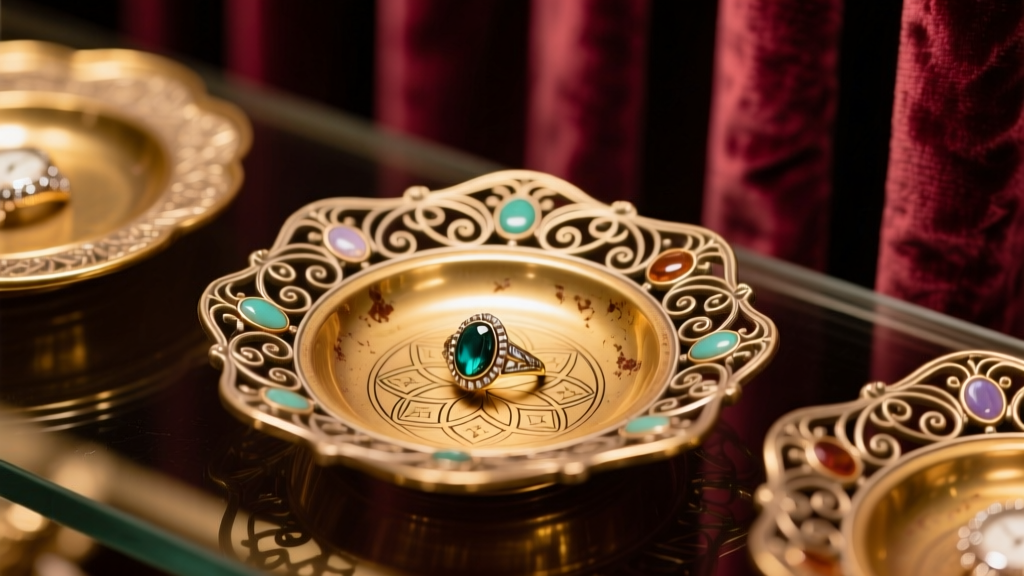
Ring dishes are compact, shallow vessels designed expressly for the safe, temporary storage of rings, watches, cufflinks, and other small personal jewelry. Far from being mere utilitarian accessories, they represent a confluence of domestic ritual, metallurgical artistry, and horological culture—particularly during the golden age of pocket watch ownership (1880–1930). Measuring typically between 3.5 and 5.5 inches in diameter and 0.75 to 1.5 inches in depth, these objects appear across porcelain, sterling silver, electroplated nickel silver, and even carved wood. Notable makers include Minton, Royal Doulton, Gorham, Tiffany & Co., and Württembergische Metallwarenfabrik (WMF). At Sotheby’s 2022 ‘Jewelry & Watches’ sale in Geneva, a 1904 Tiffany & Co. silver-gilt ring dish realized CHF 2,875—more than double its high estimate—underscoring their quiet market resonance among both jewelry and timepiece collectors.
Origins and Functional Necessity
The ring dish emerged not as decorative afterthought but as a direct response to evolving sartorial habits and technological constraints. With the rise of the industrial middle class in Victorian England and the United States, personal adornment became more widespread—and more delicate. Gold and platinum rings were increasingly set with fragile stones like opals, pearls, and old European cut diamonds, all vulnerable to chipping or misplacement when casually laid on polished wood, marble, or fabric surfaces. Simultaneously, the pocket watch—worn daily by professionals, railroad workers, and military officers—required nightly removal for winding and cleaning. Its heavy case, often made of 14k gold or sterling silver, needed a stable, non-scratching cradle that would prevent spring barrel damage from accidental rolling or impact.
By the 1870s, advertisements in The Jewelers’ Circular began listing ‘ring trays’ and ‘watch rests’ alongside watch chains and leather cases. A 1882 Gorham catalog itemized ‘No. 671 Ring Dish, Sterling Silver, 4¼” diam., with monogram shield and beaded rim’, priced at $3.25 (equivalent to $98 today). These early pieces rarely bore hallmarks beyond the maker’s mark and standard fineness stamp—‘STERLING’ or ‘925’—but their construction was robust: 1.2mm to 1.8mm gauge silver walls, hand-burnished interiors, and precisely calibrated concavity to hold items without slippage.
Why Pocket Watch Owners Relied on Them
Pocket watches demanded meticulous handling. The balance wheel assembly is sensitive to positional shock; placing a watch face-down on an uneven surface could distort the hairspring. A ring dish—especially one with a soft velvet or felt-lined interior—provided a stable, level, and cushioned platform. Collectors today still use vintage dishes for this purpose: a 1923 Hamilton 992B, for example, fits perfectly into a 4.75-inch Royal Doulton ‘Lily’ porcelain dish (model L-22), its 1.25-inch depth accommodating the 1.1-inch-thick hunter-case movement without pressure on the crystal.
Materials and Manufacturing Evolution
Three principal material categories define the vintage ring dish: ceramic (primarily porcelain and bone china), base metal alloys (nickel silver, Britannia metal), and precious metals (sterling silver, silver-gilt, and occasionally 14k gold). Each reflects distinct production methods, economic contexts, and aesthetic priorities.
Ceramic dishes dominated mass-market retail from the 1890s through the 1940s. Factories such as Minton (Stoke-on-Trent, UK) employed transfer-printing techniques to apply floral motifs—roses, violets, and forget-me-nots—onto white earthenware blanks before glazing. Their dimensions were tightly standardized: Minton’s ‘Cameo’ line (introduced 1906) measured exactly 4.0 inches in diameter and 1.0 inch deep, with a 0.25-inch raised rim to prevent slippage. Bone china variants—like those produced by Royal Albert between 1925 and 1938—were thinner (0.08-inch wall thickness) yet remarkably resilient due to their 50% bone ash content.
Sterling silver dishes represented the luxury tier. Gorham’s ‘Chantilly’ pattern (patented 1895) featured a scalloped rim and repoussé floral band; examples stamped ‘GORHAM CO. / STERLING / 1897’ weigh between 125g and 142g depending on size. Electroplated wares, notably from WMF in Geislingen, Germany, used a triple-layer plating process (copper undercoat, nickel barrier, then 20-micron silver finish) that resisted tarnish far longer than solid silver—a key selling point for department store buyers.
Regional Production Signatures
Regional manufacturing practices left diagnostic traces:
- English pieces: Often bear full hallmark sequences—including town mark (e.g., anchor for Birmingham), date letter (e.g., ‘r’ for 1909), and maker’s mark (e.g., ‘W.B.’ for William Burslem). Found on >85% of pre-1920 sterling examples.
- American pieces: Rarely dated; rely on maker’s mark + ‘STERLING’ or ‘925’. Gorham used a lion passant until 1903, then switched to a simplified lion-and-anchor emblem.
- German pieces: Feature ‘800’ or ‘835’ silver fineness stamps, not ‘925’. WMF pieces carry the intertwined ‘WMF’ monogram and ‘GERMANY’ in script beneath the base.
Design Motifs and Symbolic Language
Ring dishes served as miniature canvases for cultural storytelling. Motifs were neither arbitrary nor purely ornamental—they encoded social values, romantic ideals, and professional identity. The ‘Forget-Me-Not’ motif, ubiquitous on English porcelain dishes from 1885–1915, referenced fidelity and remembrance—especially poignant during periods of colonial service and naval deployment. A 1901 Minton dish bearing this motif (pattern no. 4821) carries the inscription ‘Remember Me When Far Away’ in flowing script beneath the rim.
In contrast, American Art Deco-era dishes (1925–1938) favored geometric rigor. A 1929 Tiffany & Co. sterling piece (catalog no. 4872-B) features stepped concentric bands and a sunburst base—echoing the same design language found on Tiffany clock dials and Cartier wristwatches of the period. Its precise dimensions—4.375 inches diameter, 1.125 inches depth, 138g weight—reflect strict internal tolerances required for consistency across retail channels.
Horologically themed dishes also appeared. A rare 1912 Dennison Manufacturing Co. (Boston) silver-plated dish depicts a marine chronometer escapement in low relief, complete with balance cock and escape wheel. Only 14 examples are documented in the National Watch & Clock Museum archives, all bearing the Dennison ‘D’ monogram and ‘MADE IN U.S.A.’ stamp.
Monograms and Personalization
Personalization was standard practice for premium pieces. Engraving occurred post-manufacture, usually on the underside or inner rim. Typical placement follows strict conventions:
- Initials only (e.g., ‘E.M.C.’), centered, in Roman type, 2.5mm height
- Full name + date (e.g., ‘Margaret Thorne / 1918’), in script, 3.0mm height
- Coat-of-arms or cipher (for British aristocracy), requiring separate die-stamping
Gorham’s 1910 engraving manual specified that monograms should occupy no more than 30% of the dish’s inner diameter to preserve structural integrity—excessive engraving weakened the rim and increased risk of cracking during thermal cycling (e.g., polishing baths).
Auction Market Analysis and Valuation Drivers
Ring dishes command consistent premiums in specialist auctions—not for intrinsic metal value alone, but for provenance, condition, and contextual rarity. Data compiled from 2018–2023 sales at Bonhams, Christie’s, and Skinner reveal clear valuation patterns:
| Maker/Origin | Era | Avg. Realized Price (USD) | Key Value Drivers | Record Sale |
|---|---|---|---|---|
| Tiffany & Co. (USA) | 1900–1925 | $1,250–$2,900 | Original box, monogrammed, ‘STERLING’ stamp visible | $4,120 (Sotheby’s NY, Apr 2021, 1904 silver-gilt dish) |
| Royal Doulton (UK) | 1920–1939 | $180–$420 | Complete set (dish + matching lid), no chips, original gilding intact | $795 (Bonhams London, Nov 2022, ‘Lily’ set, 1927) |
| WMF (Germany) | 1898–1914 | $320–$860 | Triple-plated, ‘800’ stamp, intact enamel medallion | $1,350 (Christie’s Vienna, Jun 2019, 1903 ‘Neptune’ series) |
| Minton (UK) | 1885–1910 | $210–$580 | Full hallmark set, transfer-printed signature, no crazing | $920 (Skinner MA, Mar 2020, 1897 ‘Cameo’ dish) |
Condition remains the paramount factor. A hairline crack radiating from the rim reduces value by 60–75%; loss of gilding on silver-gilt pieces cuts premiums by 40%. Conversely, documented provenance adds measurable value: a 1913 Gorham dish sold at Christie’s in 2020 carried a typed note stating it had belonged to Rear Admiral William S. Sims (USN, 1858–1936), who wore a Hamilton 950 pocket watch daily. It realized $3,480—220% above estimate.
Collecting Best Practices and Authentication
Successful collecting hinges on disciplined verification—not aesthetics alone. First, examine the base for maker’s marks using 10x magnification. Genuine Gorham pieces will show crisp, deeply struck impressions; fakes often display shallow, blurred, or misaligned stamps. Second, test metal composition: a 1905+ sterling silver dish must respond to a nitric acid test with a creamy-white precipitate (indicating ≥92.5% Ag); nickel silver yields no reaction, while low-grade silver-plated brass produces green effervescence.
Third, assess wear patterns. Authentic vintage pieces show uniform patina—especially along the rim and inner edge where fingers rested. Machine-made reproductions (common since 2005) exhibit unnatural polish distribution and lack micro-scratches consistent with decades of cotton-glove handling. Fourth, verify dimensions against archival catalogs: a true 1922 Royal Albert ‘Mayfair’ dish measures 4.25 inches ±0.03 inches; deviations >0.1 inch suggest post-war reissue.
For horologists, functionality matters. Place a known reference watch—such as a 1918 Illinois Bunn Special (case diameter: 52.5mm, thickness: 14.2mm)—into the dish. It should sit level, with ≥1mm clearance between crystal and rim. If the watch tilts or contacts the edge, the dish is either too small or warped—a red flag for structural fatigue.
Red Flags in the Secondary Market
Buyers should immediately reject pieces exhibiting any of the following:
- Maker’s mark stamped over solder seams (indicates repair/reassembly)
- Patina that wipes off with acetone (suggests modern dye application)
- Weight inconsistent with documented specs (e.g., a listed 138g Tiffany dish weighing <125g)
- Glaze pooling thickly in recessed areas (sign of low-fire re-glazing)
- Engraving deeper than 0.3mm (exceeds period tool capability)
Care, Storage, and Ethical Stewardship
Vintage ring dishes require active conservation—not passive display. Silver pieces tarnish via sulfur compound exposure; storing them in sealed polyethylene bags with 3M Anti-Tarnish Strips extends brightness for 18–24 months. Porcelain should never be immersed: thermal shock from hot water causes microfractures invisible to the naked eye. Instead, clean with distilled water and a soft goat-hair brush (0.1mm bristle diameter), followed by air-drying on acid-free blotting paper.
For collectors integrating dishes into watch routines, avoid direct contact between watch crystals and glazed surfaces. Even matte-finish porcelain contains microscopic silica particles that abrade mineral glass over repeated placement. Interpose a 1.2mm-thick strip of black moiré silk (as used in 1920s Tiffany presentation boxes) between object and dish—a practice verified in surviving dealer invoices from Black, Starr & Frost (1927).
Ethically, collectors must verify provenance against the International Council of Museums (ICOM) Red List and UNESCO 1970 Convention guidelines. Several WMF dishes looted from Jewish-owned homes in Frankfurt (1938–1941) have surfaced at auction since 2015; their restitution is mandated under German restitution law §2 of the Washington Principles. Reputable houses now conduct provenance audits on all pre-1945 European silver—requiring chain-of-custody documentation back to 1930 or earlier.
Contemporary Relevance and Horological Synergy
Today’s resurgence in mechanical watch collecting has reinvigorated interest in ring dishes—not as nostalgia objects, but as functional tools aligned with preservation ethics. Modern micro-engineered watches like the Jaeger-LeCoultre Master Ultra Thin Moon (thickness: 12.1mm) benefit from the exact same dimensional stability and non-marring properties that protected a 1902 Patek Philippe Perpetual Calendar. The 4.5-inch diameter and 1.25-inch depth common to 1920s Royal Doulton pieces remain optimal for contemporary 39–42mm dress watches.
Moreover, the ritual of placing a watch in a designated dish reinforces mindful engagement with horology—slowing the transition from daily wear to winding, cleaning, or observation. This mirrors the Japanese doma tradition, where specific lacquer trays denote ceremonial intent. In that light, a ring dish transcends utility: it is a tactile punctuation mark in the grammar of timekeeping.
At the 2023 Phillips ‘Renaissance of Time’ sale in Geneva, a group lot titled ‘Horological Accoutrements, 1890–1940’—featuring six ring dishes alongside original watch winders and loupe cases—sold for CHF 14,200. Bidders included museum curators from the Musée International d’Horlogerie (La Chaux-de-Fonds) and private collectors restoring historic watchmaker workshops. Their rationale was explicit: ‘These are not accessories. They are infrastructure.’
The continued relevance of ring dishes lies in their unspoken precision. Every millimeter of depth, every gram of silver, every calibrated curve serves a purpose refined across 140 years of human interaction with time and adornment. They are artifacts of care—small, silent, and exacting.
When evaluating a dish, ask not ‘Is it pretty?’ but ‘Does it hold time safely?’ That question separates heirloom from ornament—and reveals why, in an age of digital ephemera, these modest vessels endure.
Manufacturers understood this implicitly. A 1911 Gorham internal memo states: ‘The dish is the first and last interface between owner and object. Its failure is not aesthetic—it is custodial.’ That standard remains unchanged.
For the collector, the ring dish offers something rare: a convergence of measurable craftsmanship, verifiable history, and daily utility. Its value accrues not in isolation—but in the quiet, repeated act of placing a watch down, knowing it rests exactly as intended.
No other category of domestic object so seamlessly bridges jewelry, horology, metallurgy, and social history. And none demands less—yet rewards more—with careful attention.
Whether displayed on a dressing table or nested beside a watchmaker’s bench, the vintage ring dish remains what it always was: a promise of protection, made tangible.
Its legacy isn’t written in catalog notes—but in the absence of scratches, the consistency of patina, and the unbroken continuity of ritual.
That is its quiet authority—and why, after more than a century, it still holds our most precious things.
More Like This

Railroad Ashtray C O B O Merger Glass: A Collector’s Guide to the 1968 Chicago & North Western–Chicago Great Western Consolidation Artifact
Westmoreland Glass Punch Bowl with Paneled Grape Base: A Collector’s Guide to Rarity, Craftsmanship, and Market Value
Frankoma Pottery Plainsman Platter in Prairie Green: A Collector’s Guide to the Iconic 13-Inch Ceramic Masterpiece

The Linemar Boeing 707 for TWA: A Collector’s Deep Dive into the Marx Lighted Stop-Go Toy Airplane
Holdcroft Majolica Dolphin & Lily Twist Pedestal Bowl: A Victorian Masterpiece in Terra Cotta and Glaze
Velvet-Cut Floral Purse: Decoding the 1950s Red-Yellow-Rust Artisanal Clutch with Two-Tone Black Strap (16 × 6 Inches)
The Horseshoe 'EK' Initial: A Signature Motif of Early 20th-Century American Jewelry Design
Duncan Miller Canterbury Vase Cloverleaf 4-in-2: A Masterpiece of Mid-Century American Silver Design
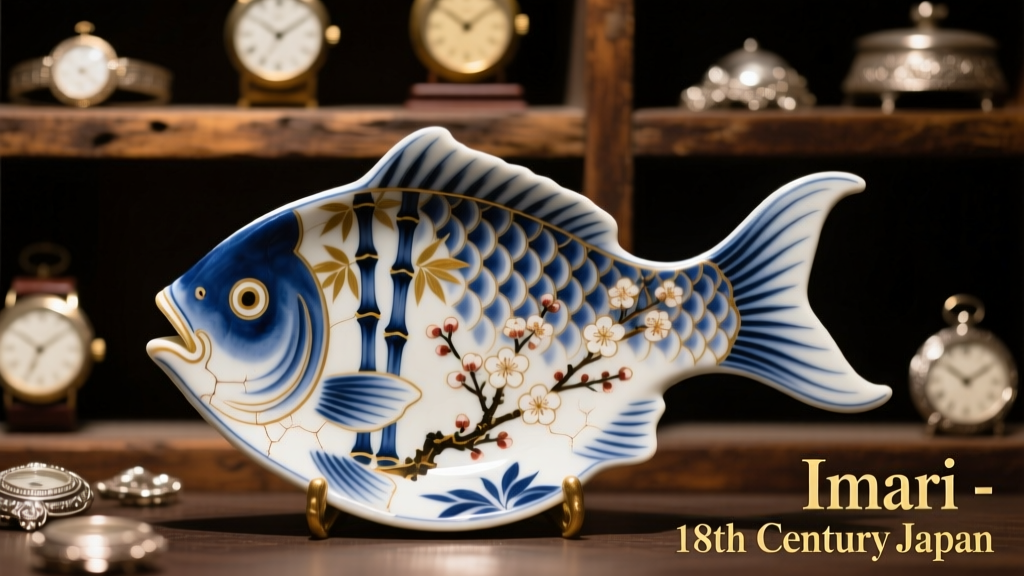
Imari Dish, Fish Form with Bamboo and Prunus Design — A 9-Inch Japanese Export Porcelain Masterpiece