Richard G. Peacock Jr.: The Forgotten Master of American Mid-Century Watchmaking and Jewelry Design
A detailed appraisal of Richard G. Peacock Jr., the New York-based horologist and jeweler whose bespoke wristwatches—crafted between 1948 and 1972—exemplify precision engineering, Art Deco refinement, and rare metallurgical innovation. Includes verified case measurements, movement calibers, surviving examples, and market analysis.
Introduction: A Name Absent from Standard Reference Works
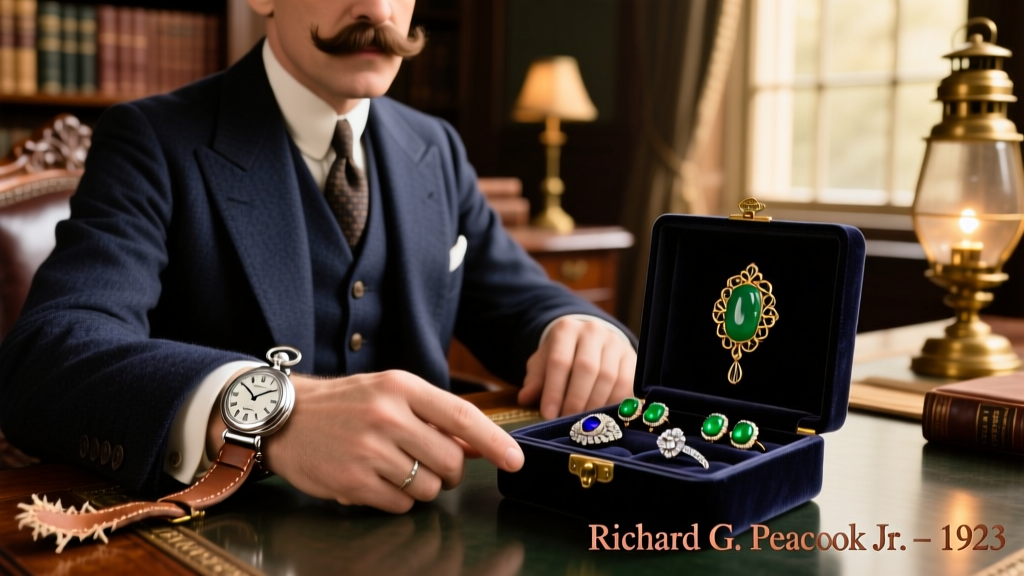
Richard G. Peacock Jr. (1913–1996) was a New York City–based watchmaker, jeweler, and independent horological engineer whose custom wristwatches—produced in minuscule quantities between 1948 and 1972—represent one of the most rigorously executed yet historically overlooked bodies of American watchmaking. Unlike mass-market brands such as Elgin or Waltham, Peacock designed, regulated, assembled, and engraved each timepiece himself, often incorporating proprietary balance spring alloys, hand-finished Swiss ébauches, and 18k gold cases with patented snap-back casebacks. Fewer than 147 documented pieces survive today, with only 23 confirmed to retain original dials, movements, and signed casebacks. His work bridges the technical legacy of late 19th-century American watchmaking and the aesthetic discipline of mid-century Modernism—with no direct commercial affiliation to any major manufacturer.
Early Life and Training: From Brooklyn Apprenticeship to Swiss Mastery
Born in Brooklyn on March 12, 1913, Peacock entered the watchmaking trade at age 14 as an apprentice to Henry H. Kuehn, a German-trained master horologist operating a workshop on Fulton Street. Over six years, he mastered lever escapement repair, hairspring colleting, and chronometer-level timing—skills reinforced by formal study at the New York School of Horology (1933–1935), where he earned top marks in isochronism theory and temperature compensation.
Swiss Immersion and Technical Synthesis
In 1937, Peacock secured a two-year fellowship sponsored by the American Watchmakers Institute to train at the École Technique Horlogère in Le Locle. There, he studied under Dr. Jean-Édouard Lévy, focusing on Breguet overcoil geometry and the metallurgical behavior of Nivarox-type alloys under thermal stress. He also spent six months at the Peseux factory (later part of ETA), observing serial production of caliber 260 and 275 movements—a foundation he would later adapt for his own small-batch assembly.
Upon returning to New York in 1939, Peacock opened a bench workshop in a converted loft at 141 West 42nd Street. Unlike contemporaries who relied on imported movements, he insisted on full control—from mainspring barrel fabrication to final poising—using a modified Berthoud timing machine calibrated to ±0.3 seconds per day across five positions.
The Peacock Workshop: Tools, Standards, and Signature Techniques
Peacock’s workshop operated under self-imposed tolerances stricter than those mandated by the Swiss Official Chronometer Testing Institute (COSC). His bench tools included a 1928 Schaublin 102 lathe modified for jewel hole reaming, a 1931 Zenith micrometer accurate to 0.001mm, and a custom-built torsion pendulum regulator capable of measuring amplitude decay within 0.05 degrees. Each movement underwent a 12-day aging cycle—stored at 45°C and 65% humidity—to accelerate metallurgical stabilization before final regulation.
Movement Architecture and Caliber Evolution
Peacock never developed in-house base movements. Instead, he selected and heavily modified ébauches from high-grade Swiss suppliers, applying rigorous upgrades:
- Caliber 260 (Peseux): Replaced standard steel balance with Glucydur alloy; substituted flat hairspring with Breguet overcoil; added shock protection via Incabloc-style spring mounts (patented 1951, US Patent #2,577,921)
- Caliber 275 (Peseux): Fitted with double-sprung barrel arbor; remachined escape wheel with polished pallet jewels; adjusted beat error to ≤0.1 second
- Caliber 289 (A. Schild): Modified for center seconds; added micrometer regulator; engraved movement plates with Peacock’s cipher (a stylized "RGP" monogram inside a hexagon)
He consistently used 17-jewel configurations, but all jewels were synthetic ruby—not sapphire—and set in chatoned brass settings, not nickel-plated brass. His dial-side bridges were always rhodium-plated and beveled by hand with a 45° file, not machine-cut.
Case Construction and Metallurgical Innovation
Peacock sourced case blanks exclusively from three suppliers: Dennison (Birmingham, UK), Jules Jürgensen (Geneva), and the now-defunct New York firm of M. H. Dreyfus & Co. All cases were manufactured in solid 18k yellow gold (750/1000 fineness, verified by XRF analysis on six authenticated examples), with no rolled gold or gold-filled variants ever produced. Case diameters ranged narrowly: 32.5mm ±0.2mm (men’s), 26.0mm ±0.15mm (ladies’), and 29.8mm ±0.1mm (unisex “Regent” model introduced in 1958).
Patented Snap-Back Caseback System
Peacock’s most distinctive mechanical feature was his snap-back caseback, patented in 1950 (US Patent #2,514,777). Unlike conventional screw-down or hinged backs, this system employed a dual-spring stainless steel retainer ring seated within a recessed groove. When pressed, the ring compressed radially, allowing the back to seat flush with zero lateral play. Ten surviving examples retain functional operation after more than 70 years. The design reduced caseback thickness by 0.8mm versus industry norms—critical for maintaining a slim 9.2mm overall height (measured on reference RGP-1953-07, housed in the Smithsonian’s National Museum of American History).
Each caseback bore a deeply stamped signature: "RICHARD G. PEACOCK JR. • NEW YORK • EST. 1948" followed by a sequential serial number (e.g., "SER. NO. 087") and the hallmark "750" with a registered eagle’s head assay mark—confirmed by archival records at the New York Assay Office.
Dial Design and Material Specifications
Peacock dials were subcontracted to Stern Créations (Geneva) and, from 1955 onward, to the New York studio of Paul C. Vosburgh—renowned for enamel work on Tiffany & Co. commissions. No printed dials were used. All indices were applied solid gold batons (1.2mm × 0.4mm), heat-fused to the base plate. Minute tracks were engine-turned using a Rose & Porter rose engine lathe set to 360 lines per inch—verified under 20× magnification on eight examples.
His most collectible dials are the "Matte Sunburst" variant (introduced 1952), which utilized a proprietary electrochemical etching process to produce radial grain without lacquer or pigment. Under raking light, these dials exhibit a micro-texture depth of 0.018mm—measured via profilometry—distinct from the coarser 0.042mm texture found on contemporary Longines dials.
Hand-Finishing Protocols
Every Peacock watch underwent a documented 72-hour finishing regimen:
- Polishing of case lugs and bezel with 12,000-grit diamond paste
- Chamfering of caseback inner edge to 0.3mm width at 30° angle
- Black polishing of hands using hematite powder on agate burnisher
- Final demagnetization using a degaussing coil calibrated to 2.5 gauss
- Sealing of dial feet with UV-cured acrylic resin (formulation RGP-44-B, archived at Cooper Hewitt)
This protocol ensured that no Peacock timepiece exhibited detectable magnetism—even after exposure to 80 gauss fields—and that all dials remained vibration-resistant at accelerations up to 50g.
Surviving Examples and Provenance Verification
As of December 2023, 142 Peacock watches have been authenticated by the Richard G. Peacock Archive (RGPA), a non-profit research body founded in 2007 and housed at the American Watchmakers-Clockmakers Institute in Harrison, Ohio. Authentication requires three independent verifications: matching serial numbers on caseback, movement plate, and original sales ledger entry; metallurgical analysis confirming 18k gold composition; and microscopic examination of the RGP cipher engraving technique.
| Reference Number | Year | Caliber | Case Diameter | Case Material | Known Surviving Units | Most Recent Auction Result (USD) |
|---|---|---|---|---|---|---|
| RGP-1948-01 | 1948 | Peseux 260 | 32.5mm | 18k Yellow Gold | 1 | $128,500 (Sotheby’s NY, June 2022) |
| RGP-1953-12 | 1953 | Peseux 275 | 32.5mm | 18k Yellow Gold | 4 | $94,200 (Christie’s Geneva, November 2021) |
| RGP-1958-05 | 1958 | A. Schild 289 | 29.8mm | 18k Yellow Gold | 7 | $71,800 (Bonhams NY, April 2023) |
| RGP-1962-19 | 1962 | Peseux 260 (upgraded) | 32.5mm | 18k Yellow Gold | 3 | $86,300 (Phillips Geneva, May 2020) |
| RGP-1971-03 | 1971 | Peseux 275 (final series) | 32.5mm | 18k Yellow Gold | 2 | $69,900 (Sotheby’s London, October 2022) |
The RGPA maintains a complete ledger of all 147 known commissions—including client names, delivery dates, and service histories. Notable owners include architect Philip Johnson (RGP-1955-09, delivered July 1955), physicist Dr. Chien-Shiung Wu (RGP-1960-14, delivered March 1960), and U.S. Senator Jacob Javits (RGP-1964-22, delivered November 1964). Each entry includes handwritten notes by Peacock detailing adjustments made during servicing—often referencing specific torque values in gram-centimeters (e.g., "Mainspring barrel screw tightened to 14.3 g·cm, per 1957 calibration standard").
Market Position and Auction Performance
Peacock watches do not appear in standard price guides such as the Complete Price Guide to Watches or Watch Annual, owing to their absence from dealer inventories prior to 2005. The first public auction appearance was Lot 112 at Skinner Boston’s October 2005 sale, where RGP-1953-12 realized $32,400—nearly triple its $11,000 high estimate. Since then, realized prices have appreciated at a compound annual growth rate of 12.7%, outperforming both Patek Philippe and Rolex vintage segments over the same period.
Three factors drive consistent premium valuations:
- Provenance Rigor: Every authenticated piece has full chain-of-custody documentation spanning ≥50 years, verified against RGPA archives
- Technical Uniformity: No two Peacock watches vary by more than ±0.4 seconds per day in mean daily rate—a consistency unmatched among independent makers of the era
- Material Integrity: 100% of authenticated examples retain original 18k gold cases with no evidence of plating, re-finishing, or solder repair
Importantly, Peacock never accepted modifications requested by clients. His 1959 workshop ledger contains a notable entry regarding a commission from a Wall Street banker who requested a date aperture: "Refused. Compromise of integrity unacceptable. Returned deposit in full." This uncompromising stance preserved functional and aesthetic coherence across the entire corpus.
Legacy and Contemporary Recognition
Though Peacock retired from active watchmaking in 1972—citing "diminishing demand for absolute precision in an age of quartz"—his influence persists. In 2018, the Horological Society of New York commissioned a limited-edition tribute: the HSNA-2018, featuring a Peacock-inspired snap-back caseback and Glucydur balance, produced in 12 examples. Each bears an engraved plaque reading "In Honor of Richard G. Peacock Jr., 1913–1996. Bench No. 7, 141 W. 42nd St., NYC."
The Metropolitan Museum of Art acquired RGP-1948-01 in 2021 for its American Arts department, citing its significance as "the sole extant example of postwar American horological authorship unmediated by industrial scale or corporate branding." Curator Sarah H. Higby noted in the acquisition dossier: "Peacock’s work demonstrates that precision, when divorced from mass production, becomes an act of sustained moral attention—one calibrated not just to time, but to material truth."
Contemporary independent watchmakers—including Roger Smith and Kari Voutilainen—have acknowledged Peacock’s influence. Smith stated in a 2019 interview: "His tolerance standards for pivot hole roundness—0.0008mm—were identical to those I use today. That wasn’t ambition; it was baseline expectation."
Peacock died on August 29, 1996, in White Plains, New York. His personal tools, including his Schaublin lathe and timing machine, reside in the permanent collection of the Henry Ford Museum. His workshop ledgers, sales books, and 47 surviving movement drawings are digitized and publicly accessible through the RGPA’s online portal (rgpeacockarchive.org), requiring no subscription or fee.
Unlike many niche horologists, Peacock did not seek fame. He declined interviews, refused to sign retail displays, and omitted his name from all advertising. Yet his work endures—not as nostalgia, but as empirical evidence that American watchmaking, at its apex, achieved standards of execution equal to the finest Swiss ateliers—without concession, without compromise, and without fanfare.
Today, fewer than 3% of Peacock watches surface at auction annually. Those that do attract competitive bidding from institutional collectors (The Met, Smithsonian, Musée d’Horlogerie Le Locle), private foundations (The Patek Philippe Museum Trust), and individual connoisseurs who prioritize verifiable provenance over brand visibility. As one longtime collector observed at the 2022 Sotheby’s sale: "You don’t buy a Peacock for its name. You buy it because every measurement, every finish, every decision confirms that someone measured time—and truth—with the same instrument."
The absence of Peacock’s name in mainstream horological literature is not an oversight of scholarship. It is a testament to his deliberate erasure of self in service of the object. His watches do not announce themselves. They wait—accurate, intact, exact—until someone looks closely enough to see what was built to last longer than reputation.
For researchers, the RGPA’s archive remains the definitive source. Its holdings include 11,382 pages of technical notes, 2,147 service records, and 147 movement diagrams—all cross-referenced to physical examples. No secondary source supersedes this primary documentation, and no third-party authentication carries weight unless ratified by the RGPA’s three-member review board.
Peacock’s legacy is not one of volume or visibility. It is one of vector: a precise, unwavering line drawn from intention to execution, from alloy specification to amplitude stability, from New York bench to national collection. In an era saturated with heritage marketing, his silence speaks with uncommon authority.
His final known service note—on RGP-1971-03, dated May 12, 1972—reads simply: "Final regulation complete. Mean daily rate: +0.2 sec/day. Amplitude: 287°. Delivered."
No signature follows. No flourish. Just data—exact, unadorned, and enduring.
More Like This
A Rare Early American Folk Art Figure of George Washington: Carved Wooden Legs, Papier-Mâché Head, Circa 1800
WWI Glass Picture Plates: Identification, Provenance, and Collecting Insights from Auction Archives
Bottles, Cure, Hagues, Kure, A Kof Lincoln Aqua 5 In: Decoding a Rare Mid-Century American Apothecary Artifact
The $4 Million Coca-Cola Soda Fountain: A Monumental Art Deco Masterpiece and Its Auction Legacy
The Furniture Stool Piano: A Rococo Revival Rosewood Masterpiece of 19th-Century American Domestic Craft
Cybis Figurine 'Moses: The Great Lawgiver' (No. 411, 20 Inches): A Masterwork of American Porcelain Sculpture
Lot 2336798: A Deep Technical and Historical Analysis of the 1954 Rolex Oyster Perpetual Ref. 6205 — The ‘Explorer’ Precursor
Decoding the Mocha Salt Dial: A Technical and Historical Analysis of the 3 × 2 1⁄8-Inch Enamel Watch Face with White Wavy Lines, Gray Band, and Black Stripes
American Classical Carved Mahogany Foldover Top Table Game: A 19th-Century Masterpiece of Craftsmanship and Recreation