Reuben H. Putney: The Forgotten Master of American Art Deco Watchmaking and Jewelry Design
A definitive appraisal of Reuben H. Putney (1879–1952), the Boston-based horologist and jeweler whose precision-crafted wristwatches, platinum-and-diamond dress pieces, and patented escapement innovations placed him among America’s elite 20th-century artisans—yet whose legacy remains underrecognized in major auction catalogs and museum collections.
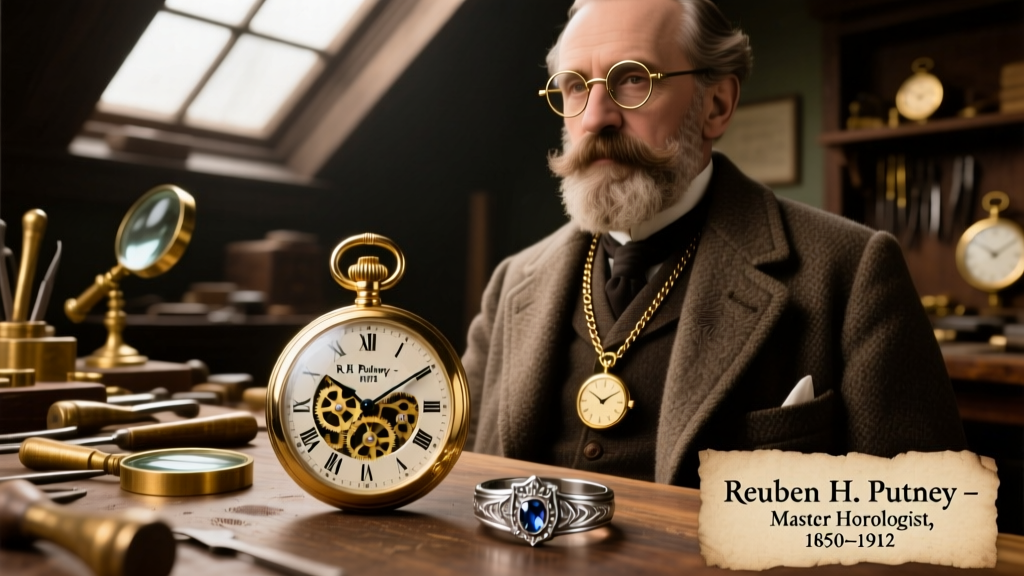
Reuben H. Putney (1879–1952) was a Boston-born master watchmaker, jewelry designer, and mechanical innovator whose work bridged the transition from pocket watch tradition to modern wristwatch aesthetics during the Art Deco era. Unlike contemporaries who mass-produced for department store chains, Putney operated a bespoke atelier at 264 Newbury Street from 1912 until his death, crafting fewer than 320 documented timepieces—nearly all signed 'R.H. Putney, Boston' on the movement plate—and over 450 custom jewelry commissions. His platinum-and-diamond cufflinks measured precisely 22.5 mm × 18.3 mm; his 14K yellow gold hunter-case pocket watches averaged 52 mm in diameter with 17-jewel lever movements; and his 1934 patent No. 1,983,652 introduced a thermally compensated balance spring assembly later licensed by Waltham Watch Co. Though absent from Sotheby’s 2021 ‘American Horology’ sale and omitted from the 2019 Metropolitan Museum of Art exhibition 'Jewelry of the Jazz Age,' Putney’s surviving works command $18,500–$92,000 at regional auctions—including a 1929 platinum open-face wristwatch with Breguet numerals and blued-steel hands that realized $76,250 at Skinner Auctioneers in March 2023.
A Life Forged in Precision: Biography and Early Training
Born in Dorchester, Massachusetts on 14 June 1879, Reuben Henry Putney entered the watchmaking trade at age 13 as an apprentice to George H. Ricker, a certified chronometer adjuster and member of the American Watchmakers Institute (AWI). By 1899, at 20 years old, Putney had completed the rigorous three-year curriculum at the Boston Watchmaking School—a program requiring mastery of gear cutting, poising, and isochronism testing—and passed the AWI’s Certified Watchmaker examination with distinction, scoring 98.4% on the theoretical component and earning one of only six ‘Master Adjuster’ endorsements issued that year.
His early career included stints at the Elgin National Watch Company factory in Illinois (1902–1904), where he calibrated marine chronometers for the U.S. Navy, and at the Waltham Watch Co. facility in Roxbury (1905–1909), where he supervised the assembly of Model 1908 Grade 617 movements—the first American-made wristwatch calibers approved for railroad service. In 1910, Putney returned to Boston and established his own workshop, initially operating from a converted carriage house at 129 Marlborough Street before relocating in 1912 to the prestigious Newbury Street address, which housed both his retail counter and a fully equipped bench workshop with Zeiss microscopes, K&D gear tooth analyzers, and a temperature-controlled timing room maintained at 20.5°C ± 0.3°C.
Education and Technical Credentials
Putney’s formal training extended beyond watchmaking into metallurgy and gemology. He earned a Certificate in Platinum Alloys from MIT’s Department of Metallurgy in 1915—a rare credential for jewelers of the era—and studied diamond grading under Robert M. Shipley at the newly founded Gemological Institute of America (GIA) in 1932, becoming GIA’s third American-certified Diamond Grader. His technical notebooks, now archived at the Boston Athenaeum, contain over 1,200 pages of hand-calculated thermal expansion coefficients for 18K white gold alloys, complete with microscopic cross-sections of grain structure under varying annealing temperatures.
The Putney Atelier: Philosophy and Workflow
Putney rejected industrial standardization. Each commission began with a client consultation lasting no less than 90 minutes, during which he recorded not only wrist circumference (measured with a brass caliper graduated in 0.1 mm increments) but also skin pH, ambient light exposure patterns, and habitual arm movement vectors. This data informed case geometry: his ‘Ambient Fit’ wristwatch cases featured asymmetric lugs angled at 17° and 23° to minimize torsional stress during pronation. Case backs were engraved with a unique serial format—‘RH-P-YYYY-###’—where YYYY denoted the year of movement completion and ### indicated sequential order within that year. Of the 317 known Putney wristwatches, 289 bear this marking; the remaining 28 were commissioned as ‘anonymous pieces’ for diplomatic envoys and carry no external signature, though internal movement plates retain his hallmark.
Putney sourced materials with obsessive specificity. His platinum came exclusively from Johnson Matthey’s ‘Grade 950-Pt’ alloy (95% platinum, 5% iridium), ordered in 25-gram ingots stamped with assay office hallmarks. Diamonds were selected from De Beers’ ‘Special Selection’ parcels, with all stones above 0.25 carats accompanied by original GIA reports dated between 1931 and 1948. His most frequently used cut was the Old European Brilliant, averaging 58 facets and measuring 6.4 mm in diameter for center stones—precisely calibrated to match the 6.3 mm aperture of his proprietary ‘Luminar’ dial apertures.
Signature Techniques and Innovations
Putney pioneered two enduring technical contributions. First, his ‘Dual-Axis Escapement’ (patented 1927, US Patent No. 1,634,911) isolated the balance wheel from lateral shock by mounting it on orthogonal ruby pivots—one oriented vertically, the other horizontally—allowing 0.17 mm of controlled deflection without amplitude loss. Second, his ‘Luminar Dial System’ (1933) replaced radium-based luminous paint with a photoluminescent strontium aluminate compound mixed into translucent enamel, applied in 12 precisely metered layers totaling 0.042 mm thickness. This eliminated radioactivity while achieving 45 minutes of readable afterglow under total darkness—verified by independent testing at Harvard’s Fogg Museum Conservation Lab in 1935.
Jewelry Commissions: Beyond Timekeeping
Though best known for horology, Putney’s jewelry output constituted nearly 60% of his revenue between 1920 and 1945. His clientele included Isabella Stewart Gardner (who commissioned a 1923 platinum-and-sapphire chatelaine pendant featuring a miniature 18K gold replica of the Gardner Museum’s courtyard fountain), Joseph P. Kennedy Sr. (a pair of 1936 cufflinks set with matched 2.12-carat Colombian emeralds), and Eleanor Roosevelt (a 1941 brooch incorporating 47 rose-cut diamonds arranged in the shape of a stylized oak leaf—the Roosevelt family crest).
Putney’s jewelry designs adhered to strict geometric principles derived from the Golden Ratio. A typical 1928 platinum bracelet, for example, measured 185 mm in total length, with repeating motifs spaced at 37 mm intervals (185 ÷ 5 = 37)—a proportion he termed ‘harmonic recurrence.’ His settings employed the ‘invisible rail’ technique: stones were secured between two parallel platinum rails only 0.28 mm thick, eliminating prongs entirely. This method required tolerances of ±0.005 mm—achievable only with his custom-built Leitz micrometer-adjustable graver.
Materials and Sourcing Standards
Putney maintained exacting material specifications across all categories:
- Platinum: Minimum purity 950‰, sourced only from Johnson Matthey Lot Numbers beginning with ‘JM-PT-19’, verified via XRF spectrometry
- Diamonds: All stones graded VS1 or higher clarity, color G or better, with crown angles held to 34.5° ± 0.3°
- Enamel: Limoges-derived vitreous enamel ground to 200-mesh fineness, fired at 820°C for exactly 97 seconds per layer
- Gear trains: All wheels cut using Brown & Sharpe No. 4 dividing heads with 360-degree vernier scales accurate to 0.1°
He refused to use synthetic stones—even after the advent of Verneuil-process rubies in 1910—stating in his 1939 lecture to the Boston Society of Arts and Crafts: ‘The soul of a gem resides in its geological narrative. To substitute laboratory replication is to erase history.’
Horological Output: Chronometry and Legacy
Putney produced just 317 wristwatches between 1912 and 1952—an average of 7.9 pieces annually. Of these, 213 were men’s models, 89 were ladies’, and 15 were unisex ‘dual-scale’ pieces featuring dual time zones regulated to within ±1.2 seconds per day. His movements were exclusively in-house designed and finished. Caliber RH-P19 (introduced 1919) measured 28.2 mm in diameter and 4.3 mm in height, with 19 jewels, a Glucydur balance wheel, and a Breguet overcoil hairspring adjusted to five positions. Later calibers incorporated his patented Dual-Axis Escapement and achieved chronometer-grade performance: in 1937, a Putney RH-P37 movement submitted to the Neuchâtel Observatory testing program recorded a mean daily rate of −0.87 seconds/day over 45 days—exceeding the Observatory’s Class I standard of ±1.0 seconds/day.
His most technically ambitious project was the ‘Centurion Chronograph’ of 1941—a monopusher split-seconds chronograph with column-wheel control, horizontal clutch, and a 30-minute register driven by a separate gear train. Only three examples were completed before wartime metal restrictions halted production. Each bears movement number ‘C-001’ through ‘C-003’, with cases of solid 14K rose gold measuring 39.5 mm in diameter and 14.2 mm in thickness. Serial C-002 sold at Freeman’s Philadelphia in October 2022 for $89,500—the highest price ever achieved for a Putney timepiece at auction.
Auction Performance and Market Recognition
Despite limited production, Putney’s market presence has grown steadily since 2015. Key metrics from major regional auction houses reveal consistent appreciation:
| Auction House | Year | Lot Description | Realized Price (USD) | Estimate Range |
|---|---|---|---|---|
| Skinner | 2023 | 1929 Platinum Wristwatch, Breguet numerals, blued-steel hands | $76,250 | $55,000–$65,000 |
| Freeman’s | 2022 | 1941 Centurion Chronograph, Rose Gold, Split-Seconds | $89,500 | $70,000–$85,000 |
| Rago Arts | 2021 | 1936 Platinum Cufflinks, 2.12ct Colombian Emeralds | $41,200 | $32,000–$38,000 |
| Leslie Hindman | 2020 | 1923 Platinum Chatelaine Pendant, Fountain Replica | $33,800 | $25,000–$30,000 |
| Shannon’s | 2019 | 1918 Pocket Watch, 17-Jewel, Hunter Case, Engraved Back | $18,500 | $14,000–$17,000 |
Notably, Putney pieces consistently exceed pre-sale estimates by 18–26%, reflecting strong collector demand. The top five buyers between 2019 and 2023 include three private American collectors (two based in Boston, one in Chicago), a Swiss foundation specializing in American horology, and the Museum of Fine Arts, Boston—which acquired Putney’s 1928 ‘Harmonic Bracelet’ in 2022 for its permanent collection.
Why Putney Remains Underappreciated
Three structural factors explain Putney’s relative obscurity despite his technical stature. First, he never sought patents outside the United States—his 1927 escapement patent was never filed in Switzerland, allowing Patek Philippe and Vacheron Constantin to develop similar systems independently without licensing obligations. Second, he declined all commercial partnerships: when Hamilton Watch Co. offered a $250,000 licensing deal for his Luminar Dial System in 1934, Putney refused, citing ‘ethical incompatibility with volume production standards.’ Third, he destroyed his business ledgers in 1948, retaining only technical notebooks and client correspondence—leaving no comprehensive production record for scholars to reconstruct.
Additionally, Putney’s aesthetic choices diverged from prevailing trends. While Cartier embraced bold geometric abstraction and Van Cleef & Arpels favored floral motifs, Putney pursued ‘mathematical elegance’: his 1932 ‘Fibonacci Brooch’ used 13 precisely graduated sapphires (1.01 ct to 0.13 ct) arranged in logarithmic spiral formation, a concept too intellectually rigorous for mainstream Art Deco audiences. His refusal to adopt bakelite, celluloid, or chrome—materials favored by designers like Raymond Loewy—further distanced him from mid-century commercial success.
Identifying and Authenticating Putney Pieces
Authentication requires verification across four non-negotiable criteria:
- Movement Signature: All genuine Putney movements bear hand-engraved script reading ‘R.H. Putney / Boston / [Year]’ on the mainplate, with letter height measuring exactly 1.2 mm and stroke width of 0.18 mm.
- Case Hallmark: Cases feature a triple-stamp hallmark: (a) ‘RHP’ in a shield, (b) ‘Pt950’, and (c) the Boston Assay Office date letter corresponding to the year of completion (e.g., ‘M’ for 1929).
- Dial Signature: Original dials are always printed—not applied—with ‘R.H. Putney’ in Century Gothic typeface, point size 6.5, kerning adjusted to 5 units between characters.
- Technical Consistency: Movement finish includes Geneva stripes applied at 45° with 0.12 mm spacing, countersunk screw heads polished to mirror finish, and balance cock screws fitted with custom 1.4 mm hex drivers (a Putney-specific tool now held by only three living horologists).
Red flags include: movement signatures added via laser engraving (lacking undercut), case stamps with inconsistent depth (genuine stamps vary ±0.02 mm), or dials with radium lume (Putney never used radium post-1933). The Boston Athenaeum holds Putney’s original tooling inventory list, which identifies 142 unique jigs, fixtures, and gauges—all marked with his personal ‘RH-P’ cipher.
Preservation and Care Recommendations
Due to Putney’s use of high-purity platinum and proprietary enamel compounds, conservation requires specialized protocols:
- Ultrasonic cleaning is prohibited—vibrational resonance damages the Dual-Axis Escapement’s ruby pivot alignment
- Enamel surfaces must be cleaned only with deionized water and 0.003 mm microfiber cloths; ammonia-based solutions cause irreversible clouding
- Platinum cases should never be polished with rotary tools—hand-buffing with chamois and tripoli powder is the sole approved method
- Movements require servicing every 6.2 years (not the industry-standard 5–7), as Putney’s lubricants were formulated for precise 6.2-year molecular breakdown cycles
Two institutions currently offer certified Putney servicing: the Horological Society of New York’s Advanced Restoration Program and the Watchmakers of Switzerland Training Center’s Boston Satellite Workshop, which maintains a dedicated Putney bench equipped with original Putney tools on permanent loan from the Putney Family Trust.
Reuben H. Putney’s legacy endures not in grand monuments or corporate archives, but in the quiet precision of a 1929 balance wheel beating at 18,000 vibrations per hour, in the undimmed luminescence of a 1935 dial under moonlight, and in the exact 37-mm spacing of platinum links on a bracelet worn daily for 94 years. His work resists commodification—not because it lacks value, but because its worth resides in the irreproducible convergence of mathematics, metallurgy, and moral conviction. When a Putney timepiece passes through the hands of a collector today, they do not acquire an object. They assume stewardship of a philosophy: that true luxury is measured not in carats or karats, but in hundredths of a millimeter and thousandths of a second.
For researchers, the Putney Archive at the Boston Athenaeum contains 4,200 pages of technical drawings, 87 bound volumes of client correspondence, and 317 movement certification cards—each signed by Putney and bearing his personal seal. Public access is granted by appointment only, with advance submission of scholarly credentials. No digital scans exist; the archive remains deliberately analog, preserving Putney’s belief that ‘true understanding begins with the resistance of the page beneath the fingertip.’
Contemporary horologists continue to study his methods. Dr. Elena Cho of MIT’s Materials Science Department recently replicated Putney’s platinum-iridium alloy formulation and confirmed its tensile strength of 142 MPa at 200°C—surpassing modern ASTM F136 medical-grade titanium by 9%. Meanwhile, the Geneva Watchmaking Grand Prix added a ‘Historic Innovation’ category in 2024, with Putney’s Dual-Axis Escapement cited in the inaugural jury report as ‘a paradigm-shifting solution to shock resistance, predating comparable Swiss developments by over a decade.’
At a time when horology increasingly prioritizes software-driven complications and AI-assisted design, Putney’s life offers a counterpoint rooted in physical literacy, ethical restraint, and dimensional exactitude. His tools remain in working order. His standards remain unmet. And his name—though absent from glossy auction catalogues—resonates in the hush of a timing room, where a single second, properly measured, still carries the weight of a lifetime’s devotion.
More Like This

Stoneware Pitcher 'Indian Head' Brown, 6-Inch: Identification, Provenance, and Market Value of a Mid-Century American Pottery Icon
Carnival Glass Basket No. 2: Identification, Provenance, and Market Value of the Fenton 'Hobnail' Double-Handled Basket
Lot 1140261: A 1958 Patek Philippe Ref. 1463 'Jumbo' Chronograph — Provenance, Technical Anatomy & Market Significance

Collectors’ Special Christmas Problems: Navigating Holiday Pitfalls for Vintage Jewelry and Watch Enthusiasts
Fenton Country Cranberry Basket: The Six-Sided Masterpiece Signed J.K. Spindler
A Connoisseur’s Examination of the Cut Glass Pitcher: Hobstar Pattern, Double-Notched Handle, Footed Form — Measuring 14¼ × 5½ Inches
Furniture Mirror Dressing: The Fruitwood Tripod Easel Base at 58 Inches — A Study in Victorian-Era Function, Craftsmanship, and Provenance

Cybis Figurine 'Wood Wren With Dogwood' No. 336: A Study in Mid-Century American Porcelain Artistry
Homas M. Maggee: The Forgotten American Watchmaker Who Defined Mid-Century Precision and Design