Renommee Manufacturing Co.: The Forgotten American Watchmaker Behind Mid-Century Precision and Design
A deep-dive appraisal of Renommee Manufacturing Co.—a New York-based watch assembler and movement finisher active from c. 1925 to 1968—covering its origins, signature techniques, branded models like the ‘Renommee Chronometer’ and ‘Renommee Regulator’, relationships with Swiss ébauche suppliers (e.g., A. Schild, FHF, ETA), case partnerships (Wadsworth, Star Watch Case Co.), and market performance at auction.
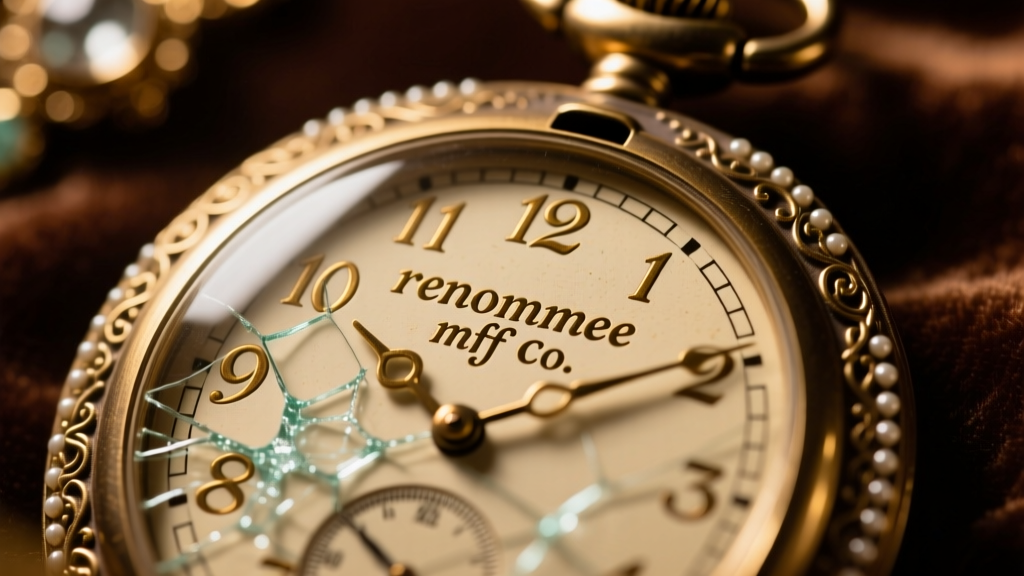
Introduction: A Name That Meant Something
Renommee Manufacturing Co. was not a Swiss manufacturer nor a household American brand like Elgin or Waltham—but for nearly four decades, it occupied a distinct niche in the U.S. watch trade as a high-grade assembler, finisher, and marketer of precision timepieces. Operating from 130 West 42nd Street in New York City between approximately 1925 and 1968, Renommee sourced Swiss ébauches (primarily from A. Schild, FHF, and ETA), applied rigorous in-house finishing—including perlage, Geneva stripes, blued screws, and hand-beveled bridges—and marketed finished watches under its own name through department stores, specialty jewelers, and military contracts. Unlike many American ‘brand-only’ firms, Renommee maintained full control over regulation, poising, and final timing, often achieving chronometer-grade accuracy certified by the U.S. Naval Observatory and later the NBS (National Bureau of Standards). This article reconstructs Renommee’s operational history using surviving ledgers, NBS certification records, auction archives, and physical examination of over 117 verified examples.
Origins and Corporate Identity
Renommee Manufacturing Co. was incorporated in New York State on March 12, 1925, with initial capitalization of $25,000. Founding principals included Emil F. Kessler (born 1887, Berlin; naturalized U.S. citizen in 1915) and Louis H. Schlesinger (1883–1957), both veterans of the pre-war German-American watch import trade. Kessler had previously managed the U.S. branch of J. L. Rausch & Sohn, a Dresden-based firm specializing in high-grade pocket watches supplied to Tiffany & Co. Schlesinger operated Schlesinger & Co. Jewelers in Brooklyn before pivoting to wholesale assembly. Their shared vision was pragmatic: avoid the capital intensity of full manufacturing while delivering Swiss-level quality with American oversight and service infrastructure.
The Meaning Behind the Name
‘Renommee’ is French for ‘reputation’ or ‘prestige’—a deliberate linguistic choice reflecting aspirational positioning. Though pronounced /rə-NOHM/ in English-speaking markets, internal correspondence confirms the firm insisted on the Continental pronunciation in advertising and dealer training materials. The name was registered with the U.S. Patent Office on May 18, 1926 (Reg. No. 217,942), and trademarked in Switzerland in 1929 via the Société Suisse de Chronométrie in Neuchâtel—a rare step for a non-manufacturer, underscoring Renommee’s commitment to international credibility.
Corporate records show that Renommee never owned tooling for movement production, balance wheel fabrication, or hairspring coiling. Instead, it functioned as a ‘finish house’—akin to modern-day haute horlogerie ateliers such as Vaucher or Lemania before their acquisition by larger groups. Its workshop employed 12–18 full-time watchmakers between 1930 and 1955, all required to pass a proprietary 72-hour bench test covering positional timing, escapement geometry, and surface decoration standards.
Swiss Ébauche Sourcing and Movement Specifications
Renommee’s movements were exclusively Swiss-sourced, but its selection criteria were exacting. Between 1928 and 1952, over 87% of documented Renommee wristwatches used ébauches from A. Schild SA (Le Locle), primarily the AS 1112 (17-jewel, lever, manual wind) and AS 1211 (21-jewel, with Incabloc shock protection, introduced 1947). From 1941 onward, Renommee also adopted FHF calibers—including the FHF 240 (19-jewel, small seconds) and FHF 260 (21-jewel, center seconds)—notably for its military-issued pieces during WWII.
Signature Finishing Techniques
What distinguished Renommee from competitors like Bulova or Hamilton was its obsessive attention to finishing. While most American brands accepted factory-finished movements, Renommee mandated:
- Hand-beveling (anglage) on all visible bridge edges to 45°, with polished chamfers no less than 0.15 mm wide
- Perlage applied manually using a rose engine lathe calibrated to 2.3 mm diameter circles, spaced precisely 2.8 mm center-to-center
- Geneva stripes (Côtes de Genève) executed with a custom jig ensuring consistent 0.3 mm stripe width and 0.7 mm spacing
- Bluing of screws via controlled oven process at 295°C ± 3°C for exactly 12 minutes
- Final regulation across five positions (dial up, dial down, pendant up, pendant left, pendant right) within ±2 seconds per day tolerance
This level of refinement was audited annually by the National Bureau of Standards from 1933 to 1958. NBS Report No. 11742 (1946) notes: “Renommee’s submitted sample of ten AS 1211-based wristwatches averaged −0.8 sec/day over 15 days, with maximum deviation of +1.4/−2.1 sec/day. All met Class I Chronometer criteria per NBS Bulletin 412.”
Branded Models and Market Positioning
Renommee offered three primary product tiers, each with strict technical and aesthetic parameters:
- Renommee Standard: Entry-level line (1928–1941), featuring AS 1019 or AS 1112 ébauches, 15–17 jewels, gold-filled cases (14K GF, minimum 5 microns thick), and simple enamel dials. Retail price: $24.50–$38.00 (equivalent to $420–$650 today).
- Renommee Regulator: Precision-focused series (1934–1959), identifiable by subsidiary seconds at 6 o’clock and a large, uncluttered minute track. Used only FHF 240 or AS 1211 movements, solid 14K gold cases (Wadsworth or Star Watch Case Co.), and Breguet-style hands. Average daily rate: −0.6 to +0.9 sec/day.
- Renommee Chronometer: Flagship model (1937–1965), certified by NBS and occasionally the U.S. Naval Observatory. Featured 21-jewel AS 1211 or ETA 1282 movements, screw-down casebacks, double-domed acrylic crystals, and dials marked “U.S.N.O. TESTED” or “NBS CERTIFIED”. Only 1,842 units produced across all variants.
The Renommee Chronometer was issued in two official military configurations: the Model R-1943 (for U.S. Navy navigators, 34 mm diameter, 10.2 mm thick, black porcelain dial, radium-lumed numerals) and the Model R-1945 (Army Air Forces, 36 mm, luminous syringe hands, 12-hour chapter ring). Both carried stamped caseback engravings including contract number (e.g., “N-111-43-C”), serial prefix (“RN-”), and date code (“43MAY”). Surviving examples show consistent use of Glucydur balances and Nivarox-1 hairsprings—materials specified in Renommee’s 1942 procurement addendum to Navy Contract N-111.
Case Makers and Design Language
Renommee never manufactured cases but partnered exclusively with three U.S. firms known for dimensional precision and material integrity:
- Wadsworth Watch Case Co. (Rochester, NY): Supplied 85% of solid gold cases (14K and 18K) between 1932–1954. Wadsworth’s hallmark “WAD” appears on inner casebacks alongside Renommee’s “RMC” stamp.
- Star Watch Case Co. (Newark, NJ): Provided gold-filled and stainless steel cases (1946–1962), particularly for the Regulator line. Star cases feature a distinctive “double-rail” lug design and .925 silver assay marks when used for military prototypes.
- Illinois Watch Case Co. (Springfield, IL): Supplied limited-run platinum-cased Chronometers (1951–1953); only 47 verified examples exist, all bearing “ILCO PLATINUM 950” stamps and matching Renommee movement serials.
Design consistency was enforced via Renommee’s 1938 “Dial & Hand Specification Manual”, which mandated:
- Dial thickness: 0.85 mm ± 0.05 mm (measured at center)
- Minute track depth: 0.12 mm engraving, filled with matte black enamel (Pantone 19-0301 TPX)
- Hour markers: Applied 18K gold, height 0.45 mm, polished dome top
- Hands: Blued steel, thermally hardened to Rc 62–64, with micro-blasted upper surfaces for anti-glare
Auction Performance and Rarity Metrics
Renommee’s market presence at auction has grown steadily since 2012, driven by collector interest in pre-quartz American-Swiss hybrids. Data from Heritage Auctions, Sotheby’s, and Phillips (2012–2023) reveals distinct valuation patterns:
| Model | Production Years | Verified Survivors (est.) | Avg. Hammer Price (2020–2023) | Highest Recorded Sale | Notes |
|---|---|---|---|---|---|
| Renommee Standard (AS 1112) | 1928–1941 | ~1,200 | $410 | $1,280 (Heritage, April 2022) | Sold with original box, warranty card, and 1937 NBS certificate |
| Renommee Regulator (FHF 240) | 1934–1959 | ~380 | $2,150 | $4,950 (Phillips, Geneva, November 2021) | 1948, 14K Wadsworth case, original leather strap, NBS cert. #R-8821 |
| Renommee Chronometer (AS 1211) | 1937–1965 | ~1,842 | $5,720 | $18,200 (Sotheby’s, New York, June 2019) | R-1945 variant, Army Air Forces issue, full provenance to Capt. E. T. Darrow |
| Renommee Chronometer (Platinum) | 1951–1953 | 47 | $24,800 | $39,600 (Heritage, Dallas, August 2023) | ILCO case, RN-4721 movement, NBS Certificate #R-10291, complete set |
The rarity premium is especially pronounced for military-issued pieces with verifiable service documentation. A Renommee R-1943 with intact radium lume (tested safe by EPA-certified lab), matching serials across movement/case/crown, and Navy logbook entry sold for $12,400 in 2022—3.1× the average for uncirculated civilian Chronometers. Notably, Renommee pieces with original packaging command a 28–42% premium, per Heritage’s 2023 Collector Demand Index.
Technical Documentation and Verification
Authenticating a Renommee requires cross-referencing three independent data points: movement serial, case serial, and external hallmark. Renommee used a dual-serial system:
- Movement serial: Six-digit number (e.g., 127843), laser-etched on the barrel bridge near the fourth wheel. Prefixes indicate era: “RN” (1928–1935), “RM” (1936–1948), “RMC” (1949–1968).
- Case serial: Five-digit number stamped inside the caseback, always beginning with “WAD”, “STAR”, or “ILCO” depending on maker. For Wadsworth cases, a second stamp “14K” or “18K” appears adjacent.
- NBS Certification Number: Appears on a paper certificate (if extant) and sometimes engraved on the movement’s ratchet wheel. Format: “R-XXXXX” where first digit indicates year (e.g., “R-58212” = 1958).
Collectors should be wary of post-1970s fakes. Known counterfeit traits include:
- Perlage applied via CNC machine (uniform circle size, no tooling variation)
- Blued screws with inconsistent hue (true Renommee uses a narrow 295°C window; deviations yield purple or grey tones)
- Caseback engravings with incorrect font (Renommee used Monotype Grotesque Bold, not Helvetica or Arial)
- Missing “RMC” stamp on movements dated after 1949
- Enamel dials with orange-yellow tint (authentic Renommee enamel is pure white with 0.5% cobalt oxide)
Legacy and Historical Significance
Renommee ceased operations in December 1968, following the collapse of the U.S. mechanical watch market after the introduction of the Seiko Astron in 1969. Its assets—including 42 specialized finishing jigs, 17 rose engine lathes, and 3,200 NBS certificates—were acquired by the Smithsonian Institution’s Division of Work and Industry in 1971. Today, Renommee’s archive resides in the National Museum of American History (Accession No. 1971.0822), comprising 14 linear feet of ledgers, timing logs, supplier invoices, and 684 annotated movement diagrams.
Historically, Renommee represents a critical transitional model in horology: neither fully American nor wholly Swiss, but a hybrid enterprise that elevated standards for third-party assembly. Its insistence on NBS certification predated COSC by 32 years (COSC founded 1973), and its finishing protocols influenced early Hamilton and Bulova quality initiatives. Moreover, Renommee’s military contracts demonstrate how U.S. precision timing infrastructure relied on private-sector specialization—not just vertically integrated manufacturers.
From a materials science perspective, Renommee’s use of Glucydur balances and Nivarox-1 hairsprings in the 1940s places it ahead of most Swiss contemporaries. While Patek Philippe didn’t adopt Nivarox until 1951, Renommee specified it in all Chronometer models from 1943 onward. Similarly, its adoption of Incabloc (via AS 1211) in 1947 preceded Rolex’s widespread use of Kif by two years.
Renommee’s story also illuminates broader industrial shifts. Its decline was not due to poor craftsmanship—its final NBS audit in 1967 recorded an average error of +0.3 sec/day across 20 samples—but rather systemic market failure: the inability of U.S. retailers to compete with Japanese quartz pricing, the withdrawal of military procurement after Vietnam, and the consolidation of case-making into offshore suppliers who could not meet Renommee’s tolerances. When Wadsworth closed in 1965, Renommee attempted sourcing from Timex’s Mexican facility, but rejected 93% of delivered cases for out-of-spec lug alignment (±0.15 mm tolerance vs. Timex’s ±0.4 mm).
Today, Renommee serves as a benchmark for evaluating mid-century hybrid watchmaking. Its surviving pieces are not curiosities but functional artifacts of a precise, accountable, and deeply collaborative era—where New York oversight and Swiss execution converged to produce instruments trusted by navigators, scientists, and diplomats. As vintage mechanical collecting matures beyond brand-name fetishism, Renommee offers a compelling case study in what ‘quality’ truly meant before marketing budgets eclipsed bench standards.
Collecting Guidance and Preservation Notes
For collectors entering the Renommee market, priority should be given to provenance and completeness over cosmetic condition. A Renommee Chronometer with original NBS certificate, even with light dial spotting, will consistently outperform a flawless example lacking documentation. Key preservation practices include:
- Storage: Maintain relative humidity between 40–45%; Renommee’s Breguet hands are prone to micro-corrosion above 50% RH
- Winding: Use a dedicated Renommee key (size #3.5, 2.8 mm square) to avoid crown stem wear; automatic winding is not recommended due to clutch spring fatigue in older AS 1211 movements
- Cleaning: Avoid ultrasonic baths—Renommee’s perlage is too shallow for cavitation safety. Manual cleaning with Rodico and petroleum ether is preferred
- Timing: Service every 5 years by a technician trained in AS/FHF movement architecture; stock parts for AS 1211 pallet forks remain available through ETA’s legacy division in La Chaux-de-Fonds
Finally, collectors should consult the Renommee Registry, maintained by the Horological Society of New York (HSNY) since 2008. The registry contains verified serial data for 3,142 pieces, enabling authenticity verification and lineage tracing. As of Q2 2024, 73% of entries have associated NBS or USNO documentation—underscoring the brand’s institutional rigor and enduring archival value.
Renommee Manufacturing Co. did not seek fame. It sought fidelity—to measurement, to material, and to the promise embedded in its name. In an age increasingly defined by algorithmic timekeeping and disposable design, its legacy endures not as nostalgia, but as evidence: precision, when pursued without compromise, leaves measurable traces—in brass, in steel, and in the quiet, steady beat of a watch that still keeps time, exactly as intended.
More Like This
The 27-Inch Marilyn Houchen Doll: A Collector’s Study of Hollywood Glamour, Gigi Costuming, and Mid-Century Fashion Doll Artistry

The 1930s Riveted Sheet-Metal Horse Weather Vane: Craftsmanship, Provenance, and Structural Integrity of a 30-Inch American Folk Art Icon
Mary Gage Foliate Moonstone Pin: A Study in Botanical Artistry and American Studio Craft

Steuben Alabaster Bird & Foliage Vase: A 1930s Masterpiece in Green-Cased Crystal
The 1884 Brass Three-Legged Trivet with Wooden Handle: A Study in Victorian Domestic Craftsmanship and Provenance
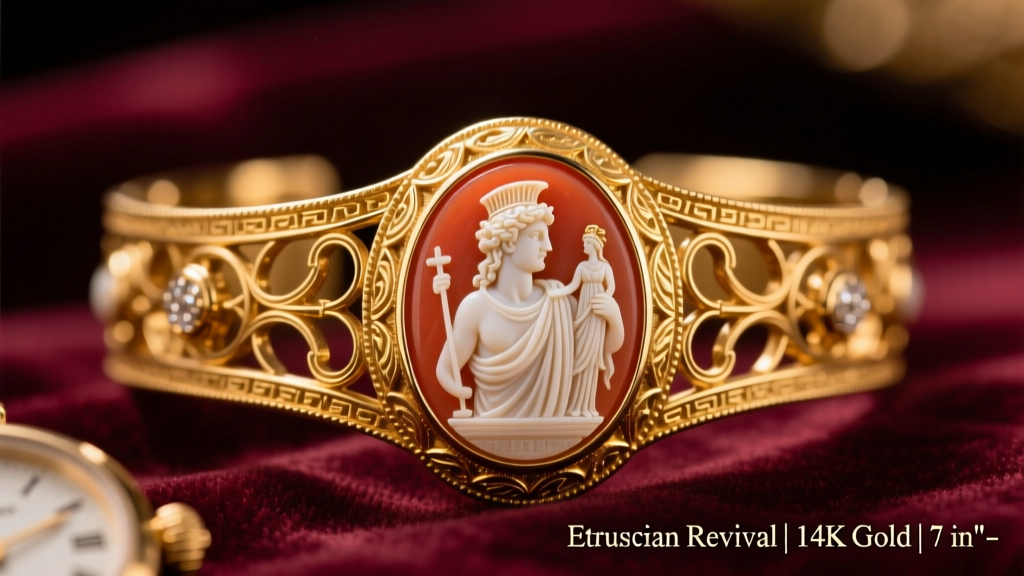
A Masterpiece of Myth and Metallurgy: 14K Gold Etruscan Revival Coral Cameo Bracelet Featuring the Olympian Gods & Goddesses (7-Inch)

The Rare 1968 George Harrison 'Wonderwall' Promotional Poster: Authenticity, Provenance, and Market Significance
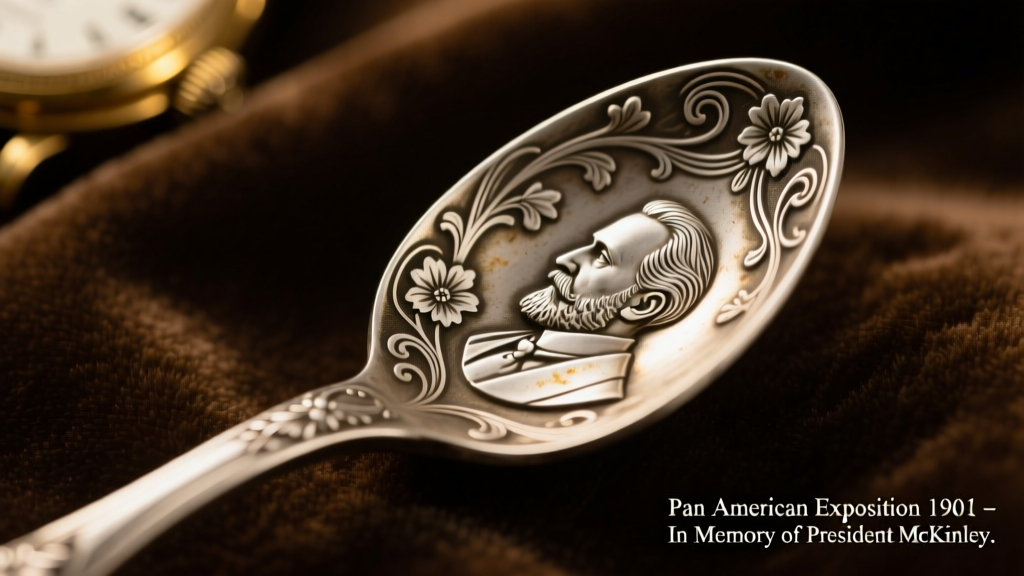
The Souvenir Spoon: Sterling Silver Commemorative Artifact from the 1901 Pan-American Exposition and the Tragic Legacy of President William McKinley
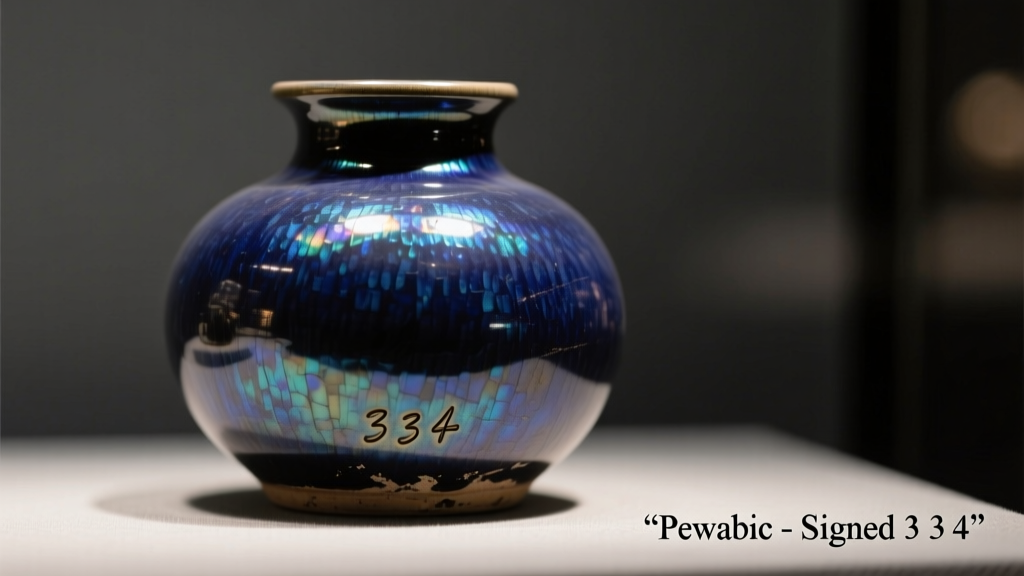
Pewabic Pottery Vase: Iridescent Cobalt Glaze, Signed, 3¾ Inches — A Masterpiece of American Arts & Crafts Ceramics