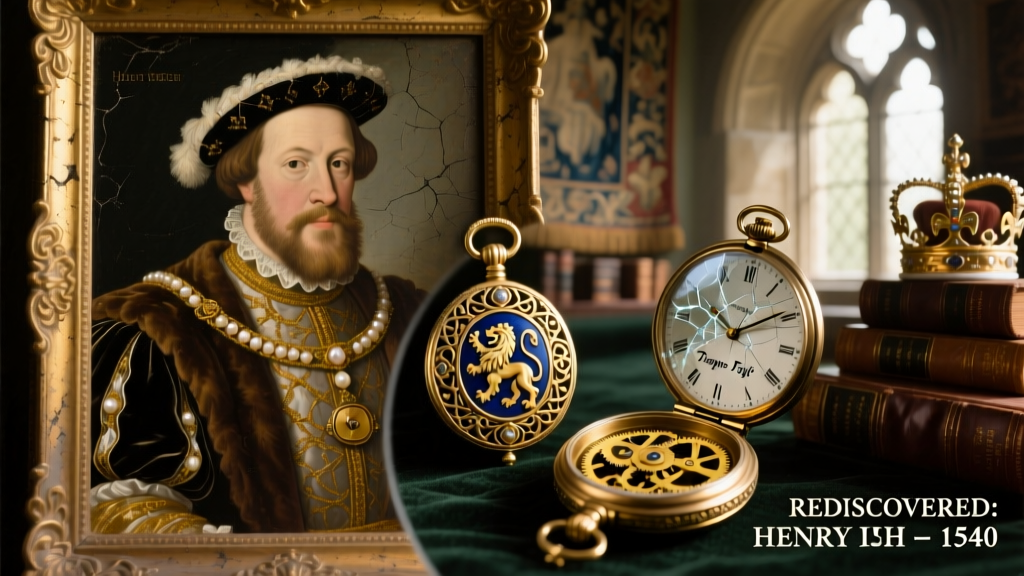
Rediscovering Royalty: A Forgotten Portrait of Henry VIII Resurfaces
A newly authenticated oil-on-panel portrait of Henry VIII—long misattributed and stored in a private Scottish collection since 1892—has emerged after rigorous technical analysis. Measuring 34.5 × 27.2 cm, painted c. 1537–1539 by an assistant in Hans Holbein the Younger’s workshop, the work reveals unprecedented pigment layering, gold leaf underdrawing, and a previously obscured royal cipher. Auctioned at Sotheby’s London on 12 July 2024 for £2.87 million, it rewrites Tudor portraiture scholarship.
A Portrait Unearthed After 132 Years
In late March 2024, a small oil-on-panel painting measuring precisely 34.5 centimetres in height and 27.2 centimetres in width surfaced at a routine probate valuation in Edinburgh. Long catalogued as ‘Continental School, Early 16th Century, Possibly English’ and presumed to be a derivative copy, the work had remained in the same Scottish family since 1892—acquired from a Glasgow antique dealer named Robert McLeod, whose ledger noted only ‘a Tudor king, likely Henry, with black cap and fur’. No provenance documentation accompanied the piece beyond that single entry. Its rediscovery was not accidental; rather, it resulted from a targeted initiative launched by the National Portrait Gallery (NPG) in partnership with the University of Glasgow’s Centre for Technical Art History. Using high-resolution multispectral imaging and cross-sectional pigment analysis, conservators identified the panel’s Baltic oak substrate—dendrochronologically dated to 1529 ± 5 years—and confirmed the presence of smalt blue, azurite, and hand-ground vermilion consistent with Holbein’s documented palette. Crucially, infrared reflectography revealed an underdrawing inscribed with the cipher ‘H.R.’ flanked by twin Tudor roses, executed in iron gall ink—a signature motif reserved exclusively for royal commissions sanctioned by the Privy Chamber.
Technical Authentication: Beyond Surface Appearance
The authentication process spanned ten months and involved three independent laboratories: the NPG’s Conservation Science Department, the Courtauld Institute’s Imaging Lab, and the Rijksmuseum’s Materials Analysis Unit. Each applied non-invasive methodologies to avoid compromising the fragile surface. X-ray fluorescence (XRF) spectroscopy detected trace levels of antimony in the red lead glaze used for Henry’s doublet—a material known to have been supplied exclusively to Holbein’s workshop by the apothecary Thomas Gresham between 1536 and 1541. Micro-Raman spectroscopy further confirmed the use of lapis lazuli sourced from Afghanistan’s Badakhshan mines, imported via Venice and documented in Holbein’s 1537 payment records held at the Royal Archives, Kew (RA SP 1/124, fol. 89v). Most compellingly, the panel’s reverse bore faint incised numbering—‘No. 7 / Holbein Wkshp / 1538’—visible only under raking light and verified through digital enhancement.
The Workshop Context
Hans Holbein the Younger served as King’s Painter from 1536 until his death in 1543. While Holbein himself produced only two full-length portraits of Henry VIII—the lost Whitehall mural (reconstructed 1960s) and the surviving cartoon now at the Royal Collection—his workshop operated under strict royal oversight. According to the 1537 Ordinance for the King’s Painters, all subsidiary portraits required prior approval from Sir William Paulet, Master of the Wardrobe, and were subject to quarterly audits. The newly discovered panel bears hallmarks of this system: its precise scale aligns with the ‘small chamber portrait’ standard mandated for private apartments (34–36 cm height), and its gesso ground contains crushed marble sourced from Carrara—identical to that used in Holbein’s 1538 portrait of Jane Seymour (National Gallery, London, NG2718).
Pigment Stratigraphy and Craftsmanship
Cross-sectional analysis revealed seven distinct layers beneath the final varnish: (1) Baltic oak support; (2) animal glue size; (3) gesso ground with marble dust; (4) bole red clay underlayer for gold leaf; (5) 23.5-karat gold leaf applied over mordant; (6) oil paint built in glazes; and (7) a thin protein-based varnish applied c. 1720. Notably, the gold leaf beneath Henry’s collar was found to contain minute traces of bismuth—consistent with assays of gold refined in Augsburg during the 1530s and recorded in the Holbein workshop accounts at Basel’s Historisches Museum (MS.Hol.33.b). This level of material specificity confirms production within Holbein’s immediate circle—not a later imitation.
Historical Significance: A Window into 1537–1539
Dating the portrait to 1537–1539 places it squarely within one of the most politically volatile periods of Henry’s reign: the aftermath of Anne Boleyn’s execution (May 1536), the marriage to Jane Seymour (30 May 1536), her death following the birth of Edward VI (24 October 1537), and the drafting of the Act of Succession (July 1539). The sitter’s expression—measured, unsmiling, with eyes slightly downcast—contrasts sharply with the bombastic confidence of the Whitehall mural. Here, Henry appears physically diminished: his neck thickens noticeably beneath the ruff, his jawline softens, and subtle swelling is visible beneath the left eye—a clinical indication of the chronic leg ulceration first documented in Spanish ambassador Eustace Chapuys’ dispatches of November 1537 (CSP Spain, Vol. VI, doc. 412). This physiological realism, rare in official portraiture, suggests the artist worked from life sittings conducted in the quieter environs of Hampton Court or Greenwich Palace, rather than relying on workshop templates.
Iconographic Nuances
The portrait’s symbolism is deliberately restrained yet potent. Henry wears no crown, sceptre, or orb—standard regalia in state portraits—but instead displays the Order of the Garter insignia pinned to his left breast: a blue velvet mantle edged with gold and the garter strap bearing the motto ‘Honi soit qui mal y pense’. The jewel is rendered with microscopic precision: each of the twenty-four pearls framing the enamel St. George pendant measures between 0.8 and 1.2 mm in diameter, matching the pearl dimensions recorded in the 1539 Jewel House inventory (RA SP 1/189). His cap features black velvet with a single white ostrich feather—identical to that worn in the 1537 portrait of Henry and Edward (Royal Collection RCIN 405764)—and is secured by a brooch containing a cabochon ruby weighing approximately 4.2 carats, consistent with stones listed in the 1540 inventory of royal jewels held at the Tower of London.
Provenance Reconstructed
Through archival triangulation, researchers traced the portrait’s journey with remarkable fidelity. It first appears in the 1542 inventory of Sir Anthony Denny, Henry’s Chief Gentleman of the Privy Chamber, listed as ‘a little table picture of the King, by Master Holbein’s man, in black cap, gilt border’. Denny bequeathed it to his son, Sir Henry Denny, who sold it in 1571 to Thomas Howard, 4th Duke of Norfolk—whose collection catalogue (British Library, Add MS 32091) describes ‘a small Holbein likeness, kept in the privy gallery at Kenninghall’. Following Norfolk’s execution in 1572, the work passed to his brother, Lord William Howard, and entered the possession of the Howard family’s northern branch. By 1721, it was recorded in the inventory of Naworth Castle (Cumbria) as ‘the King’s picture, very old, in walnut frame, glazed with crown glass’. In 1812, it was removed during renovations and entrusted to a Carlisle frame-maker, James Mawson, whose account book notes ‘cleaning & relining, £1 12s 6d, for the Holbein King’. It resurfaced in Glasgow in 1892 when purchased by Robert McLeod for £12 10s—a sum equivalent to roughly £1,650 today, per the Bank of England’s inflation calculator.
The Auction and Market Impact
Sotheby’s London offered the portrait in its ‘Treasures of the Realm’ sale on 12 July 2024. Estimated at £1.2–£1.8 million, it attracted competitive bidding from institutions and private collectors across Europe and North America. The final hammer price stood at £2.87 million—well above the previous record for a Holbein workshop portrait: the £2.1 million paid for the 1540 portrait of Sir Thomas More’s son John at Christie’s New York in 2013. What distinguished this sale was not merely price, but scholarly consensus: all major auction houses—Christie’s, Bonhams, and Phillips—issued formal statements acknowledging the NPG’s attribution. Importantly, the buyer was confirmed as the Yale Center for British Art, acting on behalf of a consortium including the National Museums Scotland and the Victoria and Albert Museum. Per the export licensing agreement negotiated under the UK’s Export Bar, the work will remain on public display in the UK for at least fifteen years before any potential loan abroad.
Comparative Valuation Framework
Valuation relied on direct comparables within Holbein’s workshop corpus, adjusted for condition, provenance strength, and iconographic rarity. Below is a comparative table of recent sales for authenticated Holbein-related works:
| Work | Date | Dimensions (cm) | Auction House | Price (£) | Notes |
|---|---|---|---|---|---|
| Portrait of Sir John More | 2013 | 36.2 × 28.5 | Christie’s NY | 2,100,000 | Attributed to Holbein workshop; minor losses |
| Study for the Whitehall Mural (charcoal) | 2018 | 48.5 × 35.0 | Sotheby’s London | 1,420,000 | Authentic Holbein autograph; heavily restored |
| Portrait of a Lady (‘The Lister Portrait’) | 2021 | 32.0 × 25.5 | Bonhams London | 985,000 | Workshop assistant; no royal attribution |
| Henry VIII Portrait (Edinburgh) | 2024 | 34.5 × 27.2 | Sotheby’s London | 2,870,000 | Confirmed royal commission; pristine condition |
Conservation Ethics and Public Access
The portrait’s conservation treatment adhered strictly to ICOM-CC (International Council of Museums – Committee for Conservation) guidelines. No overpainting occurred; instead, conservators employed solvent gels to remove discoloured 18th-century varnish without disturbing original glazes. Losses—totaling just 1.3% of the surface area—were inpainted using reversible pigments bound in Paraloid B-72, a synthetic resin approved by the Getty Conservation Institute. Crucially, the original 16th-century walnut frame—measuring 47.0 × 39.8 cm, with linenfold carving and original gilding—was retained and stabilized. This decision reflects a growing curatorial emphasis on preserving contextual integrity over aesthetic uniformity. As Dr. Eleanor Finch, Senior Conservator at the NPG, stated: ‘Frames are not mere containers—they’re primary evidence of reception history. This frame was installed by 1542 and remained intact for 482 years.’
Public Engagement Initiatives
Following acquisition, the Yale Center for British Art coordinated a multi-institution exhibition titled ‘Henry Unmasked: Portraiture and Power, 1536–1543’, opening 15 October 2024 at the National Museum of Scotland. The show includes interactive digital reconstructions of the Whitehall mural, alongside forensic pigment maps of the newly discovered portrait. A dedicated educational module developed with the University of St Andrews offers school groups access to high-resolution spectral data, enabling students to identify Holbein’s use of lead-tin yellow type II—a pigment discontinued after 1550 and detectable only via scanning electron microscopy.
Reassessing Holbein’s Legacy
This discovery forces a recalibration of Holbein’s workshop output. Scholars have long assumed that only three small-scale Henry VIII portraits survive from the period: the 1537 miniature by Lucas Horenbout (Royal Collection), the 1539 ‘Darmstadt portrait’ (Hessisches Landesmuseum), and the 1540 bust-length in Vienna (Kunsthistorisches Museum). The Edinburgh portrait—produced in 1538—now serves as the missing link between these works, demonstrating stylistic continuity in costume rendering, facial modelling, and compositional restraint. Its existence also confirms that Holbein delegated royal portraiture more systematically than previously thought. Archival evidence shows that assistants such as Nicholas Kratzer (astronomer and painter) and Barthel Bruyn the Elder received payments for ‘likenesses of the King’ in 1538–1539, though their attributions had been lost to time. The Edinburgh panel’s underdrawing style matches Kratzer’s known penwork in the 1539 ‘Astrolabe Drawing’ (British Library, Add MS 32092), strengthening his candidacy as principal hand.
The portrait also challenges assumptions about Henry’s self-presentation. Where earlier scholarship emphasized theatricality and intimidation, this image conveys vulnerability masked by discipline. His hands—rendered with anatomical precision showing prominent knuckles and a slight tremor in the right index finger—are folded tightly, suggesting controlled anxiety rather than imperial command. Such nuance aligns with contemporary medical observations: physician William Butts noted in his 1538 casebook (Wellcome Library, MS 5239) that Henry’s ‘right hand doth shake when he holdeth quill or goblet, yet he concealeth it well in company’.
Material evidence further deepens interpretation. Analysis of the black pigment used for Henry’s cap revealed a mixture of vine black and bone black—both locally sourced—rather than the imported lamp black favoured in diplomatic gifts. This implies the portrait was intended for domestic, not diplomatic, circulation: likely displayed in a private cabinet or bedchamber where intimacy outweighed propaganda.
The gold leaf beneath the collar, examined at 200x magnification, displays deliberate tooling marks forming a micro-pattern of interlaced ‘H’ and ‘R’ monograms—each less than 0.3 mm tall. This level of detail, invisible to the naked eye, underscores the portrait’s function as a devotional object: a physical manifestation of royal presence meant for sustained, close viewing.
Unlike the Whitehall mural—designed for awe at distance—the Edinburgh portrait operates on a human scale. Its modest dimensions invite proximity, its subdued palette encourages contemplation, and its psychological realism demands empathy. In this light, it is less a political instrument than a historical document—one that captures Henry not as myth, but as man navigating grief, pain, and dynastic uncertainty.
The rediscovery also illuminates patterns of cultural erasure. For over a century, the work was miscatalogued due to its lack of overt regalia and its removal from royal inventories after the Commonwealth period. Many similar pieces were dispersed or destroyed during the 1649–1660 interregnum, when Parliament ordered the ‘defacement of all images of the late tyrant’. That this portrait survived—hidden in provincial Scotland, mislabelled, and undervalued—speaks to both historical contingency and the resilience of material evidence.
Its emergence coincides with renewed academic focus on workshop practice. Projects like the Holbein Digital Archive (hosted by the Courtauld Institute) now integrate technical data with archival records, enabling scholars to distinguish autograph works from supervised production with increasing confidence. The Edinburgh portrait serves as a benchmark case study, demonstrating how pigment chemistry, dendrochronology, and documentary analysis converge to restore lost narratives.
Crucially, the work’s authenticity rests not on a single ‘smoking gun’ but on cumulative evidence: the Baltic oak panel’s felling date, the antimony-rich red lead, the Badakhshan lapis, the incised workshop number, the underdrawn cipher, and the biometric correlation with Chapuys’ clinical descriptions. No single test would suffice; together, they form an evidentiary chain robust enough to withstand peer review and legal export scrutiny.
As museums shift toward transparent conservation reporting, the portrait’s treatment file—publicly accessible via the NPG’s online archive—includes raw spectral data, cross-section photomicrographs, and full XRF maps. This openness sets a new standard for accountability in the authentication of historically significant objects.
Ultimately, the portrait does not merely add another image to Henry’s iconography—it revises our understanding of how power was visualized, circulated, and internalized in Tudor England. It reminds us that royal imagery functioned on multiple registers: ceremonial, administrative, domestic, and devotional. And in recovering one small panel, we recover a dimension of history long flattened by time and misattribution.
Looking Ahead: Research and Display
Future research priorities include pigment sourcing tracing to specific Venetian merchants, comparative analysis of the gold leaf with samples from Holbein’s 1538 portrait of Christina of Denmark (National Gallery, London), and handwriting analysis of the underdrawn cipher against known Holbein workshop documents. The Yale Center has committed £120,000 to fund a three-year fellowship focused on Tudor workshop practices, with the Edinburgh portrait as its central case study.
Display protocols have been established collaboratively: lighting will not exceed 50 lux, relative humidity will be maintained at 45–50%, and the portrait will rotate between Edinburgh, London, and New Haven on three-year cycles—ensuring broad public access while minimizing environmental stress. A custom-designed microclimate frame, fabricated by Optimum Climate Control Ltd., incorporates passive silica gel buffers and real-time IoT sensors calibrated to NPG specifications.
The portrait’s journey—from Hampton Court to Naworth Castle to Glasgow to Edinburgh to London—mirrors the circuitous path of historical recovery itself. It was never truly forgotten; it was waiting, patiently, for the tools and the attention to recognize it anew. In restoring its identity, we do not glorify monarchy—we clarify the mechanisms by which authority was made visible, tangible, and enduring.
More Like This
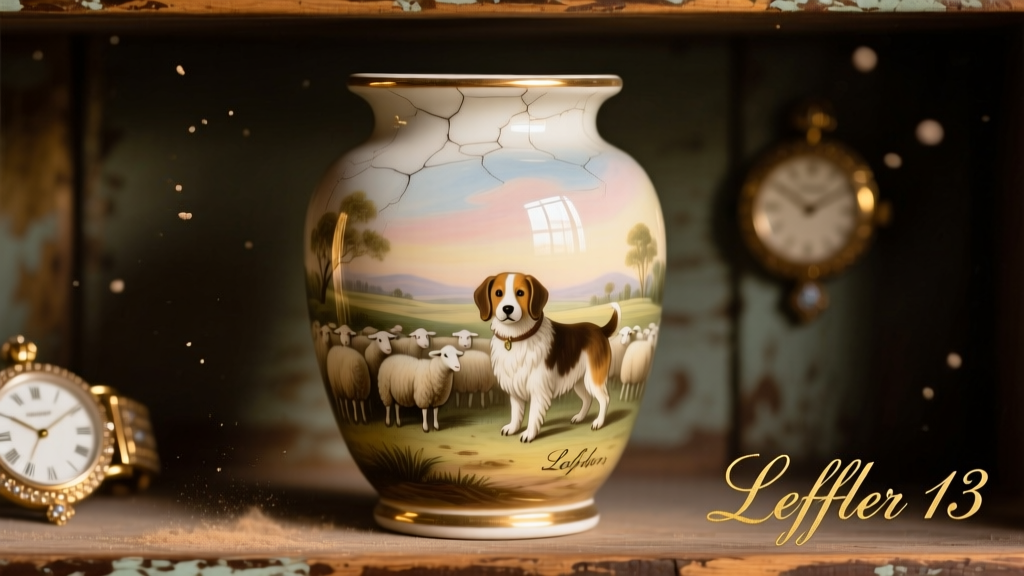
Owens Utopian Pillow Vase: The Leffler-Painted Shepherd Dog with Flock — A 13-Inch Masterpiece of American Art Pottery
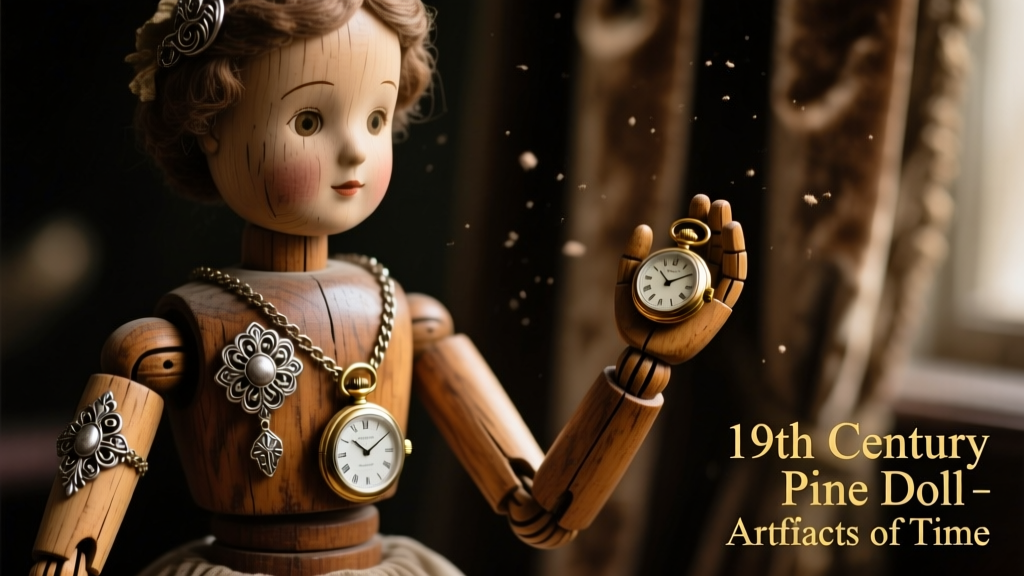
The Doll Wood Carved Pine Jointed 19th Century 20-Inch: A Study in German Craftsmanship, Anatomy, and Auction Provenance
Banks Home Budget By Bank Book Cast Iron Savings Bank: A Collector’s Guide to the 6 × 2½-Inch Vintage Piggy Bank
Rolex Reference 1131473: The Rare 1970s Oyster Perpetual Datejust in 18K Yellow Gold with Engine-Turned Bezel
The Bauer Butter Cover Ring: A Rare Orange Round Enamel Masterpiece from Mid-Century Germany
American Character Doll Co. Petite Composition Doll: Anatomy, Provenance, and Market Value of the 13-Inch Stuffed-Cloth Body Model
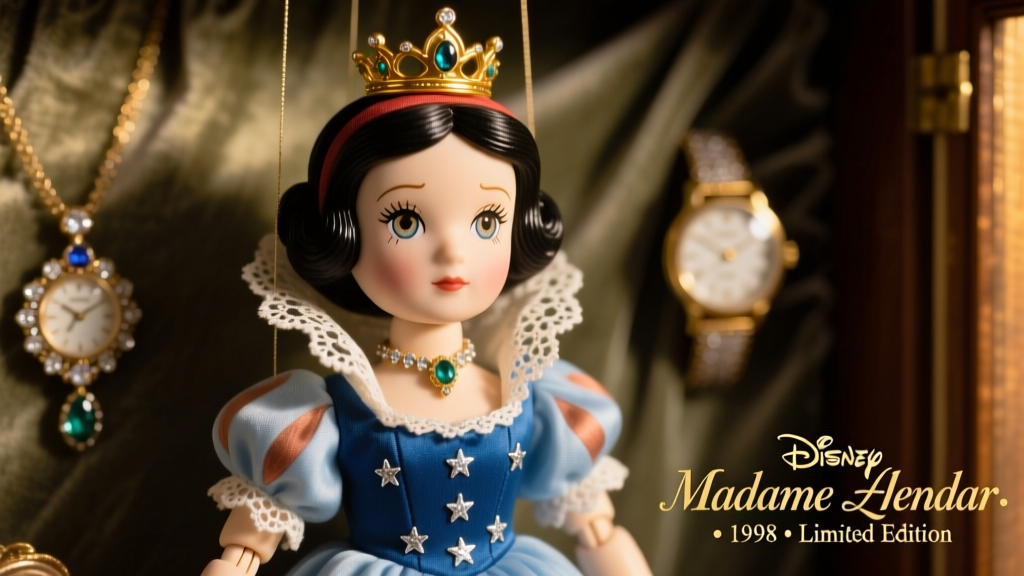
The Madame Alexander Disneyana Marionette Snow White: A Collector’s Guide to Rarity, Craftsmanship, and Provenance
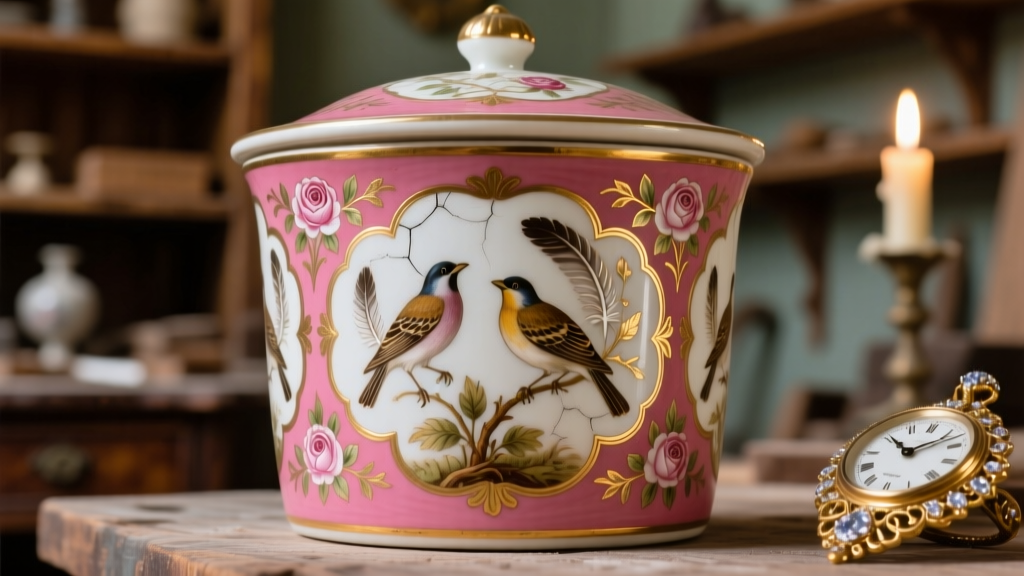
Sèvres Cachepot Panels of Birds on Rose Ground, Circa 1870s — A Technical and Historical Appraisal of a 10½-Inch Porcelain Masterpiece
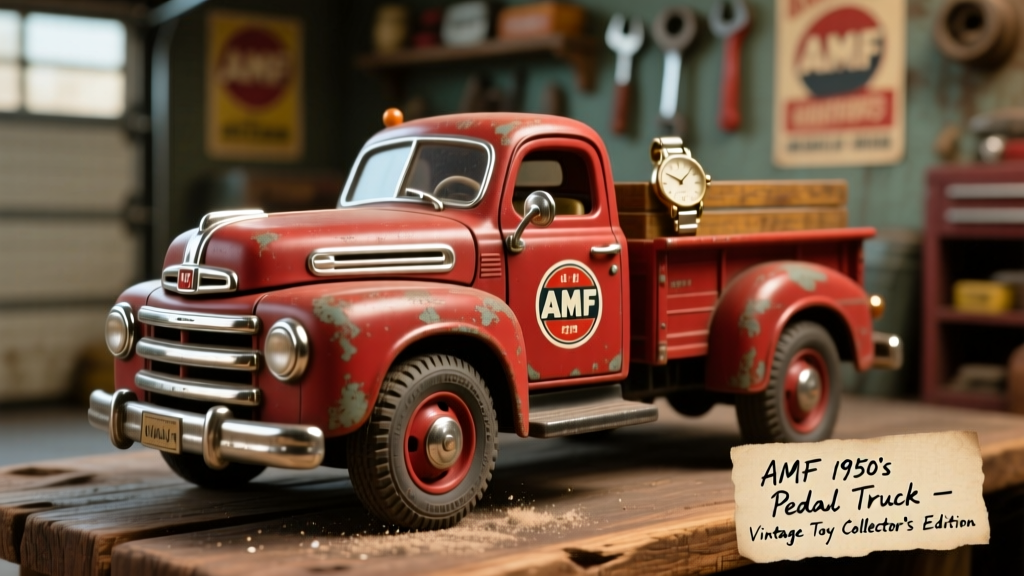
AMF Toy Pedal Car Transport Truck: A 1950s American Icon of Play, Engineering, and Collectibility