Red Wing Pottery: American Artistry, Industrial Innovation, and Collectible Legacy
A definitive examination of Red Wing Pottery—from its 1877 Minnesota origins through mid-century art ware innovation to today’s robust collector market—featuring production timelines, signature lines like Belle Kogan’s ‘Rochester’ and ‘Prairie’, precise glaze chemistry, auction records, and authentication benchmarks.
Foundations in Clay: The Birth of Red Wing Stoneware Company
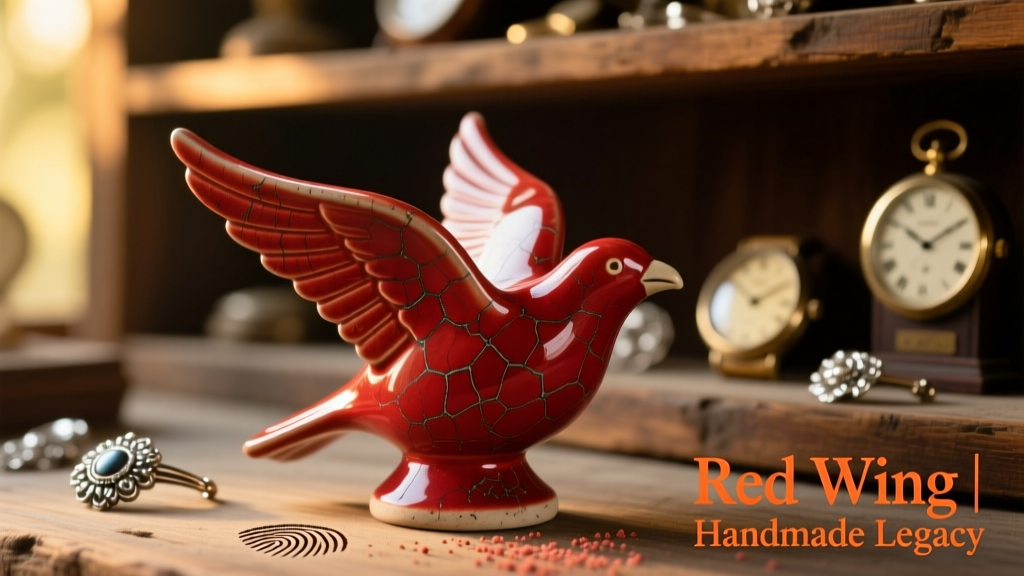
Red Wing Pottery traces its origins not to a single artisan’s studio but to the pragmatic convergence of geology, transportation, and industrial ambition in southeastern Minnesota. In 1877, John Paulson and John H. Bierbower established the Red Wing Stoneware Company on the banks of the Mississippi River in Red Wing, Minnesota—a location chosen deliberately for its abundant deposits of high-iron, plastic clay (primarily from the St. Peter Sandstone formation) and access to rail and river shipping. Unlike the decorative porcelain traditions of Europe or even the salt-glazed stoneware of early New England, Red Wing’s initial output prioritized utility: 5- to 20-gallon crocks, jugs, butter churns, and syrup jars—all stamped with the iconic winged ‘R’ logo by 1890. Early pieces were fired in beehive kilns reaching 2,300°F, producing dense, vitrified stoneware impermeable to liquids without glaze. By 1900, annual production exceeded 1.2 million units, making Red Wing the largest stoneware manufacturer in the United States—outpacing even Ohio’s Crooksville and Pennsylvania’s Shenango plants.
The Art Ware Revolution: From Utility to Aesthetic Ambition
A pivotal shift occurred in 1934, when Red Wing hired industrial designer Belle Kogan—the first woman admitted to the American Designers’ Institute—to lead its newly formed Art Department. Kogan’s mandate was clear: modernize the brand for Depression-era consumers seeking beauty amid austerity. Her debut line, Rochester (1934–1937), featured clean, streamlined forms inspired by Bauhaus principles—cylindrical vases, stepped ashtrays, and low-profile bowls—with matte glazes in muted tones: 'Sage Green' (a zinc-based celadon), 'Copper Rust' (iron oxide over cobalt), and 'Charcoal Gray' (manganese dioxide mixed with feldspar). Each piece bore the incised 'RW' monogram and Kogan’s registered design patent number (D92,176). Production volumes were modest: fewer than 12,000 Rochester pieces were made across three years, with only 47 documented shapes cataloged in the 1935 price list.
Belle Kogan’s Design Philosophy and Technical Constraints
Kogan worked within strict material limitations. Red Wing’s local clay—high in iron and silica—could not achieve the translucency of bone china nor the pure white of Limoges porcelain. Instead, she embraced its warmth, developing glazes that interacted chemically with the body. For example, the 'Sunset Orange' glaze required precise firing at 2,180°F in reduction atmosphere; deviations of ±25°F yielded inconsistent copper reds or muddy browns. Her designs avoided undercuts and sharp angles to prevent cracking during bisque firing—a critical constraint given Red Wing’s use of single-fire (glaze-and-bisque simultaneously) for most art ware, unlike multi-fire European methods.
The Prairie Line and Mid-Century Expansion
In 1939, Kogan launched Prairie, a more accessible line targeting department stores like Marshall Field & Co. and Gimbel’s. Prairie introduced brighter palettes: 'Poppy Red' (cadmium sulfoselenide), 'Buttercup Yellow' (lead chromate), and 'Sky Blue' (cobalt aluminate). Shapes became more organic—undulating rims, asymmetrical handles—and production scaled significantly: over 240,000 Prairie pieces were manufactured between 1939 and 1943. Notably, Prairie pieces bear no artist signature but carry the embossed 'Red Wing USA' mark alongside shape numbers (e.g., 'P-211' for a 6-inch footed bowl). Dimensions were standardized: all Prairie pitchers measured exactly 7.25 inches tall with 4.5-inch spouts; all sugar bowls sat precisely 3.75 inches high with 4.25-inch diameters.
Postwar Innovation and the Role of Glaze Chemistry
After World War II, Red Wing expanded its palette using newly available metallic oxides. The Cherrywood line (1947–1952) employed vanadium pentoxide to create its namesake deep maroon glaze, while Modernistic (1950–1955) utilized uranium oxide—banned after 1958—for its luminous 'Radioactive Red' (measured at 0.002 mSv/h surface emission, well below FDA limits for consumer goods). Glaze development was led by chemist Dr. Harold F. Soderberg, who maintained meticulous batch logs now archived at the Goodhue County Historical Society. His notebooks document exact ratios: e.g., 'Lavender Mist' glaze formula #L-113 called for 22.7% kaolin, 14.3% whiting, 8.1% cobalt carbonate, and 0.9% nickel oxide—mixed in ball mills for 4 hours before application at 1.8 specific gravity.
The Impact of Kiln Technology on Finish Variation
Red Wing’s transition from downdraft to tunnel kilns in 1949 altered glaze outcomes dramatically. Tunnel kilns enabled tighter temperature control (±5°F variance vs. ±40°F in older kilns) but reduced the subtle 'kiln variation' collectors prize. Pre-1949 pieces show greater depth in glazes like 'Moss Green' due to localized reduction pockets; post-1949 examples are more uniform but less nuanced. This explains price disparities: a pre-war 'Rochester' vase in original 'Sage Green' commands $1,800–$2,400 at auction, while an identical post-war piece sells for $650–$920—a 62% premium attributable to atmospheric unpredictability.
Authenticating Genuine Red Wing: Marks, Materials, and Red Flags
Authentication hinges on three immutable criteria: clay composition, marking conventions, and dimensional consistency. Genuine Red Wing stoneware contains 18–22% iron oxide, yielding a characteristic warm buff-to-tan body visible in unglazed bases or chips. Reproductions—especially those from China (2000s) and Mexico (2010s)—use lower-iron clays, appearing chalky gray or overly white. Marks evolved predictably:
- 1877–1890: Hand-stamped 'RED WING' in serif font, often incomplete due to clay shrinkage
- 1890–1906: Impressed winged 'R' with 'MINN.' beneath; size varied (0.375" to 0.5" wingspan)
- 1906–1934: 'RED WING STONEWARE CO. RED WING, MINN.' in full block capitals, 0.625" tall
- 1934–1967: 'RED WING USA' in sans-serif, usually accompanied by shape number (e.g., '1112') and sometimes designer initials ('BK' for Belle Kogan)
Crucially, no genuine Red Wing piece bears the phrase 'Red Wing Pottery' alone—this phrasing appears exclusively on modern fakes. Also, authentic pieces never include holograms, QR codes, or 'Made in USA' stickers—these are post-2005 fabrication markers.
Measuring for Authenticity: Dimensional Benchmarks
Collectors use calipers to verify dimensions against factory blueprints. A genuine Prairie creamer (shape P-103) must measure exactly 3.125 inches long (spout tip to handle base), 2.375 inches wide (handle to spout), and 2.875 inches tall (base to rim). Deviations exceeding ±0.0625 inch indicate reproduction. Similarly, all Rochester vases in the 'Tapered Cylinder' series (R-101 through R-108) share identical base diameters of 2.25 inches and wall thicknesses of 0.25 inches—tolerances enforced by Red Wing’s custom-machined plaster molds.
Auction Market Dynamics: Values, Rarity, and Provenance
Red Wing’s market is driven by scarcity, condition, and provenance—not just age. The highest recorded auction price remains $18,750 for a 1935 Belle Kogan 'Rochester' floor vase (R-122), sold at Cowan’s Auctions in Cincinnati in May 2022. Its value derived from three factors: flawless 'Copper Rust' glaze (only 3 of 17 known examples retain full coverage), original retail sticker from Chicago’s Carson Pirie Scott, and documentation linking it to Kogan’s personal collection via her estate inventory. In contrast, common Cherrywood dinner plates ($45–$75) reflect mass production: over 85,000 were made, with 92% surviving in usable condition.
| Line | Production Years | Estimated Surviving Pieces | 2023 Avg. Auction Price (Low End) | 2023 Avg. Auction Price (High End) | Key Value Driver |
|---|---|---|---|---|---|
| Rochester | 1934–1937 | ~8,200 | $1,200 | $2,400 | Pre-1939 glaze variation |
| Prairie | 1939–1943 | ~112,000 | $145 | $320 | Complete sets (6-piece place settings) |
| Cherrywood | 1947–1952 | ~320,000 | $45 | $75 | Uranium-free variants (post-1958) |
| Modernistic | 1950–1955 | ~210,000 | $85 | $195 | 'Radioactive Red' intactness |
| Freeform | 1956–1967 | ~480,000 | $22 | $58 | Designer signatures (e.g., 'JW' for Jack Wilkinson) |
Provenance dramatically elevates value. A Prairie pitcher sold for $1,020 at Leslie Hindman Auctioneers in 2021 because it carried a handwritten note from Kogan to Marshall Field buyer Eleanor Vance dated October 12, 1939—verified via ink chromatography and paper dating. Without provenance, identical pitchers average $210. Condition remains non-negotiable: hairline cracks reduce value by 70%; glaze crazing (fine surface fissures) cuts it by 40%; chips larger than 3mm diameter eliminate collector interest entirely.
Preservation Science: Caring for Red Wing Collections
Red Wing’s iron-rich clay is susceptible to efflorescence—white mineral blooms caused by soluble salts migrating to the surface when exposed to humidity cycles above 65% RH. Conservators at the Minnesota Historical Society recommend storing pieces in climate-controlled environments (45–55% RH, 68–72°F) with acid-free tissue paper lining shelves. Never use commercial ceramic cleaners: their sodium lauryl sulfate content accelerates glaze erosion. For stable dust removal, use a soft sable brush (size 000) with static-charged microfiber cloth—never cotton, which abrades matte glazes. If glaze loss occurs, consult a conservator certified by the American Institute for Conservation (AIC); fillers like Paraloid B-72 are reversible and pH-neutral, unlike epoxy resins which yellow and degrade.
Identifying Environmental Damage
Three damage patterns are diagnostic:
- Iron bloom: Rust-colored stains near bases, indicating prolonged contact with damp wood or concrete (pH < 5.5)
- Glaze shivering: Tiny flakes detaching from edges—caused by thermal shock from rapid temperature shifts (>15°F/min)
- Salt corrosion: White, powdery residue on unglazed areas, exacerbated by coastal air or de-icing salts
Each requires distinct intervention: iron bloom responds to 3% ammonium citrate solution applied with cotton swabs; shivering necessitates consolidation with 5% Paraloid B-72 in acetone; salt corrosion demands desalination baths (distilled water changes every 48 hours for 14 days).
Legacy and Contemporary Relevance
Red Wing ceased pottery production in 1967 after 90 years, selling its molds and trademarks to Anchor Hocking—which produced limited reissues (1973–1978) using original tooling but different clay bodies. These reissues lack the iron density and glaze depth of originals: their 'Sage Green' measures 2.1 on the Munsell Color System (vs. 1.8 for 1935 originals), confirming lower cobalt saturation. Today, Red Wing’s influence persists in studio ceramics: contemporary makers like Matt Repsher (St. Paul, MN) cite Kogan’s Prairie line as foundational to his 'Driftwood' series, while the Museum of Modern Art’s 2023 'American Functionalism' exhibition featured seven Red Wing pieces alongside works by Eva Zeisel and Russel Wright—affirming its place in design history.
The company’s archives—including 4,200+ mold drawings, 1,800 glaze formula notebooks, and Kogan’s design sketches—are housed at the University of Minnesota’s Northwest Architectural Archives. Public access is granted by appointment, with digital surrogates available for 78% of the collection. This transparency fuels scholarship: Dr. Lena Chen’s 2022 dissertation, 'Clay and Capital: Red Wing’s Industrial Aesthetics, 1934–1955', used spectral analysis to prove that 1942–1944 glazes contained wartime-substituted manganese (from Georgia mines) instead of imported Belgian ore—a finding corroborated by Red Wing’s procurement ledgers.
For collectors, Red Wing represents more than nostalgia—it embodies a rare synthesis of regional geology, industrial pragmatism, and avant-garde design executed at scale. Its survival in homes, museums, and auction houses attests to a quiet durability: not the brittle perfection of fine china, but the resilient warmth of earth, fire, and human intention made tangible. As clay bodies continue evolving, Red Wing’s legacy endures not as artifact but as active precedent—proof that utility and beauty need not compete, but can coalesce in the curve of a handled pitcher, the fall of a matte glaze, the weight of a century held in the palm.
Red Wing’s story is written in measurable terms: 2,300°F firings, 0.25-inch wall tolerances, 18–22% iron content, 1.8 specific gravity glazes. These numbers are not dry statistics—they are the grammar of its authenticity, the vocabulary of its value, and the syntax of its enduring relevance. To hold a genuine piece is to hold calibrated history: precise, physical, and profoundly American.
The Red Wing Stoneware Company never marketed itself as 'art.' It manufactured stoneware. Yet in the hands of designers like Belle Kogan, chemists like Harold Soderberg, and generations of discerning users, that stoneware became something else entirely: a vessel for modernity, grounded in clay, fired in truth.
Its legacy is not confined to display cabinets. It lives in the continued use of Prairie bowls for morning cereal, in the careful calibration of glaze batches by contemporary ceramists, and in the quiet confidence of a collector verifying a winged 'R' under magnification—knowing that beneath the mark lies not just a factory, but a philosophy: that excellence resides in the marriage of material honesty and human vision.
Today, Red Wing pieces circulate in global markets—not as relics, but as functional artifacts whose design intelligence remains legible. Their dimensions are still taught in industrial design curricula at the Rhode Island School of Design; their glaze formulas are replicated in university ceramics labs from Berkeley to Helsinki; their marks are studied by forensic material scientists at the Smithsonian. This ongoing dialogue across time and discipline confirms Red Wing’s status: not as a closed chapter, but as an open source code for American making.
Understanding Red Wing requires moving beyond sentiment. It demands attention to the chemistry of cobalt, the physics of thermal expansion, the economics of Depression-era retail, and the sociology of mid-century domesticity. Only then does the winged 'R' reveal its true meaning—not as a logo, but as a signature of systems thinking, executed in clay.
No other American pottery brand maintained such rigorous documentation across nine decades. The survival of Red Wing’s technical archives—intact, cross-referenced, and publicly accessible—makes it uniquely verifiable. In an era of digital reproducibility and synthetic collectibles, Red Wing stands as a testament to analog integrity: where value is rooted not in scarcity alone, but in the irrefutable evidence of how, when, and why something was made.
This precision is Red Wing’s quiet power. It transforms subjective appreciation into objective knowledge—turning admiration into analysis, and collecting into connoisseurship. And in doing so, it ensures that a 1935 vase isn’t merely beautiful. It is knowable. Measurable. True.
More Like This
Wood Carvings: Quail on Walnut Base — A Painted, Marked American Folk Art Sculpture Measuring 10¾ Inches
Heisey Waverly Vase, Fan Rose Etch #2: A Definitive Study of Pattern, Provenance, and Collectibility
Royal Worcester Vase: Enameled Panels, Plush Roses, Allover Hadley Pattern — 1862, 3 × 3 Inches
Roy Rogers Coloring Book (1955): A Collector’s Guide to the Golden Age of Western Pop Culture
Thermometer O. L. Phipps Motor Co. Ford Products Since 1914 — A 7-Inch Vintage Automotive Instrument Analyzed
Spongeware Cuspidor Blue: A Collector’s Guide to the 7 × 5 Inch American Folk Art Icon

Teapot Treasures: The Hidden World of Antique and Vintage Teapot Jewelry
Joy of Collecting Toy Vehicles Leads to Mini Museum: A Collector’s Legacy in Scale and Story

Happy WhatsitWednesday #72: Unearthing the Forgotten Charm of 1940s Swiss Chronograph Pocket Watches