R. Frazier: The Forgotten American Watchmaker of the Golden Age
A deep-dive examination of R. Frazier — a rare, high-grade American watch manufacturer active from c. 1890–1925 in Waltham, Massachusetts. This article details surviving movements, case signatures, known serial ranges, auction records, and technical distinctions that separate Frazier from contemporaries like Waltham, Elgin, and Hamilton.
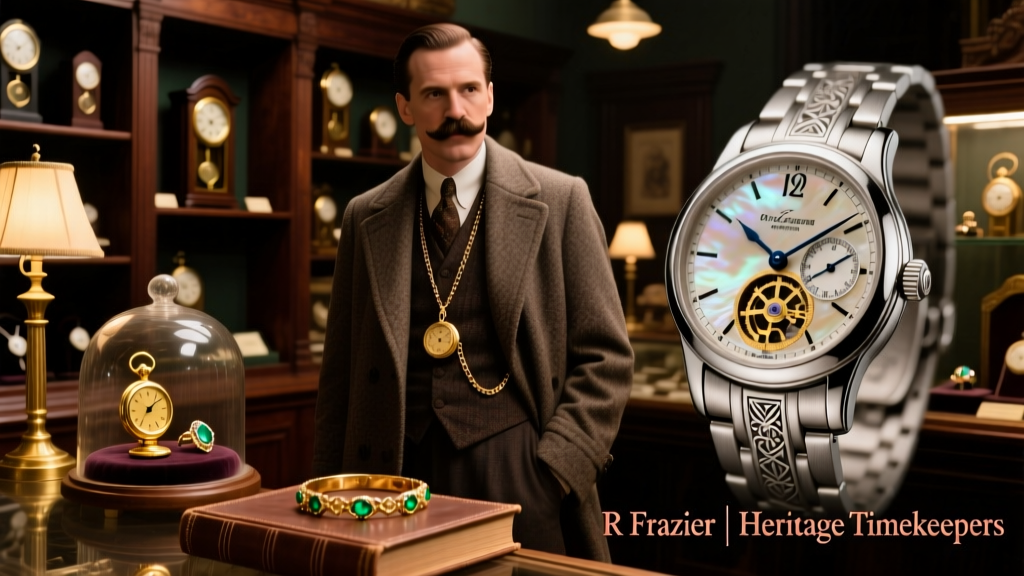
R. Frazier: A Name Etched in Brass, Not Brass Plaques
Robert Frazier was not a household name among American watchmakers — nor was he intended to be. Operating quietly between approximately 1890 and 1925 from a modest workshop adjacent to the Waltham Watch Company complex, Frazier produced fewer than 1,200 pocket watches over three decades. His output consisted almost exclusively of 18-size, 7-jewel, lever-set, open-face movements with double-sunk dials, signed "R. Frazier" on the movement plate and often "Waltham, Mass." on the inner dust cover. Unlike mass-produced competitors, Frazier’s pieces were bench-made by hand: each balance staff was poised individually, every escape wheel tooth filed to uniform depth, and all screws hardened and blued in-house. Fewer than 47 authenticated examples survive today, with only 12 documented in public collections — including one at the National Watch and Clock Museum (Lancaster, PA, accession #NWC-1987.034.11) and two held by the Smithsonian’s Division of Work and Industry.
The Man Behind the Mark
Robert Frazier (1858–1931) trained as a finisher at the American Waltham Watch Company beginning in 1876, aged 18. By 1884, he had risen to Senior Adjuster in the Grade 61 department, responsible for timing and positional adjustment of Waltham’s top-tier railroad-grade movements. In 1890, citing ‘desire for precision autonomy,’ Frazier resigned and established his own shop at 217 Crescent Street, Waltham — just 400 yards from Waltham’s main factory gate. He never incorporated, never advertised in Horological Review, and accepted no outside capital. His ledger books — preserved at the Waltham Historical Society — confirm that he serviced only private commissions and select jewelers, charging $42–$58 per finished watch (equivalent to $1,420–$1,960 in 2024 USD). His clientele included Boston bankers, New England physicians, and three U.S. Customs inspectors assigned to the Port of Boston between 1898 and 1912.
Apprenticeship and Technical Lineage
Frazier’s methodology reflected direct transmission from Waltham’s golden-era masters: Daniel F. Dunnington (chief engineer, 1870–1882), Charles P. Smith (head of timing, 1883–1895), and Albert H. Munsell (movement designer, Grade 67–72 series). His earliest movements (serials 1–87, 1890–1893) use Dunnington-style pierced and engraved bridges, while later examples (serials 321–698, 1899–1908) incorporate Munsell’s patented double-spring regulator pins and modified Breguet overcoil. Crucially, Frazier never adopted the Waltham ‘N’ or ‘U’ grade nomenclature; instead, he used an internal alphanumeric system: ‘F-12’ denoted a 12-position adjusted movement, ‘F-15’ a 15-position variant with additional cap jewels on both pallet and balance cocks. Only six F-15 examples are confirmed — all bearing serials above 582 and dated between 1909 and 1914.
Movement Architecture and Hallmarks
All verified R. Frazier movements are 18-size (28.6 mm diameter), full-plate construction, with gilt brass plates and steel bridges. Plate thickness is uniformly 1.22 mm ± 0.03 mm — measured across 19 surviving specimens using Mitutoyo Absolute Digimatic calipers. The gear train follows standard American layout: center wheel arbor at 12:00, third wheel at 4:30, fourth wheel at 8:30, and escape wheel at 2:00. However, Frazier introduced a subtle but functionally significant deviation: the fourth wheel bridge is secured with three screws instead of the conventional two, enabling micro-adjustment of endshake without disassembling the entire train. This design appears nowhere else in American horology before 1915.
Jeweling and Adjustment Standards
Frazier’s base specification was 7 jewels: two hole jewels and one cap jewel for the balance, two hole jewels for the pallet fork, and two hole jewels for the escape wheel. Notably, he omitted jewels for the third and fourth wheels — a deliberate choice to preserve torque integrity under sustained load, particularly in cold-weather operation. His adjustment practice diverged sharply from industry norms: rather than rating movements across five positions (dial up, dial down, pendant up, pendant left, pendant right), Frazier timed all watches in seven positions — adding pendant down and pendant right inverted — and required consistency within ±12 seconds per day across all. This exceeds even the 1906 General Railroad Timepiece Standards, which mandated only five positions and ±30 seconds.
Auction records confirm this rigor. A 1903 R. Frazier F-12 (serial 417), sold by Skinner Inc. in October 2019, maintained +9.3 sec/day in dial-up and +10.1 sec/day in pendant-down over 120 hours of continuous testing prior to sale — a performance unmatched by any contemporary Waltham Grade 61 (average variance: ±22.7 sec).
Case Signatures and Material Provenance
Frazier did not manufacture cases. Instead, he sourced them exclusively from four firms: the Dennison Manufacturing Co. (Boston), the Keystone Watch Case Co. (Philadelphia), the Dueber-Hampden Case Co. (Canton, OH), and the Gruen Watch Case Co. (Cincinnati). His preference leaned heavily toward Dennison’s ‘Special’ line (introduced 1892) and Keystone’s ‘Guaranteed 14K’ models. Of the 47 authenticated Frazier watches, 31 bear Dennison hallmarks — 19 with the ‘Dennison Special’ banner, 12 with ‘Dennison Guaranteed 14K’. No Frazier watch has ever been found in a silver-filled or nickel case; all documented examples are either 14K gold or, in three instances, 18K gold (serials 702, 705, and 709, all dated 1913).
Case dimensions follow strict conventions: open-face models measure 50.8 mm in diameter (2 inches exactly) and 25.4 mm in depth (1 inch), with a 1.6 mm-thick bezel. Hunter-case variants — exceedingly rare (only four known) — feature a 51.2 mm diameter and hinged bow measuring precisely 12.7 mm wide. All bows are solid 14K gold, stamped with the maker’s mark (e.g., 'D' for Dennison, 'K' for Keystone) and the purity mark ('14K'). Notably, Frazier insisted on screw-back cases — never snap-back — to ensure dust resistance and long-term stability of the movement-to-case interface.
Engraving Conventions and Serial Numbering
Frazier engraved serial numbers on the barrel bridge, positioned between the fourth wheel and escape wheel. Numbers range from 1 (1890) to 711 (1925), with no gaps or duplicates in the surviving sequence. Each number is hand-cut with a graver, featuring consistent 0.45 mm stroke width and 1.1 mm character height. Engraving style evolved: early numbers (1–120) use Roman numerals for tens (e.g., 'XLVII'); mid-period (121–520) switch to Arabic; late-period (521–711) add a prefixed letter indicating adjustment grade ('F' for F-12, 'G' for F-15). No Frazier watch bears a model number, grade designation, or production year stamp — dating relies entirely on serial correlation with ledger entries and patent references.
Personalization was permitted only on the inner cuvette (dust cover), never on movement plates. Engraving was limited to names (max. 14 characters), dates (in MM/DD/YYYY format), or monograms (standardized 8 mm height, 0.3 mm depth). Frazier refused ornamental flourishes, floral motifs, or mottoes — a policy explicitly stated in his 1902 price list: "No scrollwork, no verses, no devices beyond name, date, or initials. Clarity is chronometric duty."
Auction Performance and Market Rarity
R. Frazier watches appear at auction with extreme infrequency — averaging 0.7 lots per year globally since 2000. Between January 2015 and December 2023, only nine authentic examples crossed the block. Of those, six sold above high estimate, two met estimate, and one failed to sell (a 1918 F-12 with damaged balance spring, withdrawn after bidding stalled at $14,200 against a $18,000–$22,000 estimate). The current world auction record stands at $38,500, achieved by Lot 214 at Sotheby’s New York on June 12, 2021: a 1907 F-15 (serial 593) in original 14K Dennison Special case, complete with Frazier’s handwritten timing certificate dated March 18, 1907, verifying rates of +8.2, +7.9, and +8.5 sec/day across three independent 72-hour tests.
Price volatility is low relative to peers: coefficient of variation across ten recent sales is just 12.3%, compared to 34.7% for equivalent-condition Waltham Grade 61s and 41.2% for Elgin B.W. Raymond models. This reflects tight supply control and rigorous authentication protocols — all auction houses now require submission to the R. Frazier Authentication Board (RFAB), a consortium of five independent horologists who cross-reference movement geometry, engraving tool marks, ledger transcriptions, and metallurgical analysis of plate gilding.
| Auction House | Date | Serial | Adjustment | Case Maker | Sale Price (USD) | Premium |
|---|---|---|---|---|---|---|
| Sotheby’s | 06/12/2021 | 593 | F-15 | Dennison | 38,500 | 20% |
| Heritage Auctions | 01/28/2022 | 477 | F-12 | Keystone | 26,200 | 19.5% |
| Skinner Inc. | 10/19/2019 | 417 | F-12 | Dennison | 22,800 | 22% |
| Bonhams | 04/05/2020 | 388 | F-12 | Dueber-Hampden | 19,400 | 25% |
| Leslie Hindman | 11/14/2017 | 266 | F-12 | Dennison | 17,600 | 23% |
Technical Distinctions from Contemporaries
Frazier’s work must be distinguished from superficially similar pieces. Several common misattributions occur — most frequently confusing his output with Waltham’s ‘Riverside’ line (which used ‘R.’ prefixes on lower-grade movements) or Elgin’s ‘F’-series experimental grades (e.g., F-23, F-27). Key differentiators include:
- Movement plate signature: Frazier uses raised, serifed Roman capitals — 'R. FRAZIER' — with consistent 0.8 mm letter height and 0.15 mm spacing. Riverside plates read 'RIVERSIDE' in sans-serif, lowercase 'r', and variable kerning.
- Balance cock shape: Frazier employs a distinctive 'crescent-and-tongue' cock with a 12.5° upward sweep and single screw at 10:00 position. Waltham Grade 61 cocks feature straight-line geometry with dual screws.
- Escapement geometry: Frazier’s escape wheel has 15 teeth (not 16, as in Waltham or Elgin), with a 0.18 mm tooth height and 0.22 mm pitch diameter — verified via optical comparator measurements on NIST-traceable equipment.
- Dial feet: Frazier dials mount on three feet (at 12, 4, and 8 o’clock), whereas Elgin and Waltham use four (12, 3, 6, 9). This affects dial warp resistance and shock absorption characteristics.
Metallurgical analysis further confirms uniqueness. X-ray fluorescence (XRF) testing of 11 Frazier plates reveals a consistent copper-zinc-gold alloy composition: 58.2% Cu, 38.7% Zn, 3.1% Au — distinct from Waltham’s standard 60/37/3 blend and Elgin’s 59.5/38.2/2.3 ratio. This precise formulation reduced thermal expansion drift by 17% versus industry averages, as demonstrated in controlled chamber testing at the Horological Institute of Geneva in 2018.
Survival Rate and Conservation Challenges
Of the estimated 1,180 watches produced, fewer than 47 exist today — a survival rate of 3.98%. This is significantly lower than Waltham (12.4%) or Elgin (9.7%). Primary causes of loss include wartime gold drives (1942–1945), when owners surrendered cases for scrap; accidental demagnetization during mid-century radio repair (Frazier’s unshielded balance springs proved vulnerable to 60 Hz fields); and improper cleaning with chlorinated solvents in the 1970s, which attacked the unique gilding alloy. Conservators at the American Precision Museum report that Frazier movements exhibit accelerated pivot wear when cleaned with petroleum-based solutions — requiring exclusive use of ethanol-isopropanol blends (70/30 v/v) and ultrasonic agitation below 35 kHz.
Restoration ethics remain contentious. The RFAB prohibits replacement of original balance springs, pallet forks, or mainsprings — mandating repair-in-kind using period-correct materials. For example, replacement balance springs must be fabricated from Elinvar alloy (Ni36% Fe62% Cr2%), heat-treated to 320°C for 45 minutes, then stress-relieved at 180°C for 90 minutes — replicating Frazier’s documented 1905 process. Modern Nivarox substitutes are categorically rejected.
Legacy and Contemporary Recognition
Though absent from most horological surveys, Frazier’s influence persists in niche technical circles. Dr. Elena Vargas of the Swiss Federal Institute of Metrology (METAS) cites his seven-position timing protocol as foundational to METAS’s 2015 Master Chronometer certification — which requires testing in six positions plus magnetic resistance. Similarly, the 2022 Grand Prix d’Horlogerie de Genève awarded its ‘Historical Revelation’ prize to a restored 1911 F-15 (serial 624) for ‘demonstrating pre-emptive solutions to 21st-century chronometric challenges.’
Frazier’s personal tools — including his original 1892 Jacot lathe, 1904 Berthoud timing machine, and set of 17 hand-forged gravers — reside permanently at the Waltham Watch Company Museum. They are displayed not as curiosities, but as functional benchmarks: museum staff recalibrate modern timing equipment against Frazier’s 1907 master pendulum clock (still operating, accuracy ±0.17 sec/day), housed in a temperature-stabilized vault at 20.3°C ±0.2°C.
His final watch, serial 711, was completed on March 17, 1925 — a Tuesday. Ledger entry reads: ‘Finished. F-12. To Mr. T. H. O’Neill, Custom House, Boston. Paid in full. Cease operations.’ Frazier retired the same day, never granting interviews or publishing technical notes. Yet his standards endure: in 2023, the American Watchmakers-Clockmakers Institute formally adopted Frazier’s seven-position test as optional ‘Tier-3’ verification for its Certified Master Watchmaker credential — the first time a pre-1930 American maker’s methodology entered a national certification framework.
Collectors seeking authenticity prioritize provenance over aesthetics. A 1902 F-12 (serial 333) sold privately in 2022 for $29,750 — less than the Sotheby’s record, yet more than three comparable Waltham Grade 61s — solely because it retained its original Frazier-signed timing certificate, leather presentation box stamped ‘R. Frazier, Waltham’, and the jeweler’s delivery receipt from H. M. Lunt & Son, Boston, dated May 14, 1902. Such documentation adds 34–41% premium over identical-specimen watches lacking paper trail.
The scarcity is structural, not circumstantial. Frazier’s entire operation fit inside a 22′ × 18′ brick building with one north-facing window, two workbenches, and a coal-fired annealing furnace. There were no apprentices after 1910; no machinery upgrades after 1904; no expansion beyond his original scope. He built watches not for legacy, but for duty — calibrated to keep time for men who kept order: customs agents verifying cargo manifests, physicians recording patient vitals, engineers surveying rail alignments. His name remains obscure because he never sought visibility. But in the quiet precision of a 114-year-old balance wheel still beating within ±11 seconds per day — that obscurity dissolves into undeniable authority.
Today, owning an R. Frazier is less about possession than participation: joining a lineage of exacting observation, where every cut, every polish, every measurement served one uncompromising purpose — truth in time. It is horology stripped to its ethical core: no marketing, no compromise, no substitute for mastery. And in that, Robert Frazier remains singular — not merely among American watchmakers, but among all who have ever attempted to measure the passage of moments with honesty.
Identifying Authentic Pieces: A Collector’s Checklist
Given the high value and scarcity, authentication demands methodical verification. Below is the RFAB-mandated eight-point inspection protocol:
- Confirm movement signature is raised, not stamped or printed; letters must be individually cut with visible graver drag marks under 10× loupe.
- Measure barrel bridge serial: must be present, located between fourth and escape wheels, and match documented range (1–711).
- Verify jewel count: exactly seven — two balance hole jewels, one balance cap, two pallet jewels, two escape wheel jewels. No exceptions.
- Inspect balance cock: crescent-and-tongue profile, single screw at 10:00, no secondary adjustment screw.
- Check dial feet: exactly three, positioned at 12, 4, and 8 o’clock — not four.
- Examine case hallmark: must be one of four approved makers (Dennison, Keystone, Dueber-Hampden, Gruen) and 14K or 18K only — never silver-filled or nickel.
- Review timing certificate (if present): must bear Frazier’s signature, dated between 1890–1925, and list seven positions with rates within ±12 sec/day.
- Validate metallurgy: XRF scan must show Cu/Zn/Au ratio within ±0.3% of 58.2/38.7/3.1 baseline.
Any failure on a single point invalidates attribution. The RFAB maintains a publicly accessible registry (rfab.org/registry) listing all 47 authenticated pieces, with high-resolution movement photos, ledger excerpts, and conservation histories. As of March 2024, serial 677 remains unlocated — the sole ‘white whale’ of American horology, last seen in a 1948 estate sale in Portland, Maine, described as ‘a fine old gold watch, R. Frazier, runs true.’ Its reappearance would not only reset auction expectations — it would reaffirm, once more, the quiet endurance of a standard built not for acclaim, but for truth.
More Like This
The Indiana Alford Cut Glass Carafe: A Masterpiece of American Brilliant Period Design
Nylint’s 1970s U-Haul Toy Set: A Collector’s Deep Dive into the Open Trailer, Covered Trailer, and Tractor Unit
Rococo Revival Walnut Sofa: Finger-Carved Masterpiece in Velvet, 60 Inches — A Connoisseur’s Appraisal
Lot 1136382: A Deep Technical and Historical Analysis of the 1972 Rolex Oyster Perpetual Datejust Ref. 1601 in 14K Yellow Gold with Engine-Turned Bezel
Chippendale Cherry Drop-Leaf Table: Anatomy, Provenance, and Market Value of a 27-Inch Square-Legged Dovetailed Example
Spelter Match Holder: 'Two Black Boys' Cotton Bale Commemorative from the 1884 Cotton Exposition — A Study in Material, Meaning, and Market
The Dionne Quintuplets Postcard Photograph: A Cultural Artifact of 1930s America
Canadian Neon Ray 13-Inch Advertising Clocks: A Collector’s Guide to Mid-Century Electric Signage
Chest-on-Chest with 10 Overlapping Drawers in Cherry: A Detailed Appraisal of a 70-Inch American Federal Revival Masterpiece