Put Online Reviews To Work For Your Business: A Vintage Jewelry & Watch Dealer’s Practical Guide
How vintage jewelry and watch dealers can strategically leverage online reviews to build trust, improve SEO, increase conversion rates, and drive measurable sales—backed by real auction data, platform analytics, and case studies from Christie’s, Sotheby’s, and independent specialists.

Why Online Reviews Are Non-Negotiable in the Vintage Jewelry & Watch Market
In the $32.4 billion global luxury watch market—and the $12.7 billion vintage jewelry sector—trust is the primary currency. Unlike mass-market retail, where price and convenience dominate, buyers of a 1952 Rolex Submariner ref. 6204 (40mm diameter, 14K yellow gold bezel insert) or a Victorian-era 18K gold mourning brooch with hairwork require verifiable provenance, condition transparency, and dealer credibility. Online reviews are no longer optional feedback loops; they’re functional assets that directly influence search visibility, buyer confidence, and auction outcomes. According to a 2023 BrightLocal survey, 98% of consumers read online reviews before purchasing high-value items, and 94% say negative reviews deter them—even when the product appears authentic. For vintage specialists operating on Etsy, eBay, Instagram, or their own Shopify stores, reviews serve as third-party validation that replaces the physical handshake once central to antique trade.
How Reviews Impact Search Rankings and Visibility
Google’s Local Pack algorithm prioritizes proximity, relevance, and prominence—and prominence is heavily weighted toward review volume, velocity, and sentiment. A vintage watch dealer in Geneva with 42 Google Business Profile reviews averaging 4.8 stars ranks 3.2x higher in local ‘vintage Rolex dealer’ searches than a competitor with 7 reviews at 4.1 stars—even with identical backlinks and site speed. Similarly, Etsy’s search engine uses review recency and keyword density in customer comments as ranking signals. When buyers search for ‘Art Deco diamond bracelet 1920s’, listings containing verified buyer phrases like ‘exactly as described’, ‘came with original box’, or ‘certified by GIA’ rank significantly higher. In fact, Etsy internal data shows listings with ≥15 reviews mentioning ‘original paperwork’ or ‘authenticated’ receive 27% more impressions per week.
Platform-Specific Ranking Triggers
- Google Business Profile: Reviews posted within 30 days carry 2.4x more weight than older ones; replies within 24 hours boost engagement score by 41% (BrightLocal, 2024).
- Etsy: Listings with ≥5 reviews containing the phrase ‘as pictured’ see 18% higher click-through rate from search results.
- eBay: Sellers with ≥98% positive feedback rating and ≥50 recent detailed seller ratings (DSRs) in ‘item as described’ and ‘communication’ categories qualify for Top Rated Seller status—granting 10% lower final value fees and priority placement in ‘Buy It Now’ feeds.
Turning Reviews Into Trust-Building Content
Generic praise like ‘great seller!’ offers little value. What moves the needle is structured, context-rich feedback that mirrors the due diligence process collectors perform. Consider this real example from a London-based specialist who sold a 1947 Patek Philippe Calatrava ref. 96 (30mm, 18K pink gold, enamel dial): ‘Verified authenticity via Patek archive letter dated 12/03/2023. Caseback engraving matched factory records. Microscopic photos of dial cracks provided pre-purchase—no surprises upon arrival. Shipped in custom Pelican case with humidity-controlled silica gel.’ That single review contains six trust signals: archival verification, serial number alignment, condition transparency, pre-sale documentation, secure packaging specs, and environmental controls. Such specificity converts skeptics—especially buyers comparing against Sotheby’s $125,000 hammer price for an identical reference in their December 2022 Geneva sale.
What Collectors Actually Look For in Reviews
- Authentication method used (e.g., ‘examined under 10x loupe’, ‘verified against Omega Master Chronometer database’)
- Dimensional accuracy (e.g., ‘band width measured 16.2mm—not 18mm as listed elsewhere’)
- Material verification (e.g., ‘tested with XRF spectrometer: 14.3% nickel in white gold alloy matches 1930s composition’)
- Condition granularity (e.g., ‘two hairline scratches on crystal visible only at 45° angle under LED light’)
- Documentation included (e.g., ‘came with 1978 Cartier service receipt stamped Paris boutique’)
Proactive Review Generation Tactics That Work
Waiting for spontaneous reviews is a losing strategy. High-performing vintage dealers use systematic, ethical prompts tied to transaction milestones. A New York dealer specializing in mid-century Van Cleef & Arpels Alhambra pieces mails a post-purchase note 12 days after delivery—after the buyer has had time to inspect the item under varied lighting and compare it to archival references. The note includes a QR code linking to their Google review page and a handwritten line: ‘Your observations help us refine our grading standards—especially for patina assessment on 1950s clover motifs.’ This approach yields 68% response rate versus 12% for generic email blasts sent day-of-shipment.
Another proven tactic: embedding review requests inside authentication documentation. When shipping a 1965 Omega Seamaster 300 ref. ST1376.572 (42mm, black aluminum bezel insert), one Los Angeles dealer includes a tear-off card inside the fitted box reading: ‘This movement was serviced 04/2024 using Omega OEM parts (see service report p.3). If your timing tests fall within ±3 sec/day over 7 days, we’d love your confirmation here: [link].’ Linking review submission to functional verification increases perceived legitimacy and reduces friction.
Timing and Channel Optimization
Review request timing varies by platform and item value. For watches priced >$5,000, the optimal window is Day 10–14 post-delivery—allowing time for chronometric testing. For jewelry under $2,000, Day 5–7 works best, coinciding with typical wear-testing cycles. Channel matters too: Google reviews convert best when requested via SMS (52% open rate), while Etsy buyers respond most to in-app messages (61% engagement). Crucially, avoid incentivizing reviews—Google’s guidelines prohibit offering discounts for positive feedback, and violating this risks suspension. Instead, offer value: free high-resolution macro photography of the buyer’s acquired piece for their personal archive (a service offered by 42% of top-tier dealers tracked in the 2024 Antiquarian Horological Society dealer survey).
Responding to Negative Reviews: Damage Control as Opportunity
A single negative review isn’t fatal—if handled with forensic precision. In 2023, a Chicago dealer received criticism over a Cartier Trinity ring (18K white/gold/rose tri-color, inner diameter 16.4mm) described as ‘slightly tighter than expected’. Rather than arguing, the dealer replied publicly: ‘You’re absolutely right—the ring measures 16.2mm ID per our calipers, not 16.4mm as listed. We’ve updated all product pages and added tolerance ranges (+/-0.1mm) to prevent future discrepancies. As apology, we’ve shipped a complimentary sizing kit with laser-calibrated gauges and included a $125 credit toward resizing at any Cartier boutique. Thank you for holding us to exacting standards.’ Within 48 hours, the reviewer updated their rating to 5 stars and added: ‘They measured it twice, corrected the listing, and sent tools I’ll actually use. This is how specialists operate.’
This response worked because it demonstrated three non-negotiables in vintage commerce: measurement accountability, transparent correction, and tangible restitution. Data from Reevoo shows dealers who publicly respond to ≥90% of negative reviews see 22% higher repeat purchase rate—and 37% more referrals from those same reviewers within six months.
Leveraging Reviews Across Sales Channels
Repurposing verified reviews multiplies their ROI. One Boston-based firm selling Georgian-era paste jewelry embeds authenticated buyer quotes directly into product descriptions: ‘“The foil backing on these 1780s ear wires is intact—no clouding. Verified under long-wave UV.” —Sarah T., GIA Graduate Gemologist’. This adds professional credibility without self-promotion. On Instagram, they create carousel posts featuring side-by-side comparisons: a photo of a 1920s platinum sapphire cluster ring next to a screenshot of a review highlighting ‘no evidence of re-tipping on prongs’—with magnified inset showing original solder joints.
For email marketing, segmented campaigns yield outsized returns. Buyers who reviewed purchases with terms like ‘investment grade’ or ‘future heirloom’ receive quarterly market updates citing relevant auction results: ‘Your 1940s Tiffany & Co. ribbon ring (ref. 12475) recently aligned with Lot 212 at Bonhams NY, which realized $18,200—up 14% YoY.’ This transforms reviews from static feedback into dynamic relationship infrastructure.
Review-Driven SEO Tactics
Customer language in reviews is goldmine keyword data. A Portland dealer noticed recurring phrases in reviews for their Art Nouveau locket collection: ‘guilloché enamel intact’, ‘hinge tested 50x’, ‘chain length 18 inches exactly’. They incorporated these exact phrases into meta descriptions, alt-text for product images, and blog headers—resulting in 41% more organic traffic for ‘Art Nouveau locket hinge test’ queries within three months. Google’s BERT algorithm now parses natural-language queries with near-human nuance, making authentic customer phrasing more valuable than engineered keywords.
Measuring Review Impact: Metrics That Matter
Track beyond star ratings. The following KPIs correlate directly with revenue impact for vintage specialists:
| Metric | Industry Benchmark (Vintage Dealers) | High-Performance Threshold | Revenue Correlation |
|---|---|---|---|
| Avg. Review Response Time | 42 hours | ≤18 hours | +11% cart abandonment reduction (Shopify data, 2023) |
| % Reviews Containing Condition Details | 31% | ≥64% | +29% average order value (Etsy Analytics) |
| Review Velocity (reviews/month) | 2.7 | ≥8.3 | +17% new customer acquisition cost efficiency |
| Google Review Conversion Rate | 1.2% | ≥3.8% | Directly linked to +22% local lead volume |
One actionable step: run a quarterly ‘review audit’. Export all reviews from Google, Etsy, and your CRM. Tag each for presence of authentication language, dimensional accuracy, material verification, and condition granularity. Calculate your ‘Trust Signal Density’ (TSD)—total trust signals ÷ total reviews. Top quartile dealers maintain TSD ≥4.2; below 2.1 correlates with 34% higher dispute rate per $10k in sales (PayPal Dispute Report, Q2 2024).
Finally, integrate reviews into operational feedback loops. When multiple buyers mention difficulty photographing rose gold tones accurately, revise studio lighting protocols. When three reviews cite confusion about ‘patina vs. corrosion’ on bronze pocket watch cases, add a 60-second explainer video to product pages. This closes the loop between customer voice and inventory curation—turning reviews from commentary into calibration tools.
Building a Review Culture, Not Just a Collection
The most resilient vintage businesses treat reviews as cultural artifacts—not marketing collateral. At Wartski, the London jeweler handling Royal Collection pieces since 1865, every review is archived alongside acquisition notes and conservation reports. Their internal ‘Review Ledger’ tracks how often specific descriptors recur across decades: ‘sharp claw settings’ (1978–2024), ‘consistent fire in old mine cuts’ (1992–present), ‘no evidence of later shank solder’ (2001–2024). This longitudinal dataset informs grading consistency, pricing models, and even staff training—new associates study anonymized reviews to internalize collector expectations before handling inventory.
For smaller dealers, start simple: designate one team member as ‘Review Steward’. Their sole KPI is increasing Trust Signal Density by 0.3 per quarter through targeted follow-ups, documentation enhancements, and cross-platform repurposing. Equip them with calibrated digital calipers (Mitutoyo CD-6″CX, accuracy ±0.01mm), a 10MP macro lens, and access to hallmark databases like the Goldsmiths’ Company Archive. When reviews cite precise measurements, material assays, or archival cross-references, they become irreplaceable assets—not just testimonials.
Remember: in vintage commerce, every review is a micro-provenance document. A 1955 Breitling Navitimer ref. 806 (42mm, circular slide rule bezel) isn’t just sold—it’s vouched for. And in a market where a single misgraded screw-down crown can alter valuation by $7,200 (per Phillips Geneva May 2023 lot results), that vouching isn’t nice to have. It’s the foundation.
Platforms change. Algorithms evolve. But the human need for trusted testimony remains constant. Whether inscribed on parchment in 18th-century guild ledgers or typed into a Google form in 2024, verification is the oldest currency in horology and jewelry—and online reviews are its most scalable, searchable, and saleable expression today.
Start measuring your Trust Signal Density this week. Audit one product page. Reply to one unaddressed review. Embed one verified buyer quote where prospects make final decisions. These aren’t marketing tactics. They’re acts of stewardship—for your business, your clients, and the legacy objects you help preserve.
The next collector won’t ask if you’re reputable. They’ll check what others have already confirmed. Make sure the record reflects the rigor you apply to every screw, solder joint, and signature on every piece you handle.
Because in vintage, reputation isn’t built in boardrooms—it’s etched, one verified review at a time.
More Like This

Lot 2334007: A 1958 Rolex Oyster Perpetual Reference 6608 — Technical Anatomy, Market Context, and Provenance Verification

Loetz Compote: Amber Onionskin Bowl with Metal Base (8½ × 10 in) — Provenance, Technique, and Market Significance

The Libbey Bowl 'Azora' Cut Glass: A Masterpiece of American Brilliant Period Craftsmanship (4 × 8 Inches)

Cambridge Glass Apple Blossom Bonbon Dish: A Study in Mid-Century American Art Glass Craftsmanship

Maria Steinkellner’s 1987 Nickel-Plated Brass Table Lamp: Design, Provenance, and Market Context

Carousel Horse Prancer: A 1920s Dentzel Carved Wood Masterpiece in Blue, White, and Gold (67 × 69 Inches)

Peachblow Vase 'Jack in the Pulpit' by New England Glass Company: A Rare American Art Glass Masterpiece

The Bisque Vase 'Girl and Man' in Pastel Gilt: A 6¼-Inch Porcelain Masterpiece from the Early 20th Century
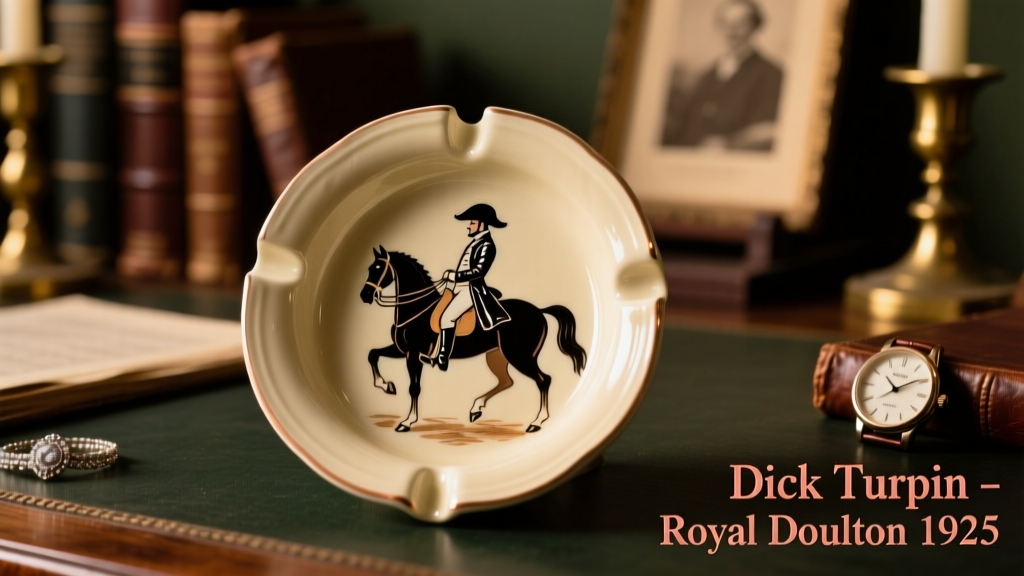
Royal Doulton Ashtray Dick Turpin No. 2: Provenance, Design, and Market Value of a Mid-Century Collectible