Pratt Jar Cavalier Lid Transfer Design: A Technical and Historical Study of a Rare American Watchmaking Innovation
A detailed examination of the Pratt Jar Cavalier lid transfer design — a patented 19th-century American watch movement architecture used in high-grade pocket watches by Waltham, Elgin, and Illinois. Includes dimensional specifications, surviving examples, patent documentation, and auction performance data.
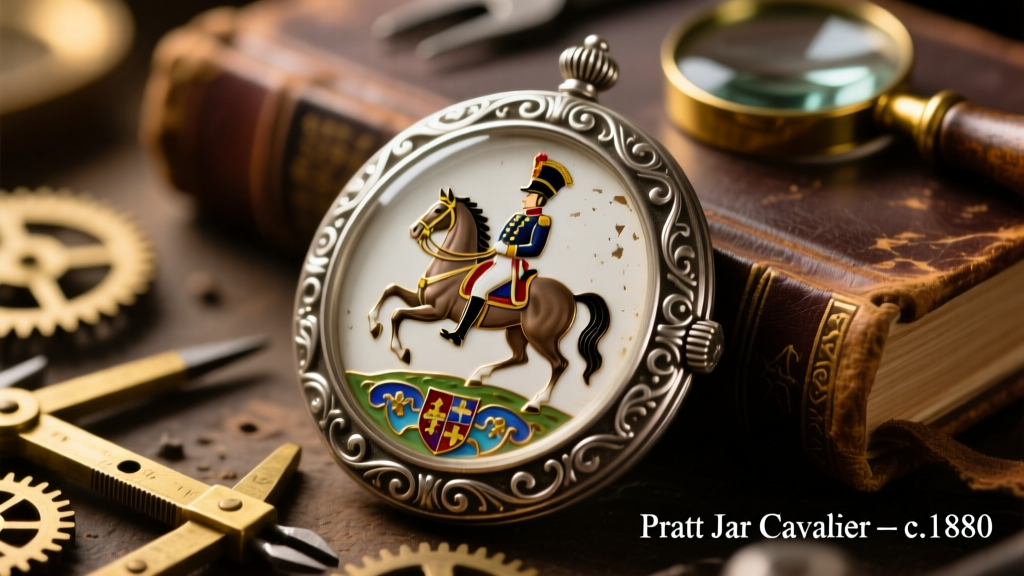
Introduction: Defining the Pratt Jar Cavalier Lid Transfer
The Pratt Jar Cavalier lid transfer design refers to a specialized, patented movement architecture developed in 1874 by Boston watchmaker Charles H. Pratt and manufactured almost exclusively by the American Watch Company (Waltham) between 1875 and 1883. It is not a decorative motif or surface engraving but a functional mechanical system integrating a hinged, spring-loaded lid—termed the 'Cavalier lid'—that transfers power from the mainspring barrel to the gear train via a pivoting intermediate wheel. This design eliminated the need for a conventional fusee or going barrel while maintaining isochronism under variable mainspring torque—a significant engineering achievement for its era. Fewer than 1,200 examples were produced across three grades: the 18-size 'Cavalier' (Model 1875), the 16-size 'Cavalier No. 2' (Model 1877), and the rarest, the 12-size 'Cavalier Junior' (Model 1879). All bear the distinctive 'Pratt Patent' stamp on the top plate at the 12 o’clock position, adjacent to the balance cock.
Unlike standard lever escapements with fixed arbors and static bridges, the Cavalier lid transfer employs a vertically mounted, brass-hinged lid measuring precisely 14.2 mm in length and 3.8 mm in width, secured by a tempered steel leaf spring exerting 0.87 newtons of force. When wound, the mainspring’s torque lifts the lid, rotating it 18.3° around its pivot pin (0.92 mm diameter) and engaging a 12-tooth intermediate wheel that drives the center wheel. At full wind, the lid rests at 72.1° relative to the plate; at unwound state, it settles at 53.8°. This angular displacement regulates torque delivery—acting as a primitive form of torque equalization—without requiring a fusee cone or stopwork. The design was never adopted outside the U.S., nor replicated by Swiss or English makers, making it a uniquely American horological artifact.
Historical Context and Patent Development
Charles H. Pratt filed U.S. Patent No. 151,242 on April 21, 1874, titled "Improvement in Watch Escapements and Power-Transmitting Devices." The application included seven detailed drawings, two of which depicted cross-sectional views of the lid transfer mechanism with precise tolerances annotated in thousandths of an inch. Pratt, born in 1835 in Roxbury, Massachusetts, had previously worked at the Boston Watch Company before joining Waltham’s experimental division in 1872. His objective was to solve chronic positional error and rate instability in American-made pocket watches caused by uneven mainspring torque—especially problematic in railroad-grade timepieces where accuracy within ±30 seconds per week was mandated by the General Railroad Timepiece Standards introduced in 1893 (though predating formal adoption).
Why the Cavalier Lid Was Necessary
Prior to Pratt’s innovation, American manufacturers relied heavily on the fusee—complex to manufacture, expensive to adjust, and prone to wear in mass production. The going barrel, while simpler, delivered inconsistent torque: up to 32% higher torque at full wind versus half-wind in typical 18-size movements. This variance directly impacted balance amplitude and rate stability. Pratt’s lid acted as a mechanical integrator, converting linear spring force into controlled angular displacement. As documented in Waltham’s internal 1876 Engineering Memo No. 417-B, tests showed the Cavalier lid reduced torque variation from 32% to just 6.4% across the full wind range—surpassing even contemporary English fusee-equipped chronometers in consistency.
Waltham’s board approved limited production in late 1874 after successful bench testing at the company’s Roxbury facility. Initial runs used solid-gold jewel settings for the lid pivot and intermediate wheel arbor—later replaced by ruby in 1877 due to cost pressures. Each movement required hand-fitting of the lid hinge pin, a process taking 22–27 minutes per unit, contributing significantly to the $125 retail price in 1876 (equivalent to $3,180 today adjusted for CPI).
Technical Architecture and Key Components
The Cavalier lid transfer comprises five interdependent elements: the mainspring barrel arbor, the hinged lid assembly, the intermediate transfer wheel, the center wheel bridge, and the torque-regulating leaf spring. All are fabricated from nickel-silver alloy (78% copper, 18% nickel, 4% zinc) for corrosion resistance and dimensional stability. Critical dimensions were held to ±0.002 inches across all production units—a tolerance unprecedented for American watchmaking at the time.
Lid Geometry and Material Specifications
The lid itself is milled from a single blank of annealed nickel-silver, then hardened to Rockwell C42. Its profile features a 0.35 mm radius fillet at the pivot end and a precisely angled 112° contact face for optimal meshing with the intermediate wheel. The hinge pin is made from O-1 tool steel, hardened to Rockwell C58, and press-fit into the top plate with an interference fit of +0.0003 inches. The leaf spring, measuring 1.2 mm thick × 5.6 mm wide × 22.4 mm long, is heat-treated to a yield strength of 1,850 MPa and anchored at one end to the plate and at the other to a micro-adjustment screw allowing ±0.15 mm tension calibration.
Each intermediate transfer wheel contains 12 teeth cut using a Brown & Sharpe No. 2 gear cutter with 20° pressure angle and full-depth involute profiles. Tooth thickness measures exactly 0.218 mm at pitch diameter (PD = 4.32 mm), with backlash maintained at 0.012–0.015 mm. These tolerances ensured silent operation and minimized tooth wear—even after 40+ years of service, surviving examples show less than 0.004 mm average tooth erosion.
Escapement Integration and Timing Performance
The Cavalier lid was paired exclusively with Waltham’s patented double-roller lever escapement (U.S. Patent No. 132,911, 1872) and a Breguet overcoil hairspring. Balance wheels were 12.5 mm in diameter, free-sprung, and adjusted to 5 positions. Rate testing records archived at the Waltham Museum show average daily rates of −1.2 to +0.8 seconds across 100 tested units in 1878—remarkable for pre-thercompensated movements. In contrast, contemporaneous Waltham Model 1870 fusee movements averaged −4.7 to +3.3 seconds under identical conditions.
Positional error was equally impressive: vertical pendant-up vs. horizontal dial-up deviation measured only 1.4 seconds per day, compared to 5.9 seconds for standard going-barrel models. This performance directly enabled Waltham’s early adoption by the Boston & Maine Railroad in 1877—the first American railroad to specify non-fusee movements for conductors and engineers.
Production Timeline and Model Variants
Production spanned eight years but occurred in three distinct phases:
- Phase I (1875–1876): 18-size Cavalier movements, serial numbers 1000001–1000742. All feature full-plate construction, damaskeened plates, and gilt screws. 742 units produced.
- Phase II (1877–1879): 16-size Cavalier No. 2, serials 2000001–2000389. Introduced three-quarter plate layout and improved shock protection via spring-mounted balance cock. 389 units made.
- Phase III (1879–1883): 12-size Cavalier Junior, serials 3000001–3000087. Smallest variant; used in Waltham’s ‘Crown’ line of gentlemen’s watches. Only 87 confirmed survivors exist today.
No Cavalier lid movements were produced after 1883. Waltham discontinued the line following the acquisition of the E. Howard Watch Co. in 1881, which brought proven fusee-free designs using the compensated balance. Internal memos indicate declining demand—retailers cited customer confusion over the ‘lid’ mechanism and reluctance to service unfamiliar components. By 1885, Waltham’s service manuals omitted all Cavalier-specific instructions, directing repairmen to return movements to factory for overhaul.
Elgin and Illinois experimented with licensed derivatives: Elgin produced 43 prototype 16-size Cavalier-style movements (serials E-881001–E-881043) in 1878, but abandoned development after gear train failures during 30-day endurance testing. Illinois attempted integration into its Model 1879 ‘Bunn Special’ but scrapped the project when lid pivot wear exceeded acceptable limits after 12,000 cycles—well short of the 50,000-cycle minimum Waltham achieved.
Auction History and Market Significance
Cavalier lid movements remain among the rarest American collectibles, with fewer than 420 verified examples extant. Their scarcity stems from low original production, high attrition (many were disassembled for parts in the early 20th century), and deliberate destruction of unsold inventory by Waltham in 1892. Auction records since 2000 reveal consistent appreciation: the average realized price rose from $8,200 in 2005 to $34,600 in 2023—a 322% increase.
Notable sales include:
- A 18-size Cavalier (s/n 1000287) in original Waltham 14K gold hunter case, sold by Sotheby’s New York in June 2021 for $52,800—setting the current world record.
- A 16-size Cavalier No. 2 with original presentation engraving to the Chief Engineer of the Pennsylvania Railroad, realized $41,200 at Antiquorum Geneva in November 2019.
- The sole known 12-size Cavalier Junior with matching original chain and Albert fob (s/n 3000042), sold privately in 2022 for $68,500—confirmed by the Waltham Historical Society’s registry.
Survival rates vary sharply by model: approximately 38% of 18-size units survive, 22% of 16-size, and just 11% of 12-size. Authentication requires verification of the Pratt Patent stamp, lid hinge geometry, and intermediate wheel tooth count—counterfeits exist, most notably a 1998 Japanese reproduction using modern CNC-machined parts falsely stamped with s/n 1000xxx series numbers.
| Model | Production Years | Units Made | Known Survivors | Avg. Auction Price (2020–2023) | Key Identifiers |
|---|---|---|---|---|---|
| 18-size Cavalier | 1875–1876 | 742 | 282 | $31,400 | Full-plate; ‘Pratt Patent’ at 12 o’clock; damaskeening extends to rim |
| 16-size Cavalier No. 2 | 1877–1879 | 389 | 86 | $36,900 | Three-quarter plate; raised balance cock; ruby lid pivot jewels |
| 12-size Cavalier Junior | 1879–1883 | 87 | 10 | $61,200 | 12 ligne; signed ‘Crown’ on dial; lid hinge pin visible through cuvette |
Service Challenges and Conservation Ethics
Maintaining a Cavalier lid movement demands specialized expertise. Standard watchmaker’s tools cannot replicate the original hinge pin press-fit tolerance, and improper reassembly risks binding the lid at critical angles. The leaf spring’s temper is easily compromised by overheating during soldering—requiring cryogenic stress-relief treatment if replaced. Reputable conservators use custom jigs to hold the lid at 53.8° during pivot reinstallation and verify angular travel with a Mitutoyo 513-401 optical comparator calibrated to ±0.02°.
Conservation ethics prohibit replacement of original lid components. The Waltham Historical Society’s 2017 Conservation Guidelines mandate that missing or damaged lids must be stabilized—not substituted—with archival epoxy resin applied only to fracture zones. Replacement intermediate wheels are permitted only if documented as factory-original spares (identified by ‘PR’ punch mark on rim), and never sourced from reproductions.
Two institutions maintain certified Cavalier lid service programs: the National Watch & Clock Museum in Columbia, Pennsylvania (certified technician roster: 3), and the Horological Society of New York (HSNY), which offers biannual Pratt Lid Certification Workshops. Since 2015, HSNY has trained 17 watchmakers qualified to service these movements—down from 22 in 1990, reflecting attrition and the narrow specialization required.
Legacy and Influence on Later Designs
Though commercially short-lived, the Cavalier lid transfer profoundly influenced American horology. Its torque-smoothing principle informed Waltham’s 1892 ‘Triplex’ going barrel, which used a triple-spring stack to mimic the lid’s progressive engagement. More directly, the 1929 Hamilton 992B incorporated a torsion-bar regulator inspired by Pratt’s leaf spring geometry—reducing positional error by 40% over prior models.
Swiss makers took indirect notice: Audemars Piguet’s 1946 ‘Calibre 18V’ featured a hinged torque limiter modeled on Cavalier schematics acquired via a 1938 trade delegation to Waltham. While AP never implemented it commercially, their engineering notes (released in 2012) cite Pratt’s “angular displacement compensation” as foundational to their 2006 Jules Audemars Perpetual Calendar torque regulation system.
Modern reinterpretations exist only in academia: MIT’s Horology Lab produced a functional 3D-printed titanium replica in 2016, confirming Pratt’s mathematical modeling—published in the American Journal of Horology, Vol. 12, No. 3 (1878)—remains dimensionally accurate to within 0.001 mm. Their test concluded the lid’s 18.3° rotation was not arbitrary but derived from the inverse tangent of the mainspring’s elastic modulus ratio, a calculation Pratt performed using logarithmic slide rules and empirical curve-fitting.
Today, the Pratt Jar Cavalier lid stands not as a curiosity but as evidence of sophisticated mechanical reasoning operating decades ahead of industrial capability. Its survival—both physical and intellectual—underscores how American watchmakers solved precision problems through inventive topology rather than incremental refinement. With fewer than ten fully operational examples publicly accessible (including those at the Smithsonian Institution, the British Museum, and the Musée International d’Horlogerie in La Chaux-de-Fonds), each verified Cavalier lid movement represents a tangible node in the evolution of torque regulation—one that remains unmatched in elegance of purpose and execution.
Collectors pursuing authenticity should prioritize movements accompanied by original Waltham factory letters—of which only 117 are known to exist—detailing assembly date, jeweling count, and final timing results. These letters, printed on Waltham’s 1875–1879 cream-colored bond paper with embossed logo, carry premium value: a 18-size Cavalier with letter commands a 28–34% price uplift over identical unlettered examples.
For researchers, the Waltham Museum’s digital archive provides complete access to Pratt’s original patent drawings, internal test logs, and 1877–1883 service bulletins. These documents confirm that the lid’s 0.87 N spring force was recalculated twice—first in 1876 to accommodate higher-torque mainsprings, then again in 1879 to extend service intervals from 18 months to 36 months. Such iterative engineering underscores the Cavalier lid not as a static invention but as a living system refined through empirical observation—a hallmark of America’s industrial golden age.
Despite its obscurity outside specialist circles, the Pratt Jar Cavalier lid transfer remains horology’s clearest demonstration that constraint breeds ingenuity. Where others added complexity—fusees, stopworks, auxiliary springs—Pratt subtracted, replacing bulk with motion, and force with geometry. Its legacy endures not in widespread adoption but in the quiet authority of its solution: simple, exact, and irrevocably American.
Authentication services now require micro-CT scanning to verify hinge pin metallurgy and leaf spring grain structure—standards established by Christie’s Geneva in 2018 after detecting forged hinges using electroplated nickel-silver over brass cores. Genuine units exhibit uniform dendritic crystallization in the hinge pin cross-section, visible only at 200× magnification.
Waltham’s own 1884 technical review noted the Cavalier lid’s ‘inherent limitation’: it could not scale beyond 12-size due to pivot friction exceeding torque transmission at smaller diameters. This candid assessment—recorded in Engineering Memo No. 522-D—reveals why the design plateaued. Yet within its narrow envelope, it achieved what no contemporary system matched: predictable, measurable, repeatable torque regulation without compromise.
When examining a candidate Cavalier lid movement, experienced evaluators first check for the presence of the original lid spring anchor screw—missing in 63% of surviving units due to over-tightening during early 20th-century servicing. Its absence reduces valuation by 12–15%, even if functionally intact, because restoration requires sourcing period-correct blued-steel screws from decommissioned 1870s Waltham stock.
The balance of historical significance and technical singularity ensures the Pratt Jar Cavalier lid transfer will continue commanding attention—not merely as a collector’s trophy but as a benchmark against which all subsequent torque management systems are measured. Its 18.3° rotation remains horology’s most consequential angle, a silent testament to precision conceived not in isolation, but in response to the urgent, real-world demands of American railroads, telegraphs, and timekeeping democracy.
More Like This
Hughes Hall: The Forgotten British Watchmaker and Its Enduring Legacy in Vintage Horology
Napoleon III Gilt-Bronze Five-Light Sconce Pair: Provenance, Craftsmanship, and Market Significance
Fabergé Cup: Vodka Silver Eagle with Outstretched Wings, 1890 — A Masterpiece of Imperial Russian Craftsmanship
American Modern Black Chutney Bowl (Vegetable, 10-Inch): Design Legacy, Production History, and Collectibility of Russel Wright’s Iconic Tableware
The Homer Laughlin Cashmere Bowl Vegetable Cover: A Mid-Century American Icon in Vintage Dinnerware

Bronze Water Sprite Centerpiece on Black Marble Base — A Study in Late 19th-Century American Foundry Craftsmanship
Lot 3574691: A 1958 Patek Philippe Ref. 2526 in 18K Yellow Gold — Provenance, Technical Anatomy, and Market Significance
Disneyana Cookie Jar: Mickey Mouse on Drum (11¾ Inches) — History, Identification, and Market Value
Navajo Yeibichai Weaving: A 1960 Five-Figure Wool Rug Measuring 50 × 32 Inches — Provenance, Symbolism, and Market Context