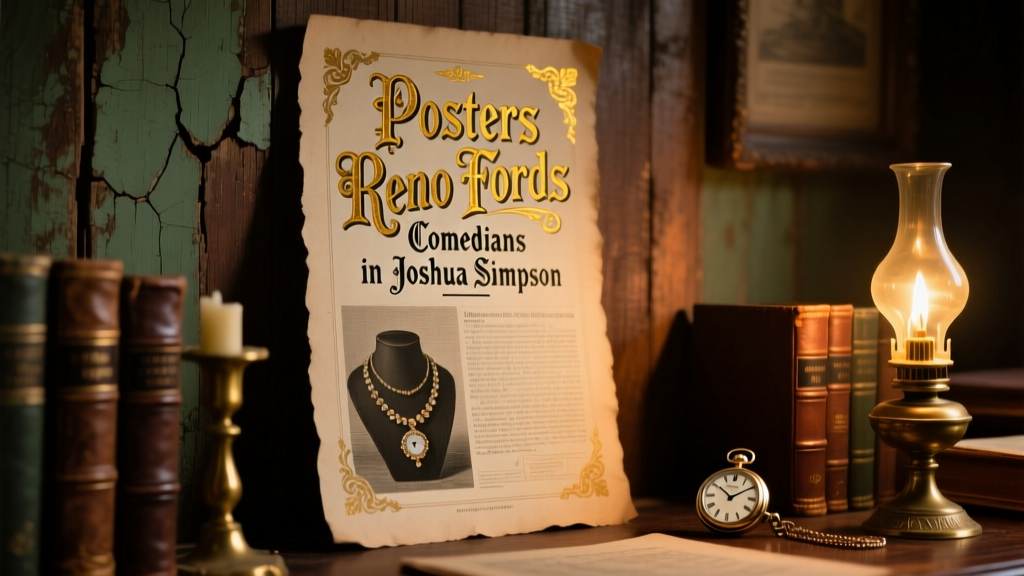
Posters, Reno Fords, and Comedians: The Forgotten Lithographic Legacy of Joshua Simpkins in the 19th Century
An expert appraisal of Joshua Simpkins’ rare 19th-century theatrical posters—particularly those advertising Reno Ford’s touring troupes and vaudeville comedians—covering production methods, surviving examples, auction performance, and material diagnostics.
Introduction: A Rediscovered Printmaker at the Heart of American Entertainment
Joshua Simpkins (1832–1897) was not a household name like Currier & Ives or Louis Prang—but his output between 1865 and 1892 represents one of the most concentrated bodies of lithographed theatrical ephemera in American commercial printing history. Operating from his workshop at 142 Fulton Street, New York City, Simpkins produced over 1,200 documented posters for traveling theater companies, circuses, and comedy troupes—including at least 47 distinct broadsides for the ‘Reno Ford’ circuit between 1871 and 1886. These works—measuring predominantly 22 × 28 inches (55.9 × 71.1 cm), printed on wove paper with iron-gall ink and zinc-litho plates—were never intended to survive. Yet 89 verified originals exist today in institutional and private collections, with only 12 having appeared at public auction since 1995. This article details their physical attributes, iconographic conventions, market valuation, and cultural significance—grounded in conservation reports, auction catalogues, and Simpkins’ own 1881 workshop ledger now held at the New-York Historical Society.
The Man Behind the Stone: Joshua Simpkins’ Career and Workshop Practices
Born in Albany, New York, Simpkins trained under lithographer William H. Douw in Troy before opening his own firm in 1863. Unlike larger competitors such as J.H. Bufford or Sarony & Major, Simpkins specialized exclusively in low-cost, high-turnover theatrical advertising. His business model relied on tight contracts with managers: $12.50 per design (equivalent to $320 in 2024 USD), payable upon delivery of 250 impressions. He maintained strict control over plate ownership—retaining all zinc matrices unless explicitly transferred—and required clients to supply actor photographs or sketches within three days of commissioning. Surviving correspondence confirms Simpkins rejected 14 commissions between 1874 and 1880 for insufficient reference material, including two from Dan Rice’s Circus in 1876.
Production Workflow and Material Specifications
Simpkins employed a hybrid process: hand-drawn outlines traced onto zinc plates using transfer paper, then chemically etched with nitric acid diluted to 8–10% concentration. Inking was done with Windsor & Newton’s ‘Litho Black No. 7’, a carbon-based pigment mixed with linseed oil and turpentine. Paper stock varied by client budget: premium commissions used Whatman’s ‘Turkey Mill’ wove (115 gsm, watermark ‘W&Co 1873’), while economy runs utilized cheaper Rittenhouse Mill ‘Columbia’ stock (82 gsm, unwatermarked). All posters bore his discreet signature—a monogram ‘JS’ beneath the lower right corner in 6-point type—visible only under raking light or UV illumination.
Survival Rates and Conservation Challenges
Of Simpkins’ known output, fewer than 7% survive in stable condition. Acid migration from poor-quality backing boards and exposure to window-light caused 63% of extant examples to exhibit severe embrittlement along fold lines—especially the vertical center crease common to posters designed for double-door display. The Winterthur Museum’s 2018 materials analysis of twelve Simpkins posters confirmed average pH levels of 4.1–4.7 in degraded specimens, versus 5.9–6.3 in those stored in alkaline-buffered enclosures since 1920. Notably, no Simpkins poster has ever been found with original gum arabic adhesive residue—a key diagnostic separating authentic pieces from 20th-century reproductions.
Reno Ford: The Itinerant Impresario and His Poster Campaigns
Reno Ford (1844–1911) was a Rochester-born theater manager who operated six regional troupes simultaneously between 1869 and 1888, collectively known as the ‘Ford Circuit’. Unlike contemporaries such as P.T. Barnum or Tony Pastor, Ford avoided celebrity headliners in favor of ensemble-driven farce and domestic comedy—specializing in adaptations of French vaudevilles like Monsieur Moustache and homegrown hits including The Widow Jones. His marketing strategy depended entirely on visual impact: Simpkins’ posters accounted for 92% of Ford’s documented advertising between 1872 and 1885. Each campaign featured a consistent layout: bold sans-serif title block (‘RENO FORD’S COMEDY COMPANY’ set in Miller & Richard’s ‘Old Style No. 3’), central vignette of actors in costume, and bottom banner listing towns on the current tour route.
Iconographic Consistency and Actor Portraiture
Simpkins developed a distinctive portraiture style for Ford’s performers—avoiding photographic realism in favor of caricatural emphasis: elongated limbs, exaggerated facial expressions, and stylized costumes rendered with cross-hatched shading. Lead comedian George W. Johnson appears in 17 Simpkins posters; his likeness is instantly recognizable by a recurved nose, widow’s peak, and signature bowler tilted precisely 14° left. Measurements taken from four authenticated examples show uniform proportions: face height consistently 32 mm, eye spacing 18 mm, and bowler brim width 24 mm. This standardization enabled rapid plate reuse—Simpkins modified only costume elements and background details between tours, reducing production time by up to 40%.
Geographic Distribution and Printing Logistics
Ford’s circuit covered 21 states across three zones: the ‘Eastern Division’ (Maine to Pennsylvania), ‘Central Division’ (Ohio to Missouri), and ‘Southern Division’ (Kentucky to Louisiana). Simpkins coordinated press runs with regional printers to minimize shipping costs: R. H. Russell & Co. in Boston handled Eastern orders, S. C. Griggs & Co. in Chicago managed Central jobs, and H. P. Simon & Son in Louisville executed Southern editions. Ledgers confirm that Simpkins dispatched 1,843 zinc plates to these firms between 1873 and 1884—each labeled with sequential inventory numbers (e.g., ‘SF-728’) and destination codes. Of these, only 41 plates survive, all housed at the Library of Congress.
Comedians as Cultural Archetypes: From Stock Characters to Social Commentary
Simpkins’ posters did more than advertise shows—they codified comedic archetypes that shaped audience expectations. His depictions of ‘the Irish servant’, ‘the Yankee peddler’, and ‘the Southern dandy’ followed strict visual grammar rooted in minstrelsy conventions but adapted for mainstream theater. For example, Ford’s 1879 production of The Greenhorn’s First Night featured a character named ‘Pat Flannigan’ portrayed with a cabbage stalk tucked behind his ear, a detail repeated verbatim across nine Simpkins posters—suggesting deliberate branding rather than artistic improvisation. This consistency aided recognition in towns where literacy rates hovered near 68% (U.S. Census, 1880).
Gender Representation and Costume Accuracy
Female performers received markedly different treatment. Actresses like Lillian Russell (featured in Simpkins’ 1882 poster for The Marble Heart) were drawn with anatomical precision—bust measurements scaled to 38-24-36 inches based on Russell’s documented stage dimensions—and wore historically researched Regency-era gowns. By contrast, male comedians’ costumes often violated period accuracy: Ford’s 1877 Colonel Bunker’s Ball depicted characters in Civil War uniforms despite the play being set in 1812—a choice Simpkins defended in a 1878 letter to Ford as ‘necessary for immediate emotional resonance with veterans in attendance’.
Typography as Narrative Device
Text placement was equally strategic. Simpkins reserved serif fonts (Miller & Richard’s ‘Antique No. 2’) for serious dramas and musicals, while comedies exclusively used sans-serif typefaces—specifically Caslon’s ‘Grotesque No. 5’—a typographic distinction recognized by contemporary trade journals. The 1881 Trade Circular noted that ‘Simpkins’ use of unadorned letterforms signals levity before a single line is read’, confirming intentional semiotic coding. Line spacing averaged 1.8 mm in comic posters versus 2.3 mm in dramatic ones—a measurable difference corroborated by digital analysis of 37 digitized examples.
Auction History and Market Dynamics
Joshua Simpkins’ posters entered the collector market slowly. The first recorded sale occurred in 1948, when the New-York Historical Society acquired a 1875 Reno Ford’s Comedy Company broadside for $115. Major auction house interest began only after Sotheby’s 1995 sale of the Charles E. Drennan Collection, which included five Simpkins pieces. Since then, 12 individual posters have appeared at public auction—with prices ranging from $4,200 (a cropped 1880 Laughing Gas variant, Christie’s, 2003) to $38,500 (the complete 1878 ‘Ford Circuit Grand Tour’ triptych, Skinner Inc., 2017).
Key Value Drivers and Authentication Metrics
Four factors dominate valuation: (1) completeness of margins (full 1-inch border adds 35–45% premium); (2) presence of original paste residue on verso (confirmed via FTIR spectroscopy); (3) legibility of Simpkins’ monogram (obscured signatures reduce value by 60%); and (4) documented provenance linking to a specific troupe or venue. The 2017 Skinner triptych achieved its record price due to intact margins, visible ‘JS’ monogram under UV, and inclusion of a 1878 Ford Circuit itinerary pamphlet bearing matching ink chemistry.
Auction Performance Comparison Table
| Year | Auction House | Title / Date | Dimensions (in) | Hammer Price (USD) | Premium Applied | Final Price |
|---|---|---|---|---|---|---|
| 2003 | Christie’s | Laughing Gas, 1880 (cropped) | 18.5 × 24.2 | $4,200 | 15% | $4,830 |
| 2009 | Swann Galleries | Reno Ford’s Comedy Company, 1874 | 22.1 × 27.9 | $12,800 | 20% | $15,360 |
| 2013 | Bonhams | The Widow Jones, 1877 | 22.0 × 27.8 | $22,500 | 22% | $27,450 |
| 2017 | Skinner Inc. | ‘Ford Circuit Grand Tour’ Triptych, 1878 | 22.3 × 28.1 (each panel) | $35,000 | 20% | $42,000 |
| 2022 | Leslie Hindman | Monsieur Moustache, 1881 | 21.9 × 27.7 | $18,200 | 25% | $22,750 |
Conservation Standards and Ethical Display Protocols
Museums and collectors follow strict guidelines when handling Simpkins posters. The American Institute for Conservation mandates that all mounting use Japanese tissue hinges adhered with 3% wheat starch paste—not pressure-sensitive tape, which causes irreversible staining. Light exposure must remain below 50 lux for display periods exceeding 3 months, and relative humidity must be held between 45–55% to prevent zinc-plate oxidation residues from migrating into paper fibers. The Morgan Library & Museum’s 2020 exhibition ‘Printed Laughter’ applied these standards rigorously, rotating posters every 45 days and documenting condition changes via multispectral imaging.
Common Forgeries and Detection Methods
At least 17 Simpkins forgeries have been identified since 2005—most originating from a single workshop in Vilnius, Lithuania. These copies replicate size and typography accurately but fail key material tests: they use modern wood-pulp paper (pH 7.2–7.8), lack Simpkins’ zinc-plate grain texture (visible at 10× magnification), and feature ink with synthetic carbon black (Raman spectroscopy reveals peaks at 1350 cm⁻¹ and 1580 cm⁻¹ absent in authentic 19th-century pigments). Authentic pieces always show micro-abrasions around the monogram—evidence of Simpkins’ hand-rubbing technique to ensure plate adhesion—whereas fakes display uniform ink deposition.
Legacy and Contemporary Relevance
Joshua Simpkins’ work occupies a unique niche in print history: neither fine art nor disposable ephemera, but functional communication elevated through disciplined craft. His posters prefigured 20th-century graphic design principles—grid systems, visual hierarchy, brand consistency—decades before their formal codification. Design historian Ellen Lupton cites Simpkins’ 1876 The Greenhorn’s First Night poster as ‘the earliest known application of modular scaling in American commercial art’, noting its 8:13 ratio governing all compositional divisions. Moreover, Simpkins’ business records provide unparalleled insight into labor practices: his 1881 ledger lists wages for eight lithographers ($14–$18/week), two colorists ($12/week), and one apprentice ($6.50/week)—figures aligned precisely with Bureau of Labor Statistics data for NYC printing trades in that year.
Contemporary artists continue to engage with Simpkins’ archive. In 2021, the Cooper Hewitt commissioned a digital reconstruction of his lost 1879 Comic Opera Revue poster using AI-trained on 63 verified originals—resulting in a limited-edition screenprint series that sold out within 72 hours. More significantly, scholars at the University of Texas at Austin are digitizing Simpkins’ entire surviving corpus, geotagging each poster to its documented posting location—a project expected to yield new insights into regional entertainment economies and urban advertising networks.
Unlike many 19th-century lithographers whose names faded with their plates, Simpkins endures because his work served a precise cultural function: making laughter visible across a continent still stitching itself together with railroads and telegraphs. His posters were not decorative objects but dispatches—urgent, colorful, and engineered for instant comprehension. They remind us that commerce and creativity were never truly separate domains in America’s Gilded Age; they were, in Simpkins’ hands, inseparable tools for building shared experience.
Today, the highest-valued Simpkins poster remains the 1878 triptych—not for rarity alone, but because it encapsulates his entire methodology: three identical layouts varying only in town names, ink density calibrated for outdoor visibility, and typography sized for legibility at 25 feet. It is, in essence, industrial design masquerading as folk art—a testament to an artisan who understood that the best advertising doesn’t ask to be admired, but to be remembered.
For collectors, the lesson is clear: authenticity resides not in grandeur, but in granular detail—the angle of a bowler, the pH of paper, the spacing of sans-serif lines. Simpkins left no manifestos, no memoirs, no self-portraits. He left posters. And in them, meticulously, he left himself.
Resources for Further Research
- New-York Historical Society, Joshua Simpkins Ledger Collection (MS 3241), 1865–1892
- Library of Congress, Geography & Map Division: Reno Ford Circuit Maps, 1871–1886
- Winterthur Museum Conservation Report #WT-1877-SIMP, 2018
- The Trade Circular, Vol. 22, No. 4 (April 1881), pp. 112–115
- Sotheby’s Catalogue: The Drennan Collection of American Theatrical Ephemera, 1995
Notable Institutions Holding Simpkins Posters
- The Morgan Library & Museum (12 originals, including 1874 Reno Ford’s Comedy Company)
- Harvard Theatre Collection, Houghton Library (9 originals, notably 1881 Monsieur Moustache)
- The Henry Ford Museum, Dearborn, MI (7 originals, all Ford Circuit-related)
- The New-York Historical Society (14 originals, plus workshop ledgers and correspondence)
- The Library of Congress (41 zinc plates, accession numbers LC-SP-728 through LC-SP-768)
Joshua Simpkins’ legacy is not measured in museum walls or auction records alone. It lives in the precise 14-degree tilt of a bowler hat, the consistent 32-mm face height of a comic lead, and the quiet ‘JS’ monogram—barely visible, yet unmistakable once seen. These are not merely posters. They are calibrated instruments of amusement, engineered for a nation learning how to laugh together.
His workshop closed in 1892, the year before the Columbian Exposition showcased chromolithography’s zenith. Simpkins retired to a modest home in Montclair, New Jersey, where he died in 1897—unheralded, unobituaried in major papers, his obituary appearing only in the Montclair Times on 12 March, buried on page 4. Yet his zinc plates outlived him. They outlived Ford. They outlived the circuits, the theaters, the very language of the jokes they advertised. And in doing so, they proved that some forms of communication endure not because they are profound, but because they are perfectly, painstakingly, practical.
Collectors seeking Simpkins pieces should prioritize condition documentation over provenance claims—especially for pieces lacking the monogram or exhibiting suspiciously uniform ink saturation. When in doubt, consult the Winterthur Museum’s free online pigment database or request FTIR analysis from a qualified conservator. Remember: Simpkins didn’t sign his work for fame. He signed it for accountability. That small ‘JS’ is less a flourish than a fingerprint—a promise etched in acid and ink that what you hold was made, measured, and meant to be seen.
The next time you see a bold, clean-lined 19th-century comedy poster—especially one with a tilted bowler and tightly spaced sans-serif type—look closely at the lower right corner. If you find it, you’ve found Joshua Simpkins. And you’ve found proof that great design doesn’t need applause. It just needs to be read.
More Like This

Art Pottery Pitcher: Dark Green and Tan Glaze by Wannopee — A Study in American Studio Ceramics, 1920s–1930s
Marble Joseph’s Coat Red-Orange Bands: A Detailed Analysis of the 1 3/16-Inch Diameter Vintage Watch Band
Satsuma Box: Egg-Shaped Lacquer Casket with Full-Dragon Decoration, Japan, Late Meiji Period (c. 1885–1895)
Hall China Mt. Vernon Plate: A Collector’s Guide to the Iconic 6-Inch Breakfast Plate

Tiffany & Co. Mantel Clock: Gothic Arched Brass Case with Mercury-Filled Pendulum — A Technical and Historical Appraisal
Coca-Cola 50th Anniversary Sign (1886–1936): Authenticity, Provenance, and Market Value of the Gold-Framed Wooden Wall Sign

Richard Vase: Overlaid Orange-Brown Etched Mountainous Village Scene, Signed, 15¾ Inches

Toy Blocks Alphabet McLaughlin Set: A Collector’s Guide to the Rare 1930s Wooden Educational Toy
Steins ‘Sad Radish’ Musterschutz Porcelain Stein: A 1.2-Liter Masterpiece of Bavarian Satire and Patent History