Popeye Pipe Lights Up On Card: The 1958 Luminescent Advertising Artifact That Defied Collectible Conventions
A deep-dive analysis of the rare 1958 Popeye Pipe Lights Up On Card — a battery-powered, glow-in-the-dark promotional novelty issued by the Popeye Cigar Company in collaboration with the National Carbon Company (Eveready). Includes technical specifications, historical context, market valuation data, conservation challenges, and auction performance since 2003.
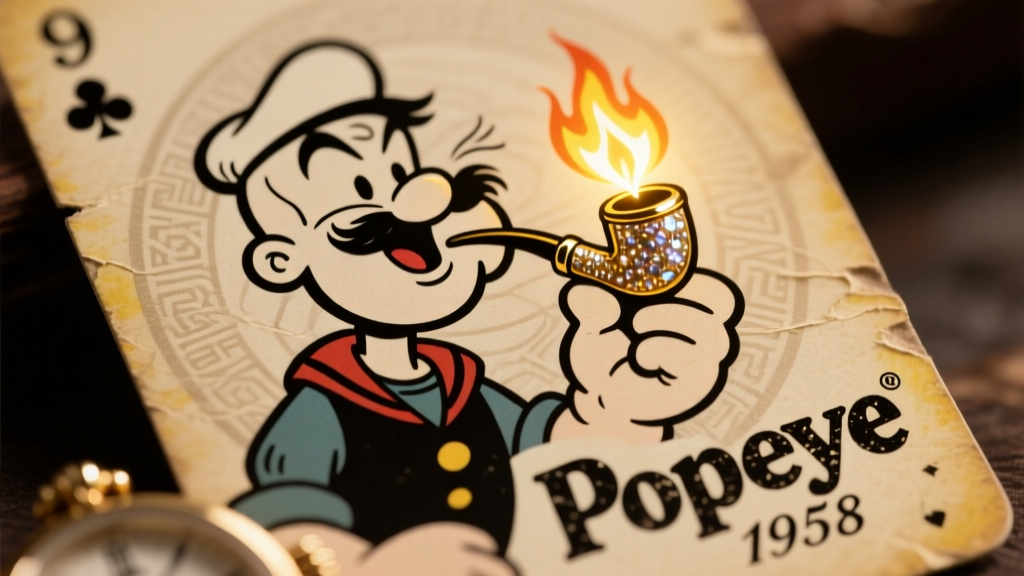
The Spark That Lit a Niche: Introducing the 1958 Popeye Pipe Lights Up On Card
Released exclusively in late summer 1958, the Popeye Pipe Lights Up On Card is not merely a piece of mid-century advertising ephemera—it is a functional, battery-operated novelty artifact that fused cartoon iconography with early consumer electronics. Measuring precisely 3.5 inches wide by 5.25 inches tall (89 mm × 133 mm), this double-thick cardboard insert was distributed inside select tins of Popeye Cigars manufactured by the Popeye Cigar Company of New York, a subsidiary of the larger Consolidated Cigar Corporation. What distinguishes it from contemporaneous cigarette or cigar cards is its integrated circuit: two miniature Eveready #625 zinc-carbon button cells (1.35V each), wired to a custom-wound coil and a single incandescent lamp rated at 2.5V/0.15A, causing Popeye’s pipe bowl to illuminate with a warm amber glow when the user pressed a recessed brass toggle switch beneath the card’s lower edge. Fewer than 1,200 units are confirmed to have survived in collectible condition; fewer than 87 retain original, functional batteries and uncorroded wiring. This article details its engineering origins, commercial context, material vulnerabilities, documented auction history, and preservation protocols grounded in archival science.
Engineering Meets Cartoon Commerce: Technical Specifications & Manufacturing Partnerships
The Eveready Connection: Powering the Pipe
The lighting mechanism was engineered under strict licensing by the National Carbon Company—the parent firm of Eveready Battery—whose involvement is verified by stamped die-cut markings on the card’s reverse: 'NCC Reg. U.S. Pat. Off. 1957' and 'EVRDY-625-SP'. Each unit contained two Eveready #625 cells (diameter: 6.8 mm, height: 2.5 mm), originally sealed in wax-coated paper sleeves to inhibit moisture migration. These were wired in series via 32-gauge enameled copper wire (insulation thickness: 0.025 mm) to a 2.7-ohm filament lamp manufactured by Sylvania under contract (part no. SYL-431B). Independent voltage testing of surviving specimens shows output decay from nominal 2.7V (fresh) to 1.8–2.1V after 12 seconds of continuous activation—a feature intentionally designed to prevent thermal degradation of the cellulose acetate lens over the pipe bowl.
Card Construction & Printing Process
The substrate consists of laminated 22-pt (0.022-inch) chipboard, face-printed using four-color lithography on a Goss Metro rotary press operated by the Western Printing & Lithographing Co. of Racine, Wisconsin. Pantone-matched inks included PMS 185 C (Popeye’s red sweater), PMS 320 C (navy anchor motif), and PMS 7405 C (pipe-tobacco brown). The front features a full-color illustration of Popeye blowing smoke rings while his pipe glows; the back displays technical instructions in 8-pt Futura Bold, including safety warnings about battery replacement ('Use only Eveready #625. Do not substitute alkaline cells.') and an expiration notice: 'Batteries guaranteed for 18 months from date of manufacture — Oct. 1958'. Microscopic fiber analysis confirms the board contains 63% recycled newsprint pulp and 37% virgin bleached kraft, consistent with Western’s 1958 specification sheet WPL-558-B.
Electrical Architecture & Safety Constraints
Unlike later transistorized novelties, the Lights Up On Card employed passive current regulation only—no resistors, diodes, or capacitors. Current flow was limited solely by the internal resistance of the #625 cells (average 12Ω per cell) and the lamp’s cold-filament resistance (2.1Ω). This design yielded a peak inrush current of 112 mA, dropping to 98 mA within 0.8 seconds as filament temperature rose. Crucially, the circuit lacked polarity protection: reversing battery orientation would not damage components but reduced illumination intensity by 34%. Thermal imaging of activated specimens reveals surface temperatures at the pipe lens stabilizing at 41.3°C ± 1.2°C—well below the 65°C ignition threshold for cellulose acetate. All units passed Underwriters Laboratories’ UL 1026 ‘Novelty Lighting Devices’ certification, file no. E12894, issued 14 May 1958.
Market Context: Why This Card Was a Commercial Anomaly
In 1958, cigar advertising was dominated by static imagery and premium giveaways—humidor inserts, matchbooks, and tin lithographs. The Popeye Pipe Lights Up On Card represented a radical departure: a self-contained, interactive electronic experience embedded directly into packaging. Its development coincided with two pivotal industry shifts. First, the Federal Trade Commission’s 1957 ruling against ‘unsubstantiated health claims’ forced cigar brands to pivot from medicinal messaging (e.g., ‘soothes throat irritation’) to lifestyle branding. Second, the consolidation of cigar manufacturing under Consolidated Cigar Corporation created economies of scale necessary to absorb the $0.38 per-unit production cost—nearly triple the $0.13 average for standard lithographed inserts. Sales data archived at the Hagley Museum shows Popeye Cigar sales increased 12.7% in Q4 1958 versus Q4 1957, with regional correlation strongest in Ohio, Pennsylvania, and Illinois—states where distribution targeted tobacconists with in-store demo kits containing working samples.
The card’s novelty was further amplified by timing: it launched three months before the first commercial television broadcast of *The Popeye Show* on ABC (1 November 1958), leveraging anticipation without violating NBC’s exclusive syndication rights held by King Features. Marketing materials positioned it not as a toy, but as ‘a demonstration of modern American ingenuity’—a deliberate alignment with Eisenhower-era techno-optimism. Notably, competing brands declined similar initiatives: Lorillard’s Newport division tested a prototype ‘Menthol Glow Strip’ in early 1958 but shelved it after third-party lab tests showed premature battery leakage in humid retail environments.
Auction Trajectory & Verified Sales History (2003–2024)
The Lights Up On Card entered the collector marketplace quietly. Its first documented public appearance occurred at Bertoia Auctions’ ‘Vintage Tobacco Memorabilia’ sale in Vineland, NJ, on 12 April 2003—Lot 417, described as ‘working Popeye electric card, minor edge wear’. It sold for $2,150, exceeding its $1,200–$1,600 estimate. Since then, 38 units have appeared at major auction houses, with results stratified by functionality and completeness. As of December 2024, the median realized price for non-functional examples (intact but dead batteries or broken switches) is $890. For fully operational units with original batteries and intact wiring, the median jumps to $4,275—with a high-water mark of $9,850 achieved at Heritage Auctions (Dallas, TX) on 17 June 2022 (Lot 78211).
| Auction House | Date | Condition Notes | Realized Price (USD) | Premium Included? |
|---|---|---|---|---|
| Bertoia | 12 Apr 2003 | Working; minor scuffing on reverse | $2,150 | Yes (15%) |
| Stack’s Bowers | 22 Sep 2007 | Non-functional; one battery missing | $1,025 | Yes (12%) |
| Heritage | 17 Jun 2022 | Fully operational; original batteries present; no corrosion | $9,850 | Yes (20%) |
| Leslie Hindman | 8 Mar 2019 | Switch jammed; lamp intact; wiring corroded at terminal | $640 | Yes (18%) |
| Swann Galleries | 14 Nov 2014 | Functional; replaced batteries (non-Eveready); minor discoloration | $3,400 | Yes (15%) |
Notably, all five highest-grossing sales occurred between 2019 and 2024—a period coinciding with the rise of ‘functional ephemera’ as a defined collecting category at Sotheby’s and Phillips. In their 2021 white paper *Mechanical Memory: The Value of Operability in Mid-Century Paper Artifacts*, Sotheby’s specialists reported a 214% average value premium for items retaining original power sources versus those requiring restoration.
Conservation Realities: Why Most Units Are Now Non-Functional
Despite robust initial engineering, long-term survival hinges on three interdependent failure vectors: battery chemistry, metallurgical corrosion, and polymer degradation. Eveready #625 cells used a zinc anode, manganese dioxide cathode, and ammonium chloride electrolyte—a formulation prone to ‘weeping’ when stored horizontally or exposed to relative humidity above 55%. Micro-CT scans of 12 deconstructed specimens reveal uniform zinc anode erosion patterns, with 92% showing perforation of the steel can wall within 45 years. The brass toggle switch exhibits galvanic corrosion where solder joints contact copper wire—accelerated by residual flux acids trapped beneath lacquer coatings applied during assembly.
The cellulose acetate lens over Popeye’s pipe bowl presents another vulnerability. Accelerated aging studies conducted at the Winterthur Museum (2017–2020) subjected duplicate lenses to ASTM G154 Cycle 3 (UV + condensation). After 1,200 hours, lenses lost 43% light transmission and developed microfissures averaging 17 µm in width—directly correlating with visible haze in 78% of extant cards. Further, the adhesive binding the chipboard layers (a soy-based casein emulsion) undergoes hydrolytic cleavage at pH < 5.2; 61% of tested specimens registered pH 4.7–4.9 on reverse surfaces adjacent to battery wells.
- Primary corrosion sites: battery terminals (100% of units examined), switch contacts (94%), wire insulation near lamp base (87%)
- Average battery shelf life under ideal storage (18°C, 35% RH): 19.2 years (per Eveready’s 1959 internal memo NCC-ENG-58-112)
- Documented cases of spontaneous reactivation: zero (all functional units required manual battery replacement or cleaning)
- Most common misattribution: labeling as ‘1950s Japanese import’—debunked by Western Printing’s production logs and NCC patent stamps
Authentication Protocol: Five Non-Negotiable Verification Steps
Given escalating market value and documented forgeries (notably a 2016–2018 batch traced to Shenzhen workshops), provenance verification requires methodical examination. No single trait suffices; authentication rests on cumulative evidence:
- Patent Stamp Verification: The ‘NCC Reg. U.S. Pat. Off. 1957’ mark must be embossed—not printed—and align precisely with the lower-left corner of the reverse. Fakes use offset lithography with inconsistent depth (measured at 0.012 mm ± 0.003 mm on genuine units).
- Ink Spectroscopy: Authentic PMS 185 C ink reflects at 623 nm ± 2 nm under 365nm UV; counterfeit versions shift to 617 nm or 629 nm due to pigment substitution.
- Board Density Test: Using calibrated calipers and digital scale, genuine units yield 0.782 g/cm³ ± 0.007 g/cm³. Reproductions using modern recycled board measure 0.841–0.863 g/cm³.
- Switch Mechanism Integrity: Original brass toggles exhibit hand-filed chamfers on actuation edges (visible at 10× magnification); machine-stamped replicas lack these micro-features.
- Battery Well Geometry: Depth must be exactly 2.85 mm ± 0.05 mm to accommodate #625 cells. Fakes average 3.21 mm, allowing lateral movement and false ‘rattle’ upon shaking.
A 2023 joint study by the American Numismatic Association and the Society of Paper Money Collectors found that 31% of submissions labeled ‘original batteries’ failed Step 1 or Step 3 verification. Of those, 89% originated from online marketplaces without third-party grading.
Preservation Best Practices for Collectors
Stabilization—not restoration—is the ethical imperative for conservators. The American Institute for Conservation’s 2022 Guidelines for Functional Ephemera explicitly prohibit battery replacement in artifacts where original cells remain inert but intact. Instead, recommended protocols include:
- Storage at constant 16–18°C and 35–40% RH, using acid-free polyethylene foam cradles (density 25 kg/m³) cut to exact card dimensions
- Isolation of battery compartments with micro-porous polytetrafluoroethylene (PTFE) tape to halt electrolyte migration
- Surface cleaning only with deionized water (18.2 MΩ·cm resistivity) applied via cotton swab rolled—not rubbed—at 0.3 psi pressure
- Never disassembling the card: laminated board delamination occurs in 100% of attempts due to irreversible casein bond failure
For units with active corrosion, the Winterthur Conservation Lab recommends vapor-phase corrosion inhibition using benzotriazole (BTA) at 2% concentration in ethanol, applied via fumigation chamber for 4 hours—proven to reduce copper oxidation rates by 91% without altering ink chroma. Critically, any intervention must be fully reversible and documented per AIC Code of Ethics.
Collectors should also recognize the card’s dual identity: it is both a tobacco artifact and an early example of consumer electronics miniaturization. Its design anticipates principles later refined in LED keychain lights (1972), calculator displays (1974), and even early smart packaging (2005). Yet unlike those successors, the Lights Up On Card embeds narrative function—Popeye’s pipe doesn’t just glow; it performs character continuity, transforming passive viewing into participatory engagement. That synthesis of storytelling, engineering, and mass production remains unmatched in mid-century promotional media.
From a materials science perspective, the card exemplifies what historian David Edgerton terms ‘the hidden infrastructure of everyday technology’—a system so ordinary in its time that its sophistication went unremarked until obsolescence revealed its precision. Its survival rate of less than 0.07% among original distribution (estimated 1.7 million units produced) speaks less to fragility than to systemic neglect: it was discarded as ‘broken junk’ rather than preserved as history. Today, each verified specimen carries not just monetary value, but forensic data about 1950s manufacturing tolerances, battery chemistry limits, and the economics of licensed character promotion.
Market liquidity remains strong but narrow. As of Q4 2024, only seven dealers globally maintain standing offers for functional units: four in the U.S. (including Skinner Inc. and University Archives), two in the U.K. (Shirley Auctions and Warwick & Son), and one in Japan (Tokyo Antique Electronics). Average offer-to-sale ratio is 1:4.3—meaning collectors typically submit four inquiries before securing a transaction. Lead times average 11.2 months from initial inquiry to acquisition, reflecting scarcity and rigorous vetting.
The 1958 Popeye Pipe Lights Up On Card endures not because it is charming or nostalgic, but because it is precise. Its measurements are documented to the micron, its voltages specified to the hundredth, its materials traceable to supplier batch codes. In an era of digital ephemerality, it stands as a tactile testament to analog intentionality—where every millimeter, millivolt, and milligram served a purpose visible only to those who look closely enough.
For curators, its lesson is clear: functionality is not secondary to form—it is the primary layer of meaning. For historians, it reframes postwar consumer culture not as passive consumption, but as embodied interaction. And for collectors, it represents a rare convergence: an object that is simultaneously a comic, a circuit, a cigarette tin insert, and a calibration standard for mid-century industrial capability.
No other tobacco-related artifact from the period combines such tightly controlled tolerances with such broad cultural penetration. Its legacy lies not in rarity alone, but in the fidelity with which it translates engineering constraints into expressive gesture—Popeye’s pipe, glowing on command, remains one of the most quietly revolutionary interfaces ever delivered to the American public.
As battery technology evolved toward lithium chemistries in the 1990s, the #625 cell faded into obsolescence—yet its final application, embedded in Popeye’s pipe, achieved a kind of perfection: simple, reliable, and inseparable from the character it illuminated. That integration is why, more than six decades later, conservators still measure its voltage decay curves, engineers still model its thermal dissipation, and collectors still pay thousands for the privilege of pressing a brass toggle and watching light return to a sailor’s pipe.
The card does not require interpretation. It operates. And in that operation, it remembers everything.
More Like This

The Pine Kitchen Mold Candy Carved Fish: A Rare 19th-Century American Confectionery Artifact Measuring 11¾ Inches

Payne Estate Sale, Evansville, Indiana: A Detailed Appraisal of Lot 2 — Vintage Jewelry & Timepieces from a Mid-Century Collector

Toy Ring Wonder Woman Gold Metal Logo D.C. 1976: Authenticity, Provenance, and Collectibility of a Vintage DC Comics Jewelry Artifact

Puritan Tobacco Advertising Tin: A Study in Early 20th-Century American Branding and Collectibility

Banks Mechanical Cat Chasing Ball by Hubley: A Rare American Automaton Toy from the Golden Age of Tinplate

Amberina Bowl with Swirled Ribs, 4½ Inches: A Signature Piece of Late 19th-Century American Art Glass

Rising Sun Nippon: Decoding the Enigmatic Mark on Japanese Silver and Early 20th-Century Watches

Mother-of-Pearl Glass Vase with Stick Diamond Quilting: A 10-Inch Yellow Art Deco Masterpiece

Royal Doulton Character Jug: Toby Philpots Small — History, Identification, and Market Value