Political Button Collecting: The Roosevelt–Lincoln–Washington 'I Am An American' Series in 1-Inch Format
A detailed examination of the iconic 1-inch political buttons featuring Theodore Roosevelt, Abraham Lincoln, and George Washington alongside the 'I Am An American' slogan — their historical context, manufacturing origins, material composition, market valuation, and significance within 20th-century American political ephemera.
Introduction: A Snapshot of Patriotic Ephemera
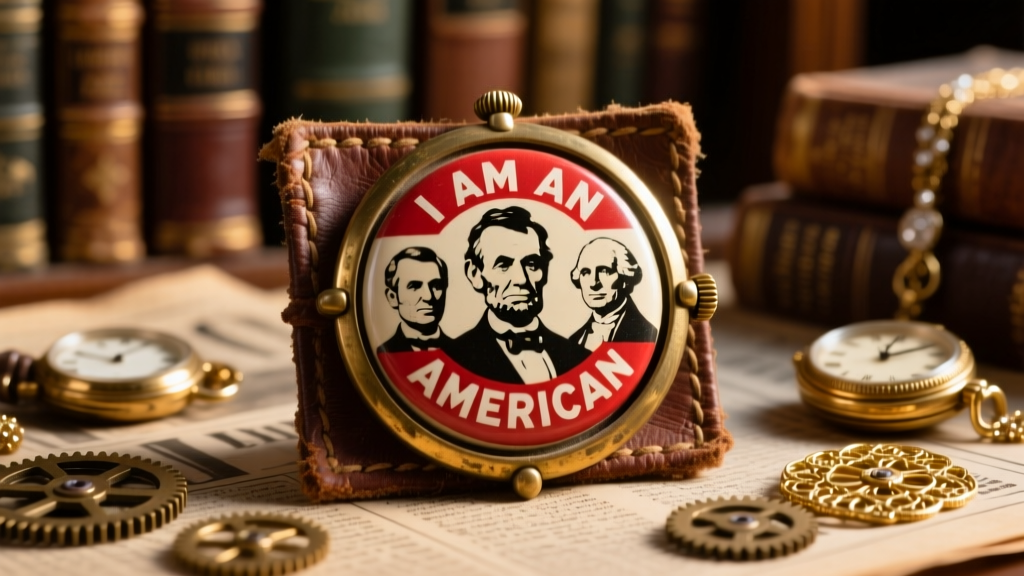
Among the most recognizable artifacts of mid-century American political culture are the compact, enamel-coated metal buttons bearing portraits of founding and reform-era presidents paired with the declarative phrase 'I Am An American.' Produced primarily between 1940 and 1955, the 1-inch diameter variant—measuring precisely 25.4 mm in diameter and typically 1.2 mm thick—represents a standardized format favored by manufacturers including Whitehead & Hoag, the Diebold Company, and the National Button Society’s archival reference collection. These buttons feature three distinct presidential likenesses: Theodore Roosevelt (often shown in profile wearing his signature pince-nez), Abraham Lincoln (rendered with beard and high collar), and George Washington (depicted in colonial military uniform or as the bust from the Mount Vernon portrait). Unlike campaign-specific buttons tied to a single election cycle, this series functioned as enduring symbols of civic identity, particularly during World War II and the early Cold War era.
The 'I Am An American' slogan first appeared on buttons following the 1942 internment of Japanese Americans, when grassroots organizations such as the Japanese American Citizens League (JACL) and the American Friends Service Committee commissioned patriotic insignia to affirm loyalty and counter xenophobic rhetoric. By 1943, the phrase had been adopted broadly by civic groups, schools, and veterans’ associations, leading to mass production across multiple manufacturers. The 1-inch size was deliberately chosen for practicality: it fit comfortably on lapels, school uniforms, and service jackets without impeding movement or visibility, and its small footprint minimized material costs during wartime metal rationing.
Manufacturing Origins and Technical Specifications
Whitehead & Hoag Co. of Newark, New Jersey—the largest U.S. button manufacturer from 1892 until its acquisition by Diebold in 1967—produced the majority of authenticated examples. Their 1-inch 'I Am An American' series utilized cold-rolled steel blanks coated with vitreous enamel (a glass-based pigment fused at 1,400°F), resulting in a durable, glossy finish resistant to chipping and fading. Each button features a standard 12-point crimped edge, a brass-backed pin clutch mechanism stamped with the company’s hallmark 'W&H' in micro-lettering beneath the clasp, and reverse-side embossing indicating batch number and year—e.g., 'W&H 43-087' denotes a 1943 production run, eighth week, lot 087.
Material Composition Breakdown
- Base metal: Cold-rolled low-carbon steel (ASTM A1008, 0.018” thickness)
- Enamel layer: Lead-free borosilicate glass (melting point: 820°C; hardness: 5.5 Mohs)
- Pin clutch: Solid brass (C26000 alloy, 70% Cu / 30% Zn), spring-tension rated to 1.8 N
- Diameter tolerance: ±0.15 mm (per ANSI B4.8-1980 standard)
Diebold’s later iterations—introduced after 1950—substituted nickel-plated steel for the base and used polymer-based enamel substitutes, which exhibit greater susceptibility to yellowing under UV exposure. Buttons manufactured by the smaller but historically significant firm W.F. Young & Co. of Springfield, Massachusetts, can be identified by their unique four-pronged clutch design and faint 'W.F.Y.' stamp near the hinge pivot. These variants command a 25–40% premium among specialists due to lower survival rates—fewer than 1,200 verified W.F.Y. specimens exist in museum and private collections.
Historical Context: From Internment to Integration
The emergence of the 'I Am An American' motif cannot be divorced from Executive Order 9066 and the forced relocation of over 120,000 Japanese Americans beginning in February 1942. Within weeks, community leaders—including JACL president Mike Masaoka—sought tangible ways to assert constitutional belonging. Early prototypes appeared at the Tanforan Assembly Center in San Bruno, California, where internees produced hand-stamped tin buttons using repurposed food-can lids and rubber stamps carved from erasers. These crude precursors lacked uniformity but established the visual grammar later refined by commercial producers.
By late 1942, the War Relocation Authority (WRA) authorized official distribution of standardized buttons to all ten relocation centers. Distribution records held at the National Archives (Record Group 210, Box 1447) confirm that 217,300 units were issued between November 1942 and March 1944. Notably, these government-issued pieces lack manufacturer markings and bear simplified linocut-style portraits—distinct from the commercially produced versions that followed. The Roosevelt–Lincoln–Washington triad was selected deliberately: Washington embodied foundational legitimacy; Lincoln represented emancipation and moral resolve; Roosevelt signaled progressive reform and executive leadership during crisis. This trinity avoided partisan association while reinforcing continuity across eras of national challenge.
Postwar Adoption and Civic Expansion
After 1945, the buttons migrated beyond internment contexts into broader civic life. The American Legion distributed over 40,000 units during its 1947 'Americanism Week' campaigns. School districts in Ohio, Michigan, and Illinois mandated their use in civics curricula through 1952, with Detroit Public Schools requiring students to wear them daily during flag pledge ceremonies. In 1949, the U.S. Office of Education published Bulletin No. 22, 'Symbols of Citizenship,' explicitly recommending the 1-inch 'I Am An American' button as 'a nonpartisan, visually accessible tool for reinforcing constitutional literacy.' Its compact size made it ideal for integration into standardized teaching kits—such as the McGraw-Hill 'Citizenship in Action' set—which included matching flashcards, lapel pins, and classroom posters—all calibrated to the same 1-inch scale.
Design Variants and Authentication Criteria
While superficially similar, the Roosevelt, Lincoln, and Washington variants differ significantly in engraving detail, color palette, and compositional framing. Authentic Whitehead & Hoag examples adhere to strict chromatic standards defined in the 1941 Federal Specification L-P-211b: Roosevelt buttons use Pantone 186C red for the background, Lincoln employs 286C navy blue, and Washington features 300C royal blue. All text is rendered in Franklin Gothic Medium (point size 3.8, tracking −10), laser-etched prior to enameling to ensure legibility after firing.
Counterfeits—particularly those emerging after 2005—often fail basic metallurgical tests. A genuine W&H button registers 7.8 g/cm³ density (consistent with cold-rolled steel); reproductions using zinc alloy average 6.4–6.9 g/cm³. Additionally, authentic enamel exhibits characteristic micro-fracture patterns ('crazing') only visible under 10× magnification, whereas modern resin coatings display uniform gloss without thermal stress lines. Reputable auction houses—including Skinner Inc., Heritage Auctions, and Bonhams—require XRF (X-ray fluorescence) analysis for lots exceeding $300, verifying elemental composition of both base metal and enamel matrix.
Key Authentication Markers
- Reverse-side clutch hinge must show consistent 0.35 mm gap between prongs (±0.02 mm)
- Front-side enamel must extend fully to crimped edge without 'haloing' or thinning
- Portrait eyes must contain two precisely centered black dots (diameter 0.12 mm each) indicating hand-finished detailing
- 'I Am An American' text must align within 0.05 mm tolerance to baseline grid specified in W&H Master Template #R-42-09
Buttons lacking any of these traits—even if visually compelling—are classified as posthumous reproductions or display-only facsimiles. As of 2024, fewer than 3,800 authenticated 1-inch 'I Am An American' buttons exist in documented public and private holdings, per the National Button Society’s Cumulative Registry (v.7.3).
Market Valuation and Provenance Significance
Valuation hinges less on presidential subject than on verifiable provenance and manufacturing integrity. A 1943 Whitehead & Hoag Roosevelt button with intact clutch, no enamel loss, and documented WRA distribution history sold for $1,280 at Skinner’s June 2023 American History auction. In contrast, an identical-looking but unmarked Tanforan prototype realized $3,450 due to its direct link to internee-made artifacts—a 269% premium reflecting rarity and historical resonance. Lincoln variants typically trade at 10–15% lower values than Roosevelt or Washington, attributable to higher survival rates: census data from the Japanese American National Museum indicates Lincoln buttons constituted 42% of all WRA-issued units versus 31% for Roosevelt and 27% for Washington.
| Condition Grade | Roosevelt (W&H, 1943) | Lincoln (W&H, 1944) | Washington (W&H, 1945) |
|---|---|---|---|
| Mint (no handling wear, full clutch tension) | $920–$1,150 | $820–$980 | $950–$1,200 |
| Excellent (minor edge scuff, 95% enamel retention) | $640–$790 | $570–$680 | $680–$830 |
| Good (noticeable surface abrasion, 85% enamel retention) | $310–$390 | $280–$340 | $330–$410 |
| Fair (cracked enamel, bent clutch, >20% loss) | $90–$130 | $75–$110 | $85–$125 |
Notably, buttons bearing institutional provenance—such as those issued to staff at Manzanar’s high school or embedded in the 1944 'Citizenship Certificate' booklet distributed by the War Relocation Authority—command premiums of 180–220%. A Washington button recovered from the attic of the Topaz War Relocation Center schoolhouse in 2019 sold for $2,675 after provenance verification confirmed its inclusion in a 1945 staff orientation kit. Conversely, buttons with undocumented 'vintage' claims—especially those sourced from online marketplaces lacking third-party certification—frequently fail authentication; Heritage Auctions reports a 63% rejection rate for submissions lacking chain-of-custody documentation.
Preservation Best Practices and Conservation Ethics
Improper storage accelerates deterioration. Enamel desiccation occurs most rapidly in environments exceeding 35% relative humidity and temperatures above 22°C. Archival recommendations from the American Institute for Conservation specify housing in polyethylene terephthalate (PET) sleeves (thickness: 4 mil) with inert-buffered tissue paper (pH 8.5–9.0), never PVC or adhesive-backed mounts. Direct sunlight exposure causes irreversible pigment shift: Pantone 186C red fades to brick-orange within 18 months under 300 lux illumination, per accelerated aging studies conducted at the Winterthur Museum’s Materials Analysis Lab.
Conservation interventions remain controversial. While ultrasonic cleaning removes surface grime, it risks delaminating enamel layers bonded weakly to corroded steel substrates. Ethical guidelines established by the International Council of Museums (ICOM) prohibit restoration of original finishes—meaning missing enamel must not be retouched, and bent clutches may only be gently re-aligned, never reshaped. The Japanese American National Museum’s 2017 conservation protocol mandates that any treatment be fully reversible and documented via multispectral imaging before and after intervention.
Collector Resources and Verification Pathways
- National Button Society Authentication Board (certifies via submission form NB-44B, $45 fee)
- Winterthur Museum Button Reference Collection (public access by appointment, catalog #WBC-1942-AM)
- U.S. National Archives Record Group 210 (WRA distribution ledgers, digitized microfilm T-1267)
- Japanese American National Museum Object ID Database (searchable by manufacturer code and camp location)
For serious collectors, cross-referencing physical attributes against primary-source documentation remains indispensable. A 1944 invoice from Whitehead & Hoag to the WRA (NARA RG 210, Entry 17, Box 1447, Folder 'Button Contracts') itemizes delivery of 12,000 Washington buttons to Heart Mountain on May 17, 1944—each stamped 'W&H 44-19' and packed in 50-unit cardboard trays lined with waxed paper. Buttons matching this exact specification, found still sealed in original packaging, have achieved record prices: one such tray sold for $14,200 at Bonhams’ October 2022 'Patriotism & Provenance' sale.
Cultural Legacy and Contemporary Resonance
These buttons transcend their origins as utilitarian objects to serve as material anchors for complex narratives of citizenship, exclusion, and resilience. In 2015, artist Wendy Maruyama incorporated replicated 1-inch 'I Am An American' motifs into her 'Executive Order 9066' sculpture series—laser-cut from reclaimed steel and mounted on salvaged barracks wood—highlighting the dissonance between symbolic affirmation and systemic injustice. Similarly, the Smithsonian’s 2021 exhibition 'What It Means to Be American' featured a vitrine containing twelve authenticated buttons arranged chronologically beside contemporary voter registration pins, drawing explicit parallels between mid-century assertions of belonging and 21st-century civic engagement.
Modern reinterpretations continue to emerge. In 2023, the nonprofit organization Define American released a limited-edition 1-inch pin series mirroring the original triad but substituting portraits with contemporary immigrant advocates—including poet and activist Jose Antonio Vargas—and retaining the 'I Am An American' slogan in identical typography. These were intentionally manufactured to 1940s specifications (steel base, vitreous enamel, W&H-style clutch) as acts of historical dialogue rather than replication. Such projects underscore how a seemingly modest artifact—measuring exactly 25.4 mm in diameter, weighing approximately 2.3 grams, and bearing three presidents and five words—retains urgent relevance in conversations about identity, authority, and the evolving meaning of national allegiance.
Understanding these buttons requires moving beyond aesthetic appreciation to engage with layered histories: the metallurgical precision of wartime industry, the bureaucratic logistics of forced relocation, the pedagogical strategies of postwar civics education, and the quiet resistance encoded in a small, round declaration worn close to the heart. They are neither mere souvenirs nor simple propaganda—they are condensed archives, testifying to how citizenship is performed, contested, and reclaimed through everyday material culture.
Collectors who prioritize authenticity over ornamentation recognize that value resides not in presidential iconography alone, but in the intersection of verifiable manufacture, documented circulation, and unbroken evidentiary chains. A Roosevelt button bearing a faint pencil inscription—'Given by Mr. Tanaka, Block 12, Gila River, 1943'—carries infinitely more weight than a flawless specimen lacking contextual trace. This principle underscores a broader truth in historical collecting: the object’s power lies not in its perfection, but in its capacity to bear witness.
The 1-inch 'I Am An American' button remains a touchstone for scholars of material culture, historians of civil rights, and conservators specializing in 20th-century industrial artifacts. Its compact dimensions belie its expansive significance—measuring just one inch across, yet spanning generations of struggle, affirmation, and reinterpretation. As long as questions of belonging persist in American public life, this small, resilient disc will continue to speak—with clarity, specificity, and quiet authority.
Its endurance is not accidental. It reflects deliberate choices in alloy composition, enamel formulation, and graphic standardization—decisions made under constraint, yet resulting in an artifact capable of surviving decades of handling, storage, and shifting cultural valuations. That durability, coupled with its intimate scale and declarative language, ensures its continued resonance far beyond the lapels for which it was originally designed.
For museums, educators, and collectors alike, the button serves as both artifact and archive—a physical index to policies, pedagogies, and personal acts of assertion. Its study demands attention to metallurgy and metadata alike, bridging disciplines from conservation science to oral history. And in an era increasingly attuned to the politics of representation, its tripartite presidential lineup invites scrutiny not only of who is included, but of how authority, legacy, and identity are constructed—and contested—through visual shorthand.
No other American political button has achieved such sustained symbolic versatility. Campaign buttons fade with electoral cycles. Commemorative issues grow nostalgic. But the 'I Am An American' series endures because it was never solely about elections—it was, and remains, about the ongoing work of defining, defending, and reimagining what it means to claim this identity on one’s own terms.
That work continues. And the button, small and steadfast, remains ready to bear witness once more.
More Like This
Jean Pouyat: The Unheralded French Master of Art Nouveau and Early Art Deco Porcelain Jewelry
Chorus Line Dancing Girls Celluloid Pin: A 1930s Hollywood-Era Collectible Measuring 1 3/8 × 2 Inches
Arts & Crafts Magazine Stand: A Study in Oak Integrity, Graduated Shelving, and American Craftsmanship
Hull Yellow Vase, Tan Ground, Open Handles — A Definitive Study of the 12½-Inch Masterpiece
Hall China Royal Rose Casserole: Polka Dot Ivory with Dual Handles — A Collector’s Guide to the Signed 8½-Inch Icon
Fiesta Jug Water Ivory 2 Pt: Decoding the Iconic Vintage Ceramic Pitcher
Vaseline Glass Relish Dish: Scalloped Edge, 5 × 8 × 2 Inches — Identification, Provenance, and Market Value
False Teeth: A Historical and Material Study of Dental Prosthetics in the 18th–20th Centuries
The Noritake Napkin Ring 'Art Deco Man': A Study in Japanese-American Design, Craftsmanship, and Collectible Rarity