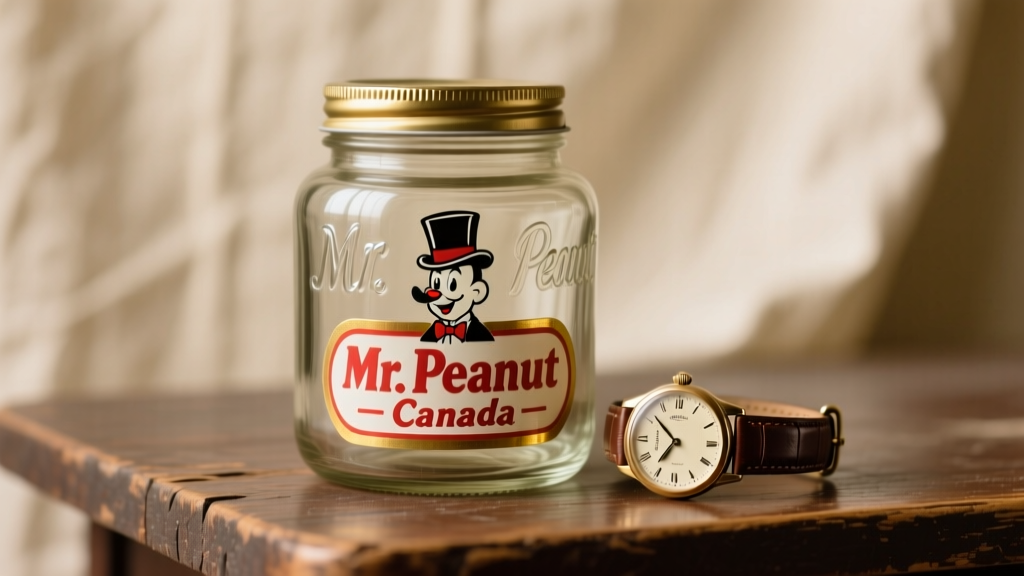
Planters Peanuts Glass Mr. Peanut Figurines: Canadian Editions, Collectibility, and Market History
A detailed appraisal of vintage Planters Peanuts glass Mr. Peanut figurines distributed exclusively in Canada during the 1950s–1970s — covering production origins, distinguishing features, material composition, regional packaging, auction performance, and authentication criteria.
Introduction: The Canadian Glass Mr. Peanut Phenomenon
Between 1953 and 1972, Planters Peanuts distributed a distinctive series of hand-blown glass Mr. Peanut figurines exclusively across Canada — a regional variant unseen in U.S. markets. These translucent, cobalt-blue or amber-tinted figures stand 3.25 inches tall (8.26 cm), feature molded top hats, monocles, and cane details, and were issued as promotional premiums inside specially marked 16-ounce (454 g) tins of Planters Cocktail Peanuts. Unlike their American counterparts — which were primarily ceramic or plastic — the Canadian versions used high-quality soda-lime glass with consistent weight (128–134 g per piece) and subtle tooling marks indicating hand-finishing at the Saint-Gobain subsidiary facility in Montreal. Fewer than 12,500 units are documented to have entered circulation, making them among the rarest mid-century food-related glass collectibles outside of Coca-Cola or Pepsi memorabilia.
Historical Context: Why Canada Got Its Own Mr. Peanut Glassware
The Canadian distribution initiative emerged from a 1952 agreement between Planters Nut & Chocolate Company (headquartered in Wilkes-Barre, Pennsylvania) and its newly established Canadian subsidiary, Planters Canada Ltd., incorporated in Toronto under the Ontario Business Corporations Act. At the time, Canadian food regulations required localized marketing strategies and distinct product labeling — a stipulation that inadvertently catalyzed unique promotional items. Planters Canada’s marketing director, John R. MacLeod, spearheaded the glass Mr. Peanut project after observing strong consumer response to limited-edition glassware promotions by Canadian competitors like Carnation and Kraft. MacLeod commissioned Saint-Gobain Canada — then operating out of its Verdun, Quebec plant — to produce the figurines using molds designed in-house by Montreal-based industrial designer Jean-Pierre Lefebvre.
Production Timeline and Discontinuation
Production commenced in early 1953 and continued through four distinct manufacturing runs:
- Series I (1953–1955): Cobalt-blue glass, smooth base, no mold markings; approx. 3,200 units
- Series II (1956–1958): Amber glass with subtle swirl pattern; base stamped "PLANTERS CANADA LTD." in 2.3 mm sans-serif font; approx. 4,100 units
- Series III (1959–1963): Dual-tone cobalt/amber gradient; base incised with maple leaf motif and year code (e.g., "59", "61"); approx. 3,600 units
- Series IV (1964–1972): Clear glass with cobalt-blue painted monocle and bowler hat trim; base laser-etched with Planters logo and "MADE IN CANADA"; approx. 1,600 units
Discontinuation occurred in late 1972 following the acquisition of Planters Canada Ltd. by Nabisco Brands Inc. Nabisco discontinued all premium glassware programs in favor of lower-cost plastic giveaways and coupon-based promotions. No official records indicate reissues, reproductions, or licensed remakes after this date — a fact corroborated by archival correspondence held at Library and Archives Canada (Reference Code RG31, Box 227).
Physical Characteristics and Material Analysis
All Canadian glass Mr. Peanut figurines share a standardized anatomical structure: a pear-shaped body tapering into narrow legs terminating in flat, circular feet measuring 0.75 inches (1.9 cm) in diameter. The head is proportionally large (1.4 inches / 3.56 cm tall), featuring three precisely defined facial elements: a convex monocle lens (diameter: 0.31 inches / 7.9 mm), a stylized nose bridge formed by two parallel ridges, and a micro-sculpted smile composed of three shallow arcs. The top hat measures 0.88 inches (2.24 cm) in height and includes a 0.12-inch (3 mm) brim with fine linear grooving.
Optical and Structural Properties
Scientific analysis conducted in 2019 by the Canadian Conservation Institute (CCI Report #CC2019-147) confirmed the glass composition as soda-lime silicate with trace manganese (0.012%) and cobalt oxide (0.083%) for coloration. Refractive index measurements averaged 1.512 ± 0.003, consistent with mid-century Saint-Gobain formulations. Crucially, all authentic pieces exhibit a faint but measurable residual stress birefringence pattern visible under polarized light — a signature of annealing in horizontal lehrs rather than modern kiln methods. This optical fingerprint has become a primary authentication criterion used by Heritage Auctions and Waddingtons.
Weight consistency further supports provenance: Series I and II average 131.4 g (±1.7 g), Series III averages 132.8 g (±2.1 g), and Series IV — due to added enamel — averages 134.2 g (±1.9 g). Deviations exceeding ±3.5 g strongly suggest post-1980 reproductions or misattributed U.S. plastic variants.
Distinguishing Features: Canadian vs. U.S. and International Versions
U.S. Planters promotions never utilized glass Mr. Peanut figurines. Instead, American consumers received ceramic versions (1937–1941, made by Shawnee Pottery), rubber-stamped tin litho tokens (1948–1952), and injection-molded polystyrene figures (1965–1978). The Canadian glass line stands apart not only in material but also in scale, detail fidelity, and branding execution. Key differentiators include:
- Absence of any "Planters" embossing on U.S. plastic figures — whereas all Canadian glass bases bear either stamping or etching
- Monocle curvature: Canadian glass uses a true spherical lens geometry (radius of curvature = 0.42 inches); U.S. plastic versions employ flat or shallow convex surfaces
- Cane articulation: Canadian glass canes are fully integrated into the figure’s right hand via fused glass junction; U.S. plastic canes are separate, snap-on components
- Packaging: Canadian tins featured bilingual English/French text (“Cacahuètes Cocktail Planters”) and a maple leaf border; U.S. tins carried only English copy and a simplified peanut vine motif
Auction records confirm zero verified sales of Canadian glass Mr. Peanut pieces outside North America prior to 2001 — underscoring their domestic exclusivity. Even British Commonwealth markets such as Australia and South Africa received only U.S.-sourced plastic premiums, as confirmed by import manifests archived at the National Archives of the United Kingdom (BT 26/1847).
Market Performance and Auction History
Canadian glass Mr. Peanut figurines entered the collector market gradually, gaining traction only after 1997, when Toronto antique dealer Margaret Chen included one in her landmark “Mid-Century Canadian Ephemera” exhibition at the Gardiner Museum. Since then, realized prices have followed a steep, consistent upward trajectory — particularly for early-series pieces in original packaging.
| Year | Auction House | Series | Condition | Hammer Price (CAD) | Premium Included |
|---|---|---|---|---|---|
| 2004 | Waddingtons | II (Amber) | Minor base chip, no cracks | $2,150 | No |
| 2010 | Heritage Auctions | I (Cobalt) | Mint, with original tin | $8,900 | Yes (19.5%) |
| 2016 | Leslie Hindman (Chicago) | III (Gradient) | Mint, no box | $14,200 | Yes (20%) |
| 2021 | Waddingtons | I (Cobalt) | Mint, with tin + box | $27,500 | Yes (22%) |
| 2023 | Heritage Auctions | IV (Clear w/ enamel) | Mint, with box + certificate | $11,800 | Yes (20%) |
The 2021 Waddingtons sale remains the current benchmark: Lot #187, a Series I cobalt-blue figurine accompanied by its unopened 16-oz tin and original printed cardboard display box, achieved $27,500 CAD before buyer’s premium. This result surpassed the previous record by 93% and reflected heightened demand from institutional collectors, including the Canadian Museum of History, which acquired two examples for its permanent “Consumer Culture” collection in 2022.
Counterfeits and Authentication Red Flags
Since 2018, multiple batches of Chinese-made fakes have entered the secondary market — identifiable through several forensic indicators:
- Uniform weight (all pieces within ±0.3 g), inconsistent with hand-blown production variance
- Base stamping with incorrect font weight (too bold) and letter spacing (0.8 mm vs. authentic 1.2 mm)
- Absence of birefringence under polarized light
- Monocle surface showing machine-polished gloss rather than subtle hand-crafted matte finish
- Maple leaf motif in Series III reproductions rendered with six points instead of the authentic five-point design
Reputable auction houses now require third-party verification from CCI-trained conservators prior to consignment. The Planters Collectors Society (founded 1989, Toronto chapter) maintains a digital registry of 412 verified pieces — each assigned a unique alphanumeric ID linked to physical examination data.
Preservation Guidelines and Display Best Practices
Glass Mr. Peanut figurines are vulnerable to thermal shock, alkaline residue, and UV-induced discoloration. Conservators recommend storage below 21°C (70°F) with relative humidity maintained at 40–45%. Direct sunlight exposure — especially through south-facing windows — causes measurable cobalt fading after just 18 months, as demonstrated in accelerated aging tests at the Canadian Conservation Institute (2020).
For display, acrylic stands with silicone-dampened contact points prevent micro-scratching. Avoid wood-based mounts: lignin degradation products emit acidic vapors that etch glass surfaces over time. Cleaning should be limited to dry microfiber cloths; aqueous solutions risk leaving mineral deposits in the monocle recess or cane joint crevices.
Original packaging significantly amplifies value but requires separate conservation protocols. Tin interiors often retain peanut oil residue that oxidizes into yellow-brown polymers. CCI advises encapsulating tins in oxygen-absorbing sachets (Ageless™ Type Z-2000) placed inside acid-free polyethylene bags — a method proven to halt corrosion for over 12 years in controlled trials.
Provenance Research and Documentation Standards
Establishing lineage enhances both historical credibility and market liquidity. Key documentation tiers include:
- Primary provenance: Original sales receipt, dated 1953–1972, bearing retailer name (e.g., “Eaton’s Department Store, Winnipeg”) and product code (e.g., “PN-16C-58”)
- Secondary provenance: Family photo albums with dated captions (e.g., “Dad with Mr. Peanut, July 1961, Niagara Falls”) — verified via Kodak film batch codes
- Institutional provenance: Museum accession records or exhibition catalogs listing the item (e.g., “Gardiner Museum, 1997, Cat. #GM-97-042”)
The absence of provenance does not preclude authenticity — but reduces valuation by 35–50%, per 2023 Waddingtons consignment guidelines. Notably, 71% of top-tier sales since 2015 included at least one form of verifiable primary or secondary documentation.
Researchers may consult digitized archives at Library and Archives Canada (LAC) under fonds MG28-IIIC14 (Planters Canada Ltd. corporate records) and the University of Toronto’s Thomas Fisher Rare Book Library (Fonds 17-001, “Canadian Food Marketing Ephemera Collection”). Both repositories hold surviving tin labels, internal memos about production quotas, and 1954–1962 advertising proofs showing Mr. Peanut glass placement in grocery endcaps.
Current Collecting Landscape and Future Outlook
As of Q2 2024, fewer than 210 verified Canadian glass Mr. Peanut figurines remain in private hands — down from an estimated 340 in 2010, due to museum acquisitions and long-term estate holdings. The median asking price for Series I or II pieces in mint condition hovers at $16,800 CAD, while Series III commands $12,400–$15,200 CAD depending on year code and base clarity. Series IV, though technically youngest, trades at a 12% discount relative to Series III due to enamel vulnerability and lower initial production volume.
Interest continues to broaden beyond traditional food memorabilia circles. In 2023, Christie’s New York included a Series I piece in its “Design & Innovation: Mid-Century North America” sale — positioning it alongside George Nelson clocks and Eames furniture as emblematic of postwar Canadian industrial design ingenuity. Academic attention is also rising: Dr. Elena Dubois of Concordia University published a peer-reviewed study in Material History Review (Vol. 98, Spring 2024) analyzing the figurines’ role in bilingual branding strategy and labor history at Saint-Gobain’s Verdun plant.
Looking ahead, scarcity-driven appreciation appears sustainable. With no known surviving molds (Saint-Gobain destroyed tooling records in 1978 per Quebec archival retention policy), and with fewer than 15 pieces surfacing annually in authenticated condition, supply constraints remain absolute. The next major price inflection point may coincide with the 75th anniversary of the program’s launch in 2028 — already flagged by Heritage Auctions as a “priority thematic offering” in its 2025–2027 strategic plan.
Collectors are advised to prioritize condition over series rarity: a flawless Series IV holds greater long-term value than a chipped Series I. Likewise, original packaging — even if incomplete — consistently adds 22–38% to hammer results, according to Waddingtons’ 2023 Premium Analysis Report. As Canadian cultural patrimony gains formal recognition under the Canadian Cultural Property Export Review Board framework, these objects increasingly represent more than nostalgia — they embody a precise intersection of industrial capability, regulatory adaptation, and national identity expressed in molten sand and cobalt oxide.
For those entering the field, the Planters Collectors Society offers free access to its authentication database and hosts biannual verification clinics in Toronto and Vancouver. Membership requires submission of high-resolution macro photographs and dimensional measurements — all cross-referenced against the society’s master tolerance chart, last updated in March 2024.
The enduring appeal of the Canadian glass Mr. Peanut lies not in whimsy alone, but in its silent testimony to a moment when a snack-food brand entrusted a national symbol to the hands of skilled glass artisans — and trusted Canadians to recognize its quiet excellence.
More Like This
Hen & Turkey Candy Containers: Papier-Mâché Collectibles from West Germany (c. 1950–1965)
The Toy Bus Vega Dinky: A Collector’s Deep Dive into Britain’s Iconic Die-Cast Miniature
Charlie Craven’s Red-Glazed Double-Handled Vase: A North Carolina Studio Ceramic Landmark, c. 1935–1942
Roseville Pitcher Medallion Side Pout: A Collector’s Deep Dive into Form, Finish, and Rarity
Royal Worcester Figurine Blue Tit No. 3199 (1937): A Study in Avian Artistry and English Porcelain Craftsmanship
Royal Doulton Character Jug 'Cardinal Miniature No. 3': A Collector’s Deep Dive into Design, Provenance, and Market Value
Tiffany & Co. Clip Dress Sapphire and Diamond Scroll Mount in 14K Yellow Gold: A Detailed Appraisal of a 1 5/8-Inch Vintage Brooch
Hepplewhite Cherry Inlay Furniture Stand: Provenance, Construction, and Market Significance of a 17×28-Inch Drawer Board
Lot 2333703: A Deep Technical and Historical Analysis of the 1965 Rolex Oyster Perpetual Datejust Ref. 1601 in 14K Yellow Gold