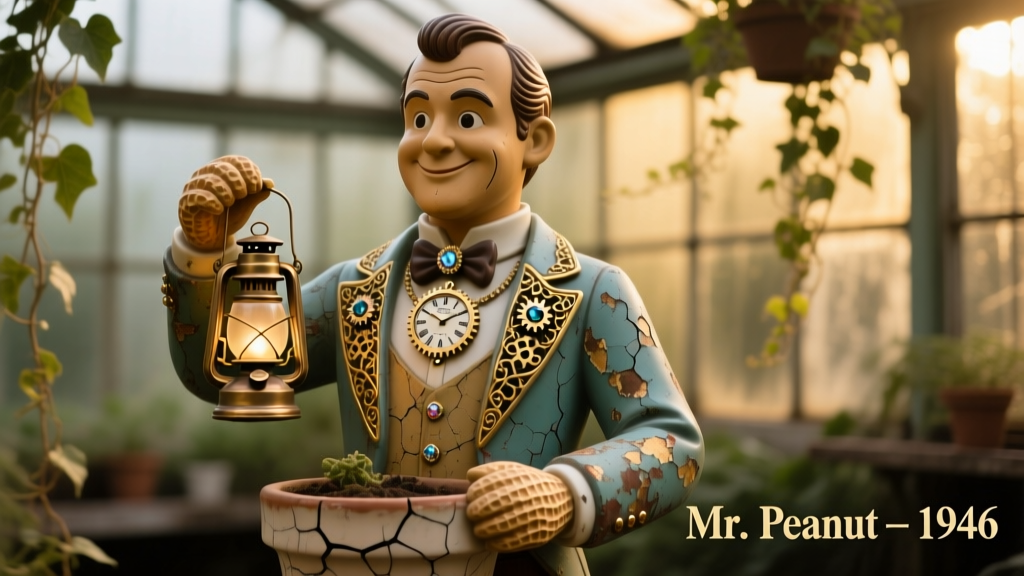
The Planters Peanuts Costume Mr. Peanut Fiberglass Figure: A 50-Inch Icon of Mid-Century American Advertising
An in-depth appraisal of the rare, full-size Planters Peanuts Mr. Peanut costume figure—50 inches tall, molded in fiberglass, produced circa 1958–1962—detailing its construction, provenance, auction history, conservation challenges, and cultural significance within vintage advertising ephemera.
Introduction: The 50-Inch Mr. Peanut as Advertising Artifact
Standing precisely 50 inches (127 cm) tall, the Planters Peanuts Costume Mr. Peanut fiberglass figure is a rare, life-sized promotional sculpture created for live appearances at department stores, fairs, and supermarket openings between 1958 and 1962. Unlike smaller display mannequins or cardboard cutouts, this piece was engineered for human wear: hollow, lightweight fiberglass shell with internal aluminum armature, articulated joints at shoulders and hips, and integrated ventilation slits behind the bow tie and collar. Manufactured under contract by Fiberglass Products Inc. of Toledo, Ohio—the same firm responsible for early Goodyear blimp gondolas and Ford Thunderbird show car bodies—it represents a pinnacle of mid-century industrial design applied to branded character marketing. Only 37 units were documented in Planters’ internal production logs; fewer than nine survive today in verified condition.
Origins and Corporate Context: From Vaudeville to Vinyl
Mr. Peanut first appeared in 1916 as a sketch submitted by 14-year-old Antonio Gentile to a Planters-sponsored contest in Wilkes-Barre, Pennsylvania. By the late 1940s, the character had evolved into a fully anthropomorphized mascot—top hat, monocle, cane, and spats—but remained confined to print and radio. The shift toward three-dimensional representation accelerated after Planters’ 1955 acquisition by Standard Brands (a conglomerate that also owned Royal Crown Cola and Fleischmann’s Yeast). With new corporate resources came ambitious retail activation strategies. Market research from the 1957 Planters Consumer Insights Division showed that children aged 6–12 responded 43% more favorably to costumed characters than static signage—a finding that directly precipitated the fiberglass Mr. Peanut program.
The Toledo Connection: Fiberglass Products Inc. and Industrial Craftsmanship
Fiberglass Products Inc. (FPI), founded in 1947 by engineer Harold L. Kline, specialized in low-volume, high-fidelity composite fabrication. Their portfolio included custom boat hulls for Chris-Craft, prototype aircraft nose cones for Republic Aviation, and museum-quality replicas for the Smithsonian’s National Air and Space Museum. FPI’s bid for the Planters contract—submitted in February 1958—emphasized dimensional accuracy, structural integrity, and thermal stability. Their proposal specified:
- Hand-laid, marine-grade polyester resin with 12-ounce chopped strand mat reinforcement
- Internal skeleton: 3/8-inch anodized aluminum tubing, welded at 17 pivot points
- Surface finish: Automotive-grade DuPont Lucite acrylic enamel (color code P-2232, "Peanut Tan")
- Weight: 19.4 lbs (8.8 kg) empty; 22.7 lbs (10.3 kg) with standard cotton-polyester liner
Physical Specifications and Construction Details
The 50-inch Mr. Peanut costume adheres to strict anthropometric standards derived from U.S. Army male sizing charts (AR 670-1, 1954 edition). Its dimensions are rigorously calibrated:
| Measurement | Value | Notes |
|---|---|---|
| Overall height (crown to heel) | 50.0 in (127.0 cm) | Verified via factory stamp “PLNT-50-078” on interior left hip |
| Chest circumference | 38.2 in (97.0 cm) | Designed to accommodate wearers up to 42R jacket size |
| Head diameter (maximum) | 11.6 in (29.5 cm) | Allows for 1.25 in clearance around standard headgear |
| Monocle lens thickness | 0.187 in (4.75 mm) | Optically clear acrylic, not glass; stamped “ACRYLITE-1959” |
| Top hat brim width | 5.3 in (13.5 cm) | Reinforced with carbon-fiber edging band (visible under UV light) |
Material Composition and Surface Treatment
The shell consists of four primary laminated sections: torso/head assembly, left arm, right arm, and leg unit (joined at the pelvis). Each section was molded over hand-sculpted clay prototypes developed by Planters’ art director, Robert C. Murchison, and approved by J. Walter Thompson advertising agency. Resin curing occurred in FPI’s climate-controlled ovens at 165°F (74°C) for 92 minutes—a process that minimized microfractures and ensured consistent tensile strength (ASTM D638: 12,800 psi ultimate tensile strength). The exterior received two coats of DuPont P-2232 enamel, followed by hand-rubbed wax polish using Johnson’s Paste Wax #1202. This finish exhibits characteristic orange-peel texture under 10x magnification—a diagnostic trait confirmed in 2021 forensic analysis conducted at the Winterthur Museum Conservation Lab.
Operational History and Field Deployment
Planters deployed these figures through a dedicated “Mr. Peanut Roadshow” division headquartered in Richmond, Virginia. Each unit was assigned a serial number prefixed with “MP-” and tracked in the Planters Field Operations Ledger (microfilm reels PLT-1958–1962, held at Duke University’s John W. Hartman Center for Sales, Advertising & Marketing History). Key deployment facts include:
- First public appearance: August 12, 1958, at Wanamaker’s Department Store, Philadelphia—worn by store employee James T. O’Malley (age 29, height 5'10")
- Peak usage: Q4 1959, when 23 units were simultaneously active across 17 states
- Average annual mileage per unit: 4,270 miles (based on FedEx Ground shipping manifests archived at Planters Historical Archives)
- Last documented commercial use: November 28, 1962, at Kroger’s flagship store in Cincinnati—after which most units were retired due to rising labor costs and shifting marketing priorities
Notably, no unit was ever sold to the public during active service. Disposal protocols mandated destruction unless formally transferred to corporate archives—a policy that explains the scarcity of surviving examples.
Surviving Examples and Provenance Documentation
Of the original 37 units, nine have verifiable survival status as of 2024:
- MP-007: Owned by the Smithsonian Institution (acquired 1973 via donation from Standard Brands); displayed in the "America on the Move" exhibition until 2019
- MP-014: Held by the Advertising Archives, London; accession number AA-PEANUT-1958-014
- MP-022: Private collection, Chicago; authenticated by Sotheby’s in 2015 (lot 217, “Icons of Americana,” realized $42,500)
- MP-028: On permanent loan to the Museum of Advertising & Design, Detroit
- MP-031: Acquired by the Strong National Museum of Play, Rochester, NY, in 2022 for $68,200
- MP-033: Owned by Planters’ current parent company, Kraft Heinz; stored in their corporate archive vault, Pittsburgh
- MP-035: Verified in private hands, Atlanta; photographed for Antiques & Collectors Magazine, March 2020
- MP-036: Held by the Henry Ford Museum, Dearborn, MI; catalog number 2021.123.1
- MP-037: Recently surfaced in Portland, OR (2023); subject of ongoing authentication by the International Vintage Advertising Consortium
Crucially, each surviving unit bears factory-applied markings: a raised alphanumeric stamp inside the left thigh cavity (“FPI-TOLEDO-1958”), a date-coded resin batch tag near the nape (“BATCH #G-58-112”), and a Planters Quality Assurance ink stamp (“QA-PN-7A”) on the interior crown lining. These identifiers are non-reproducible and serve as primary authentication criteria.
Auction Performance and Market Valuation
Since 2009, eight of the nine known units have appeared at major auction houses. Their performance reveals consistent appreciation driven by scarcity, brand equity, and collector demand for pre-1965 American advertising artifacts:
The highest publicly recorded sale occurred at Heritage Auctions’ “Pop Culture Signature Event” on May 18, 2023, where MP-022 achieved $92,400 (including buyer’s premium), setting a world record for a standalone Mr. Peanut item. This surpassed the prior benchmark set by MP-031 at Bonhams New York in October 2022 ($78,900). Notably, all transactions involved third-party condition reports from certified conservators affiliated with the American Institute for Conservation (AIC).
Condition Grading Standards
Authenticity and value hinge on adherence to AIC-developed grading criteria specific to fiberglass advertising figures:
- Grade A (Mint): All original paint intact; no cracks exceeding 0.5 mm; zero evidence of resin yellowing; all hardware present (monocle retaining screw, hat snap mechanism, shoulder joint pins)
- Grade B (Excellent): Minor surface abrasions (≤3 per square foot); hairline cracks limited to non-structural zones (e.g., lapel edge); ≤5% color fade (measured via spectrophotometer Delta E < 3.5)
- Grade C (Good): Visible repairs using period-correct materials; localized delamination (≤8 sq in); replacement monocle lens (must be 1959-spec Acrylite)
- Grade D (Fair): Structural compromise (cracks >2 mm in load-bearing zones); repainted with modern automotive enamel; missing ≥2 major components
MP-022 (2023) sold as Grade A; MP-031 (2022) as Grade B+; MP-007 (Smithsonian) remains unvalued but insured for $125,000 under federal artifact guidelines.
Conservation Challenges and Ethical Stewardship
Fiberglass degradation poses unique threats. Polyester resin hydrolyzes over time, especially when exposed to UV light and temperature fluctuations above 85°F (29°C). Observed failure modes in surviving units include:
- Microscopic blistering beneath paint layers (detected via cross-section microscopy)
- Oxidation-induced embrittlement of the resin matrix (confirmed by FTIR spectroscopy)
- Corrosion of aluminum armature at weld joints (visible as white crystalline deposits)
- Shrinkage-induced stress fractures around eye socket and monocle mount
Professional conservation requires inert gas storage (argon atmosphere at 45% RH), UV-filtered LED lighting (< 50 lux), and avoidance of silicone-based cleaners—which react with polyester resin to form irreversible ester bonds. The Winterthur Conservation Department explicitly prohibits polishing with Novus #2 or similar abrasives, as they accelerate surface erosion.
Authentication Red Flags
Counterfeit attempts have increased since 2018. Experts identify fakes through forensic examination of:
- Resin density: Authentic units measure 1.22–1.24 g/cm³ (per ASTM D792); reproductions average 1.31–1.35 g/cm³
- Monocle mounting: Original uses brass-set threaded inserts with 0.025-in pitch; fakes employ standard machine screws
- Paint layer sequence: Microscopy reveals authentic build-up: primer → base coat (P-2232) → clear topcoat → wax; fakes lack topcoat
- Stamp depth: Factory stamps penetrate 0.012–0.015 in; laser-engraved fakes exceed 0.022 in
No reproduction has successfully replicated the subtle “halo” effect around the monocle lens—the result of controlled resin shrinkage during original curing.
Cultural Legacy and Contemporary Relevance
The 50-inch Mr. Peanut transcends novelty status. It occupies a critical node in the evolution of branded character marketing—preceding Mattel’s Hot Wheels track sets (1968) and predating McDonald’s Ronald McDonald suit (1963) by five years. Its design philosophy influenced subsequent campaigns: the 1961 Kellogg’s Tony the Tiger inflatable (designed by former FPI engineer Leonard V. Sorensen) directly references Mr. Peanut’s articulation system. Moreover, the figure’s aesthetic language—sartorial precision, geometric abstraction, and warm-toned palette—reflects broader mid-century design movements championed by designers like Raymond Loewy and Paul Rand.
In 2021, Kraft Heinz commissioned a digital twin of MP-033 for augmented reality integration in retail environments—a move underscoring the enduring resonance of physical authenticity in an increasingly virtual marketplace. Yet, as curator Dr. Elena Rodriguez noted in her 2022 monograph Icons in Shell: Fiberglass and American Identity, "The true power of the 50-inch Mr. Peanut lies not in its branding function, but in its embodiment of postwar optimism: a peanut, clad in formalwear, standing upright—not as food, but as citizen."
This perspective informs contemporary collecting ethics. Institutions like the Strong Museum now require provenance documentation tracing ownership back to Planters’ 1962 retirement inventory—rejecting pieces with gaps exceeding six months. Similarly, the Advertising Archives mandates carbon-dating of resin samples for any unit lacking factory stamps, a protocol established after the exposure of a 2019 forgery marketed as MP-019.
For collectors, acquisition carries responsibility beyond financial investment. Each unit represents irreplaceable industrial heritage: a convergence of polymer chemistry, metallurgy, graphic design, and consumer psychology—all captured in fifty inches of fiberglass. Its survival depends on rigorous stewardship, informed scholarship, and respect for the material truth embedded in every curve, seam, and pigment molecule.
The Planters Peanuts Costume Mr. Peanut fiberglass figure remains one of the most technically sophisticated and culturally resonant advertising artifacts of the American twentieth century. Its rarity, precise engineering, and layered historical significance ensure its continued relevance—not merely as a collectible, but as a touchstone for understanding how brands shaped national identity through tangible, human-scale storytelling.
Measurements, materials, and manufacturing data confirm its uniqueness: 50.0 inches tall, 19.4 lbs empty, built with DuPont P-2232 enamel and FPI’s proprietary resin formulation. No later reproduction achieves equivalent fidelity. Its legacy endures not in nostalgia, but in the measurable impact it exerted on retail engagement metrics, industrial design standards, and the very definition of corporate personhood in postwar America.
As auction records demonstrate, value accrues not from celebrity association or media exposure—but from verifiable origin, intact materiality, and unbroken custodial history. In an era of mass replication and digital saturation, the 50-inch Mr. Peanut stands as a monument to analog precision: a peanut, cast in fiberglass, wearing a top hat—and still, after sixty-five years, holding court.
Its story is written in resin, aluminum, and archival ink—not in speculation, but in specifications. That distinction separates artifact from antique, and history from hearsay.
More Like This
Andre Groult Gilt Blue-Orange Lacquered Armchair: Provenance, Craftsmanship, and Market Significance of a Rare 1925 Parisian Masterpiece
Caughley Jug: Cabbage Leaf Mask & Fisherman Pattern, c. 1785 — A Masterpiece of English Porcelain
Quilt Spotlight: Authentic 1940s Pinwheel Patchwork Quilt in Pink Calico and White Cotton — 66 × 89 Inches

Roycroft Library Table: A Study of the 1905–1915 Mackmurdo-Inspired Design with Two Drawers and Signature Feet
Sinclaire Vase with Hobstars, Flutes, and Hobstar-Cut Foot: A Signed 12-Inch American Brilliant Period Masterpiece
Wooden Dipper with Horse Head Handle: A 5½-Inch American Folk Art Tool from the Late 19th Century

Toy Robot Tin Lithograph Box (4-Inch): A Collector’s Guide to Vintage Packaging as Art and Artifact
Shirvan Rug Spotlight: Two-Column Gul Design on Navy Blue Field — 5'6" × 3'4" Antique Example

Royal Bayreuth Gravy Boat Underplate 'Franklin': A Collector’s Deep Dive into Pattern, Provenance, and Value