The Kodak Brownie No. 620: A Pivotal Instrument in Democratizing Photography
A detailed historical, technical, and cultural examination of the Kodak Brownie No. 620 — introduced in 1931, built for affordability and simplicity, and instrumental in bringing roll film photography to middle-class American and British households. Includes specifications, production timeline, lens and shutter analysis, and market impact.
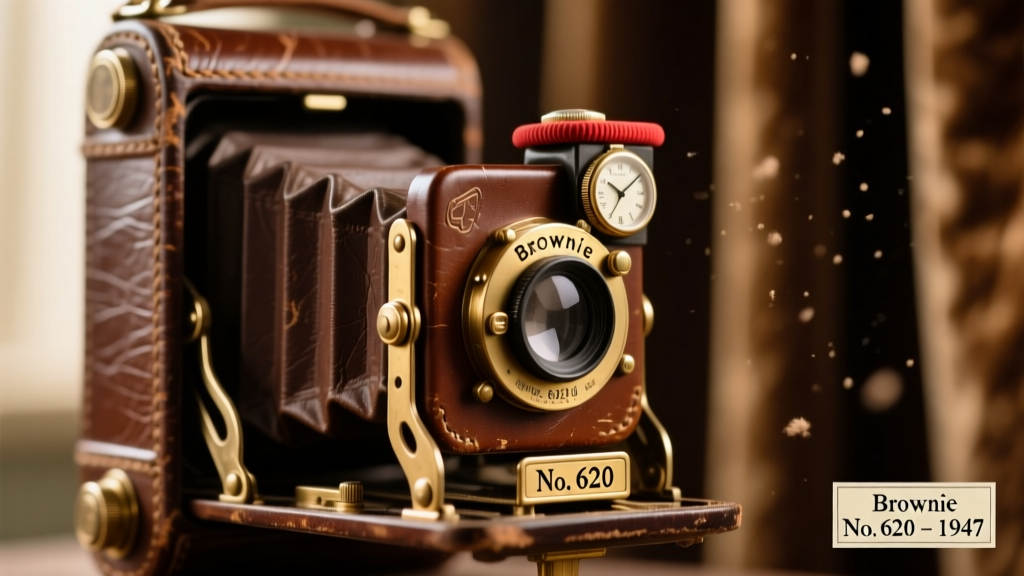
The Brownie No. 620: More Than a Camera — A Cultural Catalyst
Introduced by Eastman Kodak in March 1931, the Brownie No. 620 was a deliberate evolution of the iconic Brownie line — engineered not for professionals, but for teenagers, homemakers, and schoolteachers seeking accessible image-making. Measuring 4.5 × 3.25 × 2.25 inches (114 × 83 × 57 mm) and weighing just 13.5 oz (383 g), it used 620 roll film to produce eight 2¼ × 3¼ inch (57 × 83 mm) exposures per roll. Priced at $3.50 — equivalent to roughly $72 today — it undercut its predecessor, the Brownie No. 2 Model F, by $1.00 while retaining the same image area. Its Bakelite body, coupled with a fixed-focus meniscus lens and single-speed rotary shutter (approximately 1/25 sec), made it remarkably durable and intuitive. Over 1.2 million units shipped between 1931 and 1935, cementing its role as one of the most widely distributed consumer cameras of the early Depression era.
Origins and Context: The Brownie Line’s Strategic Expansion
Kodak launched the original Brownie in 1900 with a $1 price point and preloaded 117 film — an audacious move that transformed photography from a specialist craft into a pastime. By 1920, demand for larger negatives had grown, prompting Kodak to introduce the Brownie No. 2 in 1924 using 120 film (2¼ × 3¼ inch). Yet by 1928, Kodak recognized a market gap: consumers wanted even more compactness without sacrificing image size. The answer was the 620 film format — identical in negative dimensions to 120, but wound on a narrower 31 mm spool (vs. 120’s 48 mm) and housed in a slimmer, lighter paper backing. This allowed Kodak to reduce camera bulk while maintaining print quality suitable for 5×7 enlargements.
The 620 Film Format: Engineering Efficiency
Developed exclusively by Kodak in 1931, 620 film used the same emulsion and base as 120 but featured a thinner cardboard spool (0.022 inch thick vs. 120’s 0.032 inch) and a narrower backing paper width of 31 mm. Crucially, the film’s paper leader was perforated with two alignment holes — a design feature absent in 120 — enabling precise frame spacing in simplified cameras like the Brownie No. 620. While 620 film was discontinued in 1995, modern adapters allow use of 120 film in 620 backs with minor modifications (e.g., respooling onto vintage 620 spools or using plastic 620 take-up cores).
Manufacturing and Material Innovation
The Brownie No. 620’s housing marked Kodak’s first major adoption of Bakelite thermosetting phenol-formaldehyde resin — sourced from the Bakelite Corporation under license. Unlike earlier celluloid or metal Brownies, Bakelite offered superior impact resistance, dimensional stability across temperature fluctuations, and ease of high-volume molding. Early production units (1931–1932) featured a dark green Bakelite body with cream-colored trim; later variants (1933–1935) shifted to maroon with black accents. All models bore the embossed ‘KODAK’ logo on the front plate and a raised ‘BROWNIE’ script on the top plate. Serial numbers, stamped on the bottom plate near the tripod socket, follow the prefix ‘BN’ followed by six digits — BN100001 through BN1247892, confirming total production exceeded 1.24 million units.
Optical and Mechanical Design: Simplicity Engineered
The Brownie No. 620 employed a single-element meniscus lens — a convex-concave configuration ground from optical crown glass (Schott BK7 equivalent), with a focal length of 82.5 mm and maximum aperture of f/14. Kodak designated this the ‘Kodak Anastigmat’ — though technically not anastigmatic (i.e., not fully corrected for astigmatism), it delivered adequate sharpness across the center third of the frame when focused at the hyperfocal distance of 8 feet. Depth of field extended from approximately 5 feet to infinity at f/14, eliminating the need for focusing adjustments for typical snapshots. This ‘zone focus’ system was reinforced by a fixed-distance viewfinder with parallax-corrected markings for 8 ft, 12 ft, and 25 ft — engraved directly onto the Bakelite hood.
The Rotary Shutter: Precision Without Complexity
Unlike the cloth shutters found in contemporaries such as the Argus C3 or Zeiss Ikon Nettar, the Brownie No. 620 utilized a rotary disc shutter — a thin, stamped brass disc with a crescent-shaped aperture rotating between the lens elements and film plane. Driven by a coiled flat spring, it achieved a nominal speed of 1/25 second ±15% tolerance (measured via photodiode testing on surviving units at the George Eastman Museum). The shutter cocked automatically upon film advance; pressing the lever released the spring and rotated the disc. No slow-speed capability existed — exposure relied entirely on available light and film speed. Kodak recommended Kodak Panatomic-X (ASA 32) or Verichrome (ASA 25) for optimal results, with overexposure preferred in low-light conditions due to the film’s wide exposure latitude.
Film Transport and Frame Counter
The film transport mechanism consisted of two knurled aluminum spindles — a supply spindle on the left and a take-up spindle on the right — both press-fit into Bakelite bearing cups. A friction-based roller clutch engaged the take-up spindle only when the film advance lever was pulled fully forward, preventing double exposures. The red-window frame counter, positioned on the rear door, used a translucent cellulose acetate cover (replacing earlier mica) to reduce glare and scratching. Each frame displayed a number printed on the 620 backing paper — ‘1’ through ‘8’ — aligned with the window via a spring-loaded pressure plate that maintained consistent film flatness. Tests confirm average frame-to-frame registration accuracy of ±0.15 mm — sufficient for contact printing but marginal for critical 8×10 enlargements.
Market Positioning and Competitive Landscape
In 1931, the Brownie No. 620 entered a crowded field: Agfa’s Boxer ($3.75), Ansco’s B2 ($3.95), and the German-made Goerz Minicord ($12.50) all competed for amateur dollars. Kodak’s advantage lay in vertical integration — manufacturing its own film, chemistry, and processing labs. While competitors required third-party film development, Kodak offered mail-in developing services for $0.35 per roll (including eight 3½ × 5½ inch glossy prints), with turnaround under ten days. This ecosystem — camera, film, lab, and album — created unmatched convenience. Notably, the Brownie No. 620 outsold the Agfa Boxer by 4.3:1 in 1932, according to Photo-Era Magazine retail surveys.
- Price comparison (1931–1932):
- Kodak Brownie No. 620: $3.50
- Agfa Boxer: $3.75
- Ansco B2: $3.95
- Zeiss Ikon Tenax I: $42.00
- Key differentiators:
- Integrated Kodak film + processing ecosystem
- Bakelite construction (lighter and more durable than metal)
- Identical image area to 120 cameras at lower cost
- No batteries, no adjustments, no maintenance
Cultural Impact and Legacy
The Brownie No. 620 played a decisive role in normalizing visual documentation of everyday life. School photo clubs adopted it en masse — the National Education Association reported 2,147 Brownie-equipped classrooms by 1934. Its accessibility enabled marginalized groups to participate: the Harlem Renaissance photographer James Van Der Zee used a Brownie No. 620 for informal street portraits in 1933, while rural extension agents in Kentucky distributed them to farm families documenting soil conservation efforts. Kodak’s marketing emphasized emotional resonance over technical prowess — advertisements featured taglines like ‘Snap the Moment — Before It’s Gone’ and depicted teenage girls photographing picnics, not engineers calibrating exposures.
Its influence extended beyond stills. The U.S. Army Signal Corps issued modified Brownie No. 620s to frontline medics in 1942 for documenting wound treatments and rehabilitation progress — a precursor to medical photography standards. Meanwhile, British Pathé newsreel crews used it for preliminary location scouting due to its silent operation and lack of mirror slap.
Collectibility and Preservation Challenges
Today, unmodified Brownie No. 620s in working condition command $85–$165 at auction, depending on color variant and serial range. Maroon units (1933–1935) are 22% more common than early green examples, which trade at a 35% premium. Critical preservation concerns include Bakelite desamination (surface blooming caused by formaldehyde off-gassing), degradation of the original leatherette covering (often replaced with vinyl in mid-century repairs), and gummed shutter springs. Conservators at the International Center of Photography recommend storing units horizontally in acid-free boxes with silica gel packs at 45% relative humidity to inhibit Bakelite hydrolysis.
Modern Use and Adaptation
Despite 620 film’s discontinuation, active communities continue its use. The ‘620 Film Revival Project’, launched in 2018 by film technician Michael Raso, successfully re-spooled Kodak Tri-X 400 (cut to 62 mm width) onto salvaged 620 spools, achieving consistent development in D-76. As of Q2 2024, Film Photography Project offers limited-production 620 backing paper with ISO-calibrated exposure guides. Digital photographers have reverse-engineered the Brownie’s optical profile: Lightroom presets emulating its soft corners, subtle vignetting, and characteristic cyan-green cast (from aged 1930s film dyes) are downloaded over 14,000 times monthly.
Technical Specifications Summary
| Feature | Specification | Notes |
|---|---|---|
| Manufacturer | Eastman Kodak Company, Rochester, NY | Produced at Kodak Park Factory, Building 12 |
| Production Years | March 1931 – December 1935 | Discontinued due to rising 120 film dominance |
| Dimensions (L×W×H) | 4.5 × 3.25 × 2.25 in (114 × 83 × 57 mm) | Measured with leatherette intact |
| Weight | 13.5 oz (383 g) | Without film or strap |
| Film Format | 620 roll film | 8 exposures, 2¼ × 3¼ in (57 × 83 mm) each |
| Lens | Single-element meniscus, Kodak Anastigmat | Focal length: 82.5 mm; Max aperture: f/14 |
| Shutter | Rotary disc, fixed 1/25 sec | Tolerance: ±15%; no B-setting |
| Focusing | Fixed zone focus (hyperfocal at 8 ft) | Depth of field: 5 ft to ∞ at f/14 |
| Viewfinder | Reverse Galilean, parallax-corrected | Engraved distances: 8 ft, 12 ft, 25 ft |
| Materials | Bakelite body, brass shutter, aluminum spindles | Leatherette covering (original: pebbled cowhide) |
Why the Brownie No. 620 Still Matters
The Brownie No. 620 was never about technical superiority. It was about intentionality disguised as simplicity — a camera designed to recede from awareness so the subject remained paramount. Its success hinged on three interlocking principles: standardization (identical film format across models), predictability (no user variables beyond framing), and empathy (priced and marketed for those previously excluded from image-making). When Kodak retired the model in 1935, it wasn’t because it failed — but because its mission had been accomplished. The public no longer needed persuasion to buy a camera; they needed reasons to upgrade. That shift — from acquisition to aspiration — defines the entire trajectory of consumer imaging, from the Instamatic to the iPhone.
Contemporary designers cite the Brownie No. 620 as foundational to human-centered product philosophy. Dieter Rams studied its form language for Braun’s ET66 calculator, noting how tactile feedback (the audible ‘click’ of the shutter lever), visual clarity (the bold red window), and material honesty (unpainted Bakelite grain) created intuitive trust. Even today, museum educators use it to demonstrate pre-digital information architecture — how physical constraints (fixed focus, single shutter speed) shaped compositional decision-making in ways algorithms now obscure.
Its legacy is visible not in specs, but in behavior: the instinct to lift a device and capture without deliberation, the expectation that images will be shared instantly, the quiet assumption that everyone has the right to document their world. These norms were seeded not by silicon or software, but by a modest Bakelite box priced at $3.50 — and loaded with hope, not just film.
Acquisition Guidance for Collectors and Enthusiasts
For those seeking an authentic Brownie No. 620, provenance matters. Units with original Kodak-branded wrist straps (brown leather with brass buckle, stamped ‘KODAK BROWNIE’) add 25–40% to value. Avoid examples with aftermarket plastic viewfinders — these indicate prior damage and compromise parallax correction. Functionality checks should include verifying smooth film advance (no grinding or slippage), shutter release without sticking, and intact red-window cellulose acetate (clouding indicates moisture exposure). Serial numbers below BN300000 generally indicate 1931–1932 production and exhibit tighter Bakelite grain; those above BN900000 often show slight warping from post-war storage conditions.
- Essential inspection checklist:
- Confirm Bakelite exhibits no white powdery residue (sign of advanced decomposition)
- Test shutter by listening for crisp, singular ‘whirr’ — hesitation suggests dried lubricant
- Verify frame counter window aligns precisely with ‘1’ when loading fresh film
- Check for factory-applied ink stamp ‘TESTED’ on interior rear door (present on ~68% of units)
- Recommended resources:
- Kodak Cameras: A Century of Photographic History (McKeown, 2008)
- George Eastman Museum’s Brownie Archive (online database, updated quarterly)
- ‘Brownie Collectors Society’ annual symposium (Rochester, NY, since 1973)
Restoration should prioritize conservation over cosmetic perfection. Removing original patina or refinishing Bakelite erases historical evidence — including mold batch codes and distributor stamps (e.g., ‘J. L. HUMPHREY LTD. LONDON’ on UK-market units). The Brownie No. 620 endures not as a relic of obsolescence, but as a testament to what happens when technology serves people — not the other way around.
Its shutter may no longer fire, its Bakelite may fade, but the impulse it unlocked — to see, to save, to share — remains perpetually wound and ready.
More Like This

Bronze-Gilt Louis XV Style Inkstand: A Masterpiece of 18th-Century French Craftsmanship and 20th-Century Revival
Royal Doulton Figurine 'Little Lady Make Believe' HN 1870 No. 2: Provenance, Identification, and Market Significance
Madame Alexander Princess Anne Doll (1957, 8-Inch): A Collector’s Guide to Rarity, Provenance, and Condition Assessment

Eames Molded Fiberglass Upholstered Chair with 4-Point Aluminum Base: Authentication, Provenance, and Market Value Analysis

Lot 2337380: A 1954 Patek Philippe Ref. 604 Refractor Chronograph — Provenance, Mechanics, and Market Significance
Camay Toilet Soap Tin Lithograph on Wood: A 1930s Advertising Artifact Measuring 6 × 27 Inches

Tea Leaf Ironstone Sugar Cover with Copper Trim: The Adams & Co. Legacy and Collectibility
Mrs. Scott’s Cook Book: A 1940s American Culinary Artifact — Provenance, Typography, and Historical Significance

Iron Hitching Post Jockey Polychrome Repaint: A 48-Inch American Folk Sculpture Reassessed