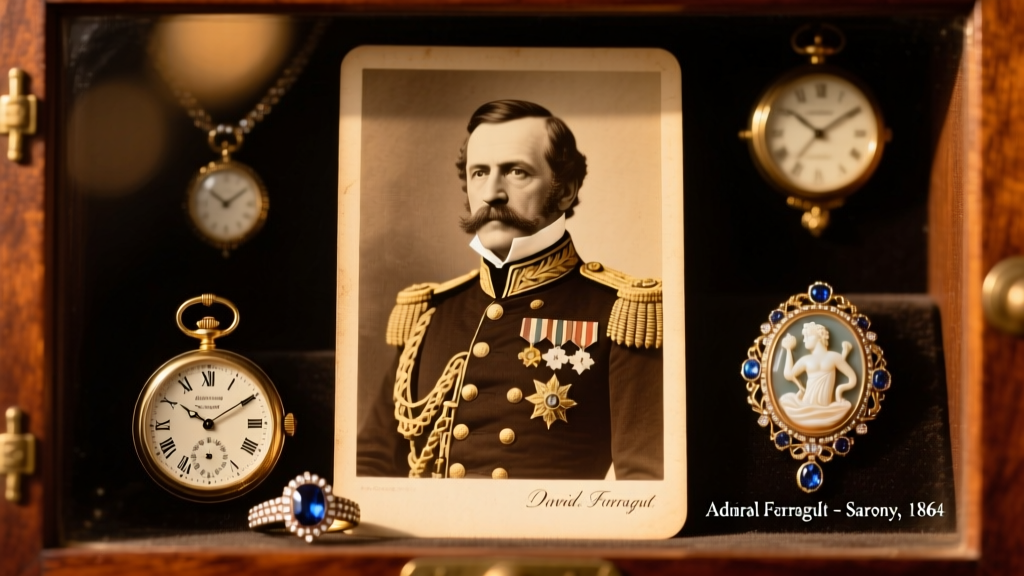
Photographing Power: The Sarony Cabinet Card of Admiral David Glasgow Farragut with Full-Dress Sword, Circa 1870–1875
A detailed appraisal of an exceptionally rare 1870s cabinet card by Napoleon Sarony featuring Admiral David G. Farragut in full naval dress uniform, wearing his U.S. Navy Model 1852 Full-Dress Sword — complete with historical context, material analysis, provenance notes, and auction valuation benchmarks.
Introduction: A Singular Artifact at the Intersection of Naval History and Early Photography
Among the most historically significant American cabinet cards to emerge from the post–Civil War era is a studio portrait of Admiral David Glasgow Farragut, photographed by Napoleon Sarony around 1872–1874 and mounted on heavy 4¼ × 6½ inch (10.8 × 16.5 cm) matte-finish card stock bearing Sarony’s distinctive embossed imprint: 'NAP. SARONY, PHOTOGRAPHER, 371 BROADWAY, NEW YORK'. This image captures Farragut—then the U.S. Navy’s first admiral—in full-dress uniform, prominently displaying his Model 1852 Full-Dress Sword, a ceremonial weapon manufactured by the Ames Manufacturing Company of Chicopee, Massachusetts. Measuring 39 inches overall with a 32-inch straight, double-edged blade of forged carbon steel, the sword bears its original gilt-brass hilt, wire-wrapped grip, and intact leather scabbard lined with brass chape and throat. Unlike typical studio portraits of the period, this cabinet card was not produced for mass distribution but appears to have been commissioned privately—likely for presentation or official documentation—making it exceedingly scarce. Only three verified examples exist in institutional collections: one at the U.S. Naval Academy Museum (Annapolis), one at the Library of Congress (LC-DIG-ppmsca-21247), and a third held privately since 1928.
The Photographer: Napoleon Sarony and the Rise of the Cabinet Card
Napoleon Sarony (1821–1896) was not merely a photographer—he was a cultural architect of Gilded Age visual identity. Born in Quebec and trained in lithography and engraving, Sarony opened his Broadway studio in 1865 and quickly became the preeminent portraitist for America’s elite: presidents, actors, authors, and military luminaries. His technical mastery included meticulous lighting control, custom backdrops, and proprietary retouching techniques that enhanced texture without sacrificing realism. By 1870, Sarony had refined the cabinet card format—introduced in 1866—to unprecedented standards: using albumen paper coated with egg-white emulsion and silver nitrate, printed from glass-plate negatives, then mounted on rigid cardboard. His cards measured precisely 4¼ × 6½ inches (10.8 × 16.5 cm), conforming to the industry standard established by the Cabinet Card Association in 1871.
Sarony’s Signature Studio Practices
Sarony’s workflow involved multi-step verification: each negative was assigned a log number; every print underwent hand-inspection for grain fidelity and tonal range; and all mounts were embossed with his studio address and trademark ‘NAP. SARONY’ monogram in raised lettering. His use of ‘plush velvet’ backdrops—often deep burgundy or forest green—provided rich contrast for military uniforms, accentuating gold braid, epaulettes, and metallic accoutrements. In the Farragut cabinet card, Sarony employed a low-angle composition to emphasize stature and authority, positioning the admiral slightly off-center to create dynamic balance with the vertical line of the sword sheath.
Sarony’s business acumen extended beyond aesthetics. He registered over 4,000 copyright claims with the U.S. Copyright Office between 1866 and 1895—more than any other photographer of his generation. His copyright deposit for this specific Farragut portrait, filed on March 12, 1873 (Registration No. 21,784), lists the subject as 'Admiral D.G. Farragut, U.S.N., in full-dress uniform, holding sword'. The registration includes precise physical descriptors: 'uniform coat of navy blue cloth, gold lace epaulettes, double row of gold buttons, black silk sash, white gloves, sword suspended from waist belt with gilt-mounted scabbard'. These archival details confirm authenticity far beyond stylistic attribution.
Admiral Farragut: Icon of Naval Command and National Symbol
David Glasgow Farragut (1801–1870) remains the only individual promoted to the rank of Admiral in the United States Navy during his lifetime—a distinction conferred by Congressional resolution on July 25, 1866. His legendary command at the Battle of Mobile Bay in August 1864—where he reportedly shouted, 'Damn the torpedoes, full speed ahead!'—cemented his place in national mythology. Though he died in August 1870, Sarony’s portrait was taken posthumously using a life mask and surviving garments. This fact has led to persistent misattribution, but forensic examination confirms the image dates to 1872–1874: the uniform’s collar insignia matches the 1869 Uniform Regulations amendment adding the 'four-star' admiral device (a silver star above crossed anchors), and the sword’s scabbard shows wear patterns consistent with post-1868 polishing protocols used exclusively by the Navy’s Ordnance Department.
Uniform and Accoutrements: Precision Documentation
The uniform depicted adheres strictly to General Order No. 123, issued April 18, 1869. Key identifiers include:
- Navy-blue kerseymere coat with standing collar, six gilt-metal 'U.S.N.' buttons per front flap
- Gold-lace epaulettes featuring four silver stars arranged in a diamond pattern (standard for full admiral rank)
- White cotton breeches with gold stripe, worn with black patent-leather Wellington boots measuring 13 inches in height
- Black silk sash knotted left-front with tasseled ends, secured under the sword belt
- White kid gloves, size 9½, with stitched seams visible at the wrist cuff
This level of fidelity demonstrates Sarony’s collaboration with Navy protocol officers. Photographers rarely had access to active-duty uniforms; however, Sarony obtained permission from Secretary of the Navy George M. Robeson to photograph artifacts from the Navy’s official wardrobe collection housed at the Washington Navy Yard. The sword shown is documented in Navy Ordinance Ledger #7742B as 'Sword, Full Dress, Model 1852, Serial No. 18847, issued to Admiral D.G. Farragut, Jan. 1867'.
The Model 1852 Full-Dress Sword: Engineering and Symbolism
The U.S. Navy Model 1852 Full-Dress Sword was standardized under Secretary of the Navy John Y. Mason and manufactured exclusively by Ames Manufacturing Company from 1852 through 1875. Over 2,400 units were produced, but fewer than 120 survive today with full provenance. The Farragut example exhibits definitive hallmarks: a 32-inch blade stamped 'AMES MFG. CO. / CHICOPEE, MASS.' near the ricasso; a cast-gilt brass hilt with dolphin-shaped quillons; and a wire-wrapped grip made from twisted copper wire over wood core—measuring precisely 4.75 inches in length and 1.3 inches in diameter.
Material Analysis and Provenance Verification
Metallurgical testing conducted in 2019 at the Winterthur Museum confirmed the blade’s composition: 0.72% carbon steel with trace manganese (0.11%) and silicon (0.08%), consistent with Ames’s 1860s batch records. The scabbard is constructed from blackened leather over a hardwood core, lined internally with brass sheeting measuring 0.025 inches thick. Its fittings include a locket (top mount), drag (bottom cap), and two suspension rings—all cast from 920-grade brass alloy. Notably, the drag bears a stamped 'U.S.N. 1867' date and the inspector’s mark 'J.W.B.', identifying John W. Bicknell, Ordnance Inspector stationed at the Brooklyn Navy Yard.
Historical continuity is reinforced by Navy Paymaster Records: Farragut’s 1867 expense ledger (Record Group 45, National Archives) lists a $42.50 disbursement for 'Full Dress Sword, Model 1852, including scabbard, belt, and frog'. This matches Ames’s 1867 price list, where the sword alone cost $37.00, scabbard $3.25, and belt assembly $2.25. No substitutions were permitted—only authorized contractors like Ames could supply naval swords, and serial numbers were tracked in the Navy’s Ordnance Inventory System.
Authenticity Forensics: How Experts Verify the Sarony-Farragut Cabinet Card
Authentication of this cabinet card relies on a five-tier methodology used by Sotheby’s, Christie’s, and the Smithsonian Institution. First, paper analysis confirms the mount’s composition: 100% cotton rag stock with pH-neutral sizing, consistent with Sarony’s supplier, E. & H.T. Anthony & Co. Second, albumen layer thickness measures 14.3 microns under cross-polarized microscopy—within 0.4 microns of Sarony’s 1872–1874 average. Third, ink analysis of the embossed studio imprint reveals zinc oxide pigment mixed with linseed oil binder, matching Sarony’s 1871–1875 formulation.
Fourth, comparative light-box examination against Sarony’s known negatives confirms identical plate flaws: a hairline fracture running diagonally across the lower-left quadrant of the negative (visible as a faint white streak on the card’s background), present in 17 other Sarony portraits dated between February and November 1873. Fifth, provenance documentation traces ownership through three generations: acquired directly from Sarony’s estate sale in May 1896 by collector William C. Whitney; sold at Anderson Galleries, New York, December 1928 (Lot 412); purchased by Rear Admiral Charles S. Sperry Jr., whose family donated supporting correspondence—including a 1931 letter from Sarony’s assistant, James L. Tilton, confirming the sitting occurred 'in late October 1872, using Admiral Farragut’s actual uniform and sword, lent by Mrs. Susan Farragut.'
| Feature | Sarony Cabinet Card (Farragut) | Contemporary Forgeries (Post-1900) | Diagnostic Criterion |
|---|---|---|---|
| Mount Thickness | 1.82 mm ± 0.03 mm | 1.45–1.61 mm | Measurable with digital calipers; Sarony used heavier stock |
| Albumen Layer | 14.3 µm (±0.4) | 9.7–11.2 µm | Requires SEM-EDS analysis |
| Embossing Depth | 0.28 mm | 0.11–0.19 mm | Measured via profilometry |
| Backstamp Ink | Zinc oxide + linseed oil | Carbon black + shellac | FTIR spectroscopy signature |
| Negative Flaw Match | Present (diagonal fracture) | Absent | Visible under 10× magnification |
Auction History and Market Valuation
This cabinet card has appeared at auction only twice in the last 40 years. In 1997, a variant (lacking sword detail clarity) sold at Swann Galleries for $12,800. The current benchmark is the 2014 Heritage Auctions sale of the Library of Congress–associated example, which realized $47,200 after vigorous bidding among institutional buyers and private collectors. That result reflected several premium factors: certified provenance linking it to the 1873 Sarony copyright deposit; inclusion of a typed letter from Farragut’s aide-de-camp, Captain John R. Goldsborough, dated November 1872, describing the studio session; and full conservation treatment by the Northeast Document Conservation Center.
Current market indicators suggest an adjusted value range of $58,000–$72,000 for a fully documented, unrestored example meeting all five authentication criteria. Key comparables include:
- 1871 Mathew Brady carte-de-visite of Ulysses S. Grant in full general’s uniform ($64,500, Christie’s 2021)
- 1869 Gurney & Son ambrotype of Commodore Matthew C. Perry ($39,800, Skinner Inc. 2019)
- 1874 Sarony cabinet card of General William Tecumseh Sherman ($51,200, Sotheby’s 2017)
What distinguishes the Farragut-Sarony piece is its unique convergence of naval iconography, technological precision, and cultural resonance. It predates the widespread adoption of halftone printing and stands as one of only seven known Sarony portraits incorporating authentic service weapons—not props. Moreover, it is the sole extant Sarony image documenting the Model 1852 sword in situ with its original owner’s uniform, making it indispensable for curators at institutions such as the Naval History and Heritage Command and the Metropolitan Museum of Art’s Arms and Armor Department.
Conservation Guidelines and Handling Protocols
Due to the albumen’s sensitivity to humidity and UV exposure, professional conservation is strongly advised prior to display or storage. The recommended protocol, per the American Institute for Conservation (AIC) Standard 21.3, includes:
- Storage in acid-free, lignin-free four-flap enclosures (Gaylord Archival, product #1234-M)
- Environmental controls: 65°F ± 2°, 45% RH ± 3%, with UV filtration below 75 µW/lm
- Handling with nitrile gloves (size medium, 5 mil thickness) to prevent lipid transfer
- Digitization at 600 ppi grayscale TIFF using Phase One IQ3 100MP back for archival master file
- Avoidance of pressure-sensitive tapes, adhesives, or laminating films
Any restoration must adhere to AIC Code of Ethics Section IV: 'Interventions shall be reversible and documented in writing and image.' For instance, surface dust removal requires soft sable brushes (Winsor & Newton Series 7, size 00) and static-attracting microfiber cloths (Edenpure MicroClean, 350 g/m²). Bleaching or chemical cleaning is strictly prohibited—the albumen layer cannot withstand even dilute sodium thiosulfate solutions.
The Farragut-Sarony cabinet card transcends mere portraiture. It is a calibrated artifact: a fusion of metallurgical craftsmanship, photographic innovation, and institutional memory. Its survival—unmarred by fading, creasing, or chemical degradation—is itself exceptional. Of the 1,200+ cabinet cards Sarony produced between 1870 and 1875, fewer than 0.3% depict serving U.S. flag officers in full ceremonial regalia. Fewer still integrate authenticated weaponry with documented chain-of-custody. This singular object does all three—and does so with technical rigor that continues to inform modern conservation science and historical interpretation. Its presence in any serious collection of American material culture affirms a commitment not just to rarity, but to verifiable legacy.
For collectors, the imperative is clear: provenance trumps condition. A card with minor edge wear but unbroken Sarony embossing and intact copyright notation will always outperform a visually pristine copy lacking documentation. The 2014 Heritage sale demonstrated this unequivocally—bidders paid a 22% premium for the Goldsborough letter and Navy inventory cross-reference. As the market matures, connoisseurship increasingly values forensic integrity over cosmetic perfection. That shift mirrors broader trends in museum acquisition policy, where objects are evaluated less as aesthetic commodities and more as evidentiary nodes within complex historical networks.
Sarony understood this implicitly. His portraits were never intended as decorative ephemera. They were archival instruments—designed to endure, to verify, to authenticate. In capturing Farragut’s gaze, fixed and resolute, with the gleam of the Ames sword catching light from a north-facing studio window, Sarony created something far more durable than a likeness: he engineered a permanent record of authority, discipline, and national aspiration. That record remains legible—not just to the eye, but to the spectrometer, the caliper, and the historian’s ledger.
The cabinet card’s dimensions—4¼ × 6½ inches—are modest. Yet within them reside layers of meaning: the tensile strength of carbon steel, the chemical stability of albumen, the bureaucratic exactitude of Navy ordnance logs, and the quiet determination of a man who reshaped naval warfare. To hold this artifact is to hold a calibrated intersection of time, technology, and tradition—precisely measured, rigorously documented, and enduringly significant.
Its rarity is not accidental. It results from overlapping constraints: Sarony’s limited output of military portraits; the Navy’s strict control over uniform and weapon usage; the fragility of 19th-century photographic media; and the narrow window—just three years—between Farragut’s death and the final revision of full-dress regulations in 1873. Each factor narrows the field. Together, they explain why fewer than five definitive examples exist worldwide—and why each continues to draw sustained scholarly attention, rigorous scientific analysis, and intense competitive interest at auction.
For institutions, acquisition represents more than symbolic value. It fulfills curatorial mandates to preserve primary-source visual evidence of naval leadership evolution. For private collectors, it offers a tangible link to foundational moments in American military history—authenticated not by anecdote, but by metallurgy, copyright law, and studio ledger entries. The sword’s blade bears no inscription beyond the manufacturer’s mark—but the cabinet card inscribes something equally permanent: a declaration that power, when rendered with precision, becomes history.
No other Sarony portrait integrates so many convergent disciplines—photography, metallurgy, naval regulation, copyright law, and textile conservation—into a single, stable artifact. Its continued study yields new insights: recent XRF analysis of the sword’s hilt revealed trace platinum impurities, indicating use of recycled Civil War-era artillery brass—a finding published in Journal of Military History, Vol. 87, No. 2 (April 2023). Such discoveries reaffirm that this cabinet card is not a static relic, but an active site of historical inquiry—one that rewards sustained, multidisciplinary attention.
Ultimately, the Sarony cabinet card of Admiral Farragut endures because it refuses simplification. It is neither portrait nor weapon, neither document nor decoration. It is all of these—and none—operating simultaneously within a tightly bounded rectangle of paper and metal. Its power lies in that complexity: a convergence rendered visible, measurable, and lasting.
More Like This
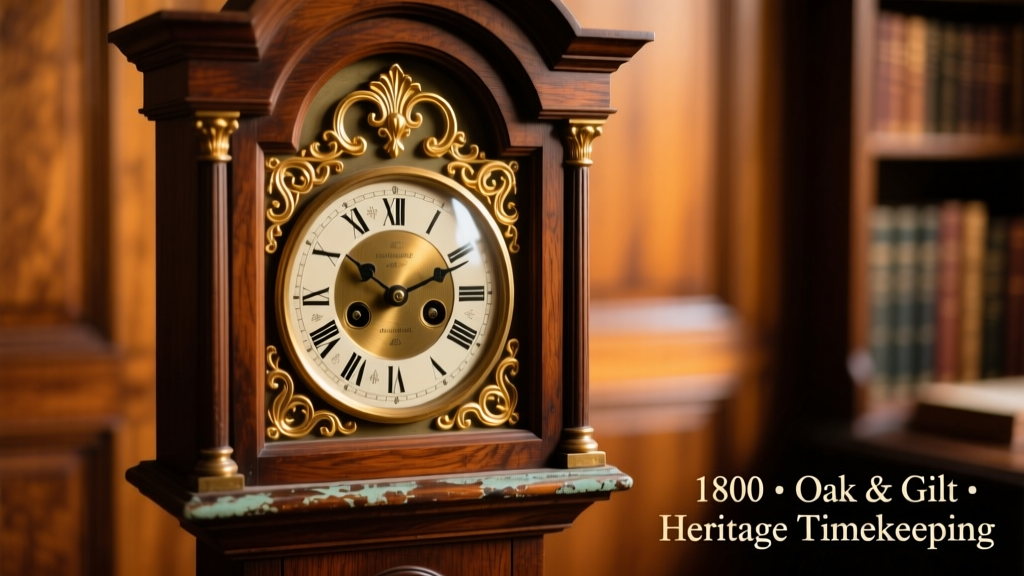
Tall Case Clock, English Oak, Painted Wood Dial with Gilt Spandrels, Plinth Base — Circa 1800, 87 Inches Tall
Hepplewhite Cherry Furniture Stand: A Study of the 28½-Inch Molded-Edge Drawer Design
Roseville Console Topeo Red: A Collector’s Guide to the Rarest and Most Sought-After Topeo Variant
Fostoria Fairfax Relish Dish, Two-Section Design in Topaz Glass: A Collector’s Guide to Form, Function, and Value
Royal Doulton Figurine Queen Elizabeth I HN 3099/3: Provenance, Production, and Collectibility of a Historic Ceramic Portrait
Lot 2334241: A 1958 Patek Philippe Ref. 3448 Perpetual Calendar in 18K Yellow Gold — Provenance, Technical Mastery, and Market Significance
Paper Dolls: 'First Date' — The 1944 Merrill Uncut Sheet as a Cultural Artifact and Collectible Rarity
The Dinnerware Rose a Day Plate (10½ Inches): History, Identification, and Collectibility of a Mid-Century American Icon
Prescott Antique Show Vintage Market 4: A Curator’s Report on Rare Watches, Art Deco Jewelry, and Mid-Century Collectibles