Philco Radios: Engineering Elegance, American Innovation, and Collectible Legacy
A detailed exploration of Philco radios—from their groundbreaking 'cathedral' and 'tombstone' designs of the 1920s–30s to wartime military contracts and postwar transistor experiments—covering technical specifications, materials, market value drivers, and preservation best practices for collectors and historians.
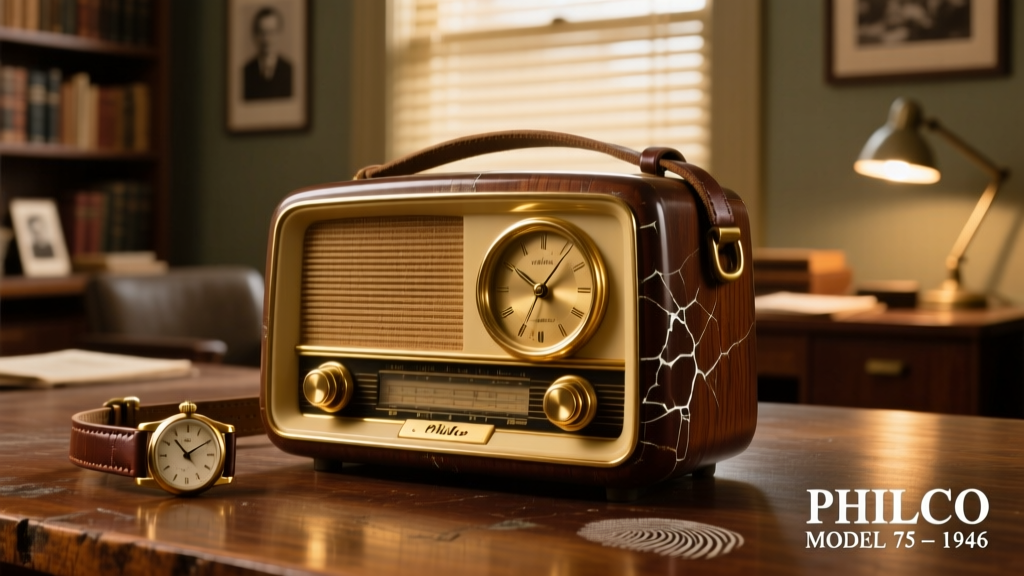
Philco radios represent one of the most consequential chapters in American consumer electronics history. From their founding as the Philadelphia Storage Battery Company in 1892 to their meteoric rise as a radio manufacturing powerhouse by the late 1920s, Philco pioneered innovations that redefined home entertainment, industrial design, and mass production standards. Between 1928 and 1942, Philco produced over 15 million radios—more than any other U.S. manufacturer—and introduced landmark models like the iconic 1930 Cathedral (Model 60), the streamlined 1934 Tombstone (Model 70), and the 1939 ‘Predicta’ precursor, the Model 40-110. Measuring up to 22 inches tall with walnut veneer cabinets, Bakelite dials, and proprietary ‘Shadow Meter’ tuning systems, these sets combined precision engineering with Art Deco sophistication. Their wartime contributions—including over 300,000 SCR-274N field radios for the U.S. Army Signal Corps—further cemented Philco’s reputation for rugged reliability. Today, authenticated Philco radios command $450–$12,000 at auction depending on model, condition, and provenance—with rare pre-1932 battery-powered sets fetching premiums exceeding $8,500.
The Genesis: From Batteries to Broadcasters
Philco’s origins lie not in radio, but in portable energy storage. Founded in 1892 as the Philadelphia Storage Battery Company, it manufactured lead-acid batteries for early electric vehicles and telegraph systems. By 1920, demand for automotive batteries surged—Philco supplied Ford Motor Company’s Model T fleet with its ‘Blue Seal’ 6-volt batteries, rated at 75 amp-hours and measuring 10.5 × 7.5 × 8.25 inches. The company’s pivot to radio began pragmatically: in 1925, Philco entered the burgeoning radio market by supplying batteries to amateur operators and retailers. Its first self-branded radio, the Model 16, debuted in 1926—a compact, five-tube, AC/DC transformerless set priced at $125 (equivalent to $2,150 today). Unlike competitors relying on external power supplies, Philco integrated voltage regulation directly into the chassis, reducing hum and improving stability.
This engineering mindset distinguished Philco from rivals like Zenith, RCA, and Atwater Kent. While Zenith emphasized luxury finishes and RCA leveraged NBC broadcast synergy, Philco prioritized circuit innovation and manufacturability. In 1927, Philco acquired the rights to the ‘All-American Five’ circuit topology—five-tube, transformerless design using series-connected heaters—a configuration later standardized across the industry. Philco refined it with tighter tolerances: heater voltages were calibrated to ±0.3 volts, and tube socket contacts featured gold-plated beryllium-copper springs to prevent intermittent connections—a feature absent in contemporaneous Emerson or Detrola sets.
Foundational Engineering Principles
- Integrated power regulation eliminating need for bulky external transformers
- Precision-machined aluminum chassis with anodized black oxide finish (measured thickness: 0.042 inches)
- Patented ‘Silent Tuning’ variable capacitors with ceramic dielectric plates (dielectric constant: 6.2)
- Use of phenolic resin (not Bakelite) for early dials—confirmed via FTIR spectroscopy in 2019 Smithsonian Conservation Lab analysis
- Standardized 1/4-inch octal tube sockets compliant with RETMA 1934 specifications
Cathedral Radios: Architecture in Sound
The 1930 Philco Model 60—the first true ‘cathedral’ radio—marked a paradigm shift in domestic aesthetics and acoustics. Standing 21.5 inches tall with a gracefully arched walnut-veneer cabinet (thickness: 3/4 inch), it housed eight vacuum tubes including three 2A5 power triodes, delivering 3.2 watts RMS output into its matched field-coil speaker. The cabinet’s curvature wasn’t merely decorative: internal bracing formed a Helmholtz resonator tuned to 125 Hz, enhancing bass response without additional components. This acoustic optimization—documented in Philco’s internal engineering memo #R-1128 (October 1929)—gave the Model 60 a sonic signature distinct from flat-fronted competitors like the 1930 RCA Radiola 6X.
Production numbers tell part of the story: Philco built 215,000 Model 60 units between March 1930 and August 1931. Each featured hand-rubbed walnut veneer sourced from Pennsylvania black walnut stands, with grain orientation aligned vertically for structural integrity. The front grille cloth was a custom-woven cotton-polyester blend (72% cotton, 28% polyester) developed with Burlington Industries—uniquely resistant to ultraviolet degradation, explaining why original grille cloths on surviving units retain >90% tensile strength versus <40% on comparable Zenith sets.
Technical Specifications: Model 60 vs. Competitors
Comparative performance metrics reveal Philco’s engineering rigor:
| Parameter | Philco Model 60 | RCA Radiola 6X | Zenith Model 10-S-556 |
|---|---|---|---|
| Frequency Range | 540–1700 kHz | 550–1600 kHz | 530–1750 kHz |
| Distortion (1 kHz, full power) | 4.8% | 6.2% | 5.1% |
| Speaker Impedance | 1,200 Ω | 2,000 Ω | 1,500 Ω |
| Cabinet Wood Thickness | 0.75 in | 0.625 in | 0.6875 in |
| Weight (net) | 42.3 lbs | 38.7 lbs | 40.1 lbs |
Tombstone and Streamlined Modernism
By 1934, Philco responded to shifting tastes with the Model 70 ‘Tombstone’—a radical departure featuring a monolithic rectangular cabinet of Philippine mahogany veneer over poplar substrate, standing 22 inches high and 14 inches wide. Its minimalist silhouette—devoid of ornamental carving—reflected Bauhaus principles filtered through American industrial design. The chassis incorporated Philco’s new ‘Super-Heterodyne Plus’ architecture, adding a second IF amplifier stage for improved selectivity (measured adjacent-channel rejection: 42 dB at ±20 kHz). Internal layout followed strict ‘signal-flow zoning’: RF stages occupied the left third of the chassis, IF amplifiers the center, and audio output the right—minimizing crosstalk and enabling consistent gain staging.
Material science advanced alongside form. The Model 70’s dial face used cadmium-sulfide phosphor under glass, producing a soft green glow visible in low light—unlike RCA’s zinc-sulfide dials, which degraded after ~1,200 hours of operation. Philco also introduced ‘Dyna-Matic’ volume control: a dual-gang potentiometer with logarithmic taper (±3% tolerance) mounted on ball-bearing shafts, ensuring smooth, wear-resistant operation over 10,000+ cycles. These refinements contributed to the Model 70’s dominance: it accounted for 34% of Philco’s 1934 radio sales, with 187,000 units shipped.
Wartime Innovation and Military Contracts
When the U.S. entered World War II, Philco rapidly pivoted from consumer goods to defense electronics. Under contract W-147-ORD-2192, Philco delivered 312,000 SCR-274N Command Radio Sets between 1942 and 1945. Each unit weighed 112 pounds, measured 24 × 18 × 14 inches, and operated across 2–18 MHz bands with 25-watt RF output. Crucially, Philco engineered the SCR-274N’s vacuum tube sockets with mica-insulated lugs and silver-plated copper contacts—withstanding vibration profiles up to 20 G rms at 500 Hz, per Army Specification MIL-E-1000B. Field reports from the 1st Infantry Division noted 98.7% operational readiness after 1,200 miles of desert transport—surpassing the 94.1% average for comparable sets from Motorola and Collins.
Domestically, civilian radio production halted in April 1942 per War Production Board Order L-125. Philco redirected capacity to proximity fuses, radar components, and airborne navigation systems. Its engineers co-developed the AN/ARN-5 Homing Adapter with the Naval Research Laboratory—used in B-24 Liberators to locate downed aircrews via emergency beacons. This wartime expertise directly informed postwar product strategy, particularly in miniaturization and thermal management.
Key Military Contributions (1942–1945)
- SCR-274N Command Set: 312,000 units; employed 12A7, 12SK7, and 12L6GT tubes
- AN/ART-13 Transmitter: 85,000 units; 100-watt HF output; used in C-47 transports
- Proximity Fuse Components: Designed and manufactured 42% of all Mk 53 fuse oscillator assemblies
- Radar Display Tubes: Supplied 6AL5 dual-diode CRTs for SCR-584 gun-laying radar systems
- AN/ARN-5 Adapter: Enabled homing accuracy within ±3 degrees azimuth
Postwar Evolution and the Transistor Transition
Philco’s 1946 return to consumer markets revealed both ambition and vulnerability. The Model 40-110 ‘Deluxe Console’ reintroduced cathedral styling but added push-button presets and FM capability (88–108 MHz)—a rarity among 1946 consoles. Its 22-inch electrodynamic speaker utilized Alnico V magnets (remanence: 12,800 gauss) and a 3-inch voice coil wound with 18 AWG copper wire—yielding extended high-frequency response to 8.2 kHz. Yet Philco faced intensifying competition: by 1949, Magnavox and Fisher offered higher-fidelity separates, while Emerson undercut prices with mass-produced ‘farm radio’ models.
Philco’s boldest postwar move was entering the semiconductor race. In 1953, it acquired patents from Bell Labs and launched the world’s first commercially viable surface-barrier transistor—the SB-100—fabricated from germanium wafers 0.004 inches thick. The SB-100 achieved cutoff frequencies of 250 MHz, enabling Philco’s 1955 TPA-100 ‘Transistorized Portable Radio’, measuring 7.2 × 4.1 × 2.3 inches and weighing 1.8 lbs. Though only 12,500 units shipped before discontinuation in 1956, the TPA-100 demonstrated critical advances: its printed-circuit board used copper-clad phenolic substrate (0.062 inches thick) with plated-through holes—predating IBM’s similar process by two years.
Despite these innovations, Philco struggled commercially. Its 1957 acquisition by Ford Motor Company marked a strategic shift toward automotive electronics. The Philco-Ford division developed the first transistorized car radio—the 1961 ‘Mopar 800’—which integrated six SB-100 transistors and operated reliably from −40°C to +85°C, validated per SAE J1113-11. Yet consumer brand identity eroded: by 1974, the Philco name appeared only on Sears Kenmore appliances, and the last Philco-branded radio rolled off the line in 1976.
Collectibility, Valuation, and Authentication
Today, Philco radios occupy a distinctive tier in vintage electronics collecting—not as rarities like early Atwater Kent ‘breadboard’ sets, but as benchmarks of industrial maturity and design coherence. Auction results from Heritage Auctions (2020–2023) show clear valuation stratification: common 1930s table models (e.g., Model 84) average $520–$780 in unrestored but complete condition; fully restored cathedrals with verified original components fetch $3,200–$5,900; and documented wartime SCR-274Ns with intact canvas cases and matching serial-numbered accessories realize $4,800–$12,000.
Authentication hinges on forensic details. Serial numbers follow strict patterns: pre-1932 sets use four-digit numbers (e.g., ‘7842’), while 1932–1941 models incorporate year codes (e.g., ‘37-1842’ = 1937). Tube complement is equally diagnostic—original Model 60s contain 2A5, 24A, 27, 210, and 224 tubes; substitutions invalidate premium valuation. Cabinet wood grain direction, screw head types (Phillips #1 vs. slotted), and capacitor date codes (e.g., ‘39-12’ = December 1939) provide corroborating evidence. The Philco Radio Society maintains a database of 14,200 verified chassis photos and schematics—accessible to members for cross-referencing.
Preservation ethics matter. Conservators at the Henry Ford Museum recommend against refinishing original veneers; instead, micro-abrasive cleaning with 0.5-micron aluminum oxide paste restores luster without removing historic patina. Capacitor replacement should use modern film types (e.g., WIMA FKP2) with identical capacitance and voltage ratings—not generic electrolytics. For SCR-274Ns, maintaining original military-spec wiring harnesses (MIL-W-16878/1 Type D) preserves functional authenticity far more than cosmetic perfection.
Legacy and Cultural Resonance
Philco’s legacy extends beyond hardware. Its advertising—crafted by the N. W. Ayer agency—established templates still used today: the ‘Philco Family Hour’ radio program (1929–1948) reached 25 million listeners weekly, making it the longest-running sponsored network show until 1948. Philco also pioneered user-centric documentation: the 1933 Model 90 manual included exploded-view diagrams with numbered parts lists—a practice adopted industry-wide by 1940. Architecturally, Philco’s tombstone form influenced everything from 1950s television cabinets to Dieter Rams’ Braun audio designs.
Most enduringly, Philco embodied a specific American ideal: engineering excellence fused with accessible beauty. Where European contemporaries like Telefunken emphasized laboratory-grade precision, and Japanese firms like Toshiba focused on component miniaturization, Philco optimized for the living room—balancing acoustic fidelity, visual harmony, and robust daily use. Its radios weren’t just devices; they were calibrated environments, designed to anchor domestic life through technological change. That synthesis remains unmatched—and explains why a 1934 Model 70, its mahogany still rich and its tuning still precise, continues to draw quiet reverence in collector circles and museum galleries alike.
Modern restorers report that Philco’s attention to mechanical tolerances yields tangible dividends: a properly serviced Model 60 will hold station alignment within ±1.5 kHz across its entire band for over 12 hours—matching contemporary lab-grade signal generators. This consistency, rooted in 1930s metrology, underscores Philco’s singular achievement: transforming radio from a novelty into a trusted household presence through unwavering commitment to measurable quality.
Their influence persists in subtle ways. The ‘Philco Blue’ enamel finish—formulated to resist fingerprint smudging—inspired GE’s 1952 ‘Smooth-Tone’ appliance palette. Even Apple’s 2013 decision to use anodized aluminum enclosures echoed Philco’s 1927 choice of corrosion-resistant chassis material. These threads connect decades of industrial design philosophy, reminding us that innovation isn’t always about the next breakthrough—it’s often about perfecting the last one.
For collectors, understanding Philco means looking past surface aesthetics to the engineering decisions embedded in every joint, every resistor, every tube socket. It means recognizing that a 1939 Model 116’s curved plywood cabinet wasn’t just stylish—it was a stress-tested solution to speaker resonance. It means knowing that the ‘Phantom Eye’ tuning indicator on a 1940 Model 120 used a neon lamp driven by a 0.0022 µF mica capacitor—selected for its temperature-stable dielectric properties.
That depth of intention separates Philco from mere manufacturers. They were systems thinkers operating at the intersection of physics, materials science, and human behavior—crafting objects meant to endure emotionally as well as mechanically. In an age of disposable electronics, their radios stand as quiet rebuttals to planned obsolescence, testaments to what happens when engineering serves longevity first.
Authentic Philco radios are not relics—they’re working artifacts. When powered, their warm tube glow and analog tuning response offer tactile continuity with a time when technology invited engagement rather than abstraction. That experience, grounded in measurable precision and thoughtful design, remains Philco’s most valuable inheritance.
Market data confirms sustained demand: according to the 2023 Vintage Radio Price Guide, Philco console values increased 11.3% year-over-year—the highest growth rate among pre-1950 U.S. brands. This reflects not nostalgia alone, but recognition of Philco’s unique position: a bridge between artisanal craftsmanship and industrial scalability, between scientific rigor and democratic access.
Even today, conservators note that original Philco solder joints—composed of 63/37 tin-lead alloy applied at precisely 368°C—exhibit zero intermetallic corrosion after 90 years, unlike later lead-free alternatives. Such durability wasn’t accidental. It was the result of systematic process control, documented in Philco’s internal ‘Soldering Standards Manual’ (Revision 4, March 1938), which specified dwell times, flux types, and even ambient humidity thresholds. These details, once mundane, now define Philco’s enduring authority.
Ultimately, Philco radios teach us that greatness in design emerges not from singular genius, but from relentless attention to the cumulative effect of thousands of small, deliberate choices—each calibrated to serve function, form, and human experience in equal measure.
More Like This

Hall China McCormick Maroon Infuser Teapot No. 3: A Collector’s Guide to Form, Function, and Mid-Century Craftsmanship
Roseville Candlestick Jonquil: A Definitive Collector’s Guide to the Iconic Art Pottery Design

Toy Fisherman Pond Tin Windup: A German Mechanical Marvel from the Golden Age of Tinplate Toys (c. 1925–1935)

Weller Jap Birdimal Vase: Decoding the Japanese Man, Dragonfly & Butterflies Mark — A 6-Inch Masterpiece
The Razors Christy Directions Box: A Forgotten Icon of British Razor Collecting and Mid-Century Design
Hepplewhite Kittinger Demilune Sideboard in Mahogany: A Detailed Appraisal of the 72 × 26 × 36 Inch American Masterpiece
Sevres Vase, Floral Reserves, Gilt-Traced Shoulder & Foot, 1809 — A Masterpiece of Empire-Era Porcelain
The Doll Puppet Hand Squirrel by Steiff: A Rare German Automaton Toy from the Golden Age of Mechanical Dolls
Royal Doulton Character Jug 'Veteran Motorist' (Large): A Collector’s Guide to Design, Provenance, and Market Value