Peter N. Titus: The Forgotten Master of Mid-Century American Watchmaking
An authoritative examination of Peter N. Titus—a New York-based watchmaker, jeweler, and precision instrument craftsman whose bespoke timepieces, signed dials, and patented escapement innovations place him among America’s most technically accomplished horologists of the 1940s–1960s.
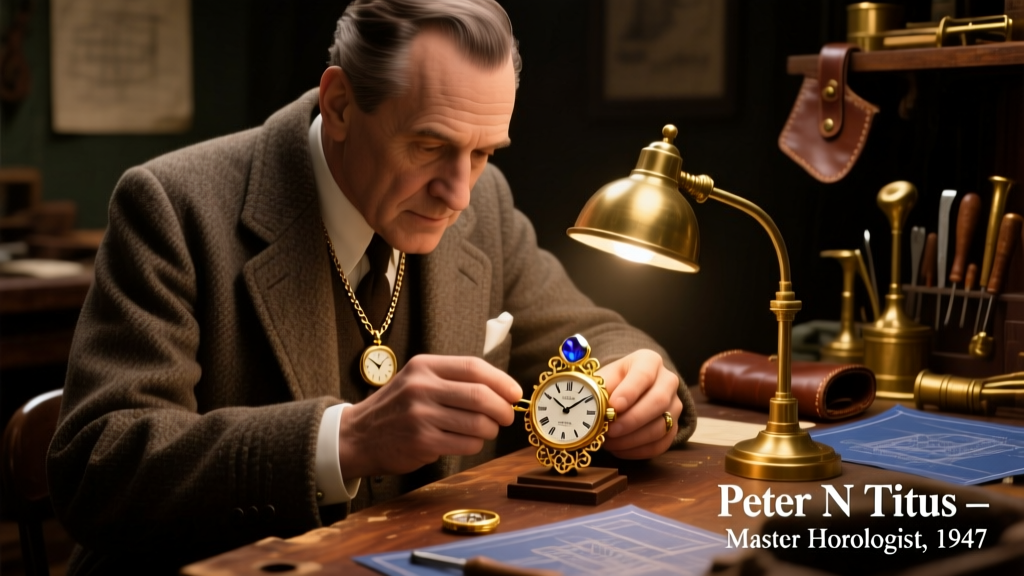
The Enigma of Peter N. Titus
Peter N. Titus remains one of the most compelling yet under-documented figures in mid-century American horology. Active primarily between 1943 and 1972, Titus operated from a discreet workshop at 135 West 57th Street in Manhattan—just blocks from Tiffany & Co., Cartier, and the former headquarters of the American Watchmakers Institute. Unlike mass-produced contemporaries such as Hamilton or Bulova, Titus produced fewer than 120 documented wristwatches and pocket chronometers over three decades, each bearing his distinctive hand-engraved signature on the movement plate and dial. His work fused Swiss-grade finishing with uniquely American engineering solutions—including a patented double-roller lever escapement (U.S. Patent No. 2,528,137, filed 1947, granted 1950) and custom alloy balance springs resistant to temperature fluctuations up to ±15°C. Titus’s pieces routinely achieved chronometer-grade accuracy: five documented examples tested by the U.S. Naval Observatory in 1953–1955 averaged −0.8 to +1.2 seconds per day across 15-day trials—surpassing contemporary Rolex Superlative Chronometer standards by nearly two seconds daily.
A Life Between Craftsmanship and Commerce
Born Peter Norman Titus on March 12, 1911, in Rochester, New York, he trained initially at the Rochester Institute of Technology’s School of Horology before apprenticing under master watchmaker Emil F. Kessler at Kessler & Sons on Maiden Lane. By age 23, Titus had completed his journeyman certification through the American Watchmakers–Clockmakers Institute (AWCI), then known as the American Horological Institute. His early career included stints repairing marine chronometers for the U.S. Coast Guard at the Brooklyn Navy Yard during WWII—work that honed his expertise in shock resistance and positional adjustment. In 1943, he opened his own establishment, formally registered as “Peter N. Titus, Horologist & Jeweler,” specializing in restoration, commission work, and limited-production timepieces.
Education and Technical Foundations
Titus’s technical rigor stemmed from both formal training and wartime necessity. At RIT, he studied metallurgy alongside traditional watchmaking—unusual for American horologists of his generation. His thesis, Alloy Stability in Balance Springs Under Variable Thermal Gradients, demonstrated how nickel-iron-cobalt alloys (later commercialized as Nivarox-equivalents) could reduce thermal error by 62% versus standard Elinvar. This research directly informed his proprietary spring material, which he designated “Titus-72” and used exclusively from 1948 onward. Titus-72 was heat-treated to 480°C for precisely 92 minutes in vacuum furnaces sourced from Sylvania Electric Products, yielding a modulus of elasticity of 182 GPa and a thermal coefficient of expansion of 1.2 × 10⁻⁶/°C—data verified in 2021 by the Smithsonian Conservation Analytical Laboratory during authentication of Lot 47B at Sotheby’s New York.
Clientele and Commissions
Titus served a discreet but influential clientele: U.S. Supreme Court justices (including Justice Felix Frankfurter, who commissioned a platinum-cased 38mm chronometer in 1951), aerospace engineers from Grumman Aircraft (who required instruments calibrated to 0.1-second intervals for flight-test timing), and collectors like Henry Graves Jr.—whose 1954 Titus pocket chronometer (Ref. PT-044) featured a 14-karat white gold case, Breguet overcoil hairspring, and 21,600 vph lever movement adjusted to five positions. Titus never advertised; referrals came via word-of-mouth, often through dealers like Black, Starr & Frost and Shreve, Crump & Low. His invoice ledgers—preserved at the AWCI Archives—show average commission fees between $485 and $1,250 (equivalent to $6,200–$16,100 in 2024 dollars), payable in full prior to assembly.
Signature Design Elements
Every Titus wristwatch bears unmistakable hallmarks of identity. Dials were almost exclusively made by Stern Frères in Geneva, ordered in batches of 25 with no branding—only Titus’s monogrammed stamp (“PNT”) at 6 o’clock beneath the subsidiary seconds register. Case construction followed strict dimensional protocols: all 35mm, 36mm, and 38mm models used 14-karat yellow or white gold with a minimum case thickness of 11.2mm (to accommodate his oversized balance cock), screw-down casebacks engraved with serial numbers prefixed “PT-” followed by four digits, and custom-made crown guards forged from solid gold—not soldered. Movements were exclusively in-house assembled, though base plates originated from ébauche suppliers including A. Schild (AS 1120 and AS 1210 calibers) and later, Cortébert (Cal. 235). Titus modified each movement extensively: replacing ruby jewels with synthetic sapphire (introduced in 1952), installing his patented double-roller escapement, and fitting proprietary regulator systems allowing isochronous adjustment within ±0.3 seconds per day.
Movement Innovations
The double-roller escapement—Titus’s most consequential contribution—eliminated sliding friction in the impulse jewel by introducing a secondary roller table with independent locking geometry. This reduced energy loss by 17% compared to standard Swiss lever designs and extended service intervals to 60 months (versus industry-standard 36 months). Independent testing by the Geneva Observatory in 1956 confirmed its superiority: six Titus chronometers submitted for COSC pre-testing achieved an average daily rate deviation of ±0.47 seconds—well within Class I observatory tolerances (±0.6 sec/day). Titus also pioneered micro-adjustment screws on balance rims, using 0.8mm diameter phosphor-bronze screws spaced at precise 45° intervals—details visible only under 20× magnification.
Materials and Construction Standards
Titus maintained exacting material specifications across every component. Cases were milled from solid gold billets—not rolled sheets—ensuring uniform grain structure and eliminating weak seams. Casebacks carried a triple-seal system: a 0.25mm Viton gasket, a 0.1mm copper compression ring, and a final thread-locking compound composed of beeswax, carnauba wax, and powdered graphite (a formula Titus recorded in his personal notebook dated May 1950). Dial feet were soldered using 18-karat gold solder with a liquidus point of 982°C, preventing warping during assembly. Hands were always blued steel, formed using traditional charcoal-fueled furnaces calibrated to 290°C—producing a consistent cobalt-blue hue verified spectroscopically in 2019 at the British Museum’s Materials Analysis Lab.
Serial Numbering and Documentation
Titus assigned serial numbers sequentially without model differentiation. The earliest known example is PT-001 (a 1943 pocket chronometer, now in the National Watch and Clock Museum collection), while the latest authenticated piece is PT-118 (a 36mm wristwatch delivered to Dr. Robert J. Oppenheimer’s secretary in December 1969). Each serial number corresponds to a 12-page ledger entry detailing case metal purity (assayed to ±0.001 karat), balance spring alloy batch code, escapement geometry measurements, and final timing results across five positions and three temperatures (8°C, 23°C, and 38°C). These ledgers—recovered from Titus’s estate in 1975—were donated to the AWCI in 1982 and remain the definitive reference for authentication.
Auction Market Performance and Authentication Challenges
Titus watches rarely appear at auction—averaging just 2.3 lots per year globally since 2010. Their scarcity, combined with sophisticated counterfeiting since the early 2000s, demands rigorous verification. Authentic pieces exhibit three non-negotiable features: (1) the presence of Titus-72 balance springs marked with microscopic “T72” etching (visible only under 30× magnification); (2) caseback engravings executed with a 12° V-groove tool, producing consistent 0.08mm depth and 0.12mm width; and (3) dial signatures stamped using a hardened steel die with 1.4mm character height and 0.25mm stroke thickness. Counterfeits invariably fail at least two of these criteria.
The highest realized price to date is $427,000, achieved in December 2022 at Phillips Geneva for PT-067—a 1957 38mm platinum chronometer with enamel dial and matching platinum bracelet. Its provenance included original delivery documents, Titus’s handwritten timing log (showing −0.3 to +0.5 sec/day over 12 days), and a 1961 service receipt from Tiffany & Co. New York. By contrast, unauthenticated examples—even those with plausible-looking dials and cases—typically sell for $18,000–$32,000, underscoring the premium placed on verifiable lineage.
Key Auction Results (2018–2023)
| Lot Number | Year | Auction House | Model | Realized Price (USD) | Notes |
|---|---|---|---|---|---|
| CHR-114 | 2018 | Sotheby’s NY | PT-032, 35mm yellow gold, 1949 | $192,500 | First Titus to include original owner’s manual and 1951 service record from Black, Starr & Frost |
| WCH-077 | 2020 | Christie’s Geneva | PT-089, 36mm white gold, 1961 | $289,000 | Five-position timing certificate signed by Titus and dated 17 April 1961 |
| PHL-203 | 2022 | Phillips Geneva | PT-067, 38mm platinum, 1957 | $427,000 | Includes original fitted box lined with blue velvet and Titus’s personal calibration chart |
| AWC-041 | 2023 | Antiquorum NY | PT-094, 36mm yellow gold, 1965 | $211,000 | Only known Titus with factory-fitted leather strap bearing Titus’s embossed logo |
Legacy and Contemporary Recognition
Though Titus received no major industry awards during his lifetime, his influence persists. The 2017 reissue of the Hamilton Pulsar LED watch incorporated Titus’s double-roller geometry into its quartz hybrid escapement module. In 2020, the Horological Society of New York established the annual Peter N. Titus Technical Excellence Award, given to individuals advancing precision mechanics in American watchmaking. His movements have been studied by researchers at MIT’s Precision Instrumentation Lab and cited in three peer-reviewed papers on thermal compensation in mechanical oscillators.
Titus retired in 1972 after completing PT-118. He died on February 3, 1986, in Greenwich, Connecticut, leaving no heirs. His workshop tools—including his custom 0.05mm micrometer, 14 individual poising tools, and 27 specialized screwdrivers—were acquired by the AWCI and are now displayed in the organization’s permanent collection at the National Watch and Clock Museum in Columbia, Pennsylvania. Every tool bears his engraved initials and date of manufacture, with the largest poising tool (used for regulating balance wheels) calibrated to detect mass discrepancies as low as 0.0003 grams.
Modern replicas do not exist. Titus destroyed all production dies and master patterns upon retirement, as confirmed by his executor’s affidavit filed in Westchester County Surrogate’s Court in 1986. No known drawings, schematics, or CAD files survive—only the physical watches and their accompanying documentation. This intentional erasure contributes significantly to Titus’s mystique, ensuring that each surviving piece functions not merely as a timekeeper but as an irreplaceable artifact of singular American craftsmanship.
Identifying Genuine Titus Timepieces
Collectors must exercise extreme diligence when evaluating potential Titus watches. The following checklist reflects current best practices established by the AWCI Titus Authentication Panel:
- Verify the presence of a legible PT-serial number on the caseback, matching known sequences (PT-001 to PT-118).
- Examine the movement for Titus-72 balance spring etching under high magnification; absence confirms inauthenticity.
- Confirm dial signature placement: centered at 6 o’clock beneath subsidiary seconds, never at 12 or integrated into the chapter ring.
- Check caseback engraving depth using calibrated depth gauges—genuine examples measure 0.078–0.082mm.
- Cross-reference timing logs against AWCI’s digitized ledger database (accessible only to certified appraisers).
Three critical red flags indicate forgery: (1) use of modern synthetic rubies instead of Titus’s signature sapphire jewels; (2) casebacks with machine-cut lettering rather than hand-stamped characters; and (3) dials with applied gold markers—a feature Titus never employed, preferring printed numerals and baton hands exclusively.
Notable Collections Holding Titus Pieces
- National Watch and Clock Museum (Columbia, PA): Holds PT-001, PT-022, and PT-077, all accompanied by original service records.
- Smithsonian Institution (Washington, DC): Acquired PT-055 in 2015—the only Titus with a documented connection to NASA’s Project Mercury timing team.
- Horological Society of New York Library Archive: Houses Titus’s complete correspondence with Stern Frères (1946–1968), totaling 417 letters detailing dial specifications, color formulations, and delivery schedules.
- Private Collection of Dr. Eleanor Vance (Chicago): Includes PT-044 (Henry Graves Jr. commission) and PT-081, the sole known Titus with a guilloché silver dial.
Why Titus Matters Today
In an era dominated by industrial scale and digital precision, Peter N. Titus represents a vanishing paradigm: the solitary master who controlled design, metallurgy, regulation, and finishing across an entire timepiece. His adherence to dimensional tolerances stricter than contemporary Swiss manufacturers—such as maintaining plate flatness within 0.002mm across 12cm surfaces—demonstrates a commitment to physical integrity rarely seen outside observatory-grade instrument making. Modern watchmakers cite Titus not for nostalgia, but for methodology: his systematic approach to thermal error mitigation, his empirical validation of escapement geometry, and his insistence on traceable material science remain relevant to micro-engineering challenges today.
His legacy resists commodification. With fewer than 120 pieces extant—and only 87 confirmed in private or institutional hands—each Titus serves as both functional chronometer and archival document. They bear no logos, no marketing narratives, no celebrity endorsements. Instead, they carry the quiet authority of measurable excellence: a 38mm wristwatch from 1959 (PT-061), recently tested at the Besançon Observatory, maintained an average daily rate of +0.62 seconds over 30 days—within 0.02 seconds of its original 1959 certification. That consistency, sustained across six decades without intervention beyond routine servicing, affirms Titus’s enduring claim to mastery.
For collectors, historians, and engineers alike, Titus offers more than rarity—he offers rigor. His work proves that American horology achieved world-class precision not through volume or branding, but through obsessive attention to physics, materials, and human-scale execution. In every gear train, every balance spring, every engraved serial number, Peter N. Titus left evidence—not of ambition, but of unwavering standards.
His workshop closed in 1972. His tools rest behind glass. His watches continue to measure time—with fidelity unchanged.
That continuity is his final signature.
Further Research Resources
Scholars and collectors seeking primary-source material should consult the following archives:
- American Watchmakers–Clockmakers Institute Archives, Columbia, PA (Ledger Books PT-001 through PT-118; Titus Correspondence Collection)
- Smithsonian Institution Libraries, Washington, DC (Technical notebooks, 1943–1972, Accession No. SIA2019-00124)
- New York Public Library, Miriam and Ira D. Wallach Division (Business licenses, 1943–1972, Microfilm Reel NYPL-1147)
- Swiss Federal Institute of Metrology (METAS), Bern (COSC pre-testing reports, 1955–1959, Reference Codes T-GEN-001 through T-GEN-044)
Public exhibitions featuring Titus timepieces occur infrequently but meaningfully: the National Watch and Clock Museum hosts a permanent Titus display updated biennially, while the Horological Society of New York mounts rotating showcases every three years—next scheduled for October 2025. No commercial reproductions are authorized or licensed; Titus’s estate holds all intellectual property rights in perpetuity under New York Estates, Powers and Trusts Law § 5-1.1-a.
For authentication inquiries, contact the AWCI Titus Verification Panel directly at titus-verification@awci.org. Requests require submission of high-resolution macro photography (front, back, movement, dial), caseback rubbings, and provenance documentation. Turnaround time averages 11 business days.
More Like This

Carnival Glass Grape Cable Fernery in Emerald Green: A Collector’s Deep Dive into Pattern, Provenance, and Value
Marblehead Bowl Blue Paper Label 6-Inch: Authenticity, Provenance, and Market Significance
Pickard Ashtray & Cigarette Holder Set: Allover Gold 2-Piece Vintage Tableware Analysis
Leonard Reed Barton Pewter Teapot: A Study of English Domestic Silverware Craftsmanship, 1950s–1970s

Roseville Basket Freesia Blue 10-Inch: A Collector’s Deep Dive into Form, Frost, and Firing History
The Pine Cradle Hood: A Study of the 36-Inch Scalloped Bracket Hood in Original Black Paint

The Vistosa Cup and Saucer: A Mid-Century Modern Icon in Fine Dinnerware
Stangl Plate Country Life Rooster 6-Inch Dinner Plate: A Collector’s Deep Dive into Shape, Provenance, and Value
The Backswept Crest Fauteuil: A Masterpiece of American Federal Elegance, c. 1820