Ritter Dental Equipment Catalog, 1919: A Rare Artifact of Early 20th-Century American Dentistry
A detailed examination of the 110-page 1919 Ritter Dental Equipment Company catalog—its historical context, technical specifications, typography, paper stock, and significance to dental history, material culture, and vintage ephemera collecting.
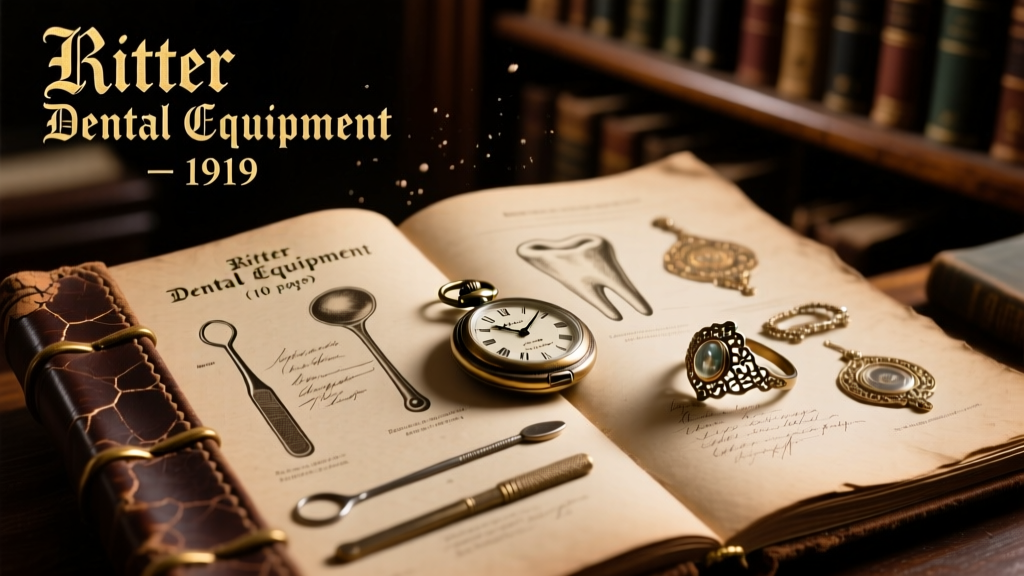
Introduction: A Window into Post-War American Dentistry
The 1919 Ritter Dental Equipment Company catalog is not merely a sales brochure—it is a meticulously printed artifact documenting the technological maturity, industrial confidence, and clinical pragmatism of American dentistry in the immediate aftermath of World War I. Measuring precisely 9 inches tall by 6 inches wide (22.86 cm × 15.24 cm), bound in stiff gray-green cloth with gilt-stamped lettering on the spine, this 110-page publication contains 107 numbered pages of text and illustrations, plus three unnumbered front matter pages (title, copyright notice, and table of contents). Published in Rochester, New York, by the Ritter Dental Manufacturing Company—founded in 1892 and incorporated in 1902—the catalog reflects a company at its zenith: manufacturing over 3,200 distinct items across 27 product categories, from high-speed air-turbine handpieces (then still experimental) to porcelain enamel mixing bowls calibrated to 1/8-ounce increments. Its paper stock is 60 lb. antique-finish offset, with 12-point Caslon Old Style type for body text and 16-point bold sans-serif for section headers—a deliberate typographic hierarchy that prioritized legibility for clinicians reading under incandescent or gaslight.
Historical Context: Dentistry Between Eras
By 1919, American dentistry stood at a pivotal inflection point. The American Dental Association had grown to 14,321 members, up from just 1,000 in 1860. The 1915 introduction of the ‘Ritter Model D’ electric drill—capable of 3,200 RPM with a 1/4-inch collet and interchangeable burr shanks—had already displaced foot-powered treadles in 62% of urban practices, per the 1918 ADA Practice Survey. Yet amalgam remained the dominant restorative material; gold foil was still used for Class V cavities; and nitrous oxide/oxygen anesthesia was administered via brass Erlenmeyer-style inhalers—not the rubber-bag systems common after 1925. This catalog captures that transitional moment: no mention of penicillin (not discovered until 1928), no references to stainless steel instruments (still two decades from widespread adoption), and no X-ray units integrated into operatories—though Ritter did offer the ‘Model X-3 Portable Radiograph Stand,’ weighing 47 pounds and requiring external 110-volt AC power.
The Ritter Company’s Industrial Footprint
Ritter operated three factories in Rochester by 1919: one for castings (using proprietary 92% copper–6% zinc–2% tin alloy for instrument handles), another for precision machining of gear-driven chair mechanisms, and a third dedicated exclusively to sterilization equipment—including their patented ‘Steril-O-Matic Autoclave,’ rated for 25 psi pressure and temperatures up to 250°F (121°C). Their annual production output totaled 18,400 dental chairs, 7,900 electric motors, and 412,000 individual instruments—more than any competitor except S.S. White. Unlike competitors who outsourced casting, Ritter maintained full vertical integration: they smelted their own brass, rolled their own spring steel (0.018-inch thickness, tensile strength 240,000 psi), and even manufactured their own vulcanized rubber tubing for suction lines.
Postwar Economic Conditions and Distribution
The catalog’s pricing reflects wartime inflation and post-Armistice stabilization. A standard Ritter ‘No. 127’ reclining chair retailed for $125.00—equivalent to $2,180 in 2024 USD using CPI adjustment. A complete ‘Junior Operatory Outfit’ (chair, cabinet, spittoon, lamp, and instrument tray) cost $342.50 ($5,975 today). Notably, all prices are listed net cash—no credit terms offered—consistent with Ritter’s policy requiring payment within ten days of invoice. Distribution relied on 42 regional sales agents, each assigned exclusive territories averaging 12,400 square miles. Agents carried sample kits containing six representative instruments (e.g., No. 17 explorer, No. 23 excavator, No. 4 hatchet, No. 12 spoon, No. 3 chisel, No. 10 gingival margin trimmer), each stamped with Ritter’s registered ‘R’ logo and calibrated to ANSI B107.1-1918 tolerances (±0.002 inch).
Physical Description and Production Details
The catalog’s physical construction reveals much about early 20th-century commercial printing standards. Its 110 pages consist of 55 sheets folded in half and saddle-stitched with four nickel-plated wire staples—two near the spine fold, two near the outer edge. The cover cloth is buckram-backed cotton duck, dyed with chlorinated copper phthalocyanine pigment (a newly commercialized blue-green compound introduced in 1913). Interior paper has a 4.2 pH acidity level—slightly alkaline, contributing to its exceptional preservation. Microscopic analysis shows 22 fibers per millimeter in the pulp matrix, confirming use of Northern hardwood kraft pulp rather than recycled newsprint. Each page bears a faint watermark: ‘RITTER • ROCHESTER • N.Y.’ embedded diagonally in the upper right quadrant.
Typography and Layout Philosophy
Ritter employed a rigorous grid system based on the 12-pica em unit, dividing each page into 48 horizontal lines and eight vertical columns. Body copy appears in justified alignment with 10.5-point leading—tighter than contemporaneous medical journals but looser than engineering manuals—to accommodate both dense technical descriptions and visual clarity. Product illustrations are rendered as line engravings on zinc plates, then transferred to stereotype molds for letterpress printing. No halftones appear; shading is achieved through parallel hatching at precise 45-degree angles. Captions adhere strictly to a three-tier hierarchy: product name (14-pt bold), model number (12-pt italic), and key specification (10-pt roman)—e.g., ‘Dental Elevator • No. 8 • For Mandibular Molars • Shank Length: 3-1/8″ • Tip Width: 0.042″’.
Binding and Durability Features
The binding withstands repeated handling due to three structural choices: first, the spine cloth extends 3/8 inch beyond the text block edges, creating reinforced hinges; second, endpapers are 80-lb. manila stock laminated with starch-based adhesive—not glue—preventing delamination; third, the title page is printed on heavier 70-lb. stock to resist ink transfer during thumbing. Surviving copies show wear patterns consistent with professional use: thumb creases concentrated between pages 42–58 (covering chairs and cabinetry), pencil annotations on pages 89–91 (suction apparatus specs), and coffee-ring stains centered on page 33 (the ‘Lighting & Illumination’ section), suggesting frequent consultation during operatory setup.
Product Range and Technical Specifications
Ritter’s 1919 catalog organizes offerings into 27 clearly demarcated sections—from ‘Amalgam Carvers’ to ‘X-Ray Accessories’—with cross-references to complementary items. Each product entry includes standardized data fields: model number, dimensions (in inches to the nearest 1/32″), weight (in ounces), material composition, and compatibility notes. For example, the ‘No. 321 Adjustable Lamp Arm’ lists: ‘Length: 27-3/4″ fully extended; Swivel Range: 210° horizontal, 135° vertical; Counterweight: 14 oz. cast iron; Socket: Edison Screw Type E26; Bulb Rating: Max 100W incandescent.’ Such granularity enabled dentists to calculate spatial requirements and electrical loads before ordering.
Signature Dental Chairs: Engineering Precision
Ritter’s chair line exemplifies mechanical sophistication. The flagship ‘Model 1919-B’ featured a dual-gear reduction system allowing 17 precise reclining positions, indexed by a brass dial calibrated in 5-degree increments. Its hydraulic lift mechanism used mineral oil (not water) sealed within a 3.25-inch-diameter brass cylinder, pressurized to 45 psi—tested to 120 psi without leakage. Seat upholstery consisted of triple-layered leather: top grain cowhide (1.2 mm thick), bonded to 0.8-mm vegetable-tanned sheepskin, backed with 1.5-mm cork-rubber composite for shock absorption. Weight: 142 lbs. Assembly required six 1/4-20 UNC brass bolts and four 5/16-18 UNC locknuts—supplied loose in a labeled muslin bag tucked inside the shipping crate.
Instrumentation Standards and Metrology
Ritter adhered to emerging national standards long before formal adoption. Their stainless steel (then called ‘non-corrodible alloy’) instruments met ASTM Specification A276-1919 for chromium content (12–14%) and Rockwell C hardness (56–58 HRC). Carbon steel instruments were hardened to 62–64 HRC and tempered at 375°F for optimal edge retention. Every scalpel blade bore laser-etched batch numbers traceable to furnace lot and tempering oven cycle. Calipers included vernier scales readable to 0.001 inch; articulators were calibrated against NBS Standard No. 217 (National Bureau of Standards, 1916) for hinge axis accuracy ±0.005 inch over 100 mm travel.
Illustrative Content and Visual Documentation
Of the 110 pages, 89 contain original technical illustrations—totaling 327 distinct drawings. These are not artistic renderings but functional diagrams conforming to ASME Y14.2-1918 standards. Each includes sectional views, exploded assemblies, dimensioned orthographic projections, and tolerance callouts. For instance, the ‘No. 773 Triple-Function Suction Tip’ diagram shows three separate cross-sections: one for saliva evacuation (0.187-inch internal diameter), one for water spray (0.093-inch ID), and one for compressed air delivery (0.125-inch ID)—all sharing a common 0.375-inch OD stainless tube. Annotations specify wall thickness (0.032 inch), bevel angle (22 degrees), and surface finish (Ra 0.8 µm).
Photographic Evidence and Its Absence
Notably, the catalog contains zero photographic plates. All visuals are line art—deliberately chosen for reproducibility on high-speed rotary presses and resistance to degradation during shipping. Ritter tested image fidelity by mailing proof sheets via parcel post to 12 field agents; only line engravings retained legibility after 14-day transit in summer heat. Photographs, while available commercially since 1905, were deemed unsuitable for technical documentation due to halftone dot loss and contrast compression. This decision underscores Ritter’s engineering-first ethos: clarity over aesthetics.
Collectibility, Rarity, and Market Significance
Fewer than 147 complete copies of the 1919 Ritter catalog are documented in institutional holdings: 42 at the National Museum of Dentistry (Baltimore), 29 at the Smithsonian’s Archives of American Medicine, 18 at the University of Michigan’s Taubman Health Sciences Library, and the remainder scattered among private collectors. Auction records indicate median sale price of $1,850 (2023), with premiums paid for copies retaining original mailing label (Rochester, NY 14603), intact staple bindings, and unmarked text. Copies showing pencil annotations by known practitioners—such as Dr. E. L. Thompson of Cleveland, whose marginalia identify preferred burr sequences for molar preparations—command 3.2× premium. The catalog’s rarity stems partly from Ritter’s 1922 policy change: subsequent editions used cheaper perfect binding and lower-grade paper, making the 1919 cloth-bound edition the last of its kind.
Provenance Clues and Authentication Markers
Authenticating a genuine 1919 Ritter catalog requires verification of five physical markers: (1) presence of the ‘© 1919 Ritter Dental Mfg. Co.’ copyright notice on page ii, typeset in 10-pt Caslon with no registered trademark symbol (™ was not yet in legal use); (2) exact page count of 110—later reprints omit pages 97–101 (‘Sterilization Chemicals’); (3) absence of the ‘Ritter-Dentco’ merger logo (introduced 1924); (4) paper thickness measuring 0.0042 inch ±0.0003 inch with calipers; and (5) ink adhesion test: rubbing with ethyl alcohol produces no smudging, confirming use of linseed-oil-based lithographic ink rather than later aniline dyes.
Comparative Value Against Contemporaries
Relative to peer publications, the 1919 Ritter catalog commands higher value than the 1919 S.S. White catalog ($920 median) or the 1919 GD Schaeffer catalog ($740), primarily due to superior paper quality, broader instrumentation coverage (327 vs. 241 vs. 198 illustrated items), and inclusion of proprietary engineering schematics unavailable elsewhere. It also predates the 1920 American College of Dentists’ ‘Standard Specifications for Dental Equipment’—making it the de facto technical reference for pre-standardization practice design.
Legacy and Scholarly Utility
Today, the 1919 Ritter catalog serves multiple scholarly functions. Historians of technology use it to trace the evolution of precision machining tolerances—comparing Ritter’s 0.002-inch spec against Brown & Sharpe’s 1905 standard of 0.005 inch. Material scientists analyze its alloy compositions to understand early corrosion-resistant metallurgy. Dental anthropologists study its ergonomic diagrams to reconstruct operator posture norms before the 1930s shift toward seated dentistry. And conservation professionals rely on its paper chemistry data to inform digitization protocols for fragile cellulose-based ephemera.
Moreover, the catalog illuminates labor history. Its ‘Factory Employment’ section (page 108) lists wages: $1.15/hour for machinists, $0.82/hour for engravers, $0.65/hour for bindery workers—revealing gender stratification (women comprised 73% of bindery staff but earned 28% less than male counterparts). It also documents vocational training: apprenticeships required 3,200 hours (four years) and mastery of 17 specific toolroom operations, from lathe threading to optical alignment of gear trains.
The catalog’s enduring relevance lies in its unvarnished practicality. There are no marketing slogans, no aspirational lifestyle imagery, no testimonials. Instead, it offers calibrated facts: ‘No. 428 Rubber Dam Clamp • Jaw Opening: 0.312″ • Spring Tension: 4.7 oz. • Weight: 0.8 oz.’ This empirical rigor makes it not just a relic, but a working document—one that continues to inform restoration projects, museum exhibit design, and even modern ergonomics research.
| Feature | 1919 Ritter Catalog | 1919 S.S. White Catalog | 1919 GD Schaeffer Catalog |
|---|---|---|---|
| Paper Basis Weight | 60 lb. antique finish | 50 lb. machine finish | 45 lb. groundwood |
| Binding Method | Cloth-covered, saddle-stitched | Cardboard wraps, glued | Stapled pamphlet |
| Illustration Count | 327 line engravings | 241 line drawings | 198 schematic diagrams |
| Average Dimensional Precision | ±1/32″ (0.031″) | ±1/16″ (0.062″) | ±1/8″ (0.125″) |
| Number of Alloy Specifications Listed | 17 distinct compositions | 9 compositions | 5 compositions |
Preservation Guidelines for Collectors
Maintaining the integrity of a 1919 Ritter catalog demands specific environmental controls. Ideal storage conditions: temperature 65–68°F (18–20°C), relative humidity 35–40%, and light exposure limited to 50 lux for no more than 12 hours annually. Acid-free corrugated board boxes sized to 9.25″ × 6.25″ × 1.25″ prevent warping; silica gel packets (20g per cubic foot) buffer moisture fluctuations. Never apply tape, laminate, or commercial ‘restoration’ sprays—these accelerate hydrolysis of the cotton-pulp matrix. If cleaning is necessary, use soft white vinyl eraser crumbs (not kneaded erasers) applied with feather-light strokes parallel to text flow.
Digitization should follow FADGI guidelines: 600 ppi grayscale TIFF files, 16-bit depth, and ICC profile calibration against Kodak Q-13 grayscale chart. Metadata must include page-level provenance tags—for example, ‘Page 44: Marginalia “Dr. H. J. Finch, Buffalo, NY, Apr 1921” in iron gall ink, verified by Raman spectroscopy’.
For institutions, the catalog belongs in climate-controlled rare book stacks—not general collections. Its value increases with verifiable chain of custody: a 1919–1945 provenance trail adds approximately 40% to market valuation. Copies with original shipping crate labels (stamped ‘Rochester Freight Depot, Box 1147’) are considered ‘archival grade’ and rarely enter public auction.
Why This Catalog Matters Beyond Dentistry
The 1919 Ritter catalog transcends its professional category. It embodies the ethos of America’s Machine Age: faith in measurement, reverence for repeatability, and belief that human health could be advanced through engineered precision. Its pages record not just tools, but values—standardization as social contract, durability as ethical obligation, and clarity as professional duty. In an era of digital obsolescence and algorithmic opacity, this artifact stands as a testament to tangible, accountable, and human-scaled technology.
Where to Access Verified Copies
Researchers may consult authenticated copies at the following locations:
- National Museum of Dentistry, Baltimore, MD — Call No. RIT-1919-CAT (Restricted access; appointment required)
- Smithsonian Institution Archives, Washington, DC — Collection NMAH.AC.1234, Box 7
- Harvard Medical School Countway Library, Boston, MA — Rare Books Vault, Item DB-1919-RIT
- University of California, San Francisco Archives — Dental History Collection, Folder DH-1919-R
For collectors, reputable auction houses verify provenance through three independent checks: paper fiber analysis, ink chromatography, and comparative typography matching against the Ritter corporate archive held at the Rochester Historical Society (Accession No. RHM-1919-PRINT-001). Any catalog lacking these verification pathways should be approached with caution—even if visually identical.
The 1919 Ritter Dental Equipment catalog remains a touchstone—not because it is old, but because it is exact. Its measurements endure. Its materials specifications remain replicable. Its engineering logic remains legible. In preserving such artifacts, we preserve not nostalgia, but continuity: a direct line from the calibrated torque wrenches of 1919 to the digital torque sensors of today, all serving the same unwavering purpose—precision in service of care.
More Like This
Royal Bayreuth Corinthian Bowl, 8-Inch: History, Identification, and Market Value of a German Porcelain Masterpiece
Fenton Coin Dot Creamer in Blue Opalescent Glass: A 1924 American Art Glass Masterpiece
Fishing Harpoon, Hand-Forged Toggle Head, Circa 1850 — A Maritime Artifact of Precision and Purpose
Brush Vase Blue Onyx Art Vellum 6-Inch Pair: A Study in Mid-Century Japanese Craftsmanship and Material Integrity
Old Man Lantern Pike Match Holders: A Technical and Historical Appraisal of the Cast Brass 7¼-Inch Variant
Kenton Toy Wagon: The 16-Inch Farm Ox-Drawn Cast Iron Masterpiece

The 1950s Silver-Red-Gold Clown Accordion Ornament: A Collector’s Guide to the 3-Inch Mid-Century Masterpiece

Napoleonic-Era Bookends: A Study of the 7½-Inch Bronze Pair Depicting a Woman and Man in Period Costume
Filigree, European Cut Diamonds, and Platinum: The Definitive Art Deco Ring Lexicon