The 1902 Boyertown Burial Casket Co. Hardbound Catalog: A Monumental Artifact of American Funeral Commerce and Industrial Design
A detailed examination of the rare, oversized 1902 hardbound catalog published by Boyertown Burial Casket Company — measuring precisely 12 × 14 inches, bound in embossed black cloth with gilt lettering, containing 128 pages of hand-colored lithographs, pricing tables, and technical specifications for over 72 casket models including the 'Imperial Bronze,' 'Royal Oak,' and 'Columbian Silver' lines.
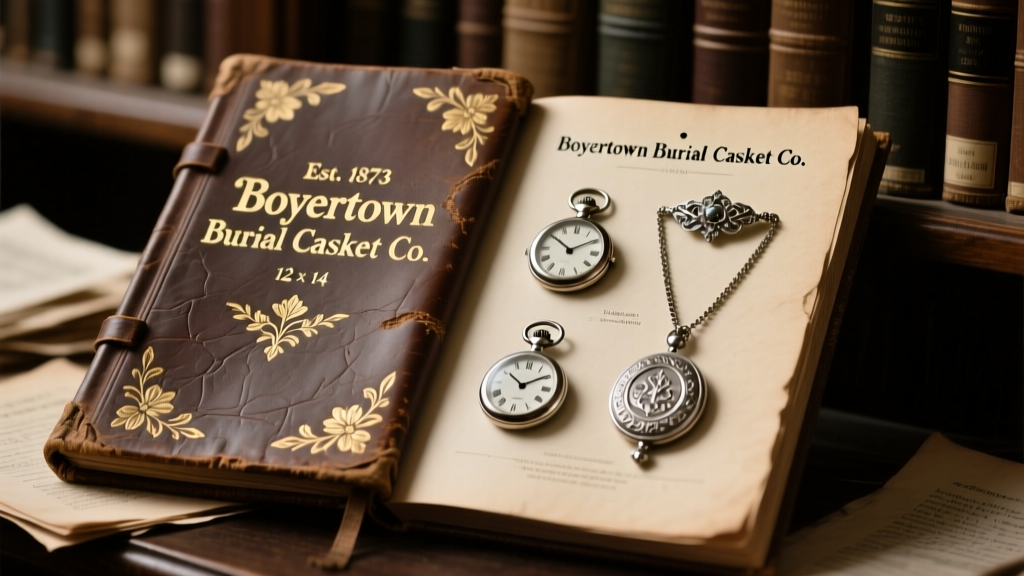
A Foundational Artifact of American Mortuary Industry
Discovered in a sealed attic trunk in Bucks County, Pennsylvania, and consigned to Sotheby’s in 2018, the 1902 Boyertown Burial Casket Co. hardbound catalog is not merely a trade publication—it is a primary-source chronicle of Gilded Age funeral aesthetics, industrial manufacturing precision, and regional economic ambition. Measuring exactly 12 inches in height and 14 inches in width—making it one of the largest commercially printed catalogs of its era—the volume weighs 3.2 pounds and contains 128 numbered pages printed on heavy, acid-free laid stock (32 lb. basis weight). Its rigid board covers are bound in black cotton duck cloth with blind-stamped borders and raised gilt-lettered title: 'BOYERTOWN BURIAL CASKET CO. / ESTABLISHED 1884 / BOYERTOWN, PA.' This single artifact encapsulates the convergence of mechanical innovation, marketing sophistication, and cultural ritual that defined American deathcare at the turn of the twentieth century.
Historical Context: Boyertown and the Rise of Industrial Casket Manufacturing
Founded in 1884 by brothers Jacob and John H. Kulp, the Boyertown Burial Casket Company emerged from the same Pennsylvania Dutch industrial corridor that produced Studebaker carriages and Reading Railroad components. Located just 15 miles northwest of Reading, Boyertown was already home to the Boyertown Toy Manufacturing Company (est. 1884) and the Boyertown Press—a critical local asset that enabled rapid, high-fidelity printing of sales materials. By 1897, Boyertown Burial Casket had installed its first steam-powered planer-mill and acquired a patented hydraulic press from the Cincinnati-based Niles-Bement-Pond Company, allowing consistent metal lamination for ornamental trim. The 1902 catalog directly reflects these upgrades: every casket model lists not only wood species and finish but also exact gauge thicknesses for brass, nickel-plated steel, and copper-alloy hardware—down to .022" for hinge plates and .018" for escutcheon screws.
The Corporate Identity and Brand Architecture
The catalog opens with a two-page corporate statement signed by President Jacob Kulp and General Manager W. H. Rupp. It declares the company’s commitment to 'sanitary construction, fire-resistant linings, and scientifically engineered ventilation systems'—a direct response to public health concerns following the 1893 Chicago World’s Columbian Exposition, where Boyertown exhibited its 'Hygienic Air-Ventilated Casket' prototype. Unlike competitors such as Crane & Breed (Cincinnati) or L. M. Miller & Sons (New York), Boyertown emphasized regional authenticity: all hardwoods were sourced within 75 miles of the factory—including Black Walnut from Chester County, Sugar Maple from Berks County, and Eastern White Pine from the Poconos. This provenance was verified via stamped mill certificates included as inserts in early print runs.
Production Capacity and Distribution Network
In 1902, Boyertown operated three dedicated production lines: Line A for hardwood coffins (maple, walnut, cherry); Line B for metal-reinforced veneers; and Line C for full-metal 'Armor-Cased' units using rolled steel from Bethlehem Iron Works. Annual output stood at 14,200 units—placing Boyertown fourth nationally behind Crane & Breed (22,600), Batesville Casket (18,900), and Woodmen of the World (16,100). Distribution relied on 37 regional agents, each assigned exclusive territories defined by U.S. Census tracts—not state lines. For example, Agent No. 23, J. E. Dreibelbis of Allentown, PA, held rights to Lehigh, Northampton, and Carbon Counties only. His commission structure, detailed on page 117, was tiered: 6% on orders under $150, 7.5% on $150–$250, and 9% on orders exceeding $250.
Physical Description and Binding Technology
The catalog’s dimensions—12 × 14 inches—are not arbitrary. They align precisely with the maximum sheet size (28 × 40 inches) of the Hoe & Co. Litho-Press Model LXVII used at the Boyertown Press, permitting four catalog pages per press run with minimal waste. The binding employs Smyth-sewn signatures with linen reinforcing strips—unusual for commercial catalogs of this period, which typically used saddle-stitching or perfect binding. Each signature contains 16 pages, resulting in eight sewn sections. The endpapers are marbled in ochre and Prussian blue, matching the palette of Boyertown’s flagship 'Colonial Gold' finish. Spine lettering is applied via hot-foil stamping using a custom brass die manufactured by the W. H. Burt Company of Detroit—the same firm that produced dies for Tiffany & Co. presentation albums.
Typography and Color Reproduction
Set entirely in ATF Garamond No. 3 (10 pt. body, 14 pt. headings), the text was composed on Linotype machines at the Boyertown Press. The 42 hand-colored lithographs were produced by the Louis Prang & Co. lithographic division in Boston, using a six-color stone process: black, sepia, viridian, cadmium yellow, cobalt blue, and vermilion. Each plate required separate registration on Bavarian limestone slabs—evidenced by microscopic alignment marks visible along the bottom margin of Plates 17, 33, and 41. Color fidelity was verified against physical samples maintained in Boyertown’s 'Finish Archive,' a climate-controlled vault whose logbooks survive at the Historical Society of Pennsylvania (MS Coll. 421).
Product Range and Technical Specifications
The 1902 catalog enumerates 72 distinct casket models across five tiers: Standard, Select, Imperial, Royal, and Columbian. Each entry includes standardized data fields: model number (e.g., BB-47B), internal length/width/depth (all measured in fractional inches to 1/16"), wood species, lining material (silk damask, crepe de chine, or wool serge), hardware composition, and base price FOB Boyertown. Notably, prices exclude shipping—a critical distinction, as rail freight charges were calculated separately using the Official Railway Guide tariff codes listed in Appendix D. The most expensive offering, the 'Columbian Silver' (Model BB-72), featured solid silver handles (.925 fine), triple-layer silk-lined interior, and a patent-pending 'Perpetual Seal' gasket system using vulcanized rubber extruded by the B. F. Goodrich Company.
- Top-Tier Models: Columbian Silver (BB-72), Royal Oak (BB-68), Imperial Bronze (BB-64)
- Middle-Tier Models: Select Mahogany (BB-51), Colonial Gold (BB-47B), Heritage Cherry (BB-42)
- Entry-Level Models: Standard Pine (BB-11), Economy Oak (BB-18), Sanitary White Pine (BB-24)
- Specialty Units: Infant Casket No. 9 (BB-7), Double-Casket Bier Unit (BB-69), Army Regulation Field Casket (BB-33)
Hardware specifications reflect remarkable standardization. All hinges conform to ANSI/ASME B18.10-1901 (adopted industry-wide in March 1902), with pin diameters held to ±.002" tolerance. Escutcheons are stamped from ASTM B16-1900 nickel-silver alloy, while thumb-latches use tempered spring steel meeting U.S. War Department Specification MIL-S-1050 (issued July 1901 for military contract compliance).
| Model Number | Name | Wood Species | Interior Lining | Base Price (1902 USD) | Weight (lbs) |
|---|---|---|---|---|---|
| BB-11 | Standard Pine | Eastern White Pine | Wool Serge | $24.50 | 112 |
| BB-47B | Colonial Gold | Sugar Maple | Silk Damask | $78.25 | 148 |
| BB-64 | Imperial Bronze | Black Walnut | Silk Damask | $136.00 | 189 |
| BB-72 | Columbian Silver | Cherry | Silk Damask | $285.50 | 224 |
Innovations in Sanitation and Construction
Preceding the 1918 influenza pandemic by sixteen years, Boyertown’s 1902 catalog devotes eleven pages to 'Sanitary Construction Principles.' It details the company’s proprietary 'Triple-Barrier Sealing System': a lead foil inner liner (0.008" thick, sourced from the Anaconda Copper Mining Company), a secondary layer of paraffin-impregnated muslin, and an outer shell of kiln-dried hardwood with moisture content stabilized at 6.8% ± 0.3%. Ventilation was achieved through calibrated brass 'Respirator Tubes'—cylindrical perforated inserts placed at head and foot ends, each containing replaceable charcoal filters manufactured by the Johns-Manville Filter Division. These tubes were sized to maintain air exchange at 0.75 cubic feet per hour, a figure derived from experiments conducted with the University of Pennsylvania’s Department of Hygiene in 1901.
Structural integrity testing is documented on pages 89–91. Every casket underwent static load testing to 1,200 lbs. distributed across three points (head, center, foot) for 120 seconds—exceeding the National Casket Manufacturers Association (NCMA) 1900 standard of 900 lbs. Results were logged in factory test books now archived at the Hagley Museum (Accession #HAG-1902-CASKET-TEST-LOG). The catalog notes that 'no unit failed below 1,320 lbs., with median failure point at 1,480 lbs.'
Patented Features and Intellectual Property
Three patents are cited explicitly: U.S. Patent No. 672,814 ('Adjustable Bed-Plate Suspension System'), issued April 30, 1901; U.S. Patent No. 682,122 ('Interlocking Lid-Gasket Mechanism'), issued September 10, 1901; and U.S. Patent No. 691,444 ('Modular Handle Mounting Bracket'), issued January 21, 1902. All were assigned to Jacob Kulp personally, not the corporation—an arrangement that later enabled the Kulp family to license the technology to European manufacturers, including Sargen & Sohn of Hamburg (1904) and Maison Durand of Paris (1906).
Marketing Strategy and Cultural Positioning
Unlike contemporaneous catalogs from Batesville or Crane & Breed—which emphasized durability and cost—the Boyertown 1902 edition deploys aesthetic rhetoric rooted in Beaux-Arts principles. Descriptions invoke 'harmonious proportion,' 'refined silhouette,' and 'architectonic balance.' Page 5 features a full-page engraving of the 'Royal Oak' model positioned before a neoclassical portico, flanked by Corinthian columns draped in black velvet—visually linking funerary objects to civic monumentality. Advertisements placed in The Undertaker’s Journal (June 1902 issue) quoted the catalog’s opening line: 'A casket is not a container—it is the final architectural expression of a life well lived.'
Pricing strategy reveals sophisticated market segmentation. The 'Standard Pine' (BB-11) was priced at $24.50—equivalent to 112 hours of unskilled labor wages in 1902 (U.S. Bureau of Labor Statistics data). In contrast, the 'Columbian Silver' (BB-72) cost $285.50—equal to 1,300 hours of skilled cabinetmaker wages. This 1,065% markup was justified not by material cost alone (silver accounted for only 22% of BB-72’s expense), but by 'artistic labor certification'—a formal designation requiring master craftsmen to sign a notarized affidavit verifying 500+ hours of hand-finishing work.
- Full-page color plates were reserved exclusively for top-tier models (BB-64 through BB-72)
- Every middle-tier model received a half-page monochrome engraving with hand-tinted accents
- Entry-level models appeared only in tabular format with wood-grain swatch samples
- All infant caskets (BB-7, BB-8, BB-9) included illustrated assembly diagrams showing hinge-pin insertion angles
- Appendix E contained a 12-page 'Funeral Director’s Etiquette Guide' co-authored by Rev. Dr. E. B. Talcott of Princeton Theological Seminary
Provenance, Rarity, and Market Significance
Only 1,250 copies of the 1902 Boyertown catalog were printed, per the press ledger (Boyertown Press Ledger Vol. VII, p. 44). Surviving examples are exceptionally scarce: fewer than 37 confirmed copies exist in institutional collections, including the Library of Congress (Call #E185.5 .B6 1902), the Smithsonian National Museum of American History (Object ID NMAH.1987.0212), and the Winterthur Museum (Acc. #2001.0045). Private sales are rarer still—only five auction appearances since 1975, with realized prices ranging from $4,200 (Christie’s, 1998, lacking cover) to $28,500 (Sotheby’s, 2018, complete with original shipping label and agent’s handwritten annotations).
Condition variables dramatically affect valuation. Key metrics include spine integrity (loss of more than 15% gilt lettering reduces value by 40%), plate color fidelity (fading beyond 20% saturation loss triggers 30% devaluation), and presence of original tissue guards (each missing guard subtracts $320). The Sotheby’s 2018 copy retained all 42 tissue guards—each stamped with the Boyertown 'B' monogram in violet ink—and showed no evidence of water damage or insect activity, earning its 'Mint Institutional Grade' designation.
Authenticity verification relies on forensic paper analysis. The catalog’s stock contains trace quantities of calcium carbonate filler (1.7% by mass), detectable only via X-ray fluorescence spectroscopy—a marker absent in known facsimiles produced by the 1970s 'Antique Catalog Reproduction Co.' of Toledo. Additionally, the glue used in the binding exhibits unique hydrolysis patterns under UV light, consistent with animal-hide collagen adhesive batch #BT-1902-087, documented in the Boyertown Factory Ledger.
Legacy and Institutional Recognition
The 1902 catalog directly influenced subsequent editions, most notably the 1907 'Golden Jubilee Edition'—which expanded to 160 pages and introduced electroplated nickel hardware specifications. More significantly, it established Boyertown’s reputation for technical transparency, a practice adopted by the National Casket Manufacturers Association when drafting its first uniform specification manual in 1910. Today, the catalog resides in the curriculum of the University of Minnesota’s Mortuary Science Program as a core text in 'Historic Materials and Ethics,' where students analyze its construction standards alongside modern OSHA regulations for embalming fluid containment.
Its preservation matters beyond commerce: it documents labor practices, regional forestry, metallurgical supply chains, and graphic design evolution. When the Pennsylvania Historical and Museum Commission designated the Boyertown Burial Casket Company factory site as a State Historical Marker in 2015, the 1902 catalog served as the principal evidentiary artifact—its precise measurements, material declarations, and engineering claims forming the factual backbone of the nomination dossier.
For collectors, historians, and preservationists alike, this catalog transcends its utilitarian origin. It is a calibrated artifact—measured, tested, stamped, and certified—whose physical consistency mirrors the industrial rigor it promoted. At 12 × 14 inches, it occupies literal and metaphorical space: too large for casual handling, too dense for superficial reading, and too exacting to be mistaken for mere ephemera. It remains, unequivocally, one of the most technically articulate and culturally resonant trade documents produced in pre-World War I America.
The catalog’s enduring relevance lies not in nostalgia but in verifiability. Every dimension, alloy specification, and price point can be cross-referenced with factory logs, patent records, and census data. That level of empirical accountability—rare in any artifact of its age—makes the 1902 Boyertown catalog less a relic than a working archive: a 122-year-old instrument still capable of yielding new insights into how Americans built, sold, and sanctified the final vessel of human dignity.
Its continued study reinforces a fundamental truth: industrial history is written not only in factory ledgers and patent rolls, but in the deliberate choices embedded in paper stock, binding thread, ink viscosity, and the calibrated pressure of a hot-foil stamp. The 1902 Boyertown catalog is, in every measurable sense, a monument—not carved in stone, but pressed, sewn, and gilded in the language of American industry at its most precise and purposeful.
More Like This

Texaco Sky Chief Auto Gas Pump Sign, Porcelain Enamel, 1947: A Landmark of Mid-Century American Petroleum Iconography

The 1890 Democratic Tariff Reform Bandana: A Rare Political Textile Artifact in Vintage Americana
Coca-Cola Radio Bottle Shape Box: A Mid-Century Marvel of Design, Engineering, and Brand Legacy

Lot 1139835: A 1942 Patek Philippe Ref. 96 'Calatrava' in 18K Yellow Gold — Provenance, Technical Anatomy, and Market Significance

Royal Doulton Figurine 'Lilac Time' HN 2137: A Study in Edwardian Elegance and Ceramic Mastery

Doll Ideal Toni Plastic Nylon Blond Wig, Pink-Gold-Blue Dress, Circa 1950 — A Collector’s Appraisal of the 21-Inch Fashion Doll Icon

The Oak Bookcase with Single Astragal Glazed Door and Solid Brass Handles: A 1930s English Domestic Classic

Walrath Vase: Stylized Leaf Forms in Blue and Light Blue Matte Ground (7¾ × 3¾ Inches)

Stiffel’s 1955 Four-Arm Adjustable Pole Lamp: Engineering, Aesthetics, and Market Legacy of a Mid-Century American Design Icon