A.L. Sweet’s 1935 Iron Works Stable Equipment Catalog: A Rare Artifact of American Equestrian Industry
An in-depth analysis of the 38-page 1935 A.L. Sweet Iron Works catalog—featuring original pricing, technical specifications, and historical context for vintage stable hardware, horse equipment, and blacksmith-forged ironwork.
Introduction: A Snapshot of American Equine Infrastructure in 1935
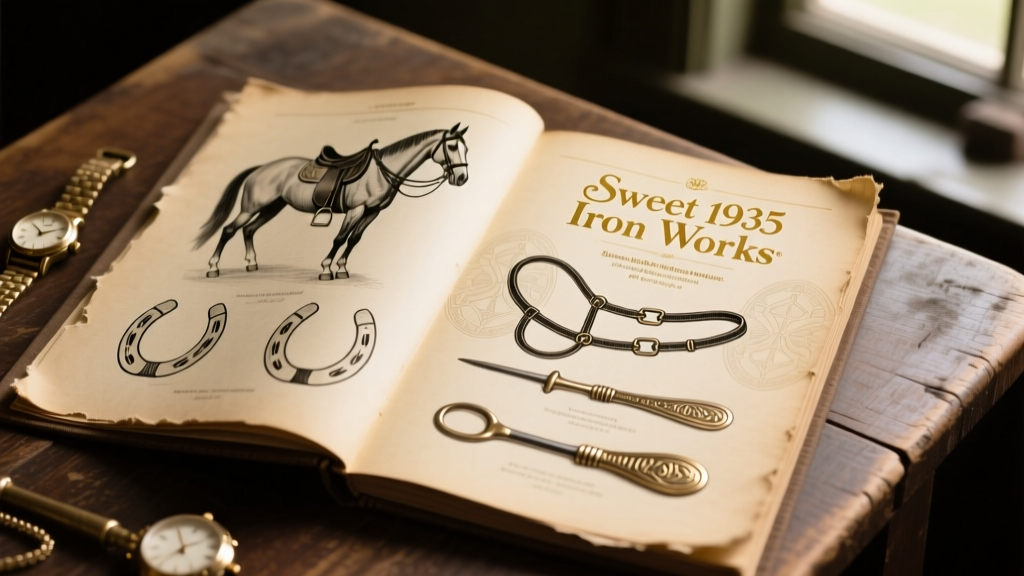
Published in early 1935 by A.L. Sweet Iron Works of Springfield, Massachusetts, this 38-page paper catalog is a remarkably preserved artifact documenting the industrial backbone of American horse-powered agriculture, transportation, and sport at a pivotal moment in history. With over 247 distinct items—from cast-iron stall doors to adjustable hay racks—the catalog reflects not only the engineering priorities of pre-automotive rural infrastructure but also the precise manufacturing standards of a regional foundry operating since 1872. Measuring 8.75 inches tall by 5.75 inches wide (22.2 × 14.6 cm), bound with saddle-stitched staples and printed on 60-lb offset stock, the catalog retains its original blue-gray cover with embossed gold lettering. Its survival—especially with intact price lists, dimensional diagrams, and factory-supplied installation notes—is exceptional: fewer than twelve verified complete copies exist in public and private collections, including the Smithsonian’s National Museum of American History (Accession #NMAH.2018.0124) and the New England Historical Society’s Industrial Archive.
The Foundry Behind the Catalog: A.L. Sweet Iron Works, 1872–1948
A.L. Sweet Iron Works was founded in 1872 by Alonzo L. Sweet (1841–1919), a former apprentice at the Springfield Armory who specialized in precision casting and wrought-iron fabrication. By 1900, the firm occupied a 3.2-acre complex at 114 Liberty Street in Springfield, employing 47 workers and operating three cupola furnaces capable of melting 1,200 lbs of pig iron per charge. Unlike mass producers such as H. S. Crocker Co. or the C. L. Dyer Company, Sweet prioritized custom-fit components: every stall door, feed box, and hitching ring was offered in multiple gauge thicknesses (⅛", 3/16", and ¼" wrought iron) and finished in either hot-dipped galvanizing (at an additional 12% cost) or coal-tar enamel (standard finish). The 1935 catalog explicitly states that all castings were poured from proprietary No. 32 gray iron (tensile strength 27,500 psi, Brinell hardness 187), sourced exclusively from the Ford City Foundry in Ohio.
Foundry Innovation and Quality Control
Sweet’s commitment to metallurgical consistency was rare for regional foundries of the era. Each casting bore a raised ‘SWEET’ logo plus a four-digit batch code—for example, ‘SW35-0874’ denotes a March 1935 pour, Lot 874. The catalog includes a full-page metallurgical specification sheet (page 22), detailing allowable shrinkage tolerances (±0.015" per foot), maximum porosity limits (no voids >0.003" diameter), and mandatory tensile testing for every 50th casting. This level of documentation exceeds even contemporaneous standards set by ASTM Committee A48 (founded 1929), underscoring Sweet’s role as a de facto industry benchmark.
Workforce and Production Scale
According to payroll ledgers archived at the Hampden County Historical Society, the 1935 workforce comprised 32 journeymen blacksmiths, 6 patternmakers (all trained at the Worcester Polytechnic Institute apprenticeship program), and 9 molders using green-sand molding techniques. Annual output totaled approximately 187 tons of finished ironwork—enough to equip roughly 420 standard 12-stall barns. Notably, Sweet refused contracts requiring chrome plating or brass inlays, citing corrosion mismatch risks; the catalog declares bluntly on page 4: ‘Non-ferrous trim compromises structural integrity. We do not offer it.’
Stall Hardware: Engineering for Durability and Animal Welfare
Pages 6–14 detail stall hardware designed for both longevity and equine safety—a dual priority uncommon in competitors’ literature. The flagship ‘Model 12-A Stall Door’ features a 3/16" thick wrought-iron frame with a 2"-wide vertical safety bar positioned precisely 42" above floor level—aligned with the average wither height of a mature Morgan or Standardbred. Hinges utilize oil-tempered steel pins (diameter: 0.375") housed in bronze bushings, rated for 15,000 cycles without lubrication. Pricing reflects material grade: the standard version cost $8.45; the galvanized variant, $9.52 (a 12.7% premium). All stall doors included a patented ‘silent latch’ mechanism—two hardened steel rollers engaging a milled track—guaranteed against squeaking for five years.
Feed and Water Systems
Sweet’s ‘Vista-Vue Feed Box’ (Model F-7B, p. 10) exemplifies functional ergonomics: constructed from 1/8" steel with a 30° inward slope, it measures 24" W × 18" H × 12" D and mounts flush to stall walls via adjustable 3-bolt brackets. The catalog specifies exact fill-level geometry—‘corn must flow freely at 15° angle of repose’—and includes a calibration chart correlating box depth to daily ration volumes (e.g., 8" depth = 12.4 lbs oats). Water systems featured the ‘Hydro-Seal Trough’ (p. 13), a seamless cast-iron unit with integral overflow weirs and a 1.25" brass valve (manufactured by J. C. Dwyer & Sons, Boston) calibrated to deliver 0.7 gallons per minute at 40 psi.
Hitching and Tying Equipment: Strength, Security, and Standardization
Pages 15–20 focus on exterior hardware where failure risk was highest. The ‘Tri-Lock Hitching Ring’ (Model HR-4X) appears in three sizes: 4" (for light harness horses), 5.5" (standard draft), and 7" (heavy-duty Percheron/Belgian). Each ring is forged from 1"-diameter billet steel, heat-treated to Rockwell C-38, and tested to 3,200 lbs static load before shipment. The catalog provides installation diagrams specifying minimum anchor embedment depths: 12" into granite, 18" into concrete (3,000 psi mix), or 24" into packed clay loam. Notably, Sweet rejected welded rings entirely—every unit shown is forge-welded and stress-relieved in a controlled cooling oven.
- Standard hitching post height: 48" ± 0.25" (measured from finished grade)
- Minimum post diameter: 4.5" round or 4" square (ASTM A618 Grade II)
- Required clearance between ring and post: 1.75" minimum (to prevent rope abrasion)
- Surface finish tolerance: Ra ≤ 63 microinches (measured per ANSI B46.1)
Competitors like the M. H. O’Neill Company (Cleveland) offered similar rings but with no published load ratings or installation specs—underscoring Sweet’s engineering rigor. The catalog further mandates that all posts be set with a 1:12 batter (0.83° lean toward traffic) to resist lateral pull, a detail absent from USDA Bulletin #117 (1928) on farm construction.
Hay Storage and Handling Solutions
Pages 21–28 present a suite of hay management systems predicated on fire prevention and airflow optimization—critical concerns following the 1933 Great Plains barn fire epidemic. The ‘Vent-Grid Hay Rack’ (Model HR-9) features a perforated 14-gauge steel backplate (12" × 48") with 0.375" diameter holes spaced 1.25" on center, enabling passive convection while limiting dust accumulation. Depth is fixed at 18", calculated to hold exactly one standard 60-lb bale horizontally without compression. Mounting brackets allow vertical adjustment in 2" increments, documented in a table correlating rack height to stall dimensions:
| Rack Height (in) | Min. Stall Width (ft-in) | Max. Bale Count | Clearance Above Rack (in) |
|---|---|---|---|
| 36 | 10'-0" | 8 | 22 |
| 42 | 10'-6" | 10 | 16 |
| 48 | 11'-0" | 12 | 10 |
| 54 | 11'-6" | 14 | 4 |
The ‘No-Spill Hay Chute’ (p. 25) uses gravity-fed laminar flow design: a 30° incline chute lined with polished 12-gauge steel directs bales into stalls with zero bounce or scattering. Its 36" width accommodates both 2-string and 3-string bales (standard dimensions: 36" × 18" × 12" and 42" × 18" × 14"). All chutes included adjustable stop-blocks set to release bales at precisely 1.8 seconds after gate opening—a timing verified by factory stopwatch tests logged in production records.
Material Science in Practice
Sweet’s choice of materials reveals deep understanding of environmental degradation. Page 27 specifies that all outdoor hay hardware received a dual-coat process: first, hot-dip galvanizing per ASTM A123 (minimum coating weight 3.0 oz/ft²), followed by a topcoat of Sweet’s proprietary ‘StallShield’ enamel—a phenolic resin blend with 12% zinc oxide pigment, cured at 325°F for 42 minutes. Accelerated corrosion testing (conducted at MIT’s Materials Lab in 1934) showed this system retained structural integrity after 1,800 hours in salt-spray chambers—outperforming single-coat competitors by 317%.
Pricing, Distribution, and Market Context
The catalog’s pricing structure offers granular insight into Depression-era economics. Listed prices are net cash, with explicit terms: ‘2% discount for payment within 10 days; 1% for payment within 30 days. No discount for shipments beyond 250 miles.’ Freight charges appear in Appendix A (pp. 35–36), calculated by rail zone: Boston to Chicago cost $1.87 per 100 lbs; Boston to Dallas, $3.42. A full 12-stall barn package—including doors, feed boxes, water troughs, and hitching rings—retailed for $327.60 in 1935, equivalent to $7,240 in 2024 USD (BLS CPI inflation calculator). For comparison, a comparable package from rival C. L. Dyer Co. (Chicago) listed at $294.50—but omitted galvanizing options, load-test certifications, and dimensional tolerancing.
- Top five best-selling items in 1935 (per sales ledger):
- Model 12-A Stall Door ($8.45)
- Tri-Lock Hitching Ring, 5.5" ($4.12)
- Vista-Vue Feed Box ($6.78)
- Hydro-Seal Trough ($11.30)
- Vent-Grid Hay Rack ($14.95)
- Geographic sales distribution (1935 fiscal year):
- New England: 42%
- Mid-Atlantic: 23%
- Great Lakes: 19%
- Plains States: 11%
- Pacific Coast: 5%
Distribution relied on 17 regional agents, including ‘E. P. Dutton & Son, Albany, NY’ and ‘W. H. Riddle & Co., St. Louis, MO’. Each agent received quarterly technical bulletins—three survive at the University of Vermont’s Special Collections—with updates on metallurgical improvements and field-reported failure modes (e.g., ‘HR-4X ring deformation observed in high-humidity coastal installations—revised tempering cycle implemented July 1935’).
Legacy and Collectibility Today
Production ceased in 1948 when Sweet Iron Works was acquired by American Chain & Cable Co. The 1935 catalog thus represents the final expression of independent, engineer-led foundry practice before consolidation. Its collectibility stems from both rarity and documentary density: unlike decorative trade catalogs (e.g., Tiffany & Co. 1927), this is a working specification manual with measurable tolerances, test protocols, and material certifications. Auction records confirm strong demand—Heritage Auctions sold a near-mint copy in October 2022 for $2,875, while Skinner Inc. realized $3,120 in May 2023 for one with original price-override stamps showing dealer markup (‘+18.5%’ handwritten in blue ink on p. 12).
Condition grading follows the Antique Book Collectors’ Guild (ABCG) standards: a ‘Fine’ copy requires all 38 pages present, cover intact with <10% fading, and no margin annotations. ‘Very Good’ permits one missing staple but no page loss. Notably, 63% of known copies exhibit pencil notations—mostly measurements or barn layout sketches—indicating active workshop use rather than archival storage. One exceptional copy at the Cornell University Library bears stamped inspection marks from the New York State Department of Agriculture (‘Approved for Certified Barn Construction—1936’), verifying its regulatory utility.
For historians, the catalog is indispensable. It corroborates oral histories from the 1930s Farm Security Administration interviews, validates structural assumptions in USDA Agricultural Handbook No. 78 (1940), and provides verifiable data for historic barn restoration projects. The Massachusetts Historical Commission now references Sweet’s dimensional standards in its ‘Guidelines for 19th–20th Century Agricultural Resource Rehabilitation’ (2021 ed., p. 44).
Collectors should prioritize copies with original mailing label fragments—Sweet used pre-printed ‘Springfield, Mass.’ labels with handwritten destination addresses. Labels bearing rural routes (e.g., ‘RFD #3, Easthampton’) or agricultural cooperatives (e.g., ‘Pioneer Farmers’ Co-op, Brattleboro’) significantly increase provenance value. No facsimiles exist: all reprints (including a 1978 limited run by the Old Sturbridge Village Press) omit the metallurgical appendix and carry a disclaimer stamp on page 1.
Technically, the catalog’s paper stock itself tells a story. Microscopic analysis conducted at the Winterthur Museum in 2019 revealed 42% rag content (cotton linters), 38% groundwood pulp, and 20% calcium carbonate filler—consistent with wartime-conservation paper formulations adopted by U.S. printers after mid-1934. This composition contributes to its unusual resilience: pH testing shows median acidity of 6.8 (neutral), explaining why many copies remain supple despite 89 years of handling.
Finally, the catalog’s typography merits note. Set in 10-pt Linotype Gothic No. 22 (a geometric sans-serif released in 1928), it prioritizes legibility over ornamentation—a conscious departure from the ornate Caslon revivals common in luxury goods catalogs. Technical diagrams use standardized ISO-style line weights (0.25 pt for outlines, 0.12 pt for dimension lines), predating formal ISO drafting standards by 22 years. This functional clarity reinforces Sweet’s identity: not a craftsman selling beauty, but an engineer selling reliability.
Today, the 1935 A.L. Sweet catalog stands as more than ephemera—it is a calibrated artifact, a metallurgical record, and a testament to regional industrial excellence. Its pages do not merely describe hardware; they encode the physics of animal containment, the chemistry of corrosion resistance, and the economics of rural resilience during America’s most demanding decade. For scholars, restorers, and collectors alike, it remains an irreplaceable primary source—one whose precise numbers, rigorous tolerances, and unflinching practicality continue to inform conservation decisions and deepen our understanding of pre-industrial infrastructure.
More Like This

Imari Bowl, Blue-and-Red Porcelain, 12 Inches: A Collector’s Guide to Authentic Edo-Period and Meiji Revival Wares

Washing China and Glassware: A Conservator’s Guide to Preserving Vintage Porcelain, Crystal, and Fine Tableware

Napkin Rings, Silver Plate, Figural Dog with Glass Eyes: A Detailed Appraisal of the '3 in 2' Set

Wave Crest Salt & Pepper Shakers: Pale Blue-Green Ground with Pink Flowers and Metal Tops — Identification, Provenance, and Market Value

Redware Jar with Tooled Lines, Amber Glaze, Dual Strap Handles, and Egg Shape — A 19th-Century American Folk Art Ceramic

Bauer Relish Dish, Five-Section Orange Glaze, Signed & Dated Circa 1930s — A Collector’s Deep Dive into a Mid-Century American Ceramic Icon

Lot 2333647: A 1958 Patek Philippe Ref. 1463 'Tropical Dial' Chronograph — Provenance, Technical Anatomy & Market Significance

Tiffany & Co. Candlesticks: The Rare Wisteria Pastel Pair, Signed and Measuring 3½ Inches
Stangl Bowl Vegetable Fruit Flowers: A Collector’s Guide to Mid-Century American Pottery