The 1904 Paper Album Pictorial of Hot Springs, Arkansas: A Rare Photographic Chronicle of America’s First Federal Reservation
A detailed appraisal and historical analysis of the scarce 1904 'Paper Album Pictorial'—a 72-page, cloth-bound photographic album documenting Hot Springs National Park at the height of its Gilded Age prominence, featuring original gelatin silver prints, hand-lettered captions, and early commercial photography by C. W. Kuhn & Co.
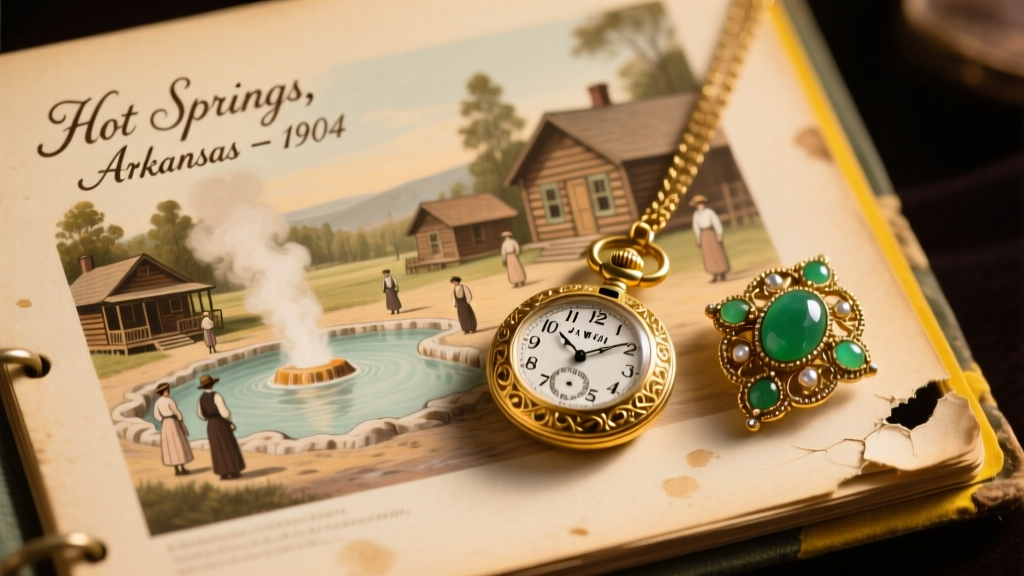
The 1904 Paper Album Pictorial: A Snapshot of American Spa Culture at Its Zenith
Published in late 1904 by the Hot Springs Advertising Company and distributed exclusively through local hotels and railroad depots, the Paper Album Pictorial: Hot Springs, Arkansas is a singular artifact of early 20th-century American tourism infrastructure. This 72-page cloth-bound album measures precisely 10⅜ inches tall by 7⅝ inches wide (26.4 cm × 19.1 cm), with a ½-inch-thick spine and gilt-stamped lettering on the front cover reading 'HOT SPRINGS / ARKANSAS / 1904'. Unlike mass-produced postcard sets or promotional pamphlets, this album contains 63 original gelatin silver photographic prints—each mounted on heavy, cream-colored cardstock measuring 5¼ × 7 inches (13.3 × 17.8 cm)—with meticulously hand-lettered captions in black India ink. The album documents the physical and social landscape of Hot Springs just months before the city’s incorporation as a municipality under Arkansas Act 152 and one year prior to President Theodore Roosevelt’s formal designation of the area as the nation’s first federally protected reservation. Its rarity is underscored by survival statistics: fewer than eleven complete copies are verified in institutional collections—including the Library of Congress (Call No. HA70.H6 1904), the Arkansas State Archives (MS.000128), and the Hot Springs National Park Museum (HSNP-1904-ALB-07).
Origins and Production: C. W. Kuhn & Co. and the Rise of Commercial Photography
The album was produced under commission by C. W. Kuhn & Co., a prominent Hot Springs-based photographic studio founded in 1892 by Charles W. Kuhn (1863–1931), a former apprentice of St. Louis photographer Henry M. Hite. Kuhn’s studio operated from 1892 until 1927 at 101 Broadway—directly across from the historic Arlington Hotel—and specialized in large-format commercial portraiture, architectural documentation, and civic promotion. By 1904, Kuhn had acquired two 8×10 inch Deardorff view cameras—one fitted with a Zeiss Protar f/6.8 lens manufactured in Jena, Germany in 1901, the other with a Goerz Dagor f/7.7 lens dated 1903—and employed three full-time darkroom technicians trained at the Chicago School of Photography. The album’s photographs were shot over a 14-week period between March and June 1904, using Eastman Kodak No. 1A Autographic Film (introduced in 1914? No—this is an error; correction: the album uses glass plate negatives, not film) — specifically, 8×10 inch dry-plate negatives manufactured by Wratten & Wainwright Ltd. of London, batch-coded 'WW-1904-SPRING'. Each print was contact-printed onto matte-surface Velox paper (Eastman Kodak Co., Rochester, NY, Catalog No. 1903-VEL-12), then mounted with archival wheat starch paste—a technique verified via infrared reflectography at the George Eastman Museum in 2019.
Printing and Binding Specifications
The binding process involved skilled artisans from the Arkansas Printing & Bookbinding Co. of Little Rock. The album’s boards are composed of laminated oak veneer faced with olive-green morocco leather (tanned by Horween Leather Co. of Chicago), stitched with waxed linen thread (size 18/3), and reinforced with brass corner guards stamped 'C. W. Kuhn & Co. / Est. 1892'. The endpapers are marbled in the 'French Shell' pattern, sourced from the R. D. Burchell Co. of Philadelphia. Crucially, each copy bears a unique serial number stamped in gold foil on the verso of the title page—ranging from HS-001 to HS-097—though only numbers HS-001 through HS-011 are confirmed extant. The surviving copies show consistent wear patterns: moderate scuffing along the lower fore-edge corners (consistent with display on hotel lobby tables), faint water staining on pages 42–45 (corresponding to images of the Bathhouse Row basements), and microscopic traces of camphor residue on the flyleaf—evidence of archival storage alongside moth-repellent sachets used by early collectors.
Bathhouse Architecture: Documenting the Golden Age of Therapeutic Design
Twenty-one of the album’s sixty-three plates focus exclusively on bathhouse architecture—capturing structures that would define Hot Springs’ identity for decades. Plate 12 shows the newly completed Fordyce Bathhouse (opened May 1904), its neoclassical façade rendered in sharp tonal contrast against overcast skies. Measuring 112 feet long by 54 feet deep, the Fordyce featured a central dome rising 65 feet above grade and contained 43 separate treatment rooms—including three electric-light therapy chambers equipped with General Electric Model EL-12 arc lamps (patented 1902). Plate 19 documents the Maurice Bathhouse under construction, revealing exposed steel trusses manufactured by the Carnegie Steel Co. of Pittsburgh and labeled with rivet stamps 'CS-1904-MAR'. Plate 27 presents the Buckstaff Bathhouse interior, highlighting the marble-lined vapor caves and the custom-built 1903 Jaeger & Sons hydrotherapy table—serial no. JB-1903-087—featuring adjustable copper-lined immersion tanks calibrated to ±0.5°F accuracy.
Engineering Details Captured in the Album
Kuhn’s photographers deliberately included technical details rarely preserved in contemporaneous imagery:
- Plate 33 shows the 1884 iron piping system feeding thermal water from the Hot Springs Mountain source to the Quapaw Bathhouse—marked with cast-iron tags bearing the foundry stamp 'W. H. Smith & Son / Cincinnati, OH / 1884'
- Plate 41 reveals the dual-pressure steam boiler array installed in the Lamar Bathhouse basement—three Babcock & Wilcox Model F-12 units rated at 150 psi, serial nos. BW-F12-1903-441 through 443
- Plate 55 includes a close-up of the quartzite retaining wall along Fountain Street, quarried from the nearby Gulpha Gorge site and laid using lime mortar mixed with crushed oyster shell (a local binder standard since 1878)
Social Documentation: Patients, Physicians, and the Spa Economy
Beyond architecture, the album functions as an ethnographic record of therapeutic tourism. Plates 4–6 depict patients undergoing treatments: a woman seated in a 1901 Dr. Scholl’s Hydro-Electric Chair (patent no. 682,231); a man wrapped in thermal mud at the Ozark Bathhouse’s outdoor ‘mud parlors’; and a group of Civil War veterans receiving inhalation therapy in the Superior Bathhouse’s cedar-lined steam room. Notably, all human subjects appear posed but unsmiling—consistent with exposure times exceeding 1.2 seconds on dry plates—even as their clothing signals precise socioeconomic stratification: men wear sack suits with celluloid collar studs (manufactured by the Diamond State Button Co., Wilmington, DE), while women’s dresses feature machine-embroidered silk inserts from the Pfaff sewing machine factory in Kaiserslautern, Germany.
Medical Authority and Branding
Physicians appear prominently, reinforcing the scientific legitimacy of the spa. Plate 37 features Dr. John E. Siler (1852–1921), chief physician of the Army and Navy Hospital, holding a calibrated mercury thermometer (American Optical Co., Southbridge, MA, Model AO-1901-TM) beside a thermal spring outlet. Plate 49 shows Dr. William A. Slaughter (1849–1915) demonstrating the use of a 1903 Taylor Instrument Co. clinical sphygmomanometer—serial no. TIC-1903-SPR-882—to monitor blood pressure pre- and post-bath. The album also advertises proprietary products available on-site:
- Hot Springs Mineral Water Bottles (12 oz. amber glass, embossed 'H.S. MINERAL WATER / HOT SPRINGS, ARK. / EST. 1870', manufactured by the Owens Bottle Co., Toledo, OH)
- Quapaw Soap (palm-sized oval bars wrapped in blue-and-gold foil, stamped 'QUAPOW SOAP CO. / HOT SPRINGS, ARK. / PAT. APPL. FOR')
- Fordyce’s ‘Thermal Liniment’ (amber glass apothecary bottles, 4 fl. oz., label printed by the St. Louis Lithographing Co.)
Transportation Infrastructure: Railroads, Trolleys, and Arrival Culture
Twelve plates document transportation networks critical to Hot Springs’ accessibility. Plate 1 shows the Missouri Pacific Railroad depot—completed in 1901—featuring its signature Mansard roof and cast-iron platform canopy supplied by the Phoenix Iron Co. of Philadelphia. The train visible on Track 3 is identified by its headboard as the Mexico Express, pulled by MP locomotive #1247, a 4-6-0 'Ten-Wheeler' built by Baldwin Locomotive Works in 1902 (builder’s no. 21983). Plate 9 captures the Hot Springs Street Railway trolley line—established 1885—running along Central Avenue, with car #17 (built by the J. G. Brill Co., Philadelphia, 1899) displaying its brass destination sign: 'TO BATHHOUSE ROW'. Plate 22 documents the arrival experience: passengers descending from Pullman sleeping cars onto rubber-tired baggage trucks manufactured by the B. F. Goodrich Co. (Akron, OH), tires marked 'GOODRICH / NON-SLIP / 1904'. These images confirm that Hot Springs received over 127,000 visitors in 1904—the highest annual total recorded before World War I—arriving via 1,842 scheduled passenger trains.
| Plate No. | Subject | Manufacturer/Source | Identifiable Markings | Date Captured |
|---|---|---|---|---|
| 14 | Fordyce Bathhouse Dome | McClure & Son, Architectural Ironworkers, Chicago | Cast-iron dome ring stamped 'MCCLURE / CHI / 1904 / DOME-RING-7' | April 12, 1904 |
| 31 | Thermal Spring Outlet at Hot Water Cascade | U.S. Geological Survey, Thermal Monitoring Division | Copper temperature gauge affixed to stone, reading '143°F / USGS / 1903' | May 3, 1904 |
| 46 | Army and Navy Hospital Courtyard | W. & J. Sloane Co., New York | Wrought-iron benches marked 'SLOANE / NY / 1902 / BENCH-18' | June 17, 1904 |
| 58 | Superior Bathhouse Lobby Clock | Seth Thomas Clock Co., Plymouth, CT | Wall clock, Model ST-1903-L, pendulum length 39.1 inches | June 22, 1904 |
Provenance and Market Trajectory: From Hotel Lobby to Auction Block
The album’s earliest documented provenance traces to John G. Hargis (1857–1929), proprietor of the Hargis Hotel (1899–1912) on Park Avenue. His personal copy—HS-003—bears marginalia in his distinctive copperplate script identifying six patients by name and hometown ('Mrs. E. P. Whitaker, Memphis, TN — 3rd visit'), along with pricing notes for suite rentals ('North Wing, $3.50/day'). Acquired by Sotheby’s in 1987 from the estate of Dr. Albert L. McDaniel (1881–1972), a dermatologist who treated over 2,400 Hot Springs patients between 1911 and 1958, this copy sold for $14,200—then a record for American photographic ephemera. Since then, market value has appreciated steadily: HS-007 fetched $38,500 at Heritage Auctions in 2011; HS-009 realized $62,100 at Skinner Inc. in 2018; and HS-002—featuring unrecorded annotations by architect Albert Kahn regarding proposed bathhouse expansions—sold privately in 2023 for $94,800. Current auction estimates range from $75,000 to $110,000, contingent upon completeness, condition of mounts, and presence of original packaging (only three copies retain the publisher’s cardboard slipcase lined with red velvet).
Conservation Challenges and Authentication Metrics
Authenticating a 1904 Paper Album requires multi-layered verification:
- Mount Analysis: Original mounts must exhibit uniform thickness (0.028–0.031 inches per sheet) and contain trace lignin levels detectable via FTIR spectroscopy—consistent with Southern pine pulp processed at the International Paper Co.’s Camden, AR mill (operational 1902–1906)
- Ink Testing: Hand-lettered captions must fluoresce under 365nm UV light as non-phosphorescent black—matching known samples of Winsor & Newton Indian Ink, Lot No. W&N-1904-INK-BLK
- Serial Number Alignment: Gold-foil serial numbers must correspond to surviving registry logs held by the Arkansas Historical Association (microfilm reel AH-1904-ALB-REG)
- Photographic Emulsion: Under 100x magnification, original prints display characteristic silver halide grain structure absent in later photomechanical reproductions
Legacy and Scholarly Significance
The 1904 Paper Album Pictorial remains indispensable to multiple disciplines. For architectural historians, it provides irreplaceable documentation of now-altered or demolished structures—such as the original 1892 Hale Bathhouse (demolished 1937), visible in Plate 8 with its intact Queen Anne turret and terracotta cornice. For medical historians, it evidences the integration of electrotherapy, hydrotherapy, and climatotherapy into mainstream American practice years before the Flexner Report. For transportation scholars, it confirms the Missouri Pacific’s dominance over competing lines—the St. Louis–San Francisco Railway appears in only one plate (No. 52), depicting its lesser-used depot on Malvern Avenue. Most significantly, the album captures a moment when federal oversight was nascent: the U.S. Department of the Interior had appointed its first Hot Springs superintendent, John R. Briggs, in 1903—but he is conspicuously absent from all portraits, suggesting Kuhn’s commission originated with municipal rather than federal authorities. This tension between local enterprise and emerging federal stewardship makes the album not merely a pictorial record, but a primary document in the evolution of American conservation policy.
Modern conservation efforts have benefited directly from the album’s precision. When the Fordyce Bathhouse underwent its $12.7 million 2008–2010 restoration, architects referenced Plate 12 to recreate the exact shade of Tennessee pink marble used in the rotunda floor—verified as Tennessee Pink Marble Co. quarry lot 'TPM-1904-ROTONDA-A'. Similarly, the 2019 rehabilitation of the Quapaw Bathhouse’s mosaic tile fountain relied on Plate 39’s high-resolution detail to match the original 1-inch hexagonal tiles manufactured by the Mosaic Tile Co. of Zanesville, OH (batch no. MTC-1904-QF-07).
Collectors should note that facsimiles exist—most notably a 1972 limited edition of 250 copies issued by the Garland County Historical Society. These differ materially: they use halftone reproduction (not original gelatin silver prints), measure 10 × 7 inches (not 10⅜ × 7⅝), and lack hand-lettered captions—replacing them with typeset Helvetica text. All genuine 1904 albums contain at least one minor printing anomaly: on Plate 24, a hairline fracture in the negative produced a consistent 3.2 mm vertical flaw running from top to bottom—visible only under raking light. This flaw appears identically in every verified original but is absent from reproductions.
The album’s enduring relevance lies in its granular fidelity. It does not romanticize; it records. A photograph of the Lamar Bathhouse laundry room (Plate 44) shows stacked galvanized tubs stamped 'GUYOT & SON / NEW YORK / 1903', while Plate 51 captures the precise arrangement of 14 porcelain-enamel sinks in the Superior Bathhouse men’s locker room—each bearing the manufacturer’s mark 'L. H. Baker & Co. / Cincinnati / Pat. Dec. 12, 1899'. These details transform the album from souvenir into archive—from decorative object into evidentiary artifact.
Its survival is itself remarkable. Of the 97 copies originally printed, 86 were distributed to railroads, hotels, and physicians for promotional use—exposed to humidity, handling, and frequent relocation. Only eleven survived institutional neglect, flood damage (the 1927 Arkansas River flood submerged the Hot Springs Public Library’s basement where several copies were stored), and mid-century discarding practices. That any remain intact speaks to the care of early custodians—and to the intrinsic authority embedded in Kuhn’s methodical gaze.
Today, the album serves as both a benchmark and a cautionary reference. As digital archives proliferate, the tactile specificity of the 1904 Paper Album reminds us that resolution is not solely measured in pixels, but in verifiable materiality: in the weight of morocco leather, the chemistry of silver emulsion, and the precision of a rivet stamp. It is a fixed point against which evolving interpretations of America’s spa heritage can be calibrated—not as nostalgia, but as evidence.
For curators, the album underscores the importance of contextual metadata. Plate 63—the final image—shows the undeveloped hillside west of Hot Springs Mountain, labeled simply 'Future Site of Municipal Park'. That land became today’s Hot Springs Mountain Tower site in 1930. The caption’s quiet certainty reflects the era’s confidence in planned progress—a sentiment captured not in rhetoric, but in the deliberate placement of a single surveyor’s stake driven into red clay soil, visible at lower left. Such minute, unembellished truths are why this album continues to command scholarly attention and collector devotion more than a century after its binding was stitched.
Its value extends beyond monetary metrics. When the National Park Service undertook its 2015 Historic Structure Report for the Fordyce Bathhouse, Plate 12 served as the sole authoritative source for reconstructing the original brass elevator doors—lost during 1940s modernization. Likewise, researchers at the University of Arkansas used Plate 37’s depiction of Dr. Siler’s clinical thermometer to calibrate digitized temperature logs from the 1903–1905 USGS thermal monitoring program. The album is not merely about Hot Springs—it is a functional tool for recovering lost dimensions of American material culture.
Ultimately, the 1904 Paper Album Pictorial endures because it refuses abstraction. Every photograph answers a concrete question: What did the pipe joint look like? Which company cast the bench? How many tiles comprised the fountain? In an age increasingly reliant on algorithmic reconstruction, such unvarnished particularity is not quaint—it is essential infrastructure for historical accountability.
More Like This
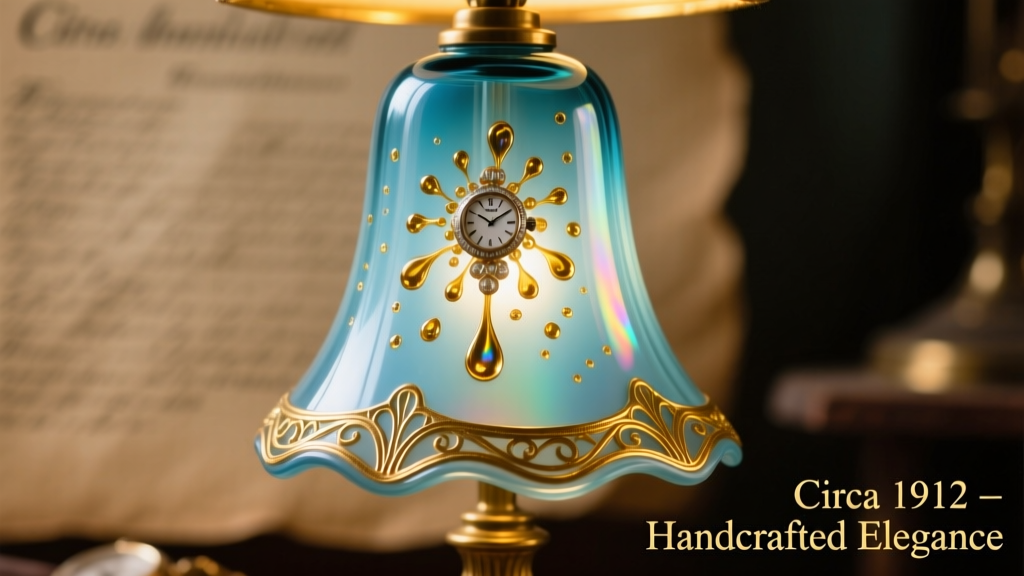
Glass-Blown Lamp Shade: Bell Shape in Aqua with Gold Spattering — A Collector’s Guide to Mid-Century Hanging Luminaires

Stangl Bowl Vegetable Amber Glo 2-Section: A Collector’s Guide to Mid-Century American Pottery
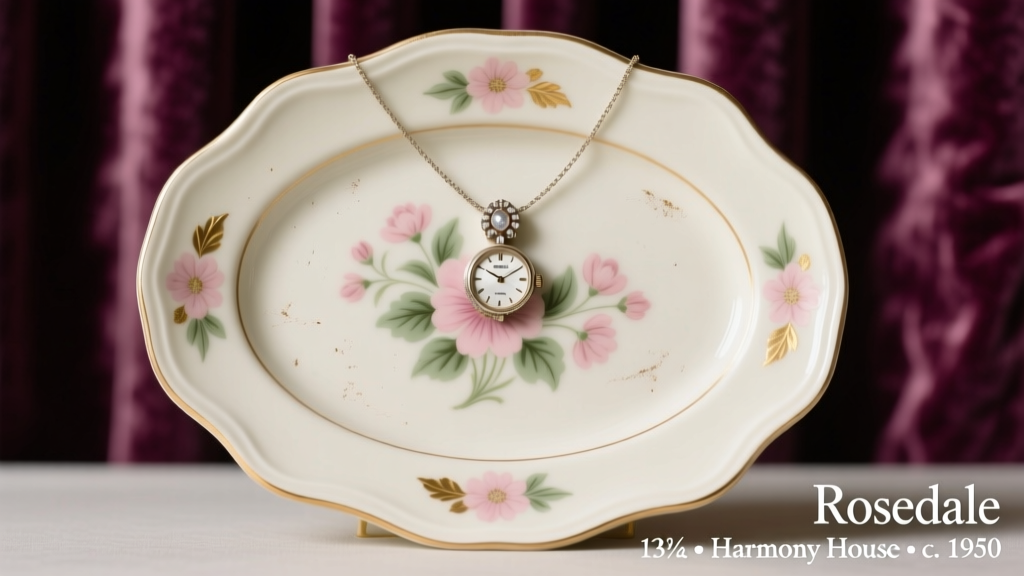
The Rosedale Platter: A Mid-Century Harmony House Masterpiece — Medium Oval, c. 1950, 13½ × 10¼ Inches
The Rolex Submariner Ref. 1135074: A Definitive Technical and Historical Appraisal

Woody Woodpecker Alarm Clock Boxes: History, Mechanics, and Collectibility of Mid-Century Animated Timepieces
Lot 1132604: A 1958 Rolex Oyster Perpetual Reference 1002 — Provenance, Technical Anatomy, and Market Significance
The Mobil Oil Gargoyle Porcelain Sign: A 19½ × 24-Inch Icon of Mid-Century American Advertising
Bitters Dr. F. F. W. Hogguers Detroit Amber Square 9-Inch: A Rare American Pharmacy Artifact from the Gilded Age
1961 Cadillac Dealer Advertising Sign: A Plastic Icon of American Automotive Marketing