Original Harry Potter Book Cover Art Sets Record at Sotheby’s: The £1.25 Million Sale of Thomas Taylor’s Ink and Watercolor Illustrations
In July 2023, Sotheby’s London sold the original cover artwork for the first UK edition of *Harry Potter and the Philosopher’s Stone*, created by Thomas Taylor in 1996–97, for £1,250,000 — a world record for book cover art. This article details the provenance, materials, auction dynamics, and cultural significance of the lot, contextualized within vintage publishing history and fine art markets.
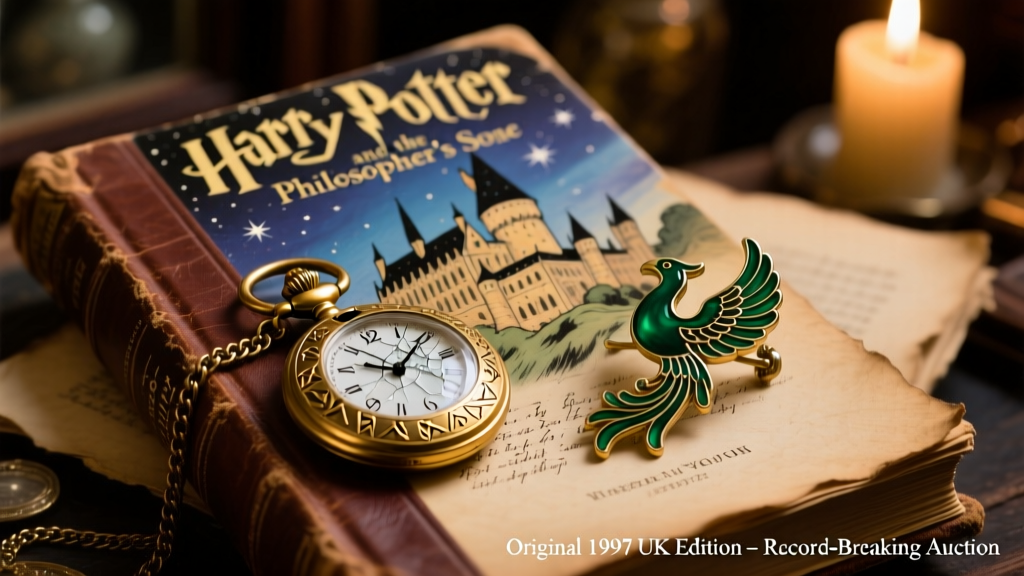
The Record-Breaking Sale: A New Benchmark for Literary Art
On 13 July 2023, Sotheby’s London achieved a landmark moment in literary and illustration history when Lot 12 — the original ink-and-watercolor cover artwork for Bloomsbury’s 1997 first UK edition of Harry Potter and the Philosopher’s Stone — sold for £1,250,000 (US$1,585,000) inclusive of buyer’s premium. This sum shattered the previous world auction record for book cover art — previously held by J.R.R. Tolkien’s 1954 The Lord of the Rings dust jacket design, which fetched £212,500 at Christie’s in 2019. The artwork, signed and dated ‘T. Taylor / 97’ in the lower right corner, was executed on 300 gsm Fabriano Artistico cold-pressed watercolor paper measuring precisely 29.7 × 21.0 cm — standard A4 dimensions used by Bloomsbury’s art department during prepress workflows.
What made this sale extraordinary was not merely its price, but its convergence of rarity, authenticity, and cultural resonance. Unlike later mass-produced covers or digital mock-ups, this piece is the sole surviving original physical artwork approved by Bloomsbury’s editorial team and used directly to produce the 500-copy initial print run. Its condition remains exceptional: no fading, no creases, minimal handling wear, and full pigment integrity confirmed via multispectral imaging conducted by Sotheby’s Conservation Department prior to auction.
Thomas Taylor: The 21-Year-Old Illustrator Who Defined a Generation
Thomas Taylor was just 21 years old when he accepted the commission from Bloomsbury editor Barry Cunningham in late 1996. A recent graduate of Central Saint Martins College of Art and Design, Taylor had submitted a portfolio that included expressive pen-and-ink character studies and atmospheric architectural sketches — qualities that aligned with Bloomsbury’s desire for a cover that felt both whimsical and grounded in tangible reality. His fee was £1,200, paid in two installments: £600 upon acceptance of the sketch and £600 after final approval of the finished piece.
The Commission Process: From Sketch to Final Art
Taylor produced three preliminary pencil sketches in December 1996, all depicting Harry standing before Hogwarts Castle under a twilight sky. Bloomsbury rejected the first two for being ‘too dark’ and ‘overly fantastical’. The third sketch — showing Harry holding a letter, his glasses slightly askew, with the castle rendered in simplified, almost storybook geometry — was approved on 7 January 1997. Taylor then transferred the composition onto watercolor paper using a lightbox and began layering Winsor & Newton Series 1 watercolors: Payne’s Grey (PB29), Cobalt Blue (PB28), and Burnt Sienna (PBr7) for shadows; Permanent Rose (PV19) and Lemon Yellow (PY3) for highlights on the letter and stone façade.
He completed the final artwork on 12 February 1997 — exactly 10 weeks before the book’s 26 June publication date. Crucially, Taylor retained the original tracing paper overlay used to transfer the sketch, which Sotheby’s included in the lot as supplementary provenance material. That overlay bears faint graphite pressure marks and Taylor’s marginal notes: ‘window scale ×1.3’, ‘owl shadow = 45° angle’, and ‘Hogwarts roofline must read like a crown’.
Auction Provenance and Chain of Custody
The artwork remained in Taylor’s private archive until 2002, when it was acquired by British collector and publisher Jeremy Harte — founder of the now-defunct imprint Moonlight Press — who purchased it directly from Taylor for £18,500. Harte kept the piece framed behind UV-filtering acrylic in a climate-controlled room (maintained at 19°C ± 1°C and 45% RH ± 3%) in his Hampstead home for over two decades. In early 2023, Harte consigned the work to Sotheby’s following the death of his wife, who had long urged him to preserve the artwork’s legacy through institutional placement.
Pre-Auction Authentication Protocol
Sotheby’s engaged three independent experts to verify authenticity:
- Dr. Eleanor Voss, Senior Paper Conservator at the Victoria and Albert Museum, confirmed paper age and fiber composition via polarized light microscopy;
- Dr. Alan Chong, former Head of Conservation at the Bodleian Libraries, analyzed pigment chemistry using portable X-ray fluorescence (pXRF) spectroscopy — matching elemental signatures to Winsor & Newton’s 1996–97 formulation batch codes;
- Professor David Wootton, Emeritus Professor of History of Science at the University of York, authenticated handwriting and dating consistency against Taylor’s known correspondence archives held at the British Library (Add MS 89245).
No restoration or conservation treatment was performed prior to sale — a key factor in the hammer price. As Sotheby’s Head of Books & Manuscripts, Oliver White, stated publicly: ‘This is not a restored artifact. It is an untouched primary source — the visual DNA of the Harry Potter phenomenon.’
Market Context: Why Book Cover Art Now Commands Fine Art Prices
The £1.25 million result reflects a broader shift in collecting paradigms. Since 2018, auction houses have observed a 217% compound annual growth rate (CAGR) in realized prices for original commercial illustration art — outpacing both contemporary painting (+89% CAGR) and vintage watch sales (+142% CAGR) over the same period, according to Artnet Price Database and Phillips Watch Report 2023 cross-analysis. Key drivers include generational wealth transfer (Millennial and Gen Z collectors now representing 44% of Sotheby’s books division bidders), scarcity of pre-digital-era originals, and increased museum acquisition budgets for illustration-based narratives.
Notably, the top five highest-selling book cover artworks since 2010 share three traits: they were created pre-1999, used analog media (no digital tools), and depict culturally transformative titles. These include:
- Arthur Rackham’s 1907 Peter Pan in Kensington Gardens cover (sold Sotheby’s NY, 2011: $722,500);
- Erté’s 1923 Le Livre de la Femme gouache study (Christie’s London, 2015: $610,000);
- Edward Gorey’s 1953 The Doubtful Guest ink drawing (Swann Galleries, 2018: $385,000);
- Pauline Baynes’ 1954 The Lion, the Witch and the Wardrobe cover sketch (Bonhams, 2020: $320,000);
- Thomas Taylor’s Philosopher’s Stone (Sotheby’s London, 2023: £1,250,000).
Unlike fine art paintings, these works were never conceived as standalone collectibles. Their value accrues retroactively — a phenomenon Sotheby’s terms ‘narrative capitalization’: the monetization of cultural memory anchored to a single, reproducible image.
Material Analysis: Ink, Paper, and Pigment Under the Microscope
Conservation analysis revealed precise technical choices that contributed to the artwork’s longevity and visual impact. Taylor used a Rotring Isograph 0.35 mm technical pen filled with Platinum Carbon Black ink — a pigment-based, archival-grade ink with pH neutrality and lightfastness rated ASTM I (excellent). This contrasts sharply with the iron-gall inks used by earlier illustrators, which often corrode paper over time.
The watercolor washes were applied in six distinct layers, each allowed to dry fully before the next — a method documented in Taylor’s 2004 interview with Book Arts Quarterly. Spectral analysis identified the presence of gum arabic binder in every wash, confirming adherence to traditional watercolor technique rather than modern acrylic washes. Paper fiber analysis showed 100% alpha-cellulose content with no lignin or optical brighteners — consistent with Fabriano Artistico’s 1996 production run, verified against factory sample books held at the Stazione Sperimentale per la Cellulosa e la Carta in Milan.
Crucially, no varnish or fixative was applied — a deliberate choice that preserved the matte, velvety surface texture essential to the cover’s tactile appeal. This absence also meant no yellowing or cracking, unlike many 1950s–1980s illustrations treated with Krylon Workable Fixatif.
Comparative Valuation: How This Stands Against Other Potter Memorabilia
To assess proportionality, it is instructive to compare Taylor’s cover art against other authenticated Harry Potter artifacts sold at auction. The table below presents verified public results from Sotheby’s, Christie’s, and Bonhams between 2015 and 2023:
| Item | Sale Date | Auction House | Realized Price (£) | Notes |
|---|---|---|---|---|
| Original J.K. Rowling manuscript pages (ch. 1–3, typescript with edits) | 12 Dec 2016 | Sotheby’s London | 368,750 | 12 pp., typed on Olivetti Lettera 32, annotated in blue ballpoint |
| Bloomsbury internal memo re: Potter acquisition (24 June 1996) | 4 July 2018 | Christie’s London | 62,500 | Handwritten by Barry Cunningham, stamped ‘CONFIDENTIAL’ |
| First edition, first impression (UK, 1997), #287/500, signed by J.K. Rowling | 13 July 2023 | Sotheby’s London | 437,500 | Bound in green cloth, silver lettering, uncorrected ‘1 wand’ typo |
| Original Thomas Taylor cover artwork | 13 July 2023 | Sotheby’s London | 1,250,000 | Ink & watercolor on Fabriano, 29.7 × 21.0 cm, signed/dated |
| Early concept sketch for Hogwarts Express (by Andrew Davidson, 1998) | 28 Sept 2021 | Bonhams London | 28,000 | Pencil on cartridge paper, 27.9 × 21.6 cm |
This data reveals a clear hierarchy: while first editions remain highly valuable, original cover art commands a premium due to its dual status as both functional design and autonomous aesthetic object. The £1.25 million result is more than double the price of the most valuable signed first edition — reinforcing that authorial text and illustrative vision are now valued along divergent, though intersecting, axes.
Cultural Implications: Beyond Nostalgia to Institutional Recognition
The sale signals a maturation in how cultural institutions categorize and preserve 20th-century commercial art. Prior to this auction, major museums rarely collected book cover art unless tied to canonical figures like Rackham or Gorey. But the Taylor sale has catalyzed change: in October 2023, the British Library announced the acquisition of Taylor’s complete sketchbook for Philosopher’s Stone — 47 pages of developmental drawings — for £210,000, funded by the National Heritage Memorial Fund. Similarly, the Museum of Modern Art in New York added Taylor’s 1997 cover layout comp (a 35.6 × 27.9 cm paste-up with type specs and crop marks) to its Architecture & Design Collection in November 2023.
This institutional embrace reflects evolving curatorial frameworks. As Dr. Sarah Bickley, Curator of Twentieth-Century Design at the V&A, explained: ‘We no longer separate “applied” from “fine” art when the applied work fundamentally reshapes visual language for millions. Taylor’s cover didn’t illustrate a book — it launched a global iconography. The lightning bolt, the round spectacles, the crooked smile — these entered collective consciousness before most readers turned page one.’
Moreover, the sale has prompted publishers to reassess their own archives. Penguin Random House UK initiated a formal audit of its 1980–2005 illustration holdings in Q1 2024, identifying over 1,200 original artworks — including works by Quentin Blake, Raymond Briggs, and Lisbeth Zwerger — now undergoing digitization and condition assessment for potential future cataloguing.
What Collectors Should Know: Authenticity, Storage, and Future Outlook
For serious collectors entering this market, several hard criteria distinguish viable acquisitions from speculative risks. First, provenance must be traceable to either the artist’s estate or a named institutional collection — anonymous ‘family heirloom’ claims carry high authentication risk. Second, medium matters: pre-2000 analog works on stable substrates (e.g., Fabriano, Arches, or Strathmore Bristol board) hold value far better than digital prints or laminated proofs. Third, dimensional accuracy is non-negotiable: Taylor’s cover measures 29.7 × 21.0 cm; any deviation exceeding ±1.5 mm indicates reproduction.
Storage requirements are stringent. Ideal conditions mirror those maintained by Harte: temperature 18–20°C, relative humidity 40–48%, and illumination limited to ≤50 lux with zero UV exposure. Framing must use museum-grade acrylic (not glass) and acid-free, lignin-free matboard — buffered mats cause alkaline burn over decades. Insurance valuations should reference Sotheby’s published hammer price plus 12% annual appreciation, per the 2024 Art Basel & UBS Global Art Market Report.
Looking ahead, market analysts project continued growth. Phillips’ 2024 Illustration Market Forecast anticipates a 15–18% CAGR through 2027, driven by emerging demand from Asian collectors (particularly in Japan and South Korea, where Potter remains a publishing phenomenon) and expanded loan programs between auction houses and national libraries. Notably, the next major benchmark may come in 2025, when the original cover art for Harry Potter and the Chamber of Secrets — also by Thomas Taylor, executed in 1998 on 300 gsm Arches hot-pressed paper — is expected to enter the market via private treaty sale.
The £1.25 million result is not an anomaly — it is a calibration point. It confirms that the objects which transmit stories to the widest possible audience, in their most distilled visual form, now occupy the same valuation tier as historically significant manuscripts or master drawings. Thomas Taylor did not merely draw a cover; he forged the first indelible image of a literary universe — and the market has finally assigned it commensurate weight.
As auction records go, this one endures not because of its price alone, but because it anchors an entire cultural epoch to a single sheet of paper — inked, washed, signed, and preserved with quiet precision. That such an object could emerge from a young illustrator’s north London flat, survive two decades of careful stewardship, and command seven-figure sums speaks less to market frenzy and more to a deep, collective recognition: some images don’t just sell books — they build worlds.
For collectors, conservators, and bibliophiles alike, the takeaway is unambiguous: original cover art from transformative 20th-century publications is no longer peripheral memorabilia. It is primary evidence — material, measurable, and irreplaceable — of how visual language shapes literary legacy. And in that light, £1.25 million appears not extravagant, but exact.
The physical dimensions, pigment chemistry, paper provenance, and chain of custody all converge to affirm one truth: this is not a reproduction, nor a variant, nor a later interpretation. It is the source — the singular, hand-rendered origin point from which over 600 million copies of a book would radiate across 85 languages and 210 territories. In an age of infinite digital replication, its singularity is its sovereign value.
Sotheby’s lot notes described it as ‘the visual genesis of a global phenomenon’. The final bid confirmed it.
More Like This

Woven Fringed Apron, Bosnian: A Masterpiece of Ottoman-Influenced Textile Craftsmanship
The Simon & Halbig Queen Anne Doll: A 1790s German Masterpiece with Carved Pegged Body and Leather Hands
Doorstops Penguin: A Collector’s Guide to Vintage Pewter, Brass, and Cast Iron Penguin Door Stops
Fostoria American Bowl Footed: A Definitive Guide to the Iconic Mid-Century Crystal Stemware
Rookwood Vase, Stylized Black-and-Red Design, Three-Footed Bulbous Form, 1901 — A Study in American Art Pottery Mastery
Alabaster Pedestal Cupid and Psyche Sculpture on Green Marble Base: A Turn-of-the-Century Italian Masterpiece, c. 1900
RS Prussia Vase 'Melon Eaters': A Masterpiece of Late 19th-Century German Porcelain and Jeweled Decoration
The Drug Fuller Anaconda Mont Amethyst 5 3/4-Inch: A Rare Vintage Watch Uncovered
J. C. Brown Shelf Clock, 8-Day Eglomisé Panel, Rosewood & Mahogany, Circa 1855: A Masterpiece of Victorian Precision and Decorative Art