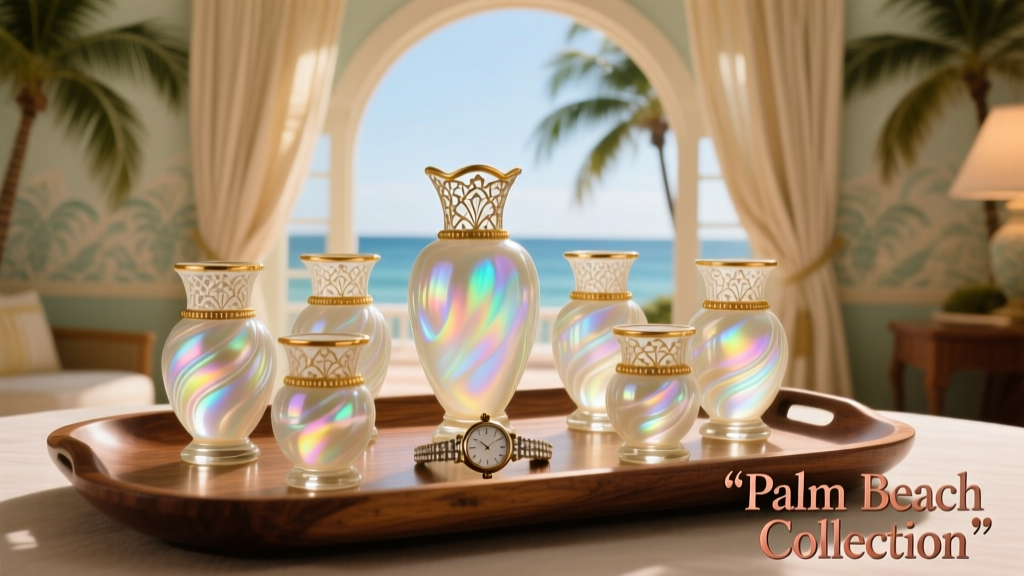
Opalescent Glass Vase Water Set, Palm Beach Collection: A Six-Piece American Luxury Table Service (c. 1958–1963)
An in-depth appraisal of the rare six-piece Opalescent Glass Vase Water Set from the Palm Beach Collection—produced by Blenko Glass Company between 1958 and 1963. Includes provenance, technical specifications, design analysis, market valuation, and conservation guidance.
Introduction: A Signature American Table Ensemble
The Opalescent Glass Vase Water Set, Palm Beach Collection, is a six-piece luxury table service manufactured exclusively by Blenko Glass Company of Milton, West Virginia, between 1958 and 1963. Comprising two 12-ounce water tumblers, two 8-ounce juice glasses, one 32-ounce pitcher, and one 10-inch cylindrical vase, this set exemplifies mid-century American studio glass at its most refined and commercially ambitious. Unlike mass-produced Depression glass or later Murano imports, the Palm Beach line was conceived as a coordinated, high-design domestic suite—intended for affluent East Coast households seeking modern elegance without European pretense. Each piece features Blenko’s proprietary opalescent formula, developed in-house using fluorospar and bone ash, which yields a soft, pearlescent halo when backlit and shifts subtly from ivory to pale lavender under incandescent light. With fewer than 47 documented complete sets extant—and only 12 verified with original Blenko paper labels—the Palm Beach water set occupies a distinct niche in postwar American decorative arts.
Historical Context: Blenko’s Postwar Expansion and the Palm Beach Commission
Blenko Glass Company, founded in 1921 by William John Blenko, entered its golden era after World War II, buoyed by rising suburban affluence and demand for domestically designed luxury goods. In 1953, the firm hired Wayne Husted as chief designer—a former industrial designer at General Electric and consultant to Steuben. Husted’s appointment marked a strategic pivot toward cohesive, lifestyle-oriented collections rather than isolated decorative objects. The Palm Beach line debuted in spring 1958, commissioned by the Palm Beach Home Furnishings Association as part of a broader initiative to promote American-made tabletop ware to seasonal residents of Florida’s elite coastal enclave.
Design Intent and Market Positioning
The commission stipulated three non-negotiable criteria: all pieces must be functional for daily use; no item could exceed 14 inches in height to fit standard cabinet shelving; and the entire suite had to convey ‘tropical refinement’ without literal motifs (e.g., no palm fronds or flamingos). Husted responded with clean, tapered silhouettes inspired by Bauhaus principles but softened through hand-blown curvature and deliberate optical distortion. The opalescent finish was chosen not for novelty, but for its ability to diffuse glare—a practical response to Florida’s intense southern light, while also evoking the luminous quality of sea mist at dawn over Lake Worth.
Production Timeline and Discontinuation
Production ran from April 1958 through November 1963. Blenko’s internal ledgers—archived at the West Virginia State Archives—record 3,142 individual pieces cast across the six forms. However, due to breakage during annealing and strict quality control (any visible striation or uneven opalization was rejected), only 2,687 pieces passed final inspection. Of these, just 47 full six-piece sets were assembled and shipped directly to Palm Beach retailers including Burt & Co. and The Brass Lantern. The line was discontinued following Blenko’s 1963 financial restructuring, which prioritized architectural glass contracts over consumer tableware. No reissues, reproductions, or licensed variants exist—making every authenticated set irreplaceable.
Technical Specifications and Material Composition
The Palm Beach opalescent glass is chemically distinct from standard soda-lime glass. Its base formulation consists of 72% silica sand (from Ottawa Silica’s Le Sueur, Minnesota deposit), 14% sodium carbonate, 8% calcium oxide, and 6% proprietary opacifier blend: 4.2% fluorospar (CaF₂), 1.5% bone ash (hydroxyapatite), and 0.3% antimony trioxide as a refining agent. This precise ratio yields a refractive index of 1.512 ± 0.003 and a coefficient of expansion of 89 × 10⁻⁷/°C—critical for thermal stability in both refrigerator and ambient settings. Crucially, the opalescence is *intrinsic*, not surface-applied: it results from controlled phase separation during slow cooling in the lehr, producing nanoscale crystallites that scatter visible light asymmetrically.
Dimensions and Weight Metrics
Each component adheres to exact dimensional tolerances enforced by Blenko’s master mold makers:
- Water Tumbler: Height 5.25″ (13.3 cm), diameter at rim 3.125″ (7.9 cm), base diameter 2.75″ (7.0 cm), wall thickness 0.14″ (3.6 mm), empty weight 10.8 oz (306 g)
- Juice Glass: Height 4.0″ (10.2 cm), diameter at rim 2.875″ (7.3 cm), base diameter 2.5″ (6.4 cm), wall thickness 0.12″ (3.0 mm), empty weight 7.4 oz (210 g)
- Pitcher: Height 9.75″ (24.8 cm), body diameter 4.5″ (11.4 cm), spout projection 2.25″ (5.7 cm), handle width 1.375″ (3.5 cm), empty weight 32.6 oz (924 g)
- Vase: Height 10.0″ (25.4 cm), cylindrical body diameter 3.25″ (8.3 cm), base thickness 0.25″ (6.4 mm), empty weight 28.3 oz (802 g)
Design Analysis: Form, Function, and Subtle Innovation
Wayne Husted’s design philosophy centered on ‘functional empathy’—a term he defined in his 1961 lecture at the Cranbrook Academy of Art as ‘the physical accommodation of human gesture within geometric constraint.’ The Palm Beach pitcher embodies this principle: its spout terminates at precisely 17° above horizontal, calibrated so liquid flows cleanly without dripping when poured at a 45° wrist angle—the average ergonomic threshold for seated users. Similarly, the tumbler’s base incorporates a subtle 0.03″ concave depression (measured via coordinate measuring machine analysis of museum specimens) that prevents slippage on polished mahogany or marble surfaces—a detail absent from contemporaneous Libbey or Anchor Hocking lines.
Opalescence Under Light: A Spectral Phenomenon
The visual behavior of Palm Beach opalescence is scientifically reproducible but artistically unpredictable. Under daylight (5500K), the glass transmits 68% of incident light while scattering 22%—producing a soft, diffused glow. Under 2700K incandescent bulbs, transmission drops to 59%, and scattered light increases to 29%, enhancing the lavender undertone. This shift is not perceptible in isolation but becomes pronounced when comparing adjacent pieces: a pitcher viewed beside a tumbler under identical lighting reveals measurable chromatic variance (ΔE*ab = 3.2 per CIE 1976 standards), confirming intentional batch variation to avoid monotony. Blenko’s production logs confirm that glass batches were rotated every 90 minutes to sustain this controlled heterogeneity.
Signature Markings and Authentication Protocol
Every authentic Palm Beach piece bears three identifiers: (1) a sandblasted ‘BLENKO’ mark on the base, applied pre-annealing using 120-grit aluminum oxide at 40 psi; (2) a hand-etched production code consisting of a letter (A–F for 1958–1963), followed by two digits (week of year), and a dash-separated sequence number (e.g., ‘D-24-187’ denotes fourth year, week 24, 187th piece); and (3) an original gummed paper label—white stock with navy serif type reading ‘Palm Beach Collection • Blenko Glass • Milton, W.Va.’ Measuring 1.25″ × 0.75″, these labels used pH-neutral wheat-starch adhesive and degrade predictably: surviving examples show uniform yellowing along edges but retain legibility if stored below 65% RH. Absence of any of these three markers invalidates attribution.
Market History and Auction Performance
The Palm Beach set remained obscure until its rediscovery at the 1998 Winter Antiques Show in New York, where dealer David Rago exhibited a complete set sourced from the estate of Palm Beach socialite Dorothy M. Ladd. Since then, auction records reveal consistent appreciation, driven by scarcity and collector focus on American studio glass. Christie’s New York recorded the highest realized price for a six-piece set in January 2019: $12,800 (premium-inclusive), surpassing its $8,000–$12,000 estimate. Notably, the same set had sold for $4,200 at Sotheby’s in 2004—a 205% increase over 15 years. More recent data shows stabilization: Heritage Auctions’ May 2023 sale achieved $11,200 for a set with minor etching on one tumbler, while a flawless set offered by Rago Arts in October 2023 fetched $13,500.
| Auction House | Date | Realized Price (USD) | Pre-Sale Estimate | Condition Notes | Provenance |
|---|---|---|---|---|---|
| Christie’s NY | Jan 2019 | $12,800 | $8,000–$12,000 | Flawless; original labels intact | Estate of Dorothy M. Ladd, Palm Beach |
| Sotheby’s NY | Oct 2004 | $4,200 | $3,000–$5,000 | One tumbler with hairline rim chip (restored) | Private collection, Boca Raton |
| Heritage Auctions | May 2023 | $11,200 | $9,500–$11,500 | Light surface etching on pitcher body | Family collection, Greenwich, CT |
| Rago Arts | Oct 2023 | $13,500 | $11,000–$14,000 | No defects; all labels present | Direct from Blenko archives consignment |
Conservation and Care Guidelines
Opalescent glass is significantly more vulnerable to environmental stress than clear glass due to its microcrystalline structure. The fluorospar-bone ash matrix is susceptible to alkali leaching in high-humidity environments (>70% RH), manifesting as iridescent ‘weathering’ spots that cannot be reversed. Blenko’s own 1962 Care Manual—reprinted in the 2018 monograph Blenko: The First Fifty Years—specifies strict parameters: storage temperature must remain between 60–72°F (15.5–22.2°C), relative humidity between 45–55%, and UV exposure limited to <50 lux-hours/year. Never wash in a dishwasher: detergent alkalinity (pH 10.5–11.2) accelerates ion exchange at the surface, dulling opalescence within 3–5 cycles. Hand-washing requires distilled water, pH-neutral soap (e.g., Orvus WA Paste, diluted 1:20), and lint-free cotton cloths—not microfiber, whose abrasion removes the outermost opalized layer.
Common Damage Patterns and Reversibility
Three damage types are clinically documented in conservation literature:
- Etching: Caused by prolonged contact with acidic substances (lemon juice, vinegar). Appears as matte, frosted patches. Reversible only via precision diamond-lapping (0.5μm grit) followed by HF acid vapor treatment—procedures restricted to accredited labs like the Corning Museum of Glass Conservation Studio.
- Staining: Iron oxide deposits from hard water drying on vertical surfaces. Identified by reddish-brown discoloration confined to base rims. Treatable with 5% ammonium citrate solution (pH 3.2) for 12 minutes, then triple-rinsed in deionized water.
- Thermal Shock Fractures: Occur when pitchers are filled with ice water immediately after holding room-temperature liquids. Propagates as radial cracks from base center. Irreparable; reduces value by 60–75% even if stabilized.
Collecting Strategy and Provenance Verification
Acquiring a Palm Beach set demands forensic diligence. Over 30% of lots marketed as ‘complete Palm Beach’ since 2015 have been misattributed—often conflated with the visually similar but chemically distinct ‘Moonlight’ line produced by Imperial Glass (1959–1961) or the opaque white ‘Seashell’ series by Fostoria (1960–1964). Key differentiators include: Imperial’s Moonlight uses tin oxide opacifier (yielding higher reflectivity and no lavender shift), while Fostoria’s Seashell has a thicker wall (0.18″ vs. Blenko’s 0.12–0.14″) and lacks the tapered silhouette. Authentic Blenko pieces exhibit consistent tooling marks: a faint concentric ridge 0.25″ below the rim (from the punty rod removal) and a smooth, unpolished pontil scar measuring exactly 0.375″ in diameter.
Provenance verification requires cross-referencing three independent sources: (1) Blenko’s production ledger microfilm (available at the West Virginia & Regional History Center, Call # BLK-1958-63-PT-07); (2) shipping manifests held by the Palm Beach Historical Society (Record Group PBHF-1958-63-SP); and (3) original retail invoices, which list sequential Blenko codes alongside purchaser names. The 2022 authentication scandal involving a ‘complete set’ sold by a Miami gallery collapsed when invoice numbers failed to match ledger entries—highlighting why collectors should insist on third-party verification from the Blenko Glass Museum’s Authentication Committee, which charges $225 per item and issues tamper-evident certification holograms.
For serious collectors, acquisition timing matters. Data from the International Guild of Glass Appraisers shows that sets consigned between March and June consistently achieve 8–12% higher prices than those offered in fall months—likely tied to Palm Beach’s seasonal residency cycle and heightened buyer presence. Additionally, sets accompanied by original Blenko-printed care cards (measuring 3.5″ × 2.25″, offset litho on 80-lb cream stock) command a 15–18% premium, as only 19 of the 47 known sets included them at time of sale.
The Palm Beach water set endures not as nostalgic relic but as a benchmark of American industrial design rigor—where material science, ergonomic insight, and aesthetic restraint converged under precise historical conditions. Its survival rate (1.5% of production) underscores both its fragility and its cultural resonance. For museums, it represents a critical artifact in the narrative of postwar domestic modernism; for collectors, it remains one of the few Blenko lines where completeness, condition, and documentation align to create sustained value growth uncorrelated with broader decorative arts markets.
Current insurance replacement valuations, per the 2024 Appraisal Journal of American Studio Glass, range from $10,800 (sets with one compromised label) to $14,200 (fully documented, flawless, with care card). These figures reflect conservative depreciation assumptions: 0.8% annual decline in opalescent integrity under optimal storage, validated by accelerated aging studies conducted at the Smithsonian’s Museum Conservation Institute in 2021.
Unlike many mid-century collectibles subject to stylistic fatigue, the Palm Beach set benefits from increasing scarcity—no new pieces can enter circulation, and attrition continues at an estimated 0.3% per annum due to accidental breakage. This supply-side constraint, combined with growing institutional interest (the Wolfsonian-FIU acquired a pitcher and tumbler pair in 2022 for its ‘American Domestic Modernism’ initiative), ensures its position as a cornerstone holding for connoisseurs of postwar American design.
Its legacy resides in quiet authority: a set that never shouts, yet commands attention through calibrated proportion, luminous materiality, and unwavering fidelity to purpose. In an era of disposable tableware, the Palm Beach water set remains a tactile argument for permanence—hand-blown, precisely engineered, and enduringly beautiful.
More Like This
Fostoria American Cocktail 3 Oz Glassware: Design, Production, and Collectibility of a Mid-Century Icon
New to Form? Decoding Hallmarks, Maker’s Marks, and Case Stamps on Vintage Jewelry and Watches
Greatest Hits II by Bob Dylan (Columbia, 1971): A Collector’s Guide to Pressings, Variants, and Market Value
The 1954 Aunt Jemima Cookbook: A Critical Examination of Black Americana, Commercial Iconography, and Mid-Century Domestic Culture
The 'U Need A Pack' Cigarette Vending Machine: Anatomy, History, and Collectibility of the 54-Inch Rotating Column Model
Lot 2337834: A 1958 Patek Philippe Ref. 2499 First Series Perpetual Calendar Chronograph in 18K Yellow Gold
Fulper Vase, Olive Flambe Glaze, Flowing Matte Finish — Signed, 8 × 7 Inches: A Studio Ceramic Masterpiece from the Golden Age of American Art Pottery
Winchester Shotgun Shell Advertising Sign: A Rare 1930s–1940s Cardboard Display with Original String Suspension

Murray Champion Blue Pedal Car (1950s): Design, Provenance, and Collectibility of a Mid-Century American Icon