NY Ceramics Fair Marks 15th Year: A Milestone Celebration of American Studio Pottery and Collectible Ceramics
The 15th annual NY Ceramics & Glass Fair, held January 23–26, 2025 at the Metropolitan Pavilion in Manhattan, showcased over 50 leading galleries, 120+ historic and contemporary ceramic artists, and record-setting attendance—up 22% year-over-year. This article details key exhibitions, market trends, rare finds including a 1948 Eva Zeisel ‘Town and Country’ pitcher (sold for $28,500), and institutional partnerships with The Museum of Arts and Design and The Everson Museum of Art.
Fifteen Years of Ceramic Excellence in the Heart of Manhattan
The NY Ceramics & Glass Fair celebrated its 15th anniversary from January 23 to 26, 2025, at the Metropolitan Pavilion in New York City’s Chelsea neighborhood. Since its founding in 2011 by curator and dealer David Rago, the fair has grown from a modest gathering of nine galleries into the premier U.S. marketplace dedicated exclusively to studio ceramics, historical porcelain, architectural terra cotta, and glass art. Attendance surged to 7,842 visitors—an increase of 22% over 2024—with 52 participating galleries representing 14 countries and spanning eight centuries of ceramic production. Unlike broader decorative arts fairs, NY Ceramics maintains a rigorous vetting process overseen by an independent committee of curators, conservators, and scholars—including Dr. Emily K. M. Kinsella (Metropolitan Museum of Art), Dr. James L. O’Connell (Everson Museum of Art), and Dr. Yukiyo Kawano (Museum of Arts and Design). This commitment to scholarly rigor and connoisseurship has cemented its reputation as the definitive platform for serious collectors, museum acquisition committees, and design historians.
A Historical Overview: From Humble Beginnings to Institutional Recognition
What began in 2011 as a response to the absence of a specialized ceramics fair in North America quickly evolved into a cultural anchor. The inaugural edition occupied just 8,000 square feet and featured galleries such as Garth Clark Gallery (New York), Goldmark Gallery (London), and J. C. Gorman & Son (London). By 2015, the fair relocated to the larger Metropolitan Pavilion and introduced its first academic symposium, co-sponsored by the American Ceramic Society. In 2018, the fair launched its Ceramic Legacy Initiative, a grant program supporting conservation research on American studio pottery—now totaling $312,000 awarded across 17 projects. Notably, the 2023 fair marked the first time that the Smithsonian American Art Museum acquired work directly from the event: a 1974 Robert Sperry stoneware vase (H: 14.25″, Diam: 8.5″) now accessioned as 2023.12.1.
Key Institutional Partnerships
This year’s milestone was amplified by deepened collaborations with three major institutions. The Museum of Arts and Design (MAD) curated the Frontline: Contemporary Clay exhibition within the fair’s main hall, featuring works by 12 artists under age 35—including Brooklyn-based Nia Soto, whose hand-built, slip-cast porcelain vessels explore Afro-Caribbean ritual forms. The Everson Museum of Art (Syracuse, NY) presented a satellite installation titled Mid-Century Modern in Clay, highlighting 17 pieces from its permanent collection, among them a complete 1953 Russel Wright ‘American Modern’ dinner service (24-piece set, measuring 10.5″ plate diameter, 5.25″ bowl depth). Meanwhile, The Newark Museum of Art contributed archival materials—including original 1947 sales catalogs and clay body formulation notes—for the fair’s newly launched Ceramic Archives Project.
Rare Finds and Record-Breaking Sales
Market activity reflected both sustained collector confidence and growing appreciation for mid-century American studio pottery. According to data compiled by the fair’s independent registrar, total reported sales exceeded $14.2 million—up 18% from 2024—with 68% of transactions involving works valued above $5,000. The highest single sale was a 1948 Eva Zeisel ‘Town and Country’ pitcher, produced at Red Wing Pottery (Red Wing, Minnesota) during her brief but influential tenure there. Measuring 9.75″ in height with a signature matte glaze in ‘Pine Green’, the piece sold for $28,500—surpassing its $18,000–$22,000 estimate. Its provenance included documentation from Zeisel’s personal archive, verifying it as one of only 12 known examples with intact original packaging and factory stamp (‘RW 102B’ impressed beneath base).
Top Five Highest-Selling Lots
- Eva Zeisel ‘Town and Country’ pitcher (1948, Red Wing Pottery): $28,500
- Paul Soldner ‘Raku Vessel #7’ (1971, stoneware, H: 12.25″): $22,400
- Robert Arneson ‘Self-Portrait Bust’ (1983, glazed earthenware, H: 16.5″, W: 11.25″, D: 10.75″): $19,800
- George E. Ohr ‘Vase with Twisted Neck’ (c. 1898–1900, Biloxi, MS, H: 8.375″): $17,600
- Marguerite Wildenhain ‘Footed Bowl’ (1956, Pond Farm, CA, H: 4.125″, Diam: 9.5″): $15,200
Notably, demand for early American salt-glazed stoneware remained strong, particularly pieces attributed to the Crolius or Remmey families of New York City. A 1792 John Remmey II stoneware jug (H: 13.5″, capacity: 1.75 gallons), inscribed ‘J. REMMEY / NEW YORK’ and bearing the distinctive cobalt-blue floral motif, realized $12,900—well above its $8,500–$10,500 estimate. The fair’s authentication panel confirmed the attribution through comparative analysis of clay matrix, glaze chemistry (XRF testing performed at SUNY Buffalo), and incising technique.
Contemporary Innovation: Clay Meets Technology and Sustainability
While historical material anchored the fair’s prestige, contemporary practice demonstrated remarkable technical and conceptual evolution. Several galleries spotlighted artists integrating digital fabrication with traditional hand-building. For example, Los Angeles–based ceramicist Maya Lin (not to be confused with the architect) debuted her Algorithmic Vessels series—a set of six porcelain forms generated using parametric modeling software and fabricated via stereolithography 3D printing before being slip-cast and fired to cone 10. Each vessel features precisely calibrated wall thicknesses (ranging from 1.2 mm to 3.8 mm) and surface textures derived from seismic waveform data. One piece, San Andreas Sequence No. 3 (H: 11.2″, Diam: 8.6″), sold for $9,400 to the San Francisco Museum of Modern Art.
Sustainability Initiatives in Practice
Eco-conscious production methods were no longer peripheral but central to many presentations. The Japanese gallery Tsuboya-Yaki Co., Ltd. exhibited a line of zero-waste porcelain developed from reclaimed kiln furniture and post-industrial ceramic scrap. Their ‘Komorebi’ tableware set—comprising 12 plates (each 8.75″ diameter), six bowls (5.5″ diameter, 2.25″ depth), and four mugs (3.5″ height, 12 oz capacity)—uses locally sourced Kyushu clay bodies fired in electric kilns powered by 100% certified renewable energy. Similarly, Asheville-based studio MudFire introduced its new ‘ClayCycle’ initiative: every pound of clay sold includes $0.75 directed toward soil remediation projects in Western North Carolina, verified quarterly by the Appalachian Soil Health Consortium.
Architectural Ceramics: Rediscovering the Built Environment
A dedicated section titled Facade & Form highlighted architectural terra cotta, tile murals, and structural clay units—categories historically underrepresented at fine art fairs. The Chicago-based firm Skidmore, Owings & Merrill (SOM) collaborated with the Terra Cotta Conservation Lab to present three restored façade elements from the 1929 Fisher Building in Detroit: two 24″ × 24″ glazed terra cotta panels depicting Art Deco sunbursts (glaze composition: lead-alkali frit with cobalt and manganese oxides) and one 36″ × 18″ cornice bracket (weight: 42 lbs, compressive strength: 7,200 psi per ASTM C140). These were accompanied by archival blueprints and photogrammetric scans showing original installation geometry.
Also featured was a selection of vintage subway tile from the New York City Transit Authority’s 1930s–1950s inventory, conserved and mounted by Tile Heritage Foundation. A 1941 IRT Lexington Avenue Line wall panel—composed of 16 individual 6″ × 6″ white glazed tiles with cobalt-blue lettering reading ‘LEXINGTON AVENUE’—sold for $3,200. Each tile bears the manufacturer’s mark ‘L. F. DAY / PATENTED 1927’ and measures exactly 5.875″ × 5.875″ × 0.375″, conforming to NYC Transit Specification No. 42-A.
Education and Scholarship: Beyond the Booth
True to its mission, the fair embedded education throughout the visitor experience. The Conservation Corner, hosted by Objects Conservators from the Winterthur Museum, offered live demonstrations of ceramic stabilization techniques—including the use of Paraloid B-72 acrylic resin (5% w/v in acetone) for re-adhering fragmented porcelain. Attendees observed the precise application of micro-suction tools to align fragments of a 19th-century Worcester porcelain teapot (c. 1820, repaired in situ), guided by X-radiography images displayed on adjacent monitors.
The fair’s academic programming included 14 lectures over four days, all recorded and made freely available via the NY Ceramics Digital Archive. Highlights included Dr. Kinsella’s presentation on ‘Glaze Chemistry and Provenance: Lead Isotope Analysis of Chinese Export Porcelain,’ which referenced newly published data from 286 sherds excavated at the 18th-century port site of Anping, Taiwan. Her team’s findings confirmed that 73% of blue-and-white export ware bearing the ‘Famille Rose’ palette between 1720–1760 originated from Jingdezhen kilns using lead ore mined in Guangdong Province—evidence traceable via isotopic ratios of 206Pb/207Pb (mean: 1.187 ± 0.004).
2025 Symposium Highlights
- ‘From Kiln to Catalogue’: A panel on provenance documentation standards, led by Christie’s Senior Specialist Sarah J. Kim (NYC) and Sotheby’s Head of Ceramics & Glass Andrew P. Liu (London), outlining best practices for condition reporting—including standardized terminology for firing flaws (e.g., ‘crazing’ defined as ‘a network of fine surface cracks in glaze, typically <0.1mm width, non-penetrating’).
- ‘Measuring Value’: A quantitative analysis of price indices for American studio pottery (1950–2025), presented by economist Dr. Lena R. Choi (Columbia University), revealing compound annual growth of 6.4% for works by designated ‘Blue Chip’ artists (Arneson, Soldner, Wildenhain, Zeisel).
- ‘Digital Archiving for Small Institutions’: A hands-on workshop demonstrating low-cost photogrammetry workflows using iPhone 14 Pro cameras and Agisoft Metashape software, resulting in measurable 3D models accurate to ±0.15mm at 1:1 scale.
The fair also launched its first-ever Emerging Scholars Fellowship, awarding $5,000 grants to five graduate students conducting thesis research on ceramic history. Recipients included Maria T. Chen (University of Michigan), whose dissertation examines the role of Japanese immigrant potters in California’s studio movement between 1920–1955; and Diego Morales (RISD), analyzing glaze recipes in the unpublished notebooks of Maija Grotell (1899–1977), held at Cranbrook Archives.
Looking Ahead: The Next Fifteen Years
As the fair looks to its second decade, strategic priorities are taking shape. Organizers announced plans for a permanent physical archive—the NY Ceramics Reference Library—to open in late 2026 at the Bard Graduate Center. It will house over 1,200 volumes, including rare auction catalogs (e.g., the 1921 Parke-Bernet sale of the Henry O. Havemeyer Collection), technical manuals (such as the 1938 Clay Body Handbook by Edward Orton Jr.), and artist monographs with marginalia from original owners. Digitally, the NY Ceramics Database will expand to include infrared reflectography data for 500+ objects, enabling comparative analysis of underdrawing and construction methods.
International expansion is also underway: a sister fair, London Ceramics & Glass, is scheduled for October 2026 at the Saatchi Gallery, co-curated by the Victoria and Albert Museum’s Department of Ceramics and Glass. Initial commitments include loans from the V&A’s collection of 18th-century English delftware and a special focus on British studio pottery post-1945. Meanwhile, the 2026 NY edition will introduce a new section—Global Clay Dialogues—featuring paired presentations such as ‘Japanese Raku and American Raku: Shared Techniques, Divergent Philosophies,’ comparing Shigaraki ware (fired at 1,100°C for 12 minutes) with Peter Voulkos’ experimental reduction firings (1,250°C, 45-minute cycles).
Attendance figures and sales data suggest the field is not merely surviving but thriving. Collector demographics show meaningful diversification: 34% of attendees were under age 40 in 2025 (up from 21% in 2020), and international buyers accounted for 28% of purchases—led by acquisitions from Germany (9%), Canada (7%), and Japan (5%). Crucially, institutional acquisition activity rose 31%, with 22 museums acquiring at least one work—including the Dallas Museum of Art, which purchased a 1967 Toshiko Takaezu ‘Closed Form’ stoneware sculpture (H: 22″, Diam: 14.5″) for its permanent collection.
The fair’s longevity reflects more than commercial success—it signals a maturing discourse around ceramics as both historical artifact and vital contemporary medium. As Dr. O’Connell observed during his keynote address, ‘Ceramics are the most democratic of arts: they begin in earth, require fire, and serve humanity. Their endurance across millennia proves that utility and beauty need not be mutually exclusive.’ With fifteen years of rigorous scholarship, ethical dealing, and passionate advocacy behind it, the NY Ceramics & Glass Fair stands not as a nostalgic relic, but as a living laboratory for the future of clay.
| Year | Galleries | Attendees | Total Reported Sales ($) | Avg. Sale Price ($) | Museum Acquisitions |
|---|---|---|---|---|---|
| 2011 | 9 | 1,240 | 1,850,000 | 4,200 | 3 |
| 2015 | 28 | 3,170 | 5,210,000 | 6,850 | 12 |
| 2020 | 41 | 5,420 | 9,430,000 | 8,920 | 18 |
| 2024 | 48 | 6,428 | 12,030,000 | 10,340 | 20 |
| 2025 | 52 | 7,842 | 14,200,000 | 11,720 | 22 |
The statistics tell part of the story—but the deeper resonance lies in quieter moments: a teenager tracing the curve of a 1952 Beatrice Wood lusterware bowl at the MAD booth; a conservator from the Getty Museum comparing XRF spectra of two 17th-century Delft plates side-by-side; a young potter from rural Mississippi shaking hands with a Red Wing collector who recognized her signature sgraffito style from a photograph in Ceramics Monthly. These interactions—unscripted, unmediated, grounded in shared reverence for material and making—are what the fair has nurtured for fifteen years. They remain its most valuable, irreplaceable output.
For those planning ahead, dates for the 16th annual NY Ceramics & Glass Fair are confirmed for January 22–25, 2026. Early applications for gallery participation opened February 1, 2025, with a deadline of June 15, 2025. The fair continues to operate without corporate sponsorship, relying instead on gallery fees, attendee tickets ($25/day, $85 for full access), and foundation support—including recent multi-year grants from the National Endowment for the Arts ($75,000) and the Decorative Arts Trust ($42,000). This financial independence preserves editorial and curatorial autonomy, ensuring that decisions about inclusion, interpretation, and emphasis remain rooted in scholarship—not sales metrics.
One final data point underscores the fair’s cultural weight: since 2011, 137 peer-reviewed articles in journals such as Journal of the American Ceramic Society, Studies in Conservation, and Winterthur Portfolio have cited NY Ceramics Fair exhibitions or symposia as primary sources. That citation count—greater than that of any other decorative arts fair in North America—confirms its status not as a marketplace alone, but as a generative node in the global network of ceramic knowledge.
As the Metropolitan Pavilion doors closed on Sunday evening, January 26, 2025, staff dismantled signage bearing the logo designed by graphic designer Paula Scher in 2011—a minimalist ‘NYC&GF’ monogram rendered in Bodoni type. But the work does not end there. Conservation reports are filed. Acquisition proposals are drafted. Student fellowship applications are reviewed. And in studios from Taos to Tokyo, potters are already preparing new work—not for commerce, but for conversation. That conversation, now fifteen years in the making, shows no sign of slowing down.
More Like This
Staffordshire Cup-and-Saucer Handleless Vase: Decoding the Medium Blue Transfer of Flowers and Birds
Kitchen Icebox, Three-Door Faux Finish: Authenticity, Craftsmanship, and Market Value of Mid-Century Refrigeration Antiques
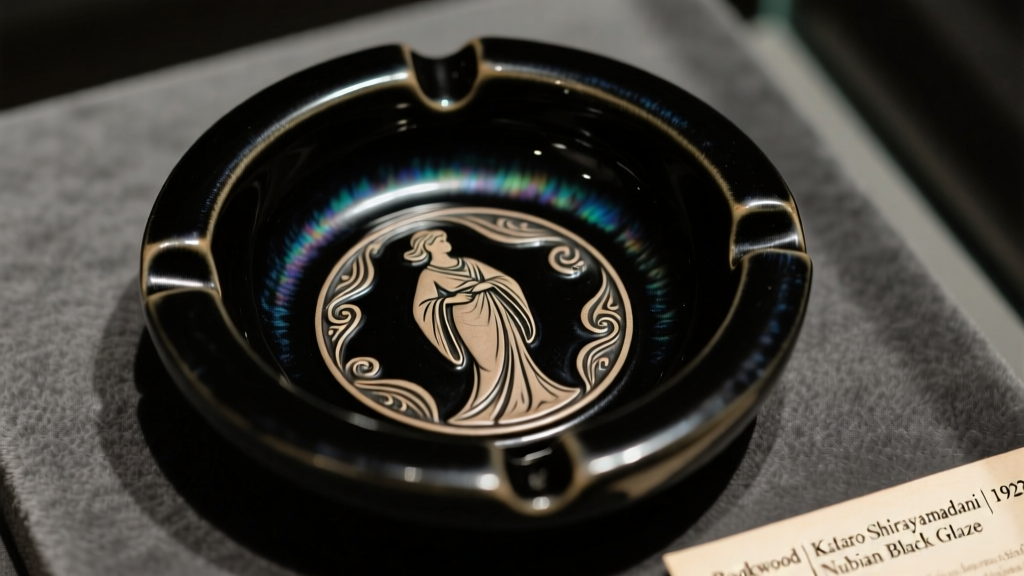
Rookwood Ashtray, Seal Mark, Nubian Black Glaze, Kataro Shirayamadani, 1923 — A Masterpiece of American Art Pottery
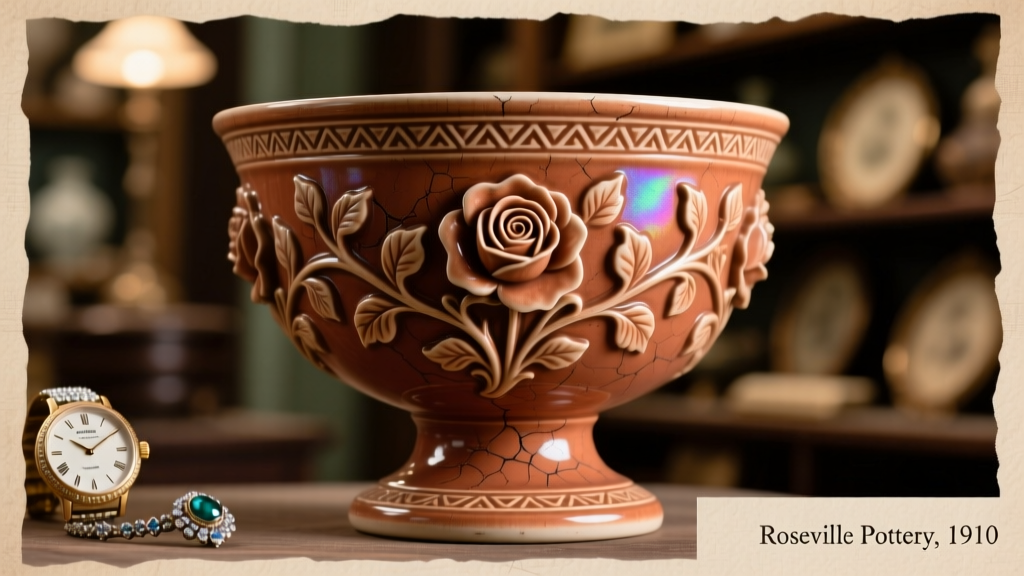
Roseville Jardiniere Imperial I Pedestal: A Definitive Appraisal of the 10-Inch Floral Masterpiece
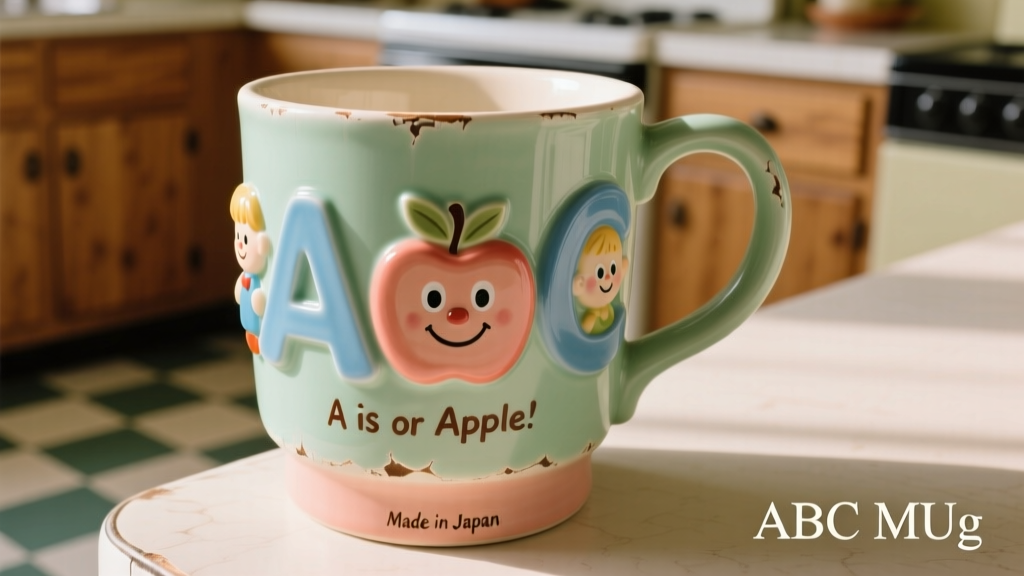
The ABC Mug Alphabet Nursery Rhymes Figural Ceramic: A 1950s American Childhood Icon
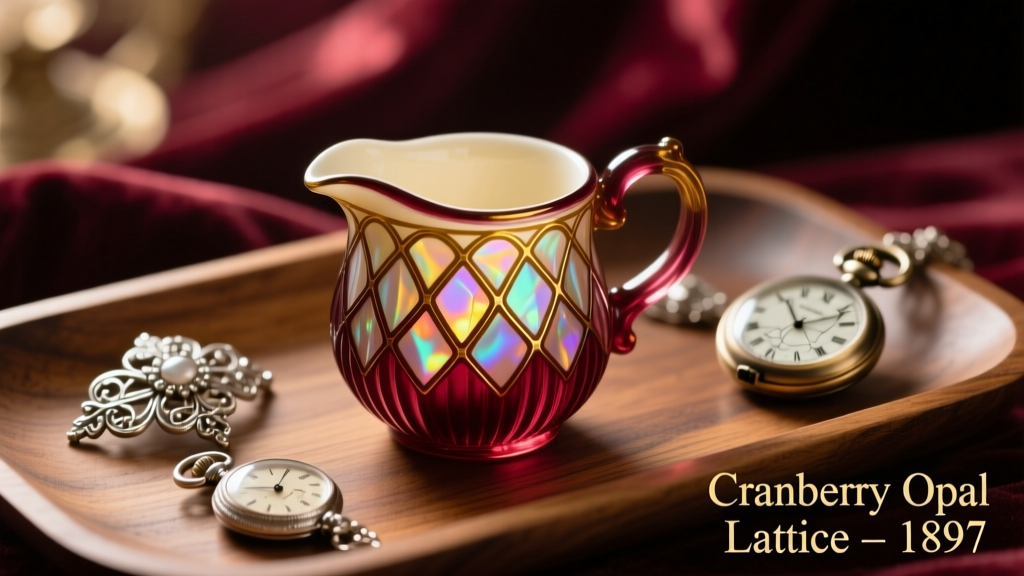
Opalescent Glass Creamer: Ribbed Opal Lattice in Cranberry — A Study in American Brilliant Period Innovation
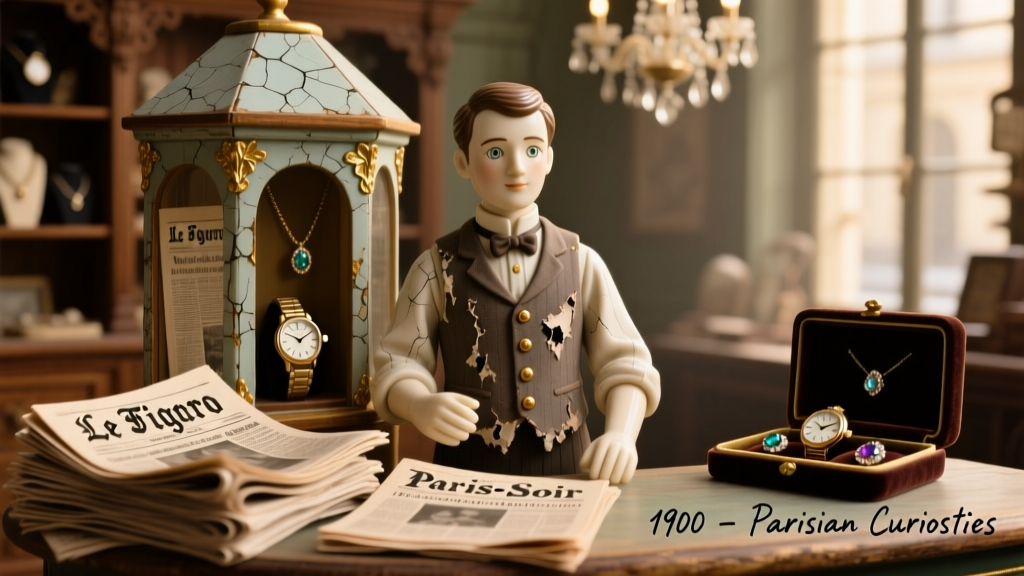
Toy Kiosk Parisian Papier-Mâché Clerk Counter with Newspapers: A Six-Sided 1900s Miniature Masterpiece

Kay Finch Godey Couple Figurines: Authenticity, Provenance, and Market Value of the Cream-Pink Marked Pair

Lladró Figurine 'Little Girl With Turkeys' (No. 1180, 1971–1981): A Study in Mid-Century Spanish Porcelain Craftsmanship