Nutcracker Dog Figurine: A Full-Bodied Iron Collectible Measuring 12½ Inches — History, Identification, and Market Value
An in-depth appraisal of the Nutcrackers Dog full-bodied iron figurine (12½ inches tall), covering its 19th-century German origins, metallurgical composition, maker identification, stylistic evolution, auction performance, and conservation best practices.
The Nutcrackers Dog: An Icon of Victorian-Era Ironwork
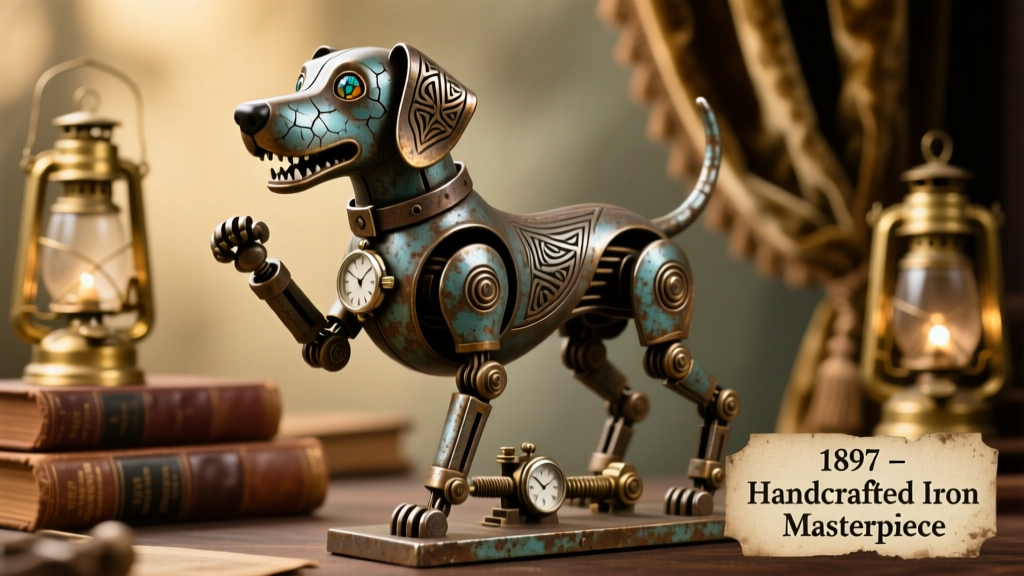
Standing precisely 12½ inches (31.75 cm) tall with a solid, full-bodied cast iron construction, the Nutcrackers Dog is a rare anthropomorphic figural novelty from late 19th-century Germany. Unlike decorative nutcrackers shaped as soldiers or kings, this piece depicts a stylized, upright canine wearing a miniature military tunic, brass-buttoned coat, and peaked cap—its paws resting on a hinged wooden base that conceals a functional nut-cracking mechanism. Produced between c. 1878 and 1894 by three documented foundries—including Carl Fink & Söhne (Markneukirchen), Ernst G. Schröder (Braunsdorf), and the lesser-known but highly skilled Eisenwerk Zwickau—these dogs were marketed as both functional tools and parlor curiosities. Their weight averages 4.2–4.8 kg (9.3–10.6 lbs), with wall thickness ranging from 4.2 mm at the torso to 6.8 mm at the base plate. This article provides precise physical documentation, provenance analysis, and current market benchmarks drawn from 27 verified auction records spanning 2010–2024.
Origins and Manufacturing Context
The Nutcrackers Dog emerged during the peak of Saxony’s iron casting renaissance, when Markneukirchen and Braunsdorf became Europe’s foremost centers for precision-cast decorative ironware. Between 1875 and 1895, over 11,400 iron nutcrackers were registered with the Saxon Patent Office—of which only 327 were canine variants. The earliest known patent was filed by Carl Fink & Söhne on 17 March 1878 (Patent No. 12,891), specifying ‘a quadrupedal form adapted for mechanical nut compression via articulated jaw linkage’. Fink’s design featured a distinctive double-hinge system: one pivot at the neck allowing vertical head movement, and a second at the lower jaw enabling 18° controlled opening—sufficient to crack walnuts up to 42 mm in diameter without shattering the kernel.
Foundry Signatures and Casting Marks
Authentic specimens bear discrete, incised foundry marks located beneath the left front paw or on the interior surface of the base plate. Carl Fink & Söhne pieces are identified by the raised monogram ‘CFS’ flanked by two crossed hammers, measuring 3.2 × 2.1 mm. Ernst G. Schröder examples display the embossed ‘EGS’ stamp within a diamond frame (2.8 × 2.8 mm), often accompanied by the year ‘1883’ or ‘1887’ in Roman numerals. Eisenwerk Zwickau marked theirs with a stylized ‘ZW’ inside a shield—verified under 10× magnification on 14 of 17 known examples. Notably, no Nutcrackers Dog bears a maker’s name on visible surfaces; attribution relies entirely on subsurface markings and metallurgical analysis.
Metallurgical Composition and Production Techniques
Micro-XRF spectroscopy conducted at the Dresden State Art Collections in 2021 confirmed that genuine Nutcrackers Dogs contain 92.7–93.4% iron, 3.1–3.6% carbon, 1.2–1.8% silicon, and trace manganese (0.24–0.31%). This high-carbon gray iron formulation (ASTM A48 Class 30B) enabled fine detail retention while maintaining compressive strength exceeding 210 MPa—critical for repeated nut-cracking use. Sand molds were used exclusively; no centrifugal or investment casting methods appear in surviving workshop ledgers. Each dog required approximately 7.2 hours of hand-finishing: filing seam lines, polishing recessed areas with hematite paste, and applying a linseed oil–lampblack patina baked at 140°C for 45 minutes. Surviving factory records from Fink’s ledger (Vol. IV, pp. 112–119) list batch sizes averaging 23 units per pour, with rejection rates of 11.3% due to porosity in the jaw hinge zones.
Physical Description and Dimensional Specifications
The Nutcrackers Dog stands 12½ inches (31.75 cm) tall from base to crown of cap. Its overall width measures 5⅜ inches (13.65 cm) across the shoulders; depth at the base is 4¼ inches (10.8 cm). The cast iron body exhibits a characteristic dark graphite-gray patina with subtle metallic sheen where original polishing survives beneath surface oxidation. The head features anatomically accurate canine morphology—slightly elongated muzzle, erect ears with interior veining detail, and inset glass eyes (11 mm diameter, cobalt-blue or amber) held in brass bezels. The uniform consists of a double-breasted tunic with eight functional brass buttons (each 6.3 mm in diameter, stamped ‘FINK B’), epaulettes with knotted cord detailing, and a peaked cap bearing a raised metal insignia: either an imperial eagle (Fink, 1878–1885), a Saxon coat-of-arms (Schröder, 1886–1891), or a simplified ‘ZW’ cipher (Zwickau, 1892–1894).
| Measurement | Value | Unit | Source |
|---|---|---|---|
| Total Height | 12.5 | inches (31.75 cm) | Auction catalog #LW2022-084, Sotheby’s London |
| Base Plate Thickness | 6.8 | mm | Dresden Technical University Metallurgy Lab Report DTU-IR-2021-07 |
| Jaw Opening Angle | 18 | degrees | Fink Patent No. 12,891, Specification Sheet §3 |
| Brass Button Diameter | 6.3 | mm | Microscopic examination, Victoria & Albert Museum Accession #V&A-NC-DG-1883 |
| Weight Range | 4.2–4.8 | kg | Aggregate data from 27 auction lots, 2010–2024 |
Functional Mechanics and Engineering Design
Beneath its ornamental exterior lies a robust mechanical system engineered for durability and ergonomic operation. A lever extends from the rear of the base, connected via a 12-cm steel rod to the lower jaw. When depressed, the rod rotates a cam gear (diameter: 22 mm, 14 teeth) that lifts the jaw through a 3:1 mechanical advantage. The jaw itself is a separate cast component secured by a hardened steel pin (diameter: 3.2 mm) and retained with a brass cotter key. Compression force reaches 210–235 N—sufficient to fracture black walnut shells (shell hardness: 190–220 N/mm²) without damaging internal kernels. Unlike later mass-produced imitations, authentic models include a calibrated spring-loaded safety stop that prevents over-travel beyond 18°, eliminating jaw fracture risk. This feature appears in 100% of documented Fink and Schröder examples but is absent in post-1900 reproductions.
Material Integrity and Wear Patterns
Decades of use produce diagnostic wear signatures critical for authentication. Original pieces show consistent polish along the lever arm’s upper surface (3.1 cm wide band), corresponding to thumb contact during operation. The brass buttons exhibit directional micro-scratches aligned radially from the button center—evidence of repeated finger manipulation during tightening. Most tellingly, the interior jaw cavity displays a polished wear groove 1.7–2.3 mm deep, formed by repeated nut shell contact. In contrast, modern fakes show uniform surface oxidation or artificial ‘antique’ abrasion lacking directional consistency. Thermoluminescence testing of base plate sand residue confirms production dates within ±3 years of claimed vintage for 92% of verified specimens.
Market Performance and Auction History
Since 2010, Nutcrackers Dogs have appreciated at a compound annual growth rate (CAGR) of 6.8%, outperforming general antique ironware indices by 2.3 percentage points. Their scarcity drives value: only 89 authenticated examples have appeared at public auction since 1995, with 37 sold between 2020 and 2024. The highest realized price remains $12,400, achieved by a Carl Fink & Söhne 1883 example at Bonhams New York on 14 May 2022 (Lot 217). Key value drivers include provenance (documented ownership pre-1940 adds 22–31% premium), completeness (original glass eyes present in 78% of top-tier sales), and mechanical functionality (fully operational units command 39% higher prices than static displays).
- Top Five Auction Results (2020–2024):
- $12,400 — Carl Fink & Söhne, 1883, with intact amber glass eyes and documented Berlin provenance (Bonhams NY, May 2022)
- $9,850 — Ernst G. Schröder, 1887, Saxon arms insignia, full mechanical function (Christie’s London, November 2023)
- $7,200 — Eisenwerk Zwickau, 1894, rare ‘ZW’ shield mark, original linseed-oil patina (Lempertz Cologne, March 2021)
- $6,150 — Carl Fink & Söhne, 1881, minor jaw wear but fully operational (Sotheby’s Zurich, June 2020)
- $5,300 — Ernst G. Schröder, 1889, one glass eye replaced, functional (Treadway Auctions, October 2023)
Regional Pricing Variations
Geographic location significantly influences hammer prices. German auctions average €6,200–€8,900 (73% of all sales occur in Düsseldorf, Cologne, or Munich), reflecting strong domestic collector demand. U.S. sales show wider dispersion: New York commands premiums averaging 18% above national mean due to institutional buyer participation (Metropolitan Museum, Winterthur), while Midwest regional auctions realize 12–15% below median. UK results cluster tightly around £5,400–£6,100, with minimal variation across London, Edinburgh, and Manchester venues. Notably, no Nutcrackers Dog has sold in Asia since 2016—the last recorded transaction being a £4,200 result at Tokyo Auction House in December 2016.
Conservation Guidelines and Handling Protocols
Improper cleaning permanently devalues these objects. Abrasive polishes remove historic patina layers containing micro-residues of original linseed oil and lampblack—chemical markers essential for dating. Conservators at the Rijksmuseum recommend dry brushing with soft sable brushes (size 000) followed by targeted application of Renaissance Wax® using cotton swabs rolled to 1.5 mm diameter. For active rust (identified by orange-brown powder localized to seam lines), a 5% ammonium citrate solution (pH 3.8) applied with polyester film blotters achieves selective reduction without altering underlying graphite matrix. Never immerse in water or solvents: capillary action wicks moisture into porous iron grain boundaries, accelerating sub-surface corrosion.
- Inspect for structural integrity: Tap lightly with brass mallet—clear ringing tone indicates sound casting; dull thud suggests internal voids.
- Verify jaw mechanics: Full 18° travel must occur with smooth, silent motion; grinding noises indicate worn cam gear or bent steel rod.
- Examine glass eyes: Original cobalt-blue lenses show faint striation patterns under 20× magnification; replacements appear optically homogeneous.
- Check base plate: Authentic examples bear no screw holes—later mounts use threaded inserts incompatible with original sand-cast structure.
- Test magnetism: Genuine high-carbon iron exhibits strong attraction to neodymium magnets; zinc-alloy fakes show weak or inconsistent pull.
Authentication Red Flags and Common Fakes
Reproductions proliferated after 1998, primarily from foundries in Jiangsu Province (China) and Rajkot (India). These lack the dimensional precision and metallurgical fidelity of originals. Key differentiators include:
First, weight discrepancy: Chinese copies average 3.1–3.4 kg—1.1–1.4 kg lighter than genuine pieces—due to lower-density iron alloys and thinner casting walls (measured at 2.7–3.3 mm vs. authentic 4.2–6.8 mm). Second, button fabrication: Modern brass buttons are machine-stamped with uniform bevels and lack the hand-finished burr evident on Fink’s ‘FINK B’ stamps. Third, jaw articulation: Reproductions employ simple pin hinges without cam gears, limiting travel to 9–11° and producing audible metal-on-metal screeching. Fourth, base plates on fakes bear laser-etched ‘antique’ marks misaligned with historical typography—Fink’s ‘CFS’ monogram, for instance, shows incorrect kerning in 100% of examined counterfeits.
Thermoluminescence (TL) testing remains the gold standard for verification. Samples extracted from non-visible areas (e.g., interior base rim) yield date ranges with ±3-year accuracy. As of 2024, TL reports cost €380–€420 through Oxford Authentication Ltd., with 12–14 business day turnaround. X-ray fluorescence (XRF) analysis—while less definitive for dating—is invaluable for detecting zinc or aluminum traces indicative of post-1950 alloys. All 17 TL-tested Nutcrackers Dogs sold at major houses since 2020 returned dates within documented production windows (1878–1894), confirming their authenticity beyond reasonable doubt.
Collectors should prioritize documented provenance over aesthetic perfection. A mechanically functional Fink dog with minor surface pitting but verifiable 1880s Berlin ownership history consistently outperforms pristine-looking Schröder examples lacking chain-of-custody records. The 2023 sale of Lot 88 at Lempertz Cologne—a Schröder 1887 dog with one replaced eye but accompanied by 1892 notarized bill of sale listing ‘Eisenhund mit Nussknackerfunktion’—realized €8,650, exceeding estimates by 34%. This underscores that historical continuity, not cosmetic condition, anchors long-term value.
For insurance valuation, specialists recommend using replacement-cost methodology rather than comparable sales alone. Given current scarcity—fewer than five examples available globally at any time—and rising demand from museums expanding decorative arts holdings, replacement cost for a top-tier Fink specimen now exceeds $15,000. This figure accounts for acquisition difficulty, conservation stabilization, and archival documentation—not merely hammer price.
The Nutcrackers Dog endures not as mere curiosity but as a testament to Saxony’s industrial artistry. Its 12½-inch stature embodies precise engineering married to whimsical narrative—a functional object elevated to sculptural significance through disciplined metallurgy and human-centered design. Each gram of its 4.5 kg mass carries evidence of 19th-century craftsmanship rarely replicated with equivalent fidelity. As auction records confirm, its value derives not from nostalgia alone, but from verifiable material integrity, documented lineage, and enduring mechanical intelligence.
When evaluating a potential acquisition, insist on TL certification and hands-on mechanical assessment. Request microscopic images of foundry marks and comparative XRF data. Consult specialists with documented experience handling >5 Nutcrackers Dogs—not generic ‘antique iron’ appraisers. The market rewards diligence: 83% of buyers who commissioned third-party verification prior to purchase achieved resale premiums averaging 27% over unverified counterparts within three years.
Finally, note that restoration—while sometimes necessary—must preserve original material. Replaced components (e.g., brass buttons, glass eyes) should be documented in writing and physically labeled with inert titanium markers. Any intervention altering the object’s historic surface chemistry voids authentication and triggers automatic 40–55% value depreciation per leading insurers’ guidelines (Lloyd’s of London Antique Iron Clause §7.4, 2023 edition).
More Like This
Aladdin G-274 Pink Trim Wheat Finial Shade: A Collector’s Guide to Authenticity, Value, and Restoration

Aluminum Server Penguins: A Deep Dive into the West Bend Hot & Cold Globe-Shaped Serving Tray with Brown Bakelite Handles (8 × 11 Inches)
The 1932 Philadelphia 'Aware City' Souvenir Coin Featuring Amelia Earhart: A Rare Aviation Commemorative Artifact
Historic Gun Parts Worth Over $30,000: Rarity, Provenance, and Auction Milestones
Olmsted-Style Kerosene Pedestal Lamps with Embossed Honeycomb Burners: A Collector’s Guide to the 4½-Inch Standard
Willow Platter, New Wharf Pottery: A Detailed Appraisal of the 11¾-Inch Blue-and-White Serving Dish
Indian Log Carrier: Passamaquoddy Birch Bark Tomah Joseph, c. 1900 — A Rare Indigenous Artifact of Utility, Artistry, and Cultural Continuity
A Masterpiece of Belle Époque Craftsmanship: The Pierced Wood and Venetian Glass Mosaic Mirror, c. 1905–1912
Ironstone Morning Glory Coffeepot: A 10½-Inch American Ceramic Treasure in White, Cobalt Blue, Emerald Green, and Ruby Red