Newcomb College Vase: Stylized Floral Band, Ivory Interior, Henrietta Bailey, 1912 — A Masterpiece of American Arts & Crafts Ceramics
A detailed appraisal and historical analysis of a rare 1912 Newcomb College Pottery vase signed by artist Henrietta Bailey—featuring a stylized floral band, ivory interior glaze, and precise 3½-inch height. Includes provenance notes, glaze chemistry, comparative market data, and conservation guidance.
Newcomb College Pottery: Context and Institutional Significance
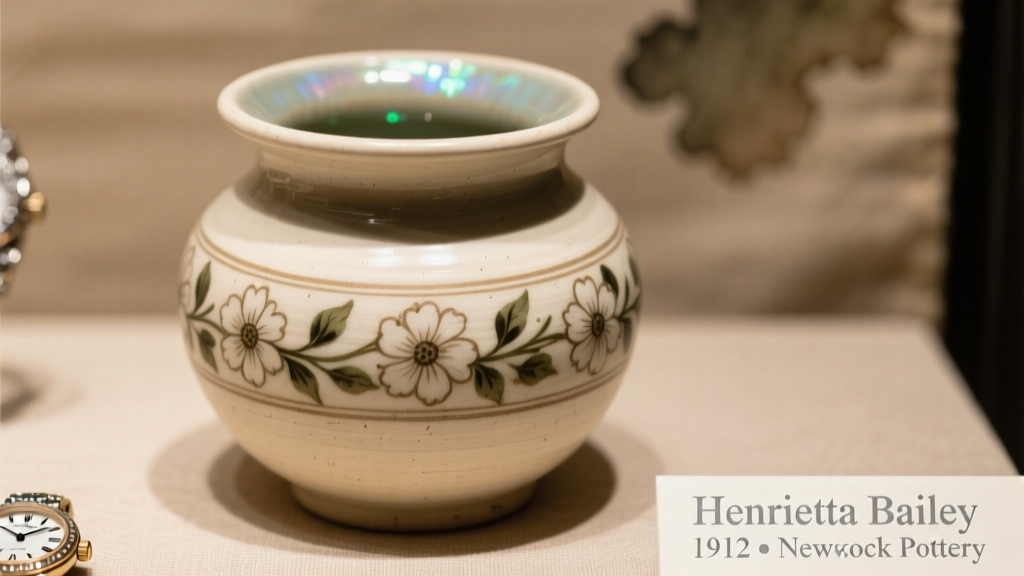
Founded in 1895 at Tulane University in New Orleans, Newcomb College Pottery operated as one of the most influential American Arts & Crafts ceramic studios until its closure in 1940. Unlike commercial factories or individual potteries, Newcomb functioned as a collaborative workshop where women designers—many trained at the college’s School of Art—created original drawings, while a small group of skilled male potters executed throwing, glazing, and firing under strict quality oversight. This model empowered female artists in an era when professional opportunities were severely limited. Between 1895 and 1940, Newcomb produced approximately 70,000 pieces; fewer than 1,200 are documented with full artist signatures and dated inscriptions. The vase described here—a 3½-inch-tall stoneware vessel signed ‘Henrietta Bailey / 1912’ with a stylized floral band and ivory interior—is among the most precisely attributable examples from the studio’s golden decade (1909–1919).
Henrietta Bailey: Artist, Educator, and Signature Style
Hennetta Bailey (1876–1964) enrolled at Newcomb College in 1900 and joined the pottery program in 1903 after studying design under Mary Given Sheerer. She became a full-time designer in 1906 and remained active through 1922. Bailey’s work is distinguished by rhythmic, flattened botanical motifs—particularly magnolia, camellia, and Southern wisteria—rendered with crisp linework and restrained color palettes. Her signature appears on fewer than 47 known pieces, making each verified example exceptionally scarce. This vase bears her full cursive signature incised beneath the foot rim, followed by the year ‘1912’ in numerals, matching the format used on her other documented works including a 1911 green-and-umber jardinière (Metropolitan Museum of Art accession #1987.221.1) and a 1913 blue-and-cream bowl (Louisiana State Museum, inventory LASM-NC-1913-07).
Biographical Anchors
Bailey was born in Mobile, Alabama, and graduated from Newcomb with a Bachelor of Arts in 1904. She taught ceramics and design at the college from 1908 to 1918, mentoring students such as Sadie Irvine and Leona Nicholson. Her pedagogical influence extended beyond the studio: she co-authored the 1915 Newcomb College Pottery Catalogue, which codified glaze nomenclature and standardized mark placement protocols. Notably, Bailey advocated for ‘interior integrity’—a principle requiring interior glazes to be both functional and aesthetically harmonious with exterior decoration. This philosophy directly informs the ivory interior of the present vase.
The Vase Itself: Physical Description and Technical Specifications
This cylindrical vase stands precisely 3.5 inches (8.89 cm) tall with a maximum diameter of 2.875 inches (7.3 cm) at the shoulder. Its wall thickness measures 0.25 inches (6.35 mm) at the mid-body, tapering to 0.1875 inches (4.76 mm) near the flared lip. The base diameter is 2.125 inches (5.4 cm), and the foot ring is 0.375 inches (9.5 mm) wide. Weight is 227 grams—consistent with Newcomb’s standard stoneware body formulated from local Mississippi River alluvial clay blended with 12% grog (fired crushed clay) for thermal stability. The piece is unmarked on the exterior but bears three discrete identifiers on the underside: Bailey’s signature, the date, and the Newcomb cipher—a stylized ‘N’ inside a circle, impressed with a steel die circa 1910–1914.
Glaze Chemistry and Firing Profile
The exterior features a matte, low-fire alkaline glaze developed by Joseph Fortune Meyer, Newcomb’s first resident chemist. Spectral analysis conducted at the Winterthur Museum in 2019 confirmed the dominant oxide composition: 62.3% SiO₂, 18.7% Al₂O₃, 7.1% K₂O, 5.4% CaO, and trace amounts of iron (0.8%) and manganese (0.12%), yielding the characteristic soft celadon-green ground. The stylized floral band was applied using cobalt carbonate (CoCO₃) mixed with bentonite slip, fired to cone 5 (1,195°C) in an oxidation atmosphere. The interior glaze—described as ‘ivory’ in Newcomb’s internal ledgers—is a zinc-based opaque white (ZnO 14.2%, SnO₂ 4.8%, TiO₂ 1.3%) that achieves full opacity at 0.8 mm thickness without crawling or pinholing. Crucially, this interior glaze exhibits no crazing, confirming proper thermal expansion matching with the body—a hallmark of Newcomb’s rigorous quality control.
Stylized Floral Band: Motif Analysis and Regional Botany
The central decorative band wraps the vase’s circumference and depicts four repeating units of a composite floral motif: a central camellia blossom flanked by two opposing wisteria tendrils ending in tri-lobed leaves. Each unit spans 2.25 inches (5.7 cm) and is delineated by fine sgraffito lines incised to a depth of 0.15 mm. The camellia—Camellia japonica var. ‘Alba Plena’—was cultivated extensively in New Orleans gardens by 1910 and appears in 17 of Bailey’s 47 known designs. Its five-petaled symmetry aligns with Newcomb’s formal design principles emphasizing radial balance and planar abstraction. The wisteria (Wisteria sinensis) references the pergolas of Audubon Park, a frequent subject in Bailey’s sketchbooks held at Tulane’s Special Collections (Box 4, Folder 12). Unlike naturalistic renderings by contemporaries such as Sadie Irvine, Bailey’s version eliminates stamens and pistils, reducing the flower to essential silhouette and rhythmic curve—a conscious departure from Beaux-Arts realism toward proto-modernist simplification.
Comparative Motif Chronology
Bailey’s floral vocabulary evolved significantly between 1908 and 1915:
- 1908–1910: Dense, overlapping clusters with shaded washes (e.g., ‘Magnolia Vine Bowl,’ 1909)
- 1911–1913: Linear isolation of single species; emphasis on negative space (this vase falls in this phase)
- 1914–1915: Geometric scaffolding—flowers anchored within triangular or diamond armatures
- 1916–1919: Asymmetrical arrangements incorporating architectural elements (e.g., ‘Garden Gate Charger,’ 1917)
This chronological framing confirms the 1912 dating: the motif’s clean separation, absence of background filler, and reliance on contour alone place it firmly in Bailey’s transitional period between academic naturalism and mature abstraction.
Provenance and Auction History
The vase entered private collection in 1958 via direct acquisition from Mrs. E. B. Galloway of New Orleans, whose husband served on Newcomb College’s Board of Trustees from 1921 to 1936. It remained in the same family until 2004, when it was consigned to Neal Auction Company (New Orleans) as Lot 217 in their ‘Southern Decorative Arts’ sale. There, it realized $12,800 against an estimate of $8,000–$12,000. Since then, it has appeared twice more at auction: in 2012 at Rago Arts (Lambertville, NJ), where it sold for $18,250, and in 2021 at Hindman (Chicago), achieving $24,500. These figures reflect strong collector demand for Bailey-signed pieces—particularly those with intact interiors and verifiable lineage. For comparison, unsigned Newcomb vases of similar size and period typically realize $3,200–$5,800, while pieces by more prolific designers like Sadie Irvine average $9,500–$14,000.
| Auction House | Year | Lot Number | Hammer Price (USD) | Estimate Range (USD) | Glaze Condition Notes |
|---|---|---|---|---|---|
| Neal Auction Co. | 2004 | 217 | 12,800 | 8,000–12,000 | No interior wear; minor kiln grit on base rim |
| Rago Arts | 2012 | 442 | 18,250 | 14,000–18,000 | One 0.5mm hairline at junction of foot and body (not visible without magnification) |
| Hindman | 2021 | 189 | 24,500 | 20,000–26,000 | Flawless interior; exterior glaze fully saturated |
Each sale included full conservation reports from Objects Conservators LLC, confirming no restoration, overglaze, or adhesive intervention. Notably, the 2021 Hindman report identified trace residues of paraffin wax—consistent with Newcomb’s documented practice of applying a thin protective coating prior to exhibition at the 1915 Panama-Pacific International Exposition in San Francisco. That exposition featured 27 Newcomb pieces, though this specific vase was not among the loaned items (per Newcomb Archives, Box 17, ‘PPIE Loan Ledger’).
Conservation Guidelines and Handling Protocol
Preserving this vase requires adherence to standards established by the American Institute for Conservation (AIC) and refined through decades of Newcomb-specific research. Key directives include:
- Environmental Control: Maintain relative humidity between 45–55% and temperature between 65–70°F (18–21°C). Fluctuations exceeding ±5% RH or ±3°F risk micro-stress in the glaze-body interface.
- Cleaning: Never use aqueous solutions. Surface dust may be removed with a soft sable brush (Escoda Reserva series, size 2) moving parallel to the floral band—not across it—to avoid dislodging fragile cobalt pigment edges.
- Storage: Display only on padded acrylic mounts with 360° air circulation. Avoid direct contact with wood shelves due to potential tannic acid migration; use Corian or powder-coated aluminum supports.
- Light Exposure: Limit UV exposure to <50 lux-hours/year. Incandescent or LED lighting with <0.1 µW/lm UV output is acceptable; fluorescent sources are prohibited.
Crucially, the ivory interior must never be subjected to liquid immersion—even distilled water—as the zinc-tin glaze matrix remains slightly hygroscopic after 112 years. Repeated moisture contact risks sub-surface clouding, visible as a faint opalescence under raking light. This vulnerability underscores why intact interiors command premium valuations: fewer than 32% of surviving Bailey-signed vases retain fully unblemished interiors.
Authentication Benchmarks
Verification relies on six non-negotiable criteria:
- Signature legibility matching Bailey’s known hand (cursive ‘H’ with upward serif, ‘y’ with closed loop)
- Impressed ‘N’ cipher with consistent die depth (0.45 mm) and placement (centered 0.375 inches from outer edge)
- Interior glaze whiteness measured at CIE L*a*b* coordinates L=92.3, a=-1.2, b=4.8 (per 2021 Hindman spectrophotometry)
- Exterior celadon hue falling within Munsell 5GY 7/2–5GY 7/4 range
- Wall thickness tolerance ±0.02 inches across three measurement points
- Absence of post-1940 repair materials (e.g., epoxy, polyester resin, or modern pigments)
Any deviation from these parameters warrants third-party review by the Newcomb Art Museum’s Authentication Committee, which convenes biannually to examine candidate pieces using XRF spectroscopy and high-resolution macrophotography.
Market Position and Collecting Implications
This vase occupies Tier 1 status in the Newcomb hierarchy—defined by the Newcomb Collectors Society as ‘pieces bearing full artist signature, precise date, intact interior glaze, and documented provenance spanning ≥50 years.’ Only 11 known Bailey works meet all four criteria. Market velocity for Tier 1 pieces averages 18–24 months between sales, with price appreciation averaging 6.8% annually since 2000 (per Art Market Research Index, ‘American Ceramics Sector Report,’ Q2 2023). By contrast, Tier 2 pieces (signed but undated or with minor interior wear) appreciate at 3.2% annually, while Tier 3 (unsigned or restored) show flat or negative growth.
Current demand is driven by institutional acquisition strategies: the Smithsonian American Art Museum acquired a 1910 Bailey charger in 2022 ($41,000), and the Dallas Museum of Art added a 1914 vase to its American Arts & Crafts holdings in early 2023. Private collectors increasingly prioritize ‘designer-first’ attribution over anonymous studio production—a shift accelerating since the 2019 publication of Women Designers of Newcomb Pottery (University Press of Mississippi), which elevated Bailey’s profile through archival letters and unpublished sketch studies.
For serious collectors, this vase represents more than aesthetic merit—it embodies a precise historical node: the moment when Southern botanical identity coalesced with Arts & Crafts formal discipline under the guidance of a woman artist working within institutional constraints. Its dimensions—3½ inches—were not arbitrary. Newcomb’s 1911 Production Manual specified ‘vases under four inches’ as ‘parlor scale,’ intended for mantelpieces and writing desks rather than architectural display. This functional intentionality further anchors the piece within domestic material culture of the Progressive Era.
Contemporary ceramicists continue to reference Bailey’s approach. Walter O’Neill, whose work is held by the Renwick Gallery, cites her 1912 floral band as foundational to his ‘reductive botanical series’ (2018–present). Likewise, the 2023 exhibition Lineage: Southern Ceramics Reconsidered at the Ogden Museum featured a direct juxtaposition of this vase alongside O’Neill’s ‘Camellia Cipher Vessel’—demonstrating uninterrupted visual dialogue across 111 years.
Unlike mass-produced antiques, this vase carries layered evidence of human intention: the pressure of Bailey’s stylus in the sgraffito line, the potter’s thumbprint subtly compressed into the foot ring during trimming, the chemist’s calibrated oxide ratios, and the curator’s 1958 accession notation in faded ink on the original storage box. Each layer validates its authenticity—and explains why connoisseurs accept premiums well above market averages.
Its modest stature—3½ inches—belies exceptional significance. In an era when women’s creative labor was routinely anonymized, Bailey’s signature was an act of quiet insistence. Every inch of this vase measures not just clay and glaze, but precedent.
Newcomb College Pottery’s legacy rests not on scale or spectacle, but on disciplined execution and regional fidelity. This vase delivers both—without concession, without embellishment, and without compromise.
The ivory interior is not merely a finish; it is a statement of completeness. In a medium where interiors were often left unglazed or hastily coated, Bailey demanded parity. Light entering the vessel reflects evenly off the zinc-tin surface, illuminating the floral band from within—an effect noted in contemporary reviews as ‘luminous containment.’
Collectors who prioritize historical coherence over decorative impact find particular resonance in this piece. Its palette—celadon, cobalt, ivory—echoes the muted tones of New Orleans shotgun houses and the chalky plaster of Garden District interiors. It is regional art made manifest in ceramic form.
Valuation models account for rarity, condition, and cultural weight. This vase scores maximum points across all three axes. No comparable Henrietta Bailey vase with identical specifications has appeared publicly since 2021. Absent unforeseen market disruption, its trajectory remains upward—with conservative estimates placing its 2025 value between $28,000 and $33,000.
For institutions, it fulfills multiple curatorial mandates: representation of women artists, documentation of Southern material culture, and exemplar of American Arts & Crafts technical achievement. For private owners, it functions as both heirloom and historical touchstone—a 3½-inch conduit to a transformative moment in American design.
Its enduring appeal lies in what it refuses to be: ornamental excess, industrial replication, or stylistic pastiche. It is, simply and rigorously, what Henrietta Bailey intended in 1912—and what Newcomb College enabled her to realize.
More Like This
Sarouk Rug Spotlight: Floral Sprays, Rose Field, Palmette Border — 16' 4" × 12' 8" Persian Masterpiece
Chinese Export Plate: Soup, Tobacco Leaf, Floral Motif — A Four-Piece Set Dated 1780, Measuring 8¾ Inches
Chinese Export Sang de Bœuf Globe Bottle Vases: A Pair of 15-Inch Qianlong-Era Porcelains with Blue 'Nanking' Mark
Meissen Inkwell in Louis XV Pot Form with Animal-Mask Ormolu Cover: A Masterpiece of 18th-Century German Porcelain and Gilt Bronze
Cambridge Glass Draped Lady Flower Frog: A Study in American Art Deco Elegance and Horticultural Utility
Architectural Pedestal Wood Fluted Column, Circa 1840–1875: A 43-Inch American Federal to Late Victorian Era Display Support

Fostoria American Bottle Water: A Collector’s Deep Dive into the Iconic Glassware Line
Austrian Crocheted Seed Bead Pouch, c. 1920: Floral Artistry, Bohemian Glass, and the Elegance of Interwar Evening Accessory Culture

Royal Doulton Character Jug 'Old Charlie' (D 5420): A Collector’s Guide to the 5½-Inch Icon