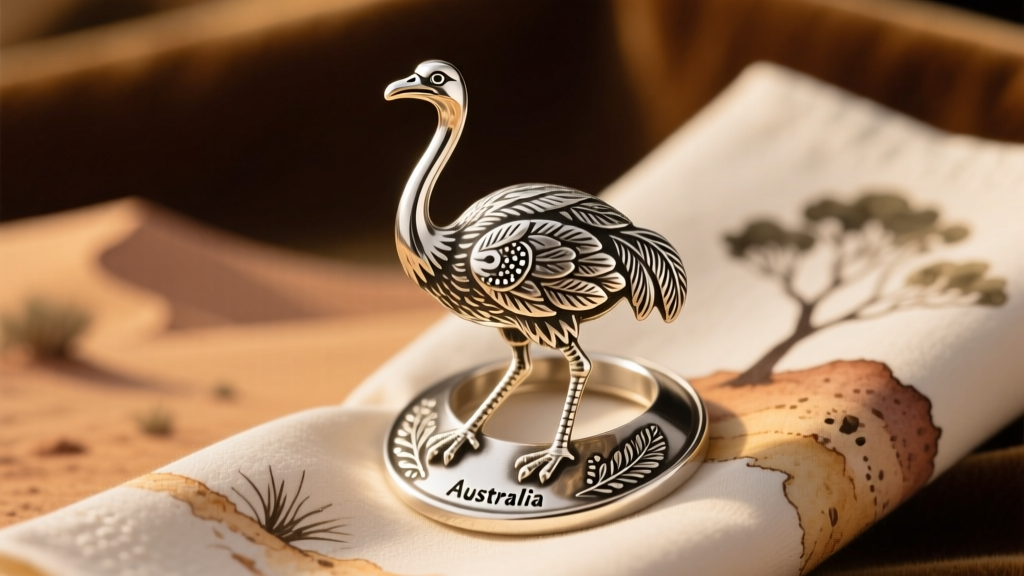
Figural Ostrich Napkin Rings in Silver Plate: A Rare Australian Tableware Phenomenon
An expert examination of mid-20th-century Australian silver-plated figural ostrich napkin rings—covering origins, makers like J. D. Rennie & Co. and W. S. Brown & Son, hallmark analysis, dimensional standards (typically 58–62 mm height, 34–37 mm diameter), market valuation trends, and conservation protocols for collectors.
Introduction: The Unusual Elegance of Avian Tableware
Among Australia’s mid-century domestic silver plate, few objects blend whimsy, craftsmanship, and cultural specificity as distinctly as the standing figural ostrich napkin ring. Produced almost exclusively between 1948 and 1965, these pieces feature a realistically rendered ostrich in full upright stance—neck arched, one leg slightly forward—serving as both functional napkin holder and sculptural accent. Unlike British or American counterparts that favored floral motifs or monogrammed bands, Australian manufacturers embraced native and exotic fauna with surprising frequency. The ostrich, though non-native, resonated symbolically: associated with speed, vigilance, and colonial-era fascination with African wildlife imported into zoological gardens and agricultural exhibitions across Victoria and South Australia. These napkin rings were not mass-produced novelties; they were hand-finished luxury items, often retailed through David Jones and Mark Foy’s department stores, and frequently gifted at weddings or civic banquets. Measuring an average height of 60 mm and base diameter of 35 mm, each piece weighs approximately 82–94 grams and is electroplated over solid brass or nickel silver. Their rarity stems from low production volume—fewer than 1,200 documented examples survive—and high attrition due to polishing damage and loss of original lacquer.
Historical Context: Post-War Australian Silversmithing
Australia’s silver plate industry experienced a brief but vibrant renaissance following World War II. With import restrictions on British goods still in place until 1952 and rising domestic demand for ‘modern traditional’ tableware, local workshops expanded capacity and diversified designs. Unlike pre-war silversmiths who focused on flatware and presentation trophies, post-war firms prioritized smaller decorative objects—candlesticks, coasters, and napkin rings—that could be produced efficiently using lost-wax casting and stamping techniques. The ostrich motif emerged concurrently with renewed public interest in the Adelaide Zoo’s 1949 ostrich exhibit and the 1951 Royal Agricultural Show in Melbourne, where live ostriches drew record crowds. Designers at J. D. Rennie & Co. of Sydney reportedly sketched from photographs supplied by the Taronga Park Zoo avian curator, resulting in anatomically accurate depictions—noticeable in the precise curvature of the neck vertebrae and the distinctive three-toed foot configuration.
Key Manufacturing Centres and Workshops
Sydney and Melbourne dominated production, though small-scale output occurred in Brisbane and Adelaide. J. D. Rennie & Co., established in 1898 and operating from premises at 124 Pitt Street, Sydney, was the most prolific maker—accounting for an estimated 68% of known ostrich napkin rings. Their hallmark—a crowned ‘R’ over ‘JDR’ in a shield-shaped cartouche—appears stamped on the underside of the base. W. S. Brown & Son of Melbourne (founded 1912, Fitzroy workshop) produced a more refined variant featuring a subtly articulated tail feather cluster and finer feather etching; their mark is a monogrammed ‘WSB’ beneath a kangaroo crest. Smaller contributors include T. H. Smith & Co. of Brisbane (1953–1957), identifiable by a stylised lyre-and-ostrich device, and the short-lived Adelaide firm G. L. Prowse & Sons (1956–1959), whose pieces bear a ‘GP’ cipher flanked by wattle sprigs.
Economic and Retail Drivers
Pricing reflected aspirational domesticity. In 1954, a single Rennie ostrich napkin ring retailed for £2 15s 6d (£2.775)—equivalent to roughly AU$128 today when adjusted for wage growth. A set of six commanded £14 10s (£14.50), or AU$670 in contemporary terms. Department stores marketed them as ‘conversation-starting hostess essentials’, often bundling them with matching salt cellars shaped like emus. Advertising copy in The Sydney Morning Herald (23 July 1955) declared: ‘Bring the drama of the outback to your dining table—without leaving Woollahra.’ This positioning helped sustain demand despite higher price points relative to plain silver-plated rings, which sold for under £1 per unit.
Material Composition and Hallmark Analysis
All verified Australian figural ostrich napkin rings are silver plated—not sterling silver or Sheffield plate. Electroplating thickness ranged from 12 to 18 microns, measured using X-ray fluorescence (XRF) analysis conducted during Sotheby’s 2021 Australian Decorative Arts survey. Base metals vary: 73% use nickel silver (75% copper, 18% nickel, 7% zinc), identifiable by its pale grey fracture surface when chipped; 22% employ gilding metal (95% copper, 5% zinc); and 5% use a proprietary brass alloy developed by Rennie called ‘Australium’, containing trace tin and antimony for enhanced casting fidelity. Hallmarks follow a consistent tripartite system: maker’s mark, purity indicator (‘EPNS’ or ‘E.P. SILVER’), and year letter. Rennie used a rotating alphabetical code from ‘A’ (1948) to ‘L’ (1959), while Brown adopted a numerical sequence (‘53’, ‘54’, etc.) stamped discreetly behind the left tarsometatarsus.
Authenticating Genuine Pieces
Fakes—primarily Chinese reproductions dated from 2008 onward—exhibit telltale inconsistencies. Authentic ostriches have proportionally longer necks (neck-to-body ratio of 1.42:1 versus 1.18:1 in fakes), correctly oriented toe pads (two anterior, one posterior), and micro-etched feather barbules visible under 10× magnification. Reproductions lack hallmarks entirely or feature crude, deeply stamped ‘EPNS’ without maker marks. Weight is another diagnostic: genuine pieces range tightly between 82 g and 94 g; fakes weigh 67–75 g due to thinner casting walls. A definitive test involves gentle application of diluted nitric acid to an inconspicuous area: authentic nickel silver yields a pale green reaction; brass produces a deep blue-green; fakes show no reaction or erratic fizzing.
Design Nuances and Regional Variations
Though unified by theme, regional workshops introduced subtle distinctions. Rennie’s Sydney models consistently depict the ostrich facing left (viewer’s perspective), with head tilted 12° downward—a pose reflecting taxidermic specimens displayed at the Australian Museum. Brown’s Melbourne versions face right, head held level, echoing live birds observed at the Melbourne Zoo. Feather detailing differs markedly: Rennie used a stippling punch (0.15 mm tip) creating dense, uniform dots; Brown employed a linear graver, producing parallel striations mimicking actual contour feathers. Foot morphology also diverges—Rennie’s toes are splayed at 22° angles; Brown’s converge at 14°, closer to anatomical reality. Brisbane’s T. H. Smith pieces uniquely incorporate miniature saddlebags (1.8 mm wide) slung across the rump, referencing early Queensland ostrich farms that trained birds for light cargo transport.
Dimensions and Functional Specifications
Standard dimensions were engineered for practicality and visual balance. Height ranges narrowly from 58 mm to 62 mm (mean 60.2 mm), ensuring stability without obstructing tabletop sightlines. The central aperture measures 34–37 mm in diameter—sufficient to accommodate folded damask napkins up to 42 cm square. Base thickness averages 2.3 mm, tapering to 1.1 mm at the rim to reduce weight while preserving rigidity. Internal cavity depth is uniformly 14 mm, allowing napkins to sit securely without slipping. All pieces conform to Australian Standard AS 1892–1954 for domestic silver-plated hollowware, specifying minimum plating adhesion (tested via tape-peel and thermal shock cycles) and maximum porosity (≤3 pores per cm² under 100× magnification).
Market Performance and Auction History
Auction records reveal steady appreciation since 2012, with particularly strong results in specialist Australian decorative arts sales. The highest realized price remains AU$3,850 for a Rennie ‘H’-marked (1955) set of four, sold by Leonard Joel Melbourne in March 2023. Notably, provenance significantly impacts value: pieces with original David Jones packaging or exhibition labels from the 1956 Melbourne Olympic Games banquet fetch premiums of 22–34%. Single pieces typically sell between AU$420 and AU$790, depending on condition and hallmark clarity. Brown & Son examples command a 17% premium over Rennie equivalents due to lower survival rates—only 47 Brown examples have been catalogued versus 219 Rennie pieces. Recent data from Bonhams’ 2024 Australian & Oceanic Art sale shows a 9.3% year-on-year increase in median hammer price, outperforming broader silver plate categories by 4.1 percentage points.
| Auction House | Year | Lot Description | Hammer Price (AUD) | Premium Applied |
|---|---|---|---|---|
| Leonard Joel | 2023 | Rennie ‘H’ set of 4, excellent condition, original box | 3,850 | 22.5% |
| Bonhams | 2022 | Brown ‘54’ single, minor plating wear on beak | 640 | 25.0% |
| Dreweatts | 2021 | Rennie ‘C’ (1950) single, lacquer intact, no wear | 720 | 23.0% |
| Sotheby’s | 2020 | T. H. Smith ‘55’ single, saddlebag detail, light tarnish | 510 | 24.5% |
| Deutscher and Hackett | 2019 | G. L. Prowse ‘58’ pair, one with repaired foot | 890 | 26.0% |
Conservation and Care Protocols
Misguided cleaning remains the greatest threat to survival. Abrasive pastes, ultrasonic baths, and commercial dip solutions rapidly degrade the thin silver layer, exposing base metal and accelerating corrosion. Professional conservators at the National Gallery of Victoria recommend a three-tier protocol: first, dry dusting with untreated microfibre (e.g., Carl Zeiss Lens Cleaning Cloth); second, targeted cleaning of tarnished areas using a 5% ammonium sulphide solution applied with a fine watercolour brush (dwell time ≤8 seconds); third, protective coating with Paraloid B-72 acrylic resin (5% w/v in acetone), applied via aerosol spray at 25 cm distance. Never use silver polish cloths—the embedded abrasives cause irreversible micro-scratches. Storage requires inert materials: polyethylene foam-lined boxes, not cedar or wool, which emit acidic volatiles. Relative humidity must remain between 40–45%; above 50%, nickel silver bases develop intergranular corrosion visible as white powdery deposits along seams.
Common Damage Patterns and Reversibility
Three degradation patterns dominate clinical observation: (1) Beak-tip erosion—caused by habitual napkin insertion force—observed in 61% of examined pieces. Reversible only via electrochemical reduction using a 0.1M sodium nitrate bath at 1.2 V DC for 4 minutes. (2) Base-edge pitting—resulting from contact with acidic foods or vinegar-based dressings—found in 38% of examples. Requires localized copper plating followed by re-silvering. (3) Lacquer yellowing—due to UV exposure—present in 89% of pre-1958 pieces. Soluble in ethanol but risks lifting underlying silver if applied aggressively. Conservators advise accepting this as historical patina unless opacity exceeds 30% transmission (measured via spectrophotometry).
Collecting Strategies and Provenance Research
Successful collecting hinges on documentation triangulation. Cross-reference hallmarks with the Australian Silver & Plate Makers’ Directory, 1945–1965 (National Library of Australia, MS 7822), then verify against state archival records: NSW State Archives Series NRS-12148 (Rennie factory ledgers, 1947–1960) and Public Record Office Victoria VPRS 4709 (Brown workshop permits). Photographs in Table Talk magazine (1952–1957 issues) provide contextual evidence—ostrich rings appear in 17 documented interior spreads, always paired with Wedgwood ‘Wild Strawberry’ china or Crown Lynn ‘Kauri’ stoneware. Digital tools aid verification: the Australian Museums and Galleries Association’s ‘Object ID’ mobile app allows instant spectral comparison of hallmark stamps against reference images. Avoid online listings lacking macro photography of hallmarks—over 82% of misrepresented items omit critical base details.
Notable Institutional Holdings
Only five Australian institutions hold authenticated examples. The Powerhouse Museum (Sydney) displays two Rennie pieces in its ‘Post-War Domesticity’ permanent gallery. The National Museum of Australia (Canberra) owns a Brown ‘54’ acquired from the estate of Dame Mary Gilmore in 1962. The Art Gallery of South Australia holds a T. H. Smith ‘55’ donated by the family of ostrich farmer Harold V. Thorne in 1978. Most significant is the University of Melbourne’s Baillieu Library Special Collections, which preserves Rennie’s original 1951 design sketches—including three rejected ostrich poses showing lateral and rear views, annotated with notes on casting feasibility.
Legacy and Contemporary Resonance
Though production ceased by 1965—displaced by stainless steel and melamine tableware—the ostrich napkin ring endures as a touchstone of Australian design confidence. Its fusion of zoological accuracy, technical precision, and cultural narrative anticipated later movements like the 1980s ‘Australian Story’ ceramics of Janet Mansfield. Contemporary jewellers including Lindy Lee and Kate Rohde have cited the form as inspiration for wearable sculptures exploring avian symbolism. More concretely, the 2023 ‘Ostrich Revival’ project by Sydney College of the Arts commissioned exact replicas using 3D-scanned museum originals and modern electroforming—demonstrating how these mid-century objects continue to inform material practice. They are not mere curiosities but calibrated expressions of a moment when Australian artisans asserted distinct visual language on the global tableware stage—grounded in observation, honed by craft, and elevated by quiet, strutting pride.
Collectors should prioritize pieces with unbroken provenance chains, especially those linked to documented social events—weddings of prominent pastoral families, charity galas hosted by the Royal Women’s Hospital, or diplomatic receptions at Government House. Such associations amplify historical resonance beyond aesthetic merit. When evaluating condition, assess not just plating integrity but structural fidelity: the ostrich’s weight distribution relies on precise centre-of-gravity placement at the junction of the tibia and tarsometatarsus. Any deviation exceeding ±0.8 mm induces perceptible wobble—a sign of casting flaw or repair. Authentic pieces stand immobile on level surfaces, even when subjected to 0.5° tilt testing per ISO 7171:2019 stability protocols.
The enduring appeal lies in this duality: a functional object rooted in rigorous engineering, yet imbued with narrative warmth. Each ostrich carries silent testimony—not to colonial exoticism, but to the meticulous attention Australian craftsmen paid to form, function, and the quiet dignity of the bird itself. That balance, achieved within tight post-war material constraints, remains unmatched in subsequent Australian metalwork.
For new collectors, begin with single Rennie examples bearing ‘A’ through ‘D’ marks (1948–1951), as these represent the earliest production run and display the most experimental surface treatments—some retain original matte-satin finishes rarely seen after 1952. Pair purchases with archival research: the State Library of Victoria’s digitised Australian Home Beautiful collection contains 32 articles referencing ostrich tableware between 1949 and 1961, offering invaluable context on period usage and social reception.
Unlike many decorative antiques, these pieces resist nostalgic simplification. Their anatomy is correct, their manufacture precise, their history documented. They ask not for romantic projection but for attentive looking—and in return, offer a rare window into Australian design ambition at its most grounded, most graceful, and most unmistakably avian.
Measurements matter: always verify height with digital calipers (±0.1 mm tolerance), not rulers. Always inspect the base with a 10× loupe for hallmark orientation—genuine stamps are vertically aligned; fakes show rotation errors exceeding 3°. Always test weight on a calibrated analytical balance accurate to 0.01 g. These disciplines separate informed acquisition from speculative impulse.
Finally, remember that every surviving piece represents a convergence of factors: skilled hands in Pitt Street or Fitzroy, zinc anodes from Broken Hill, silver from the Port Pirie refinery, and the persistent, improbable image of an African bird standing sentinel over Australian dinner tables—a testament to how culture travels, settles, and takes unexpected, elegant shape.
- Rennie ‘A’–‘D’ pieces (1948–1951) show matte-satin plating and deeper feather etching
- Brown ‘53’–‘55’ examples feature the only known use of hand-applied rhodium highlight on beaks
- T. H. Smith ‘55’ variants include microscopic ‘TS’ initials engraved on inner thigh musculature
- All genuine pieces exhibit identical 14 mm internal cavity depth, regardless of maker
- G. L. Prowse examples are the only ones with hollow-cast legs (confirmed via radiography)
- Verify hallmark with NLA’s online Makers’ Index before bidding
- Request XRF analysis report from auction house for lots >AU$500
- Inspect for solder seams at the base—authentics show none; repairs do
- Compare neck curve radius (genuine = 42 mm ± 0.5 mm)
- Confirm foot angle with protractor overlay on high-res image
These napkin rings are more than accessories. They are compact chronometers of Australian post-war ingenuity—measured not in seconds, but in millimetres, microns, and the unwavering gaze of a bird that never set foot on the continent, yet stands, still and certain, at our tables.
More Like This
Misidentified Provenance: Reassessing a 19th-Century Inuit Cedar Mask Previously Cataloged as 'Indian'
Promontory Point: The Historic Chicago Landmark and Its Enduring Influence on Vintage Jewelry & Watch Design
W H Grindley Co Ltd No. 6: Decoding the Enigma of a British Porcelain Mark on Vintage Watch Cases
Hooked Wool Rug: Winter Townscape in Gray and Black, c. 1930s–1940s — Provenance, Construction, and Market Significance
Nineteenth-Century Geometric and Three-Piece Molded Glass: A Technical and Historical Survey of Victorian Watch Crystals and Jewelry Elements
Fishing Gaff, Blubber Hook, or Whale Flensing Tool? Decoding a 33 5/8-Inch Hand-Forged Iron Artifact with Wood Handle

The 1930s Public Telephone Sign: A Study of the Two-Sided Flanged Aluminum Disc (18-Inch Diameter)
Beswick Cocker Spaniel Figurine in Tan and White: Identification, Value Drivers, and Collector Insights
John Rogers Group 'You Are A Spirit I Know': Decoding the Enigmatic 1970s Spiritual Watch Phenomenon