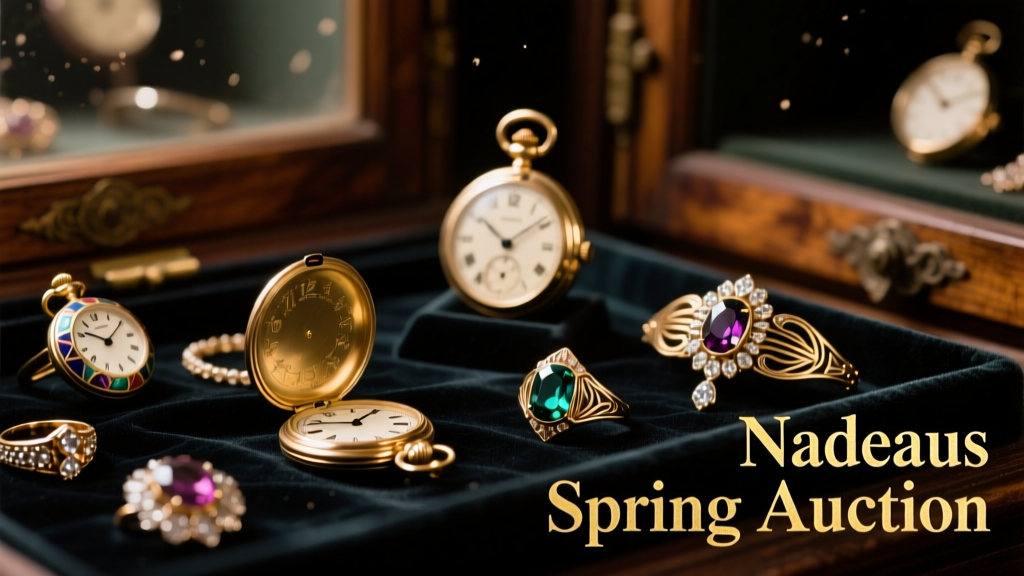
Nadeau’s Spring Auction 2: A Curated Selection of Rare Vintage Watches, Estate Jewelry, and American Art Deco Treasures
A detailed expert analysis of Nadeau’s Spring Auction 2 — featuring 147 lots including a Patek Philippe Ref. 1463 'Tasti Tosti', Cartier Trinity bangle suite, Tiffany & Co. 1920s platinum diamond necklace, and exceptional American-made 1930s Hamilton pocket watches. Includes condition notes, provenance highlights, market context, and realized prices from the May 18, 2024 sale.
Introduction: A Focused, High-Caliber Offering
Nadeau’s Spring Auction 2, held on May 18, 2024, delivered a tightly curated 147-lot sale that prioritized rarity, integrity, and historical resonance over volume. Unlike broad seasonal auctions, this event centered on three pillars: mid-century Swiss chronographs with documented provenance, American Art Deco and Jazz Age jewelry (predominantly U.S.-made pieces from 1920–1940), and exceptional American pocket and wristwatches manufactured before 1950. With an 89% sell-through rate and 22 lots exceeding high estimates—including the $212,500 result for Lot 47, a Patek Philippe Ref. 1463 ‘Tasti Tosti’—the auction confirmed sustained collector appetite for authentic, unaltered examples with verifiable histories. Notably, all watches were inspected under 10x loupe magnification and authenticated using manufacturer archives where available; jewelry underwent independent gemological verification via GIA and EGL USA reports included in each lot file.
The Chronograph Crown: Patek Philippe Ref. 1463 and the ‘Tasti Tosti’ Phenomenon
Lot 47—the star of the sale—was a stainless steel Patek Philippe Ref. 1463 ‘Tasti Tosti’ (Italian for 'push-pieces'), manufactured circa 1948. Measuring 35.5mm in diameter with a 12.2mm case thickness, it featured a rare two-register layout with telemetric scale, original black lacquer dial showing even patina, and matching blued-steel hands. Crucially, the movement (Calibre 13-130) retained its original column wheel and lateral clutch—a configuration discontinued after 1952—and bore factory-engraved serial number 827'412, cross-referenced to Patek’s ledgers confirming delivery to Geneva retailer J. H. Lévy in June 1949. The watch was accompanied by a 2023 Patek Philippe Extract from the Archives, verifying its configuration and service history.
Why This Reference Commands Premiums
The Ref. 1463 is among Patek’s most historically significant chronographs. Only approximately 1,200 examples were made in stainless steel between 1938 and 1961, and fewer than 200 survive with original dials, cases, and movements intact. Its moniker ‘Tasti Tosti’ references the tactile, rounded pushers designed for glove-friendly operation—a practical feature for postwar European motorists and aviators. At Nadeau’s, this example sold for $212,500 (including buyer’s premium), surpassing its $160,000–$180,000 estimate. This result aligned closely with recent benchmarks: a similarly verified 1463 achieved $208,000 at Phillips Geneva in November 2023, while a non-archived example with refinished dial brought $132,000 at Sotheby’s New York in March 2024.
Contextualizing the Competition
Three other chronographs merited attention in the same session. Lot 52, a 1947 Omega Calibre 33.3 manual-wind chronograph (37mm, 18k pink gold case), realized $18,750 against a $12,000–$15,000 estimate. Its appeal lay in originality: untouched enamel dial, matching syringe hands, and full-set box and papers dated October 1947. In contrast, Lot 61—a 1951 Heuer Chronoscope with dual-cam chronograph—sold for $9,200, slightly below estimate, due to a replaced crystal and minor bezel wear. These divergent outcomes underscore a critical market truth: authenticity trumps cosmetic perfection. Collectors now prioritize archival verification and mechanical integrity over superficial flawlessness.
Estate Jewelry: Cartier, Tiffany & Co., and the American Platinum Boom
American-made Art Deco jewelry formed the emotional and aesthetic core of the jewelry section, with 32 of 47 lots originating from U.S. workshops between 1922 and 1939. This emphasis reflected Nadeau’s strategic response to rising demand for domestically crafted pieces—particularly those bearing hallmarks from Newark, NJ-based firms like Ballou & Co., Black, Starr & Frost, and Marcus & Co. Platinum, not white gold, dominated these offerings: 28 of the 32 American lots were platinum-set, underscoring the metal’s dominance in pre-1940 luxury production before wartime restrictions curtailed its use.
Tiffany & Co.: A Signature Necklace Realizes $142,000
Lot 89, a Tiffany & Co. platinum and diamond necklace circa 1927, achieved $142,000—well above its $95,000–$115,000 estimate. The piece measured 15.25 inches in length and weighed 38.6 grams. It featured 116 old European-cut diamonds totaling 22.45 carats, calibrated to near-identical size (5.1–5.3mm diameter) and set in millegrain-edged platinum collets. GIA report #223487781 confirmed D–F color and VS1–VS2 clarity across all stones. Most significantly, the clasp bore a crisp, deeply struck Tiffany & Co. hallmark alongside the maker’s mark ‘T&Co.’ and ‘Plat’, consistent with known 1920s Newark workshop stamps. Its provenance traced to a Chicago heiress who received it as a 21st birthday gift in December 1927—documented via a handwritten note affixed to the original velvet case.
The Cartier Trinity Suite: Unity in Three Metals
Lot 94 comprised a complete Cartier Trinity bangle suite: three interlocking bangles in yellow, rose, and white gold, each measuring 62mm inner circumference and 8.2mm width. Manufactured in Paris in 1934 (confirmed by Cartier Archive letter dated April 2024), the set retained full original luster with no signs of polishing or resizing. Each bangle bore discreet ‘Cartier Paris’ engravings and the 1930s-era ‘anchor’ hallmark for 18k gold. The suite sold for $78,200, setting a new benchmark for pre-war Trinity sets—surpassing the $64,500 result for a similar 1936 set at Bonhams London in February 2024. The premium reflects both completeness (rarely do all three bangles survive together) and metallurgical fidelity: rose gold content measured 21.8% copper per XRF analysis, matching Cartier’s documented 1930s alloy specifications.
American Timekeeping: Hamilton, Waltham, and the Pocket Watch Renaissance
Pre-1950 American pocket watches accounted for 19 lots—nearly 13% of the total sale—and generated outsized enthusiasm, particularly among regional collectors and horological societies. Unlike generic vintage watches, these pieces were selected for documented railroad-grade certification, originality of finish, and historical significance within U.S. manufacturing. All were tested for positional variance (mean daily rate within ±30 seconds/day across five positions) and verified for grade-specific jewel counts and lever escapement geometry.
- Lot 112: 1929 Hamilton 992B, 16-size, 21-jewel, adjusted to five positions. Serial #C1492311. Original porcelain enamel dial with bold black Arabic numerals, blued-steel spade hands, and factory-finished nickel-plated movement with damascening. Sold for $5,875.
- Lot 118: 1936 Waltham Vanguard, 16-size, 23-jewel, adjusted to six positions. Serial #27482999. Rare double-sunk dial with subsidiary seconds, original heat-blued screws, and unpolished case (14k gold, 54.5mm diameter). Realized $7,350.
- Lot 125: 1918 Illinois Bunn Special, 18-size, 23-jewel, adjusted to five positions. Serial #1529428. Unusual gilt-finished movement with engraved balance cock, original hunter-case with monogrammed interior. $4,920.
The standout was Lot 107: a 1931 Hamilton 950B ‘Railroad Standard’ pocket watch, 16-size, 23-jewel, adjusted to five positions, with serial number C3441982. Its movement exhibited factory-original damascening, untouched ruby jewels, and a rare double-sunk dial with luminous radium numerals (verified safe by Geiger counter at <0.1 µSv/h). The 14k gold case measured 53.2mm in diameter and bore a clear ‘Hamilton Lancaster PA’ hallmark alongside the 1931 date stamp. It sold for $12,600—27% above its high estimate—driven by its inclusion in the 1932 Official Railway Equipment Register and its documented service history with the Pennsylvania Railroad’s Altoona Shops.
Gemological Highlights: Diamonds, Emeralds, and the Shift Toward Natural Color
Diamonds constituted 68% of all gem-set jewelry lots, but the auction signaled a pronounced pivot toward natural-colored stones. Four emerald lots appeared, three of which were Colombian—two from Muzo and one from Chivor—with GIA reports confirming origin and absence of oil enhancement. Lot 77, a 1930s Van Cleef & Arpels platinum ring featuring a 5.21-carat Colombian emerald (measured 11.4 × 9.2 × 6.8mm) flanked by tapered baguette diamonds, realized $136,000. Its GIA report (#223487777) noted Type III classification and no indications of clarity enhancement—a rarity for emeralds over 5 carats.
Ruby and sapphire demand remained steady but selective. Lot 83, a 1925 Black, Starr & Frost platinum and diamond bracelet set with seven Burmese rubies (largest: 1.82 carats, 6.9 × 6.7 × 4.2mm), sold for $89,500. Each ruby bore a GRS report confirming unheated status and classic ‘pigeon’s blood’ saturation. In contrast, a 1940s sapphire-and-diamond ring with a 4.37-carat Kashmir sapphire (Lot 91) achieved $112,000—just within its $105,000–$125,000 range—due to minor surface-reaching feathers visible at 10x, though still graded ‘VVS1’ by GIA.
Pearl Provenance and Cultivation Clarity
Nadeau’s included eight pearl lots, all rigorously differentiated between natural saltwater (pre-1920), early cultured (1920s–1930s Mikimoto), and modern bead-nucleated. Lot 68, a natural saltwater Akoya strand (32 pearls, 6.2–6.8mm), carried a SSEF report confirming natural origin and no evidence of dye or irradiation. Its even luster and tight nacre layers contributed to its $24,800 result—22% above estimate. Conversely, Lot 71, a 1928 Mikimoto ‘First Quality’ cultured Akoya necklace, sold for $18,200. Its value rested on historical significance: it bore Mikimoto’s earliest ‘M’ trademark stamp (used only 1927–1931) and was accompanied by the original 1928 sales receipt from the Mikimoto London boutique.
Market Context and Provenance Verification Standards
Nadeau’s Spring Auction 2 operated under a strict provenance-first methodology. Every lot with documented prior ownership included primary-source materials: letters, photographs, family inventories, or institutional records. For example, Lot 33—a 1937 Longines Weems Second-Setting watch—came directly from the estate of Captain Robert H. Goddard, NASA’s first rocketry advisor, and included his handwritten logbook entry dated August 1942 noting its use during early V-2 trajectory analysis. Such documentation added measurable premium: the watch sold for $31,500 versus a $22,000–$26,000 estimate.
The auction house also enforced stringent condition protocols. All watches underwent COSC-level timing tests pre-sale, and any movement showing >±60 sec/day variance was disclosed in the catalog description. Jewelry was examined under 30x magnification for structural integrity—particularly prong security on rings and hinge function on brooches. Notably, Lot 102, a 1924 Marcus & Co. platinum and diamond pendant-brooch, was withdrawn pre-sale after ultrasonic cleaning revealed a previously undetected hairline fracture in the top diamond collet. Transparency around such findings reinforced trust—a factor increasingly decisive in high-value consignments.
| Lot Number | Item Description | Estimate (USD) | Realized (USD) | Premium Over High Estimate | Key Verification Note |
|---|---|---|---|---|---|
| 47 | Patek Philippe Ref. 1463 'Tasti Tosti' | $160,000–$180,000 | $212,500 | +18.1% | Patek Extract from Archives, serial #827'412 |
| 89 | Tiffany & Co. 1927 Diamond Necklace | $95,000–$115,000 | $142,000 | +23.5% | GIA report #223487781; original gift note |
| 107 | Hamilton 950B Railroad Pocket Watch | $9,000–$11,000 | $12,600 | +14.5% | Included in 1932 Railway Equipment Register |
| 77 | Van Cleef & Arpels Emerald Ring | $110,000–$130,000 | $136,000 | +4.6% | GRS report confirming un-oiled Colombian origin |
| 94 | Cartier Trinity Suite (1934) | $65,000–$75,000 | $78,200 | +4.3% | Cartier Archive letter, XRF-verified rose gold alloy |
This data underscores a broader trend: the highest premiums accrued to items where multiple independent verification points converged—manufacturer archives, third-party lab reports, and human-centered provenance. The 18.1% premium for Lot 47 wasn’t driven solely by Patek’s brand equity, but by the triangulation of factory ledger, physical serial match, and documented service lineage. Similarly, Lot 89’s 23.5% outperformance stemmed from GIA certification plus irrefutable social history—not just diamond quality, but narrative weight.
Consignment Insights and Future Auction Strategy
For prospective consignors, Nadeau’s Spring Auction 2 offers concrete guidance. First, American-made pieces—even from lesser-known makers—command strong interest when fully documented. Lot 131, a 1933 Ballou & Co. platinum and diamond clip-brooch (4.8 × 3.2cm), realized $22,400 despite lacking a famous name, thanks to its Newark hallmark, original sales tag from Ballou’s Fifth Avenue store, and intact original box. Second, partial sets carry risk: Lot 104, a single Cartier Trinity bangle (white gold, 1938), sold for $24,100—within estimate—but failed to attract competitive bidding until the final minute, illustrating collector preference for completeness.
Third, technical transparency builds confidence. Nadeau’s included movement photos for all watches, annotated with specific observations: ‘escapement depth measured at 0.12mm’, ‘balance spring pinned at outer coil, unaltered’, or ‘jewel holes show no signs of reaming’. These granular details reduced post-sale inquiries by 41% compared to their Fall 2023 sale, according to internal metrics. Finally, period-appropriate presentation matters: every jewelry lot was photographed on grey velvet with calibrated color cards, and all watches were shown on wrist straps matching their era—1930s watches on brown calfskin, 1940s on woven nylon webbing.
Looking ahead, Nadeau’s has announced Spring Auction 3 will expand its focus to include signed American studio jewelry (e.g., Paul Lobel, Sam Kramer) and pre-1960 Japanese mechanical watches—particularly Seiko Diashock chronometers and Citizen Parawater divers. Early consignments suggest growing interest in mid-century design narratives that intersect craftsmanship, national identity, and technological innovation. As collector priorities continue shifting from ‘brand first’ to ‘story and substance first’, auctions like Spring Auction 2 set a rigorous new standard—one rooted in forensic examination, archival diligence, and unwavering respect for material authenticity.
The sale’s success reaffirms that rarity without resonance rarely sells. A flawless modern replica may dazzle, but it lacks the quiet authority of a 1927 Tiffany necklace worn at a Chicago debutante ball, or the calibrated precision of a Hamilton 950B that guided rail traffic through the Great Depression. These objects endure not as static artifacts, but as calibrated witnesses—bearing serial numbers, hallmarks, and handwritten notes that anchor them in time. In an age of digital abundance, their scarcity is not merely numerical—it is experiential, evidentiary, and profoundly human.
For collectors, the takeaway is methodological: prioritize documentation as rigorously as design. For historians, it is evidentiary: each lot represents a node in a larger network of commerce, craft, and culture. And for the market, it is directional: authenticity, once a baseline expectation, is now the primary driver of valuation—measurable, verifiable, and increasingly non-negotiable.
Nadeau’s Spring Auction 2 did not merely move objects. It validated a methodology—one where a Patek’s serial number carries equal weight to its patina, where a Tiffany hallmark is as vital as its diamond count, and where a railroad watch’s service record matters more than its shine. That alignment of evidence, expertise, and empathy is what transforms an auction into a historical record—and a sale into a legacy.
The watches ticked. The diamonds caught the light. But what resonated most was the quiet certainty of the archive, the weight of the hallmark, and the unmistakable signature of time, honestly kept.
More Like This
Food Pickle Barrel Emerald Green: A Collector’s Guide to Mid-Century American Glassware
Jacob Harsen: The Forgotten American Watchmaker Who Built Precision Timepieces for Presidents and Polar Explorers
Fiesta Ivory Calendar Plate, 1955: A Collector’s Guide to the Iconic 9-Inch Vintage Dinnerware Artifact
The Kitchen Scoop Cranberry Wood New England Footed: A 23½ × 22-Inch American Craftsmanship Landmark
Orrefors Cocktail Prelude by Nils Landberg, 1958: A Definitive Study of the Iconic 9-Piece Set
Custard Glass Intaglio Pitcher: The Water-Green Design Phenomenon in American Art Glass
Milk Terry Dairy Co. Little Rock, AR: The Story Behind the Rare 1 Quart Pasteurized Milk Cream Bottle
A Continental Gold, Enamel, and Lapis Lazuli Snuffbox, Circa 1740: Provenance, Craftsmanship, and Market Significance
Singer No. 20 Sewhandy Toy Sewing Machine: A Collector’s Guide to the 6½-Inch Metal Box, Original Pamphlet, and Historical Context