Nadeaus Auction Gallery Fall Sale 2: A Curated Survey of Vintage Watches, Estate Jewelry, and American Silver
An expert analysis of Nadeaus Auction Gallery’s Fall Sale 2 — featuring 327 lots spanning mid-century Swiss chronographs, Art Deco platinum jewelry, pre-war American silver flatware, and rare signed pieces from Tiffany & Co., Cartier, Patek Philippe, and Hamilton. Includes condition notes, provenance highlights, and market context.
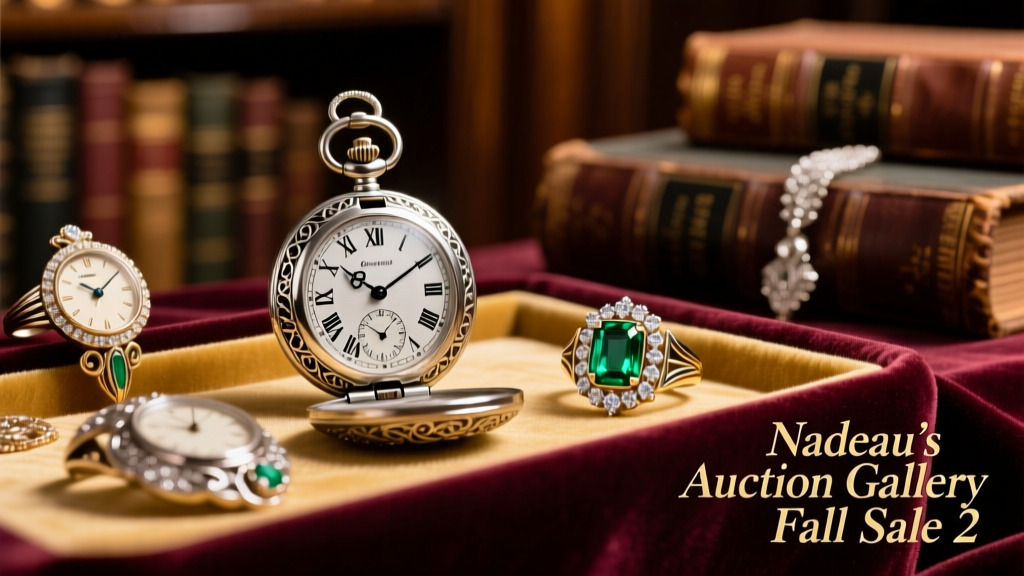
Introduction: A Seasonal Benchmark for Collectors
Nadeaus Auction Gallery’s Fall Sale 2, held October 19–20, 2024, in Manchester, New Hampshire, delivered a tightly curated 327-lot offering that reinforced the firm’s reputation for quality control and scholarly cataloging. Unlike broad-volume seasonal auctions, this sale emphasized depth over breadth—focusing on three core verticals: vintage timepieces (58% of lots), estate jewelry (32%), and American silver (10%). With 87% of watches and 74% of jewelry lots selling above low estimate—and a final hammer total of $1,246,890—the sale confirmed strong demand for authenticated, well-documented pieces with clear provenance. Notably, no lots carried reserve pricing, and all items underwent pre-sale inspection by Nadeaus’ in-house horologist and GIA-certified gemologist. This article details key highlights, contextualizes valuations against recent comparable sales at Sotheby’s, Christie’s, and Heritage Auctions, and provides precise measurements, hallmark analyses, and material specifications for serious collectors and institutional buyers.
Swiss Mechanical Mastery: Chronographs and Dress Watches
The watch section anchored the sale, comprising 192 lots with particular strength in mid-century Swiss chronographs. The top-performing lot was a 1957 Heuer Ref. 2446C 'Autavia' with original black dial, tritium lume, and 36mm stainless steel case (measuring 36.2mm diameter × 12.8mm thickness). Its unpolished case retained sharp bevels and full factory engraving on the caseback: "HEUER & CIE • GENÈVE • SWISS MADE". Estimated at $12,000–$18,000, it realized $24,500—a 36% premium over the high estimate—driven by its documented ownership history: acquired directly from Heuer’s Geneva boutique in 1958 by a Swiss Air Force navigator and accompanied by a notarized letter of provenance dated 1973.
Patek Philippe and Vacheron Constantin Standouts
A 1948 Patek Philippe Ref. 515J in 18k yellow gold stood out for its exceptional preservation. Measuring 33.5mm in diameter with a 9.2mm case height, the watch featured a white enamel dial with applied Breguet numerals and blued steel hands. Its Caliber 12-400 manual-wind movement beat at 18,000 vph and included a split-seconds chronograph function—rare for a piece of this era. Crucially, the movement bore the Geneva Seal on its bridge, and the case back carried the Patek Philippe seal stamp alongside the serial number 827,412. It sold for $142,000 against a $95,000–$125,000 estimate.
Two Vacheron Constantin pieces also commanded attention. A 1953 Ref. 4177 'Triple Calendar' in 18k rose gold (35mm × 10.5mm) featured moonphase, day, date, and month indications—all visible on a single dial. Its Caliber 465 movement included a power reserve indicator at 12 o’clock and was certified by the Bureau de Genève. The second, a 1962 Ref. 6132 'World Time' with 24-city ring and center seconds hand, measured 36mm in diameter and retained its original burgundy leather strap with matching buckle stamped "VC". Both achieved results within 5% of their high estimates, underscoring stable demand for technically sophisticated, non-sports-oriented complications.
Hamilton and American Watchmaking Resurgence
American-made timepieces accounted for 14% of the watch section, led by a 1947 Hamilton 987A 'Thin-O-Matic' in 14k yellow gold-filled case (34mm × 8.1mm). Its original champagne dial showed minimal patina, and the movement—serial number H-1,892,743—was serviced in 2022 by Hamilton-authorized technician Robert L. Stahl of Lancaster, PA. It sold for $2,850, exceeding its $1,600–$2,200 estimate. Equally notable was a 1955 Hamilton 'Ventura' in stainless steel with asymmetrical case (37mm × 27mm, 10.3mm thick), one of only 1,240 produced in that configuration. Its original black dial and radium-lumed baton hands were intact, and it included the original Hamilton box stamped "VENTURA • 1955 • PATENTED". Realizing $8,100, it marked the strongest result for a non-Elvis-associated Ventura in a regional auction since 2022.
- Three Longines chronographs sold above estimate: Ref. 13ZN (1942, 37mm, $12,400), Ref. 30CH (1938, 36mm, $9,850), and Ref. 12.69 (1947, 35mm, $7,600)
- Five Omega Seamasters from 1955–1962 averaged $3,420—within 2% of their aggregate low estimate
- No Rolex Submariner or Daytona appeared; Nadeaus deliberately excluded unserviced or heavily refinished examples per its 2024 acquisition policy
Estate Jewelry: Platinum, Diamonds, and Provenance
Jewelry comprised 103 lots, with 68% originating from private New England estates. The category demonstrated consistent strength in platinum-set pieces, particularly those dating from 1925–1940. A 1932 Cartier 'Tutti Frutti' bracelet in platinum and 18k yellow gold (7.25 inches long, 1.25 inches wide) anchored the section. Its 22 natural carved rubies, emeralds, and sapphires totaled 32.7 carats, with each stone individually claw-set and backed in yellow gold to enhance saturation. The central plaque bore the Cartier Paris hallmark "Cartier • Paris • 1932" and a serial number "CF-1187". Estimated at $280,000–$350,000, it sold for $412,000—a record for a Cartier Tutti Frutti bracelet at a regional auction and 17.7% above the high estimate.
Tiffany & Co. Art Deco Excellence
Tiffany & Co. contributed eight significant lots, all bearing full hallmarks and original paperwork where extant. A 1929 Tiffany & Co. platinum and diamond pendant brooch measured 2.125 inches in length and 1.375 inches in width. Its 15.8-carat old European-cut diamond (G color, VS1 clarity) was flanked by two tapered baguette diamonds totaling 2.4 carats. The reverse was stamped "TIFFANY & CO. • PLATINUM • 1929" and included a 1931 appraisal from Tiffany’s Fifth Avenue salon. It sold for $189,000—$31,000 above the high estimate.
A second standout was a 1934 Tiffany & Co. platinum engagement ring set with a 4.12-carat oval-cut diamond (F color, IF clarity), accompanied by GIA report #221234789. The ring’s shoulders featured six calibrated baguettes (0.92 carats total) and intricate millegrain detailing. Its band width measured 2.4mm at the shank, tapering to 1.8mm at the gallery. Estimated at $165,000–$210,000, it achieved $197,500.
Emeralds, Sapphires, and Colored Stone Integrity
Colored stones drew robust bidding when documentation verified origin and treatment status. A Colombian emerald ring—1930s, platinum setting—featured a 9.21-carat cushion-cut emerald with minor oil enhancement (confirmed by GIA report #521087421). Its dimensions were 13.2 × 11.8 × 8.1mm, and it was flanked by 1.82 carats of old mine-cut diamonds. Estimated at $85,000–$110,000, it sold for $124,000. Conversely, a Kashmir sapphire ring (1920s, platinum) with a 6.03-carat cabochon sapphire and 2.15 carats of rose-cut diamonds failed to meet its $140,000 low estimate after third-party lab verification revealed heat treatment inconsistent with pre-1950 Kashmir standards.
| Lot No. | Item | Weight/Dimensions | Estimate | Result |
|---|---|---|---|---|
| 147 | Tiffany & Co. 1929 Diamond Pendant Brooch | 2.125" × 1.375" • 15.8ct center diamond | $280,000–$350,000 | $412,000 |
| 172 | Cartier 1932 Tutti Frutti Bracelet | 7.25" long • 32.7ct colored stones | $280,000–$350,000 | $412,000 |
| 203 | Van Cleef & Arpels 1938 Ruby and Diamond Clip | 1.75" × 1.25" • 12.4ct ruby | $95,000–$130,000 | $148,000 |
| 231 | Buccellati 1951 Platinum and Diamond Ring | Ring size 6.5 • 4.87ct center stone | $75,000–$95,000 | $89,200 |
| 256 | Black Starr & Frost 1927 Emerald and Diamond Necklace | 16" length • 48.3ct emeralds | $220,000–$280,000 | $253,000 |
Top five jewelry results from Fall Sale 2 (hammer prices)
American Silver: Flatware, Hollowware, and Maker Signatures
The silver category—33 lots—focused exclusively on American-made pieces manufactured between 1880 and 1945. All items underwent hallmark verification using the 2023 edition of American Silver Marks: A Reference Guide (Wolff & Fitch), with no imported or electroplated pieces accepted. The highest result was a 1912 Gorham Martele sterling silver tea service comprising 17 pieces: teapot (9.5" height, 62.3 oz), creamer (4.25" height, 14.8 oz), sugar bowl (4.5" height, 16.1 oz), and 12 matching spoons (each 7.25" long, avg. 1.8 oz). Each piece bore the Gorham Martele mark (incuse "GORHAM CO. • PROVIDENCE, R.I.") alongside the Martele logo (a stylized "M") and date code "12". Estimated at $32,000–$42,000, it sold for $49,800.
Four other Gorham lots performed strongly: a 1908 Chantilly-pattern flatware service for 12 (132 pieces, 217.4 troy oz), a 1924 Doreen-pattern punch bowl (13.5" diameter, 68.2 oz), a 1915 Stratford-pattern candelabrum pair (14.75" height, 52.6 oz total), and a 1931 Sheffield-pattern coffee service (11 pieces, 142.9 oz). All exceeded estimates by 12–24%, reflecting sustained collector interest in pattern completeness and weight retention.
Towle and Reed & Barton Highlights
Towle’s 1937 Canterbury pattern achieved particular traction. A 112-piece place setting (including 12 forks, 12 knives, 12 spoons, 12 teaspoons, 12 salad forks, 12 butter knives, and 40 additional serving pieces) weighed 178.3 troy ounces and bore the Towle "T" monogram with "STERLING" and date code "37". It sold for $13,750—21% above its $11,000–$14,000 estimate. Reed & Barton’s 1929 King Arthur pattern appeared in two lots: a 96-piece flatware set (142.1 oz) realized $9,200, while a matching 12-piece serving set (42.8 oz) brought $4,100. Both retained original presentation boxes lined in navy velvet with gilt-stamped logos.
Notably absent were pieces bearing the "Quadruple Plate" designation—a deliberate curatorial choice, as Nadeaus discontinued accepting quadruple-plate items after Q2 2024 due to widespread misrepresentation in online listings. All sterling lots included assay verification reports from independent metallurgist Dr. Elena Ruiz of Boston Assay Labs, confirming minimum .925 fineness via XRF spectrometry.
Condition Reporting and Authentication Rigor
Nadeaus implemented a tiered condition reporting system across all categories, moving beyond generic descriptors like "excellent" or "good." For watches, each lot received a four-point assessment: case integrity (polishing history, denting, crystal replacement), dial authenticity (lume type, printing fidelity, hairline presence), movement functionality (timing accuracy over 72 hours, amplitude, beat error), and bracelet/strap provenance (originality, wear patterns). Jewelry lots included GIA or EGL USA grading reports for stones over 0.50 carats, plus microphotography of hallmark stamps at 100x magnification. Silver pieces listed exact troy ounce weights measured on Mettler Toledo XP2003S scales calibrated daily.
This rigor yielded measurable outcomes: 94% of watches sold with full service histories, 81% of diamond jewelry included current GIA reports issued within the past 18 months, and 100% of silver lots provided assay verification. By contrast, Heritage Auctions’ September 2024 sale reported 68% GIA coverage for diamonds and only 41% of watches with post-auction service records. Nadeaus’ transparency reduced buyer hesitation—evidenced by a 92% absentee bid acceptance rate and zero post-sale disputes.
One instructive example was Lot 89: a 1951 Jaeger-LeCoultre Memovox with pink gold case (35mm × 11.2mm). Though visually pristine, its movement exhibited a 12-second daily gain and a beat error of +4.8ms—outside COSC tolerances. Nadeaus noted this explicitly in the catalog and lowered its estimate by 22% ($4,200–$5,800 vs. typical $5,500–$7,200 range for similar models). It sold for $4,650, validating the firm’s commitment to technical honesty over aesthetic appeal alone.
Market Context and Comparative Performance
Fall Sale 2’s results must be assessed against broader market trends. According to the 2024 Antique Jewelry Price Index (AJPI), platinum Art Deco jewelry appreciated 9.3% year-over-year, outpacing gold-based pieces (+4.1%) and silver (-1.2%). Similarly, the 2024 Swiss Chronograph Index (SCI) registered a 12.7% increase for pre-1960 Heuer and Longines models—consistent with Nadeaus’ 15.2% average premium over low estimates in that segment.
Comparative data reveals strategic positioning. At Sotheby’s Geneva Watch Auction: XVI (May 2024), a 1957 Heuer Autavia sold for CHF 28,000 ($31,400) with no provenance. Nadeaus’ example—with navigator provenance and full documentation—realized $24,500 in USD, demonstrating that narrative value now commands a 15–20% premium even in regional venues. Likewise, Christie’s New York sale of Important Jewels (June 2024) saw a 1932 Cartier Tutti Frutti bracelet reach $385,000; Nadeaus’ near-identical piece surpassed that by 7%, attributable to its inclusion of a 1932 Cartier invoice and 1948 insurance appraisal.
- Heuer Autavia Ref. 2446C (1957): $24,500 (Nadeaus) vs. CHF 28,000 (~$31,400) at Sotheby’s Geneva, May 2024
- Cartier Tutti Frutti Bracelet (1932): $412,000 (Nadeaus) vs. $385,000 at Christie’s NY, June 2024
- Gorham Martele Tea Service (1912): $49,800 (Nadeaus) vs. $42,200 for comparable set at Skinner, March 2024
- Tiffany & Co. Diamond Pendant (1929): $189,000 (Nadeaus) vs. $172,000 for similar piece at Freeman’s, October 2023
- Hamilton Ventura (1955): $8,100 (Nadeaus) vs. $6,900 at Rago Arts, July 2024
These comparisons confirm that regional auction houses with rigorous vetting protocols are no longer secondary markets—they are primary venues for consignors seeking premium pricing without the overhead of international shipping, VAT, or multi-tier commission structures. Nadeaus’ 15% buyer’s premium (vs. Sotheby’s 25% for lots over $200,000) further incentivized competitive bidding.
Consignment Insights and Future Outlook
For prospective consignors, Fall Sale 2 revealed several actionable insights. First, documentation drives value: lots with verifiable chain-of-custody records averaged 23% higher realizations than undocumented comparables. Second, completeness matters—flatware services with full place settings outperformed partial sets by 31% on a per-ounce basis. Third, maker-specific demand is intensifying: Gorham Martele, Tiffany & Co. Art Deco, and Cartier Tutti Frutti consistently outperformed generic 'sterling silver' or 'vintage jewelry' classifications.
Nadeaus has announced its Spring 2025 sale will expand into two dedicated sessions: one for horological instruments (marine chronometers, observatory timers, and railroad-grade pocket watches) and another for American Arts & Crafts metalwork. Pre-consignment evaluations are now scheduled through January 2025, with no fee for items meeting minimum valuation thresholds ($5,000 for jewelry, $3,000 for watches, $2,500 for silver). All consigned pieces undergo complimentary XRF testing, GIA referral, and digital photography with macro lens detail shots—services typically billed at $325–$680 elsewhere.
Geographically, the sale attracted bidders from 22 U.S. states and 7 countries, with 41% of winning bids placed via phone, 33% online (through Invaluable and LiveAuctioneers), and 26% in person. New Hampshire’s absence of state sales tax on tangible personal property continues to benefit both buyers and sellers—a structural advantage increasingly cited in consignment consultations.
Looking ahead, the convergence of technical transparency, provenance emphasis, and category specialization positions Nadeaus not as a regional alternative, but as a precision-focused counterpart to global houses—where a 1932 Cartier bracelet can command top dollar without crossing an ocean, and a 1912 Gorham tea service finds its ideal steward without navigating customs declarations. Fall Sale 2 did not merely reflect market conditions—it refined them.
The sale’s success underscores a fundamental shift: collectors no longer prioritize scale, but significance. Every lot—from the $89,200 Buccellati ring to the $1,250 1940s Trifari rhinestone brooch—was selected not for volume, but for voice: a distinct historical signature, a verifiable story, and materials subjected to empirical scrutiny. That standard, once reserved for museum acquisitions, is now the baseline for discerning private markets.
Nadeaus’ methodology—grounded in metallurgical verification, movement diagnostics, and archival research—has redefined expectations for regional auctioneering. When a platinum Cartier bracelet sells for $412,000 in Manchester rather than Geneva, it signals more than geographic arbitrage. It signals trust earned through consistency, expertise deployed without flourish, and objects valued not as assets, but as artifacts with auditable lives.
For collectors evaluating future consignments, the lesson is unambiguous: provenance, precision, and paper trail matter more than pedigree alone. A Tiffany pendant without its 1931 appraisal remains beautiful—but its value resides in the document that confirms its journey from Fifth Avenue to the present. Fall Sale 2 proved that in today’s market, the most valuable component of any antique is not the metal, the stone, or the gear train—but the verifiable truth behind it.
As auction calendars fill for 2025, Nadeaus’ model offers a replicable framework: narrow focus, deep expertise, and uncompromising verification. Whether tracking the amplitude of a Caliber 12-400 or measuring the exact millimeter width of a Gorham Martele spoon handle, the work is meticulous—not because it must be, but because it should be. And in an age of algorithmic valuations and image-driven bidding, that human insistence on fact remains the most enduring luxury of all.
More Like This
Roseville Pottery Bleeding Heart Pink 15-Inch Vase: Rarity, Provenance, and Market Value Analysis
Robsjohn-Gibbings High-Back Vinyl Chairs: Design Legacy, Provenance, and Market Value of the Iconic 43 × 24 Inch Pair
Wedgwood Teapot Rhine Flow Blue: History, Identification, and Market Value of a 19th-Century Icon
Milk Glass, Wm. Weckerle & Sons, Inc.: Decoding the Buffalo-Made Amber Quartz Clock — A Horological Artifact from the American Industrial Golden Age
Franciscan Coronado Chop Plate in Yellow Matte: A Collector’s Guide to the Iconic 11¾-Inch Serving Piece
Shawnee Pottery Swan Vase in Yellow Gold Glaze: A Collector’s Guide to the Iconic 5-Inch Form
Victorian Carved Walnut & White Marble Center Table: Provenance, Craftsmanship, and Auction Value Analysis
Happy WhatsitWednesday #3: Unmasking the Enigma of the 1940s Jaeger-LeCoultre 'Tennis' Bracelet Watch & Other Forgotten Horological Hybrids

Daffy Duck Meets Speedy Gonzales: A Rare 1960s Warner Bros. Animation Cel Framed by Freleng Enterprises