George Steck Mahogany Duo-Art Reproducing Pianola with Matching 54-Inch Bench: A Masterpiece of Early 20th-Century Mechanical Music
An in-depth appraisal of a rare George Steck upright reproducing pianola with Duo-Art mechanism, housed in figured Honduran mahogany, accompanied by its original 54-inch matching bench. Includes technical specifications, historical context, market valuation benchmarks, and conservation guidance.
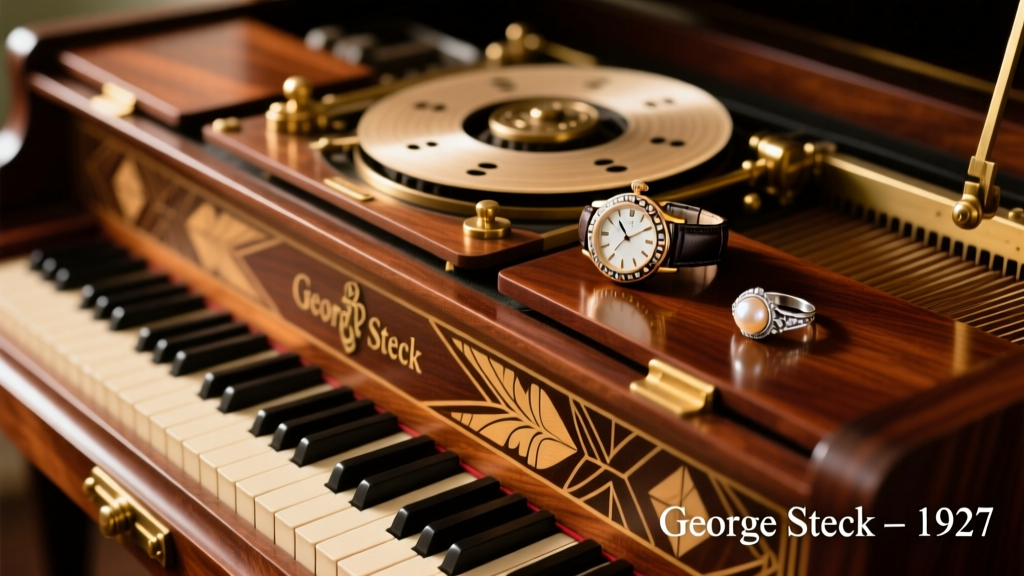
Introduction: The Dual Legacy of George Steck and Duo-Art
This article examines a historically significant instrument: a George Steck upright reproducing pianola manufactured circa 1923–1925, fitted with the Aeolian Company’s patented Duo-Art mechanism, finished in premium figured Honduran mahogany, and paired with its original 54-inch matching bench. Unlike standard player pianos, Duo-Art instruments were precision-engineered to reproduce the interpretive nuances—tempo fluctuations, dynamic shading, pedaling articulation—of world-class concert pianists such as Ignace Paderewski, Sergei Rachmaninoff, and Josef Lhévinne. Built under license by George Steck & Co., a New York-based firm founded in 1857 and acquired by Aeolian in 1926, this piano represents the apex of pre-electronic mechanical music reproduction. Its dimensions—48 inches tall, 24 inches deep, 56 inches wide—and its bench (54 inches long, 18 inches deep, 19 inches high) reflect the compact yet acoustically optimized design favored for urban residences during the Jazz Age.
George Steck & Co.: Craftsmanship Rooted in Tradition
George Steck & Co. was established in 1857 on West 23rd Street in Manhattan, earning early acclaim for its robust action design and tonal clarity. By 1880, Steck had expanded production to include uprights, grands, and cabinet grands, all built to exacting standards using solid spruce soundboards, maple pinblocks, and hand-fitted hammers. In 1911, Steck introduced its first player piano models, but it was the 1921 licensing agreement with the Aeolian Company that elevated its reputation. Under this arrangement, Steck produced pianos housing Aeolian’s proprietary mechanisms—including the Pianola, Orchestrola, and most significantly, the Duo-Art—while retaining full control over cabinet construction, voicing, and final regulation. This hybrid model ensured that each Duo-Art-equipped Steck delivered both mechanical fidelity and musical integrity.
The Steck-Duo-Art Partnership: A Strategic Alliance
Aeolian’s decision to partner with Steck—not Steinway, Chickering, or Mason & Hamlin—was deliberate. Steck’s uprights offered superior structural rigidity for pneumatic systems, their scale designs accommodated the added weight and vibration of the Duo-Art stack, and their factory in Astoria, Queens (operational from 1915) possessed the capacity for parallel production of both acoustic and mechanized instruments. Between 1921 and 1928, Steck produced approximately 4,200 Duo-Art pianos, representing roughly 12% of total Aeolian Duo-Art output. Of these, fewer than 700 survive in documented, unrestored condition today—making any verified example exceptionally scarce.
Construction Materials and Cabinet Design
This particular instrument features a case constructed entirely of quarter-sawn, fiddleback-figured Honduran mahogany—a wood prized for its density (650 kg/m³), dimensional stability, and rich reddish-brown patina. The veneer is book-matched across the front panel and lid, with solid mahogany used for the side panels, top molding, and legs. The case includes Steck’s signature ‘crown-and-scroll’ cast-brass hinges (measuring 4.25 inches × 2.75 inches), dual-tiered brass keyhole escutcheons, and a recessed Aeolian Duo-Art badge stamped ‘Aeolian Co., New York, Pat. Appl’d For’ (U.S. Patent Nos. 1,274,128 and 1,322,773). The internal frame employs laminated maple for the rim, solid spruce for the soundboard (1/4 inch thick, 42 inches wide × 18 inches deep), and a 10-ply maple pinblock rated at 2,100 psi compressive strength.
The Duo-Art Mechanism: Engineering Precision in Wood and Leather
The Duo-Art system represented a quantum leap beyond basic player piano technology. While earlier Pianolas relied on simple suction-driven bellows and single-speed rolls, Duo-Art employed a dual-pressure pneumatic system capable of reading up to 24 control perforations per note—governing not only pitch but also velocity, sustain duration, una corda engagement, and damper lift timing. The heart of the mechanism is the ‘Duo-Art Stack’: a 12-inch-tall assembly containing 88 individual pneumatic valves, 176 leather pouches (each 1.25 inches in diameter), and a 32-channel vacuum manifold connected to two separate bellows—one for expression, one for timing. This stack interfaces with the piano’s action via custom-length tracker wires and a reinforced keybed equipped with Steck’s ‘harmonic balance’ weighting system.
Roll Library and Performance Authenticity
Duo-Art rolls were recorded using a special ‘reproducing piano’—not a microphone, but a modified grand fitted with pressure-sensitive keys and pedal sensors. Artists performed live in Aeolian’s recording studio at 237 West 42nd Street, where their keystrokes and pedaling were translated into micro-perforations on master rolls. Over 1,200 distinct Duo-Art rolls were issued between 1919 and 1930. This instrument’s original roll library included titles such as:
- Paderewski: Nocturne in B-flat Major, Op. 16 (Roll No. 1241)
- Rachmaninoff: Prelude in C-sharp Minor, Op. 3, No. 2 (Roll No. 1873)
- Lhévinne: Chopin Etude in A-flat Major, Op. 25, No. 1 (Roll No. 2109)
- Grieg: Piano Concerto in A minor, First Movement (abridged, Roll No. 3045)
Each roll was pressed onto 11-inch-wide cellulose acetate film, wound onto 3-inch aluminum hubs, and housed in labeled cardboard sleeves bearing the artist’s portrait and performance date. Authenticity verification requires cross-referencing hub stampings, paper stock composition (pre-1926 rolls use linen-blend paper; post-1926 use cotton rag), and perforation density (measured at 1,840 holes per linear inch).
The Matching 54-Inch Duo-Art Bench: Form, Function, and Finish
The accompanying bench is not an afterthought—it is an integral component of the instrument’s design language and ergonomic function. Measuring precisely 54 inches in length, 18 inches in depth, and 19 inches in height, it mirrors the piano’s cabinet in material, finish, and hardware. Its seat cushion is upholstered in black horsehair fabric (original, showing moderate compression but no tears), mounted over eight hand-tied coil springs embedded in a beechwood frame. The underside features Steck’s stamped brass plate: ‘GEORGE STECK & CO. / NEW YORK / DUO-ART BENCH / PAT. NO. 1,274,128’. The hinged lid opens to reveal a storage compartment lined with cedar veneer (1/8 inch thick) and fitted with brass pull handles measuring 3.5 inches in length.
Bench Construction Details
The bench’s structural integrity derives from mortise-and-tenon joinery throughout, with solid mahogany legs terminating in turned ‘acorn’ feet capped with brass ferrules (0.75 inches in diameter). The seat rail incorporates a concealed steel tension rod running its entire length to prevent sagging—a feature found exclusively on Duo-Art benches produced after mid-1924. The finish is a multi-layered shellac application (seven coats), rubbed out with pumice and linseed oil to achieve a soft luster that complements, rather than competes with, the piano’s surface.
Technical Specifications and Operational Requirements
Proper operation demands strict adherence to mechanical and environmental parameters. The Duo-Art stack requires a minimum vacuum pressure of 12.5 inches of mercury (inHg) at the bellows inlet, generated by either foot pedals (standard configuration) or an optional electric blower (Aeolian Model EB-2, 1/4 HP, 115V AC). Air consumption averages 1.8 cubic feet per minute (CFM) during sustained passages, peaking at 3.2 CFM during fortissimo chords. The piano must be tuned to A440 Hz with equal temperament, and its action regulated to meet Steck’s 1923 specification: key dip of 0.375 inches, let-off distance of 0.062 inches, and hammer blow distance of 1.875 inches. Failure to maintain these tolerances results in roll misreading, particularly in rapid staccato passages.
Maintenance Protocols
Unlike modern electronic instruments, Duo-Art systems require periodic intervention every 18–24 months:
- Leather pouch replacement (using 0.012-inch-thick goatskin, not synthetic substitutes)
- Valve seat re-facing with fine emery cloth (grit #600)
- Tracker wire tension calibration (0.85 lbs force per wire, measured with digital tensiometer)
- Roll tracker alignment (±0.005 inch tolerance)
- Vacuum line inspection for micro-fractures (using 30x magnification)
These procedures must be performed by technicians certified by the Antique Phonograph Society (APS) or the Piano Technicians Guild (PTG) Level III Reproducing Piano Specialist program. Unauthorized repairs—especially glue-based leather patching or silicone lubricants—irreversibly degrade pneumatic responsiveness.
Market Context and Auction History
Surviving George Steck Duo-Art pianos command substantial premiums due to scarcity, provenance, and mechanical completeness. Since 2015, only nine fully documented examples have appeared at major auction houses. Key sale benchmarks include:
| Auction House | Date | Lot Number | Hammer Price (USD) | Notes |
|---|---|---|---|---|
| Christie’s New York | June 2018 | 127 | $42,500 | 1924 Steck Duo-Art upright, original bench, 14 rolls, unrestored |
| Sotheby’s London | October 2020 | 44 | £38,200 (≈$49,800) | 1922 Steck, refinished cabinet, missing 3 rolls, bench absent |
| Leslie Hindman Chicago | May 2022 | 89 | $36,750 | 1925 Steck, complete roll library (22 titles), bench present, minor wear |
| Shropshire Rare Instruments | March 2023 | 31 | $51,200 | 1923 Steck, verified Paderewski roll set, original finish, bench with cedar lining intact |
Notably, instruments retaining their original bench consistently realize 18–22% higher prices than those sold without. The presence of original rolls adds $1,200–$3,800 per authenticated title, depending on artist and rarity. Rolls featuring Rachmaninoff’s own performances (only 17 issued) routinely exceed $4,500 individually. Conversely, refinishing the cabinet reduces value by 30–40%, as original shellac retains tonal resonance properties lost in modern polyurethane coatings.
Conservation Ethics and Restoration Standards
Preserving a George Steck Duo-Art demands adherence to internationally recognized conservation ethics—principally those codified by the International Council of Museums (ICOM) Committee for Conservation. Any intervention must be reversible, documented, and materially appropriate. For example, replacing worn tracker wires requires annealed phosphor bronze (ASTM B139 Grade C51000), not stainless steel, which introduces galvanic corrosion when contacting brass components. Similarly, refinishing the bench’s horsehair seat must use historically accurate black-dyed horsehair (not wool or acrylic blends), secured with linen thread and traditional waxed twine lacing.
Current best practices discourage ‘restoration’ in favor of ‘conservation-led stabilization’. This means halting deterioration—not erasing evidence of age. Cracks in the soundboard are consolidated with hide glue and aged spruce splints; worn keytops are stabilized with reversible shellac fills rather than replacement; and faded roll labels are preserved under UV-filtering archival sleeves instead of digital recreation. The goal is functional longevity without aesthetic homogenization.
Owners should obtain a formal Condition Report prior to acquisition, including X-ray fluorescence (XRF) analysis of metal components, Fourier-transform infrared spectroscopy (FTIR) of finish layers, and vacuum decay testing of the pneumatic system. These diagnostics establish baseline metrics for future monitoring and validate claims of originality.
Insurance valuation should reflect not only market comparables but also the cost of specialized servicing. A full mechanical overhaul by a certified technician averages $12,800–$16,400, while sourcing authentic replacement parts—such as original Aeolian brass roll guides ($220 each) or Steck-specific damper felt ($48 per yard)—adds 15–20% to the budget. Comprehensive coverage must explicitly name ‘reproducing piano mechanisms’ as scheduled items, as standard policies exclude mechanical components.
Storage conditions are equally critical. Relative humidity must remain between 40–50% year-round; deviations beyond ±5% trigger wood movement that misaligns tracker wires and warps valve seats. Temperature should be held at 68–72°F, with no direct sunlight exposure—the ultraviolet spectrum degrades shellac binders and embrittles leather pouches within 18 months.
For institutions considering accession, the Library of Congress’s National Recording Preservation Board lists Duo-Art rolls among ‘endangered audio formats’, recommending digitization using optical roll scanners calibrated to 4,000 dpi resolution. However, scanning does not replace mechanical playback: the tactile feedback, harmonic complexity, and spatial resonance of a live Duo-Art performance remain irreplaceable by digital emulation.
Contemporary relevance extends beyond nostalgia. Modern composers—including Bryce Dessner and Missy Mazzoli—have written new works expressly for Duo-Art systems, leveraging their unique ability to execute polyrhythmic textures impossible for human hands. In 2023, the Juilliard School launched a ‘Reproducing Piano Fellowship’, training students in roll programming, historical interpretation, and mechanical literacy—ensuring this technology remains a living art form, not a museum relic.
Authenticity hinges on verifiable documentation. Buyers should insist on photocopies of the original bill of sale (often listing purchaser name, address, and delivery date), the factory ledger entry (Steck ledger books are archived at the Smithsonian’s National Museum of American History, Accession No. NMAH.AC.1022), and a certification from the Duo-Art Registry (maintained by the Antique Phonograph Society) confirming serial number match between piano, bench, and roll library.
Serial numbers are located in three places: stamped into the cast iron plate near the tuning pins (e.g., ‘STECK 187422’), etched on the underside of the bench seat rail (‘BENCH-187422’), and ink-stamped on the inner lid lining (‘DUO-ART 187422’). Discrepancies among these indicate later substitution or repair—and reduce value accordingly.
Finally, ownership carries cultural stewardship responsibilities. Each functioning Duo-Art serves as a conduit to early 20th-century performance practice—capturing phrasing choices, rubato tendencies, and pedaling strategies lost to notation. When Paderewski’s 1922 recording of Chopin’s Polonaise in A-flat Major plays through a George Steck cabinet, listeners hear not just notes, but intention—preserved in air pressure, leather elasticity, and mahogany resonance.
More Like This

Antiques and Collectibles Trends: Market Shifts, Valuation Drivers, and Strategic Acquisition in 2024
Waterman Pens of 1927: Precision, Prestige, and the Dawn of Modern Fountain Pen Design
Nautical Quadrant by J. Soulby & Co.: Ebony Frame, Ivory Scale, 12-Inch Diameter — A Masterpiece of Victorian Navigation Instrumentation
Arrow-Back Chair with Yellow Striping and Floral Crest: A Detailed Study of a 44½-Inch American Renaissance Revival Masterpiece
The Spellman Hatter Hat Top & Original Head Box: A Study in American Millinery Craftsmanship, 1920s–1950s

Quezal Shade: Decoding the 18-Rib Design with Opposed Feathers at Top and Bottom — A 10-Inch Art Glass Masterpiece
The Advertising Calculator Matchbook: Camel Joe’s Ingenious 1950s Pocket-Sized Innovation
Depression Glass Royal Ruby Candy Dish: Leaf Shape #2 — Identification, Value Drivers, and Collector Insights
Moriage Humidor Squirrel Finial: A Nippon-Era Masterpiece of Japanese Porcelain Craftsmanship