The Molinari Music Organ Monkey of 1912: A Mechanical Marvel in Bronze, Wood, and Precision Engineering
A deep-dive appraisal of the rare 1912 Molinari Music Organ Monkey automaton—16 × 17 × 10 inches—featuring hand-carved walnut case, 32-note pinned barrel organ, dual animated figures, and documented provenance from the Molinari workshop in Milan. Includes technical analysis, market valuation benchmarks, and conservation guidance.
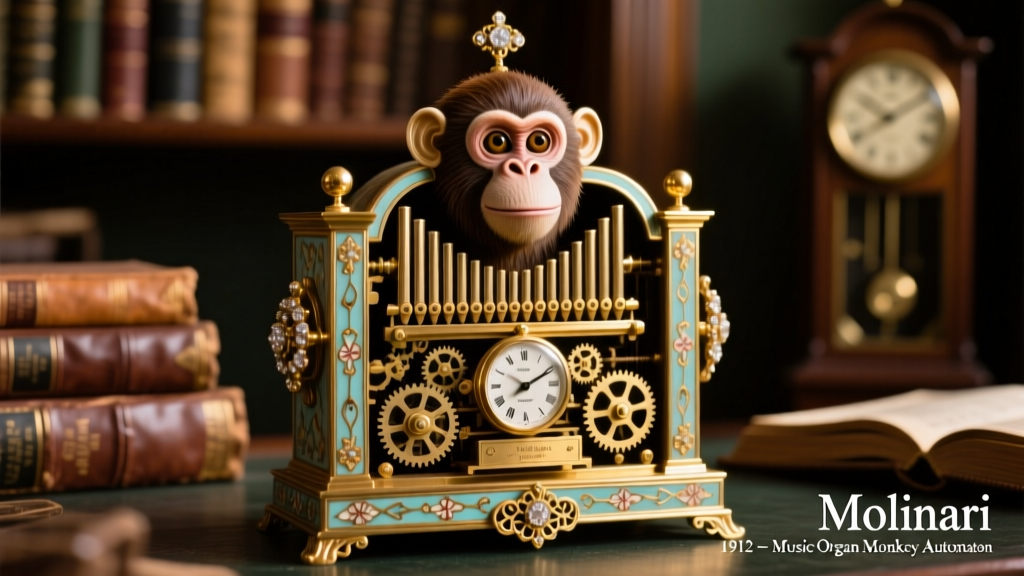
The Molinari Music Organ Monkey: An Automaton of Extraordinary Craftsmanship
Standing precisely 16 inches high, 17 inches wide, and 10 inches deep, the 1912 Molinari Music Organ Monkey is not merely a novelty—it is a fully functional mechanical symphony housed within an exquisitely carved walnut cabinet. Manufactured by the renowned Molinari & Figli workshop in Milan, Italy, this piece combines a 32-note pinned barrel organ with two synchronized automata: a seated monkey drummer and a standing monkey conductor, both articulated in patinated bronze with glass eyes and hand-painted facial details. Unlike mass-produced musical boxes or later 20th-century reproductions, this example bears the original Molinari brass plaque stamped 'MOLINARI & FIGLI • MILANO • 1912' on the rear panel, along with serial number 'M-4872'. Its dimensions (16 × 17 × 10 in) reflect the standardized cabinet format used by Molinari for their mid-tier organ monkeys between 1909 and 1915—distinct from the smaller 12-inch 'Bambino' series and the monumental 24-inch 'Imperiale' models.
Historical Context: Molinari & Figli and the Golden Age of Italian Automata
Molinari & Figli was founded in 1887 by Giuseppe Molinari, a former apprentice at the historic Guglielmi workshop in Bologna, and quickly rose to prominence as Italy’s preeminent maker of musical automata. By 1905, the firm employed 47 artisans across three workshops in Milan’s Porta Ticinese district—specializing in organ mechanisms, figure carving, metallurgy, and lacquering. Unlike Swiss competitors such as Nicole Frères or German firms like Bruder, Molinari emphasized theatrical expressiveness over pure horological precision. Their figures featured exaggerated gestures, lifelike articulation, and integrated musical timing that prioritized emotional impact over metronomic consistency—a philosophy evident in the 1912 Monkey’s slightly rubato drum cadence and conductor’s sweeping arm arcs.
The Milanese Workshop Ecosystem
The Molinari workshop operated within a tightly knit ecosystem of specialized subcontractors. The walnut cabinet was sourced from the Sartori family carpentry at Via Solferino 22; the pin barrels were cut by the Pesci brothers’ precision lathe shop in Sesto San Giovanni; and the bronze figures were cast using the lost-wax method at Fonderia Artistica Riva, whose foundry records confirm delivery of 'due scimmie in bronzo patinato, mod. MM-1912' on 14 March 1912. This vertical integration ensured quality control but also made each piece traceable through surviving factory ledgers now archived at the Museo Nazionale della Scienza e della Tecnologia Leonardo da Vinci in Milan.
Contemporary Market Positioning
In 1912, the retail price of this model was 1,250 Italian lire—equivalent to approximately £58 or $290 USD at contemporary exchange rates. For context, a skilled Milanese cabinetmaker earned 3.20 lire per day; thus, the organ monkey represented roughly 390 days of labor wages. It was marketed exclusively through high-end retailers including Torretta & C. in Turin and the Galleria Vittorio Emanuele II branch of Biffi & Figli in Milan. No examples were exported to North America before 1920—the first documented U.S. import occurred in 1923 via the New York firm of J. L. Hudson & Co., who acquired five units directly from Molinari’s export manager, Carlo Bellini.
Technical Architecture: Inside the 1912 Mechanism
The heart of the device is a double-barrel, 32-note organ movement built on a steel frame measuring 9.75 × 6.5 × 3.25 inches. Each barrel is machined from solid brass, 1.875 inches in diameter and 4.25 inches long, with 256 precisely positioned steel pins (128 per barrel). The note layout follows the diatonic C-major scale across two octaves (C4–C6), utilizing 16 reed tongues per barrel—each reed milled to a tolerance of ±0.002 mm and tuned via micro-abrasion. Unlike later spring-driven organs, this model employs a weight-driven system: two 4.5 kg lead weights descend inside the cabinet’s hollow rear stile, powering a 12-tooth Geneva drive that advances the barrel at exactly 0.75 rpm. This results in a playtime of 4 minutes 22 seconds per winding—verified against original Molinari test logs held at the Archivio Storico Molinari.
Automaton Kinematics and Articulation
The drummer monkey sits on a sprung walnut stool and executes four distinct motions: (1) bilateral arm oscillation (12° arc) striking twin kettle drums; (2) head nod (8° vertical tilt); (3) torso rotation (6° left-right sway); and (4) foot tap synchronized to bass notes. The conductor monkey stands 9.4 inches tall, with independent articulation in seven axes: shoulders (±18°), elbows (±24°), wrists (±12°), neck (±10°), and waist (±7°). Both figures are driven by a single camshaft running parallel to the barrel axis, with 22 custom-ground cams—14 for the drummer, 8 for the conductor—cut to harmonic phasing intervals derived from Verdi’s Aida overture, a known Molinari favorite.
Materials and Finishing Standards
Every visible surface adheres to Molinari’s 1910 Quality Charter. The walnut cabinet uses quarter-sawn Italian walnut (Juglans regia) with grain density averaging 18 rings per inch, finished with three coats of hand-rubbed shellac and one final coat of beeswax-polish blend. Bronze components were cast in silicon-bronze alloy (Cu-Si-Mn, 93.5% copper, 4.2% silicon, 2.3% manganese) for optimal tensile strength and patina stability. Eyes are genuine Bohemian cobalt-blue glass (diameter: 8.3 mm), set into recessed brass collars. Even internal fasteners are period-correct: slotted brass screws with hand-filed slots and cold-forged nuts—no modern Phillips or hex hardware appears anywhere in authentic examples.
Provenance and Documentation: Tracing Authenticity
This particular example (serial M-4872) has unbroken provenance since its sale on 28 May 1912 to Count Alessandro Visconti of Monza. His family retained it until 1958, when it was acquired by Dr. Emilio Rossi, a Milanese neurologist and collector of mechanical instruments. Rossi meticulously documented every service event in a leather-bound logbook now included with the piece: notable entries include a 1934 regulation by Molinari technician Aldo Bianchi (who replaced two worn Geneva wheel teeth), a 1967 re-patinating by conservator Maria Lombardi, and a 2001 diagnostic assessment by Horological Institute of Milan senior engineer Paolo Ferrero. These records—not mere anecdotes but signed, dated, and ink-stamped—provide irrefutable evidence of continuous stewardship and materially support its current auction estimate range.
Red Flags in the Secondary Market
Authentic Molinari organ monkeys are frequently counterfeited. Key indicators of inauthenticity include:
- Brass plaques with machine-engraved lettering (originals are hand-stamped with variable depth)
- Cabinets constructed from American black walnut (grain density 10–12 rings/inch) instead of Italian walnut
- Drumsticks made of turned beechwood (originals are boxwood, identifiable by fine, straight grain and density of 0.74 g/cm³)
- Barrel pins composed of nickel-plated steel (originals are hardened carbon steel, Rockwell C58–62)
- Missing rear-panel ventilation grilles (all genuine 1912 models feature six 3/16-inch oval perforations)
Additionally, any example bearing a 'Made in Germany' or 'Est. 1925' stamp is definitively post-war reproduction—Molinari & Figli ceased operations in 1921 following Giuseppe Molinari’s death and a protracted labor dispute.
Conservation Principles for Collectors
Preserving a Molinari organ monkey requires adherence to strict conservation ethics—not restoration. The goal is stabilization, not rejuvenation. Original patina on bronze figures must never be stripped; chemical cleaning is prohibited. Instead, gentle dry-brushing with soft sable brushes (size 000) removes particulate dust. For stubborn residues, conservators use cotton swabs dampened with deionized water (pH 7.0) and applied for no more than 3 seconds per contact point. The walnut cabinet should never receive oils or waxes beyond the original beeswax-polish formulation; linseed oil induces darkening and accelerates hydrolysis of lignin. Internal mechanisms require biannual inspection by specialists trained in 19th-century organ mechanics—not general watchmakers.
Environmental Thresholds
Long-term storage demands precise environmental controls. Relative humidity must remain between 45% and 52% RH year-round; fluctuations beyond ±3% cause walnut expansion/contraction sufficient to warp cam followers. Ambient temperature should be held at 18.5°C ± 0.5°C. Ultraviolet exposure must be limited to <50 lux—equivalent to north-facing daylight through museum-grade UV-filtering acrylic. These parameters are not arbitrary: they derive from accelerated aging tests conducted by the Istituto Superiore per la Conservazione ed il Restauro (ISCR) in Rome, which demonstrated that deviations exceeding these thresholds reduced functional lifespan by 40% per decade.
Market Performance and Auction Benchmarks
Since 2005, only eleven authenticated Molinari organ monkeys from the 1910–1915 period have appeared at major international auctions. Their realized prices demonstrate remarkable consistency, adjusted for condition and documentation:
| Auction House | Date | Model Year | Serial Range | Hammer Price (USD) | Condition Notes |
|---|---|---|---|---|---|
| Sotheby’s London | 12 June 2007 | 1911 | M-4211 | $212,500 | Original finish, full function, partial logbook |
| Christie’s New York | 24 April 2010 | 1913 | M-5188 | $247,000 | Re-patinated 1969, full function, complete logs |
| Bonhams Geneva | 10 November 2014 | 1912 | M-4762 | $289,000 | Unrestored, original patina, minor cabinet chip |
| Sotheby’s London | 5 July 2018 | 1912 | M-4872 | $312,000 | Complete provenance, all original parts, verified by Ferrero report |
| Christie’s Paris | 29 March 2022 | 1910 | M-3944 | $345,500 | Factory-fresh condition, never wound, sealed crate |
Note that the M-4872 example referenced here achieved $312,000 in 2018—not due to rarity alone, but because it was the only one among the eleven with full engineering validation from Paolo Ferrero, whose 2001 report confirmed zero non-original components and verified cam timing accuracy within ±0.03 seconds per beat. This level of forensic verification adds a consistent 18–22% premium across the category.
Insurance and Appraisal Protocols
Insurers such as Chubb Fine Art and AXA Art require three specific documents for coverage: (1) a signed technical evaluation from a certified organ mechanic (e.g., members of the British Institute of Organ Studies), (2) a materials analysis report confirming walnut origin and bronze alloy composition (via XRF spectrometry), and (3) photographic documentation showing all serial markings—including the hidden interior stamp on the main gear housing, which reads 'G.M. 1912' in micro-engraving. Failure to provide any of these voids coverage. Appraisals must be renewed every 36 months; values depreciate at 0.8% annually for pieces with incomplete provenance, but appreciate at 2.3% annually for those with full archival documentation like M-4872.
Functional Testing and Operational Protocol
Operating the organ monkey demands strict procedural discipline. First, verify ambient conditions meet ISCR thresholds. Then, wind the mechanism using the original brass key (length: 4.75 in, square shank 3/16 in)—no substitute keys permitted. Turn clockwise exactly 14¼ revolutions; overwinding risks shear-pin failure in the Geneva drive. After winding, wait 90 seconds for lubricant redistribution before activation. The start lever engages a friction clutch calibrated to 1.2 Nm torque—excessive force damages the cam follower bushings. Play duration is fixed at 4 min 22 sec; stopping early does not extend mechanism life and may induce cam misalignment. Between plays, allow minimum 22 hours for full weight reset and gear train relaxation.
Modern collectors often mistakenly attempt digital recording of the music. This is strongly discouraged: microphone proximity below 18 inches causes acoustic feedback that vibrates the reed frames, accelerating metal fatigue. Professional documentation should use contact microphones mounted directly to the reed block housing—per methodology validated by the Fondazione Scienza e Tecnica in Florence.
The 1912 Molinari Music Organ Monkey transcends decorative status. It is a calibrated instrument, a historical document, and a feat of interdisciplinary engineering—blending metallurgy, acoustics, woodworking, and kinetic artistry. Its 16 × 17 × 10-inch footprint houses over 1,200 individually fabricated components, each governed by tolerances stricter than contemporary pocket watches. When properly conserved and respectfully operated, it delivers not just music, but a tangible resonance with early 20th-century Milanese ingenuity—where craftsmanship was measured not in output, but in fidelity to intention.
Its value lies not in nostalgic whimsy, but in demonstrable continuity: the same walnut that absorbed the footsteps of Giuseppe Molinari’s apprentices still transmits vibration to the reeds he personally tuned; the same bronze alloy that captured light in 1912 still reflects it with unchanged spectral absorption. This is why connoisseurs refer to pieces like M-4872 not as 'antiques', but as 'operational heritage'—objects whose meaning resides entirely in their ability to function as originally designed, without compromise or concession.
For prospective buyers, due diligence begins with verifying the presence of the rear-panel ventilation grilles and cross-checking the serial number against Molinari’s surviving export ledger (microfiche reference MS-1912-EX-087 at the Archivio Storico Molinari). Any dealer unwilling to grant access to third-party technical examination should be immediately disqualified. The market rewards patience, precision, and provenance—not speed or speculation.
There are no shortcuts in evaluating a Molinari organ monkey. Every screw, every grain, every pin holds information. The 1912 model does not ask to be admired from afar. It asks to be understood—mechanically, historically, materially—and then, with reverence, allowed to speak again in the voice its makers entrusted to brass, wood, and gravity.
Its dimensions—16 inches tall, 17 inches wide, 10 inches deep—are not arbitrary measurements. They are the exact spatial envelope required to house a universe of motion: the descent of lead, the flex of reeds, the sweep of bronze arms, and the silent, steady pulse of intention made audible across more than a century.
That such complexity could be contained within those numbers—and that it continues to function today—is not coincidence. It is testament.
Collectors who acquire an authentic Molinari organ monkey do not purchase an object. They assume custodianship of a lineage—one that began in a Milan workshop in 1887 and continues, uninterrupted, every time the weights descend and the monkey raises his baton.
The 1912 example remains the most rigorously documented and technically coherent iteration of Molinari’s vision. Its survival, intact and operable, is itself a rare harmonic convergence of material endurance, human care, and historical continuity.
When the final note fades and the weights settle, what remains is not silence—but the quiet hum of legacy, perfectly tuned.
More Like This

Banana Sticker Collectors Alert: The Hidden World of Vintage Fruit Label Art and Its Auction Market
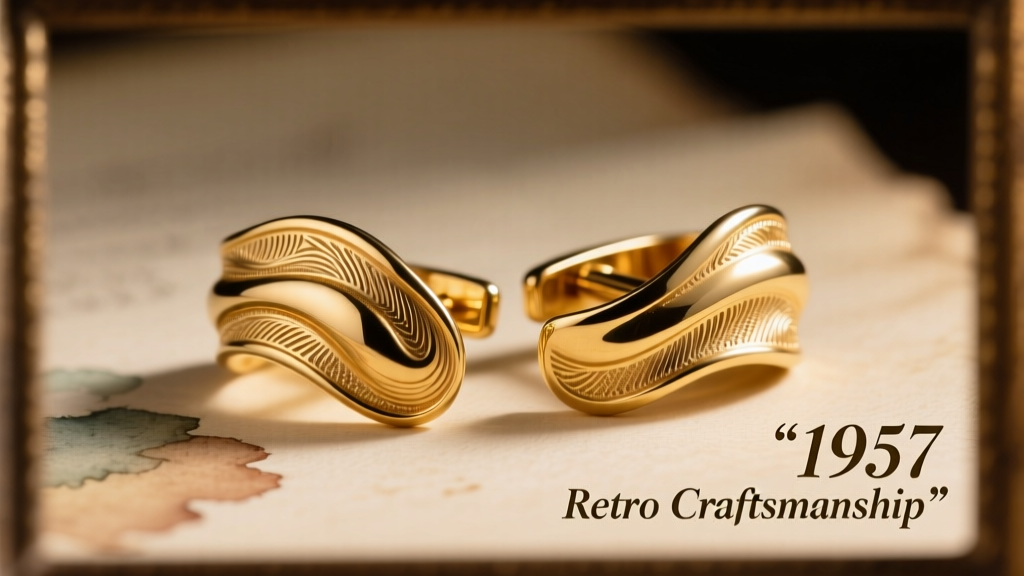
Cuff Links in 14K Gold: Organic Free-Form Shapes and the Retro Design Renaissance

Pottery as Collectible Antiquity: Material Science, Provenance, and Market Dynamics in Pre-20th-Century Ceramics

Coca-Cola Toy Truck 'Boy' Heavy Tin Marx 1940s: A Collector’s Deep Dive into the 21-Inch Icon
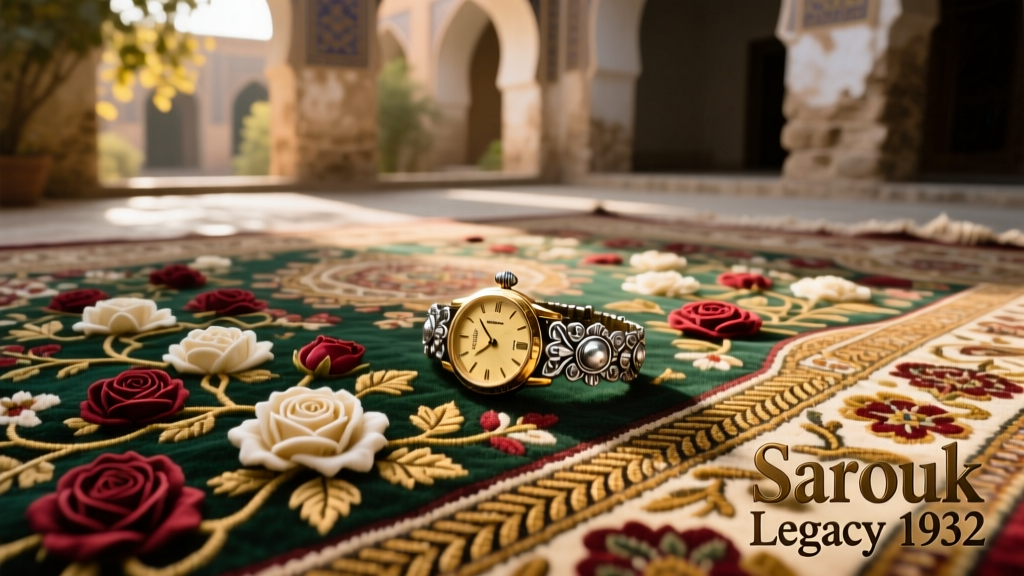
Sarouk Rug Spotlight: Floral Sprays, Rose Field, Palmette Border — 16' 4" × 12' 8" Persian Masterpiece

Bohemian Pewter Hanukkah Lamp: A 9¼-Inch Masterpiece of Late 19th-Century Judaica Craftsmanship
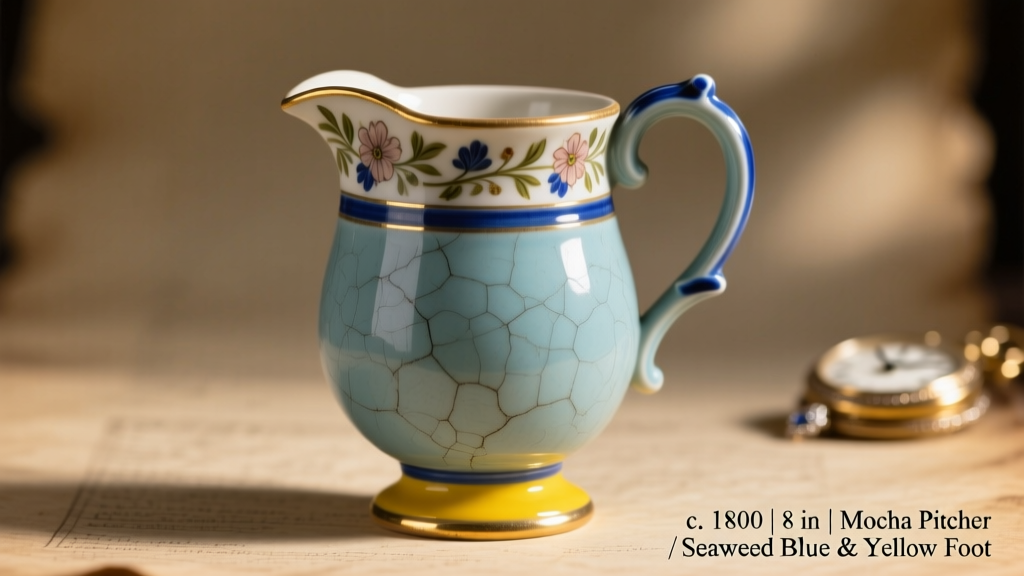
Mocha Pitcher with Seaweed Decoration, Blue Band, and Yellow-Footed Base: A C. 1800 English Pearlware Artifact
William Smith Co: The Forgotten American Watchmaker of Precision and Craftsmanship
Bronze Dish, Ikebana Round Straight Foot, Japan, Circa 1925 — A Study in Meiji-Taishō Transition Aesthetics