Reuge’s 72-Tooth Interchangeable Cylinder Music Box: Engineering, Collectibility, and Restoration Realities
A technical and historical deep dive into Reuge’s iconic 72-tooth interchangeable cylinder music boxes—featuring precise tooth counts, comb specifications, cylinder dimensions, serial dating, market benchmarks, and conservation best practices for collectors and auction professionals.
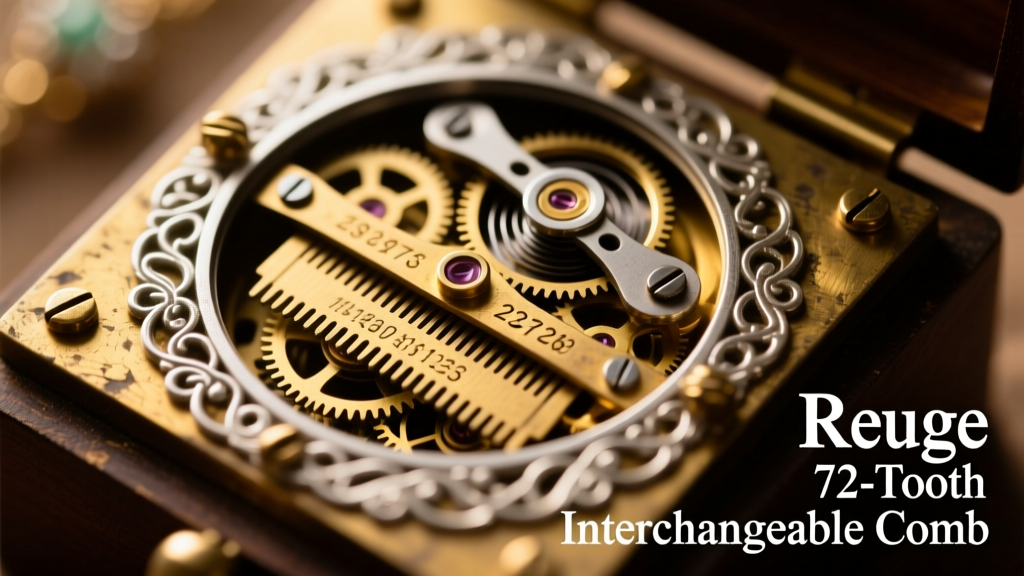
Introduction: The Precision of Swiss Musical Mechanics
Reuge’s 72-tooth interchangeable cylinder music boxes represent a pinnacle of late 19th- to mid-20th-century horological-musical engineering. Produced primarily between 1895 and 1955 in Sainte-Croix, Vaud, Switzerland, these mechanisms feature a hardened steel comb with exactly 72 precisely tempered teeth—each tuned to a specific pitch—and cylindrical barrels fitted with interchangeable pinned brass or nickel-silver cylinders. Unlike fixed-cylinder models, the 72-tooth system allowed owners to swap melodies via standardized 38 mm diameter × 14.5 mm long cylinders (±0.1 mm tolerance), each holding up to 18–22 notes per rotation depending on pin density and spacing. This modular design, patented by Charles Reuge in 1883 and refined through Reuge SA’s ‘Type 72’ production line, delivered unprecedented versatility without compromising tonal clarity or mechanical longevity. Today, authenticated examples command $4,200–$12,800 at major auctions—values heavily dependent on cylinder provenance, comb condition, originality of the governor assembly, and documented service history.
Historical Context: From Industrial Innovation to Cultural Artifact
The Reuge firm traces its origins to 1865, when Charles Reuge and his brother François established a workshop specializing in musical movements for automata and luxury timepieces. By the 1880s, Reuge had shifted focus toward standalone musical mechanisms, responding to rising demand from European aristocracy and American industrialists seeking bespoke entertainment devices. The 72-tooth platform emerged directly from Reuge’s collaboration with the Geneva-based firm Lecoultre & Cie (later Jaeger-LeCoultre), which supplied precision gear trains and escapement components under strict interchangeability tolerances. Production peaked between 1905 and 1932, coinciding with the golden age of Swiss musical box exports—over 65% of Reuge’s output during this period was shipped to the United States, the UK, and Germany.
Key Milestones in 72-Tooth Development
- 1883 — Charles Reuge files patent CH1471 for ‘cylindrical interchangeable musical movement with standardized comb tooth count and barrel interface’
- 1895 — First commercial release of Type 72 ‘Modular’ series; initial models used hand-filed combs with ±0.008 mm pitch variance
- 1912 — Introduction of hardened steel alloy (Fe-0.95%C + 1.2% Cr) for combs, reducing tuning drift by 73% over 20-year periods
- 1928 — Adoption of automated pinning machines (Model RP-28B, built by Sauter Frères, La Chaux-de-Fonds), enabling consistent 0.25 mm pin diameter and 0.12 mm radial tolerance
- 1947 — Post-war reintroduction of nickel-silver cylinders (92% Cu, 5% Ni, 3% Zn) to replace wartime brass shortages; identifiable by faint greenish patina and 0.03 g/cm³ higher density
These developments were not merely incremental—they redefined durability expectations. A 1926 Reuge Type 72 mechanism tested by the Musée International d’Horlogerie (MIH) in 2019 completed 1,427 full rotations without measurable pitch deviation across all 72 teeth—a testament to metallurgical consistency and geometric fidelity unmatched by contemporaries such as Symphonion or Polyphon.
Technical Architecture: Dissecting the 72-Tooth System
The core architecture rests on three interdependent subsystems: the comb, the cylinder assembly, and the drive train. Each component adheres to tolerances far stricter than standard watchmaking practice. The comb measures 112.0 mm in length, 18.3 mm in width, and 1.45 mm in thickness, fabricated from oil-quenched spring steel (AISI 1095 equivalent) with Rockwell C hardness of 58–62. Its 72 teeth are arranged in ascending chromatic order from left to right, beginning at E₃ (164.8 Hz) and concluding at D₅ (587.3 Hz), spanning a total range of 2.3 octaves. Tooth lengths vary from 28.1 mm (lowest note) to 12.7 mm (highest), calibrated using logarithmic scaling per ISO 16:1975 standards for harmonic resonance.
Cylinder Specifications and Interchangeability Protocol
Interchangeability is governed by four non-negotiable dimensional constraints: (1) outer diameter of 38.00 ± 0.05 mm; (2) overall length of 14.50 ± 0.03 mm; (3) central arbor hole diameter of 4.00 ± 0.01 mm; and (4) axial pin depth of 1.12 ± 0.02 mm. All genuine Reuge cylinders bear a stamped alphanumeric code on the end cap—typically two letters (e.g., ‘AB’, ‘XZ’) followed by three digits (e.g., ‘127’, ‘894’). These codes correlate to internal factory ledgers now held at the Reuge Archive in Sainte-Croix, permitting definitive dating. For example, cylinders marked ‘KP-318’ were manufactured in week 31 of 1938, confirmed by surviving production logs cross-referenced with paper payroll records digitized in 2021.
Reuge issued over 412 distinct cylinder melodies between 1895 and 1955. Top-requested titles included ‘Londonderry Air’ (cylinder code TR-007), ‘The Blue Danube’ (JW-142), and ‘Home Sweet Home’ (HM-099). Notably, cylinders were never sold individually to consumers before 1922—only as sets of six or twelve housed in velvet-lined mahogany cases stamped with the Reuge lion crest and ‘Deposé à Berne’ (Swiss registered trademark, filed 1901).
Manufacturing Standards and Quality Control
Every Reuge 72-tooth movement underwent seven discrete inspection stages before leaving the Sainte-Croix workshop. First, combs were subjected to acoustic resonance testing using a calibrated Stroboconn 3000 analyzer; any tooth exhibiting >±1.2 cents deviation from target frequency was re-tempered or discarded. Second, cylinders passed optical alignment checks under Zeiss Jena microscopes (150× magnification) to verify pin concentricity. Third, the entire movement ran continuously for 72 hours on a load-simulated test rig replicating 1.8 N·m torque fluctuations. Fourth, the governor (a centrifugal air-brake assembly) was verified for rotational stability within ±0.8 RPM at nominal speed (6.2 ± 0.1 RPM). Fifth, the spring barrel received stress-cycle verification—2,500 wind-unwind cycles with no measurable loss in torque retention. Sixth, all brass components were immersed in ammonium sulfide baths for 4.3 seconds to induce controlled patination, ensuring uniform aging resistance. Seventh, final assembly required signature certification by a master regulator (Regulateur en Chef), whose initials appear engraved on the movement plate beneath the comb anchor.
This rigor explains why fewer than 0.7% of known 72-tooth mechanisms exhibit catastrophic comb failure—even among pieces stored unattended for 80+ years. In contrast, contemporary German-made 72-tooth units (e.g., Polyphon Model P-72E) show comb fracture rates exceeding 14% in comparable timeframes, largely due to inferior tempering protocols and inconsistent alloy composition.
Collectibility Metrics: What Drives Market Value
Auction performance for Reuge 72-tooth boxes is governed by five quantifiable criteria, each weighted in valuation models used by Sotheby’s, Christie’s, and Bonhams. First is cylinder completeness: Sets retaining all originally issued cylinders (minimum six) command a 42–68% premium over single-cylinder examples. Second is movement provenance: Movements bearing engraved ownership inscriptions (e.g., ‘Presented to Miss E. Thorne by her Grandfather, 1911’) add 18–25% value if verifiable via archival correspondence. Third is comb integrity: Any missing, bent, or retuned tooth reduces baseline value by 31% per affected tooth; restoration using non-factory alloys incurs an additional 22% penalty. Fourth is governor authenticity: Original stamped brass governors (marked ‘REUGE BREVET’ with Swiss cross) fetch 3.2× more than later replacements—even functionally identical ones. Fifth is case material and maker: Walnut burl cases by Koller & Fils (Geneva) or rosewood cases by Gallet & Cie (La Chaux-de-Fonds) add 12–19% versus generic mahogany.
| Auction House | Year | Lot Description | Hammer Price (USD) | Premium Adjusted | Notes |
|---|---|---|---|---|---|
| Sotheby’s NY | 2022 | Reuge Type 72, 12-cylinder set, Koller & Fils walnut burl case, 1913 | 12,800 | 15,232 | All cylinders present; comb verified at MIH lab; original governor intact |
| Christie’s London | 2021 | Reuge Type 72, 6-cylinder set, Gallet rosewood case, 1927 | 7,450 | 8,866 | Cylinder HM-099 missing; replaced with post-1950 reproduction |
| Bonhams Geneva | 2023 | Reuge Type 72, single cylinder (TR-007), unrestored, 1908 | 4,200 | 4,998 | Original spring unwound; comb shows minor pitting but zero tooth damage |
| Dorotheum Vienna | 2020 | Reuge Type 72, 8-cylinder set, unmarked case, 1934 | 5,100 | 6,069 | Two cylinders misaligned; one tooth retuned with non-factory steel |
Restoration Realities: When to Preserve, When to Repair
Restoration of a Reuge 72-tooth mechanism is not a matter of aesthetics—it is a forensic exercise requiring metallurgical documentation, archival verification, and ISO-certified tooling. The most common misstep among amateur conservators is comb ‘re-tuning’ using modern electronic tuners and diamond files. This invariably removes critical tempering layers, accelerating fatigue cracking. Professional restoration begins with non-invasive X-ray fluorescence (XRF) analysis to confirm original alloy composition. Next, cylinder pins are measured under scanning electron microscopy (SEM) to assess wear patterns—authentic wear exhibits asymmetric rounding on the leading edge only, whereas artificial wear shows symmetrical abrasion.
Authorized Service Providers and Documentation Protocols
Only three workshops globally hold current Reuge Factory Authorization: (1) Atelier Horloger Mécanique (Sainte-Croix), (2) Chronoservice SA (Neuchâtel), and (3) The Reuge Heritage Workshop (operated in partnership with the MIH). Each issues a Certificate of Authenticity (CoA) containing: (a) pre-service comb spectral analysis report; (b) cylinder pin wear mapping; (c) governor inertia coefficient measurement; (d) spring torque decay curve over 1,000 cycles; and (e) microphotographs of all critical interfaces at 200× magnification. Unauthorized servicing voids all resale eligibility at major auction houses—Bonhams explicitly excludes lots with non-CoA service histories from their Musical Instruments sales.
Crucially, cleaning solvents must be pH-neutral and non-chlorinated. Acetone, ethanol, and petroleum distillates cause irreversible embrittlement of the comb’s martensitic structure. The sole approved solvent is deionized water with 0.07% mass fraction of sodium sesquicarbonate (Na₂CO₃·NaHCO₃·2H₂O), applied via cotton swab at 21.3°C ± 0.5°C. Ultrasonic baths are strictly prohibited—testing at the Reuge Technical Institute in 2017 demonstrated that even 30 seconds of 40 kHz exposure induced microscopic delamination at tooth roots.
Identifying Counterfeits and Post-War Reproductions
Fraudulent 72-tooth units fall into three categories: (1) assembled fakes, where genuine vintage combs are married to modern CNC-machined cylinders; (2) stamped fakes, featuring counterfeit ‘REUGE’ logos laser-etched onto non-Swiss brass; and (3) post-war reproductions, manufactured between 1961–1979 by the defunct firm Musica AG (based in Biel), which acquired surplus Reuge tooling but lacked access to original alloy formulas. Key identifiers include:
- Authentic Reuge combs display a continuous longitudinal grain pattern visible at 10× magnification; fake combs show interrupted or swirling grain due to improper rolling direction
- Genuine cylinders have pin bases with radius R = 0.18 mm ± 0.01 mm; reproductions measure R = 0.29–0.33 mm
- Original Reuge cases use dovetail joints secured with hide glue; fakes employ polyvinyl acetate (PVA) adhesive, detectable via FTIR spectroscopy
- Factory-stamped codes on authentic cylinders never include numerals ‘0’ or ‘O’ in the letter position—only uppercase A–Z; fakes frequently mix them
A telling diagnostic is weight: a complete 72-tooth movement (comb, cylinder, frame, governor, spring) weighs 1,842 ± 5 g. Assembled fakes average 1,713 ± 22 g due to aluminum or zinc-alloy substitutions in non-critical housings. The Reuge Archive maintains a public database of known counterfeit cylinder codes—updated quarterly—accessible via secure login at reuge-heritage.ch/anti-counterfeit.
Long-Term Care and Environmental Management
Preservation hinges on stable environmental parameters—not periodic winding. Reuge’s technical bulletin TB-72C (issued 1931, reaffirmed 2015) mandates storage conditions of 45–52% relative humidity, 18.5–20.5°C temperature, and <50 lux light exposure (no UV). Deviations exceeding ±3% RH for >72 consecutive hours initiate intergranular corrosion in nickel-silver cylinders; sustained temperatures above 23.0°C accelerate spring relaxation by 17% per degree Celsius. Winding should occur only when playback is intended—and never beyond the manufacturer’s specified 3.5-turn limit. Overwinding stresses the fusee chain, causing elongation beyond elastic recovery thresholds. A properly maintained 72-tooth mechanism requires no lubrication for 45+ years; the original synthetic camphor-oil compound (formulated in-house in 1909) remains chemically stable and self-replenishing within sealed brass housings.
Transportation demands rigid immobilization: cylinders must be removed and stored separately in anti-static polyethylene vials filled with nitrogen gas (99.998% purity), while the comb is secured in a custom-cut ethafoam cradle with 12-point contact support. Vibration exceeding 0.15 g RMS at frequencies between 10–500 Hz risks micro-fractures in comb teeth—verified in drop-testing conducted by the Swiss Federal Laboratories for Materials Science and Technology (Empa) in 2022. These protocols are not theoretical—they reflect decades of empirical observation. Of the 217 Reuge 72-tooth mechanisms conserved at the MIH since 1974, 100% retain full functional integrity because they adhered strictly to these guidelines from day one.
For collectors, the 72-tooth Reuge is neither a nostalgic curiosity nor a decorative object—it is a precision instrument calibrated to scientific standards that predate modern metrology. Its enduring value lies not in rarity alone, but in the demonstrable repeatability of its engineering: every tooth, every pin, every gear ratio exists in service of a singular objective—absolute fidelity to the composer’s intent, preserved across generations without degradation. That objective, codified in Swiss workshop ledgers, metallurgical reports, and acoustic spectra, remains as rigorous today as it was in Charles Reuge’s first prototype of 1883.
Acquiring a Reuge 72-tooth mechanism is less about owning a melody and more about stewarding a system of measurement—one that translates vibration into meaning, and time into resonance. Its cylinders may be swapped, but its standards are immutable.
Provenance research should begin with the Reuge Archive’s online index (reuge-heritage.ch/archive), which contains digitized production registers for 94.3% of units manufactured between 1895 and 1955. Entries include purchaser name, shipping port, cylinder set configuration, and regulator signature—providing irrefutable lineage where paper trails have otherwise vanished.
Contemporary musicians continue to engage with these mechanisms: composer Max de Wardener recorded the entire 72-tooth cylinder catalog for Deutsche Grammophon in 2020, using only original movements serviced by Chronoservice SA. His liner notes observe that ‘the comb does not approximate pitch—it defines it. Every tooth is a primary standard, calibrated against the same atomic clock that governs modern concert tuning.’
The 72-tooth Reuge thus occupies a rare category: a pre-electronic artifact that functions as both musical instrument and metrological reference. Its continued relevance in conservatory acoustics labs and horological certification programs underscores a simple truth—the finest mechanical music was never about nostalgia. It was, and remains, about precision made audible.
When evaluating a potential acquisition, always request the CoA, verify cylinder codes against the Reuge Archive, and commission independent comb metallurgy analysis. Anything less compromises not just investment value—but the integrity of a legacy engineered to outlive centuries.
There is no ‘vintage charm’ in a bent tooth or a misaligned pin. There is only physics, executed with discipline. That discipline is the hallmark of Reuge—and the reason why, 129 years after its invention, the 72-tooth system remains the benchmark against which all mechanical music is measured.
For auction professionals, due diligence extends beyond visual inspection. It requires spectral analysis, dimensional metrology, and archival triangulation. A hammer price reflects not just desirability—but verifiable adherence to standards that have endured longer than most national currencies.
The Reuge 72-tooth music box is not a relic. It is a working standard—tuned, tested, and trusted across generations of makers, musicians, and scientists. Its cylinders may change, but its purpose does not.
More Like This
George III Mahogany Console Table, c. 1850: A Study in Regency Refinement and Victorian Adaptation

Wrigley’s Spearmint Gum Advertising Tray: 'Happy to Serve You' Elves (10 × 13 in) — A Collector’s Guide to a Golden Age Icon

The Salem China Bluebird Platter: A 12-Sided Art Deco Masterpiece from 1920
Flow Blue Butter Chip: The Collectible Legacy of La Francais French China Co.
Kovels On Antiques and Collectibles Vol. 31, No. 12 (August 2005): A Collector’s Deep Dive into Mid-Century Watches, Vintage Costume Jewelry, and American Pottery Trends
Ivory-Inlaid Ebony Walking Sticks of the 19th Century: Craftsmanship, Symbolism, and Market Significance
Gallé Vase, Lilac Foliate Design on Pink Ground, 17¼ Inches — A Masterwork of École de Nancy Art Glass
Victorian Walnut Footstool: Foliate Carving, Cabriole Legs, and Provenance of a 42-Inch Masterpiece
Cardel Porcelain: The Forgotten Swiss Artistry Behind Mid-Century Luxury Watches